The monitor view that changes the question
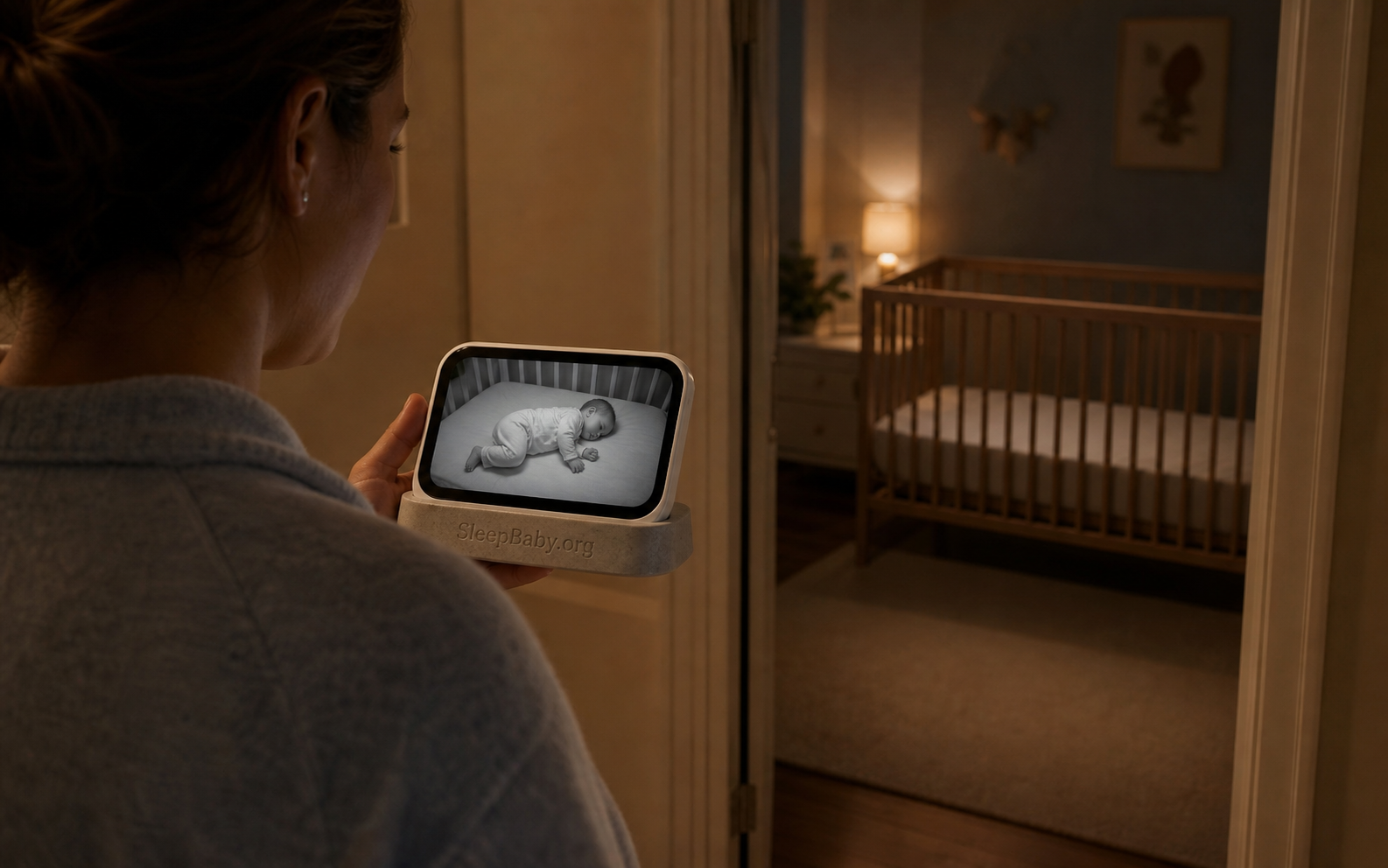
You placed your baby flat on her back. Now the monitor shows one shoulder tipped forward, her knees tucked, and her whole body resting on its side. The fear is immediate: Do I move her, or could moving her make this worse?
The short, safe answer
Always place your baby wholly on her back for every nap and night sleep. Side placement is unstable and is not a recommended starting position. If she independently rolls both back-to-tummy and tummy-to-back, you do not need to keep flipping her after every self-directed roll; keep starting sleep on her back and keep the space firm, flat, level, and bare. If she rolls only one way, or a young newborn tips into a side curl, return her to her back when you notice. Stop swaddling at the first signs or attempts of rolling. Never use a wedge, positioner, rolled towel, pillow, or weighted product to hold her in place.13
This is not a test of whether you can watch a monitor without blinking. The useful question is not simply, “Is side sleeping safe?” It is: How did she get there, what can she do next, and is the sleep space still safe if she moves? Those three details turn a frightening snapshot into a decision you can actually make.
Use three checks: Placed, Rolled, Clear
I would not begin with the clock, a milestone chart, or a product search. I would begin with three checks in this order. They are deliberately plain because a useful rule at night should survive a tired brain.
Placed: How did she get there?
If an adult placed her on her side, return her to her back. The side is not a safer compromise for a baby who dislikes back placement, spits up, or settles faster when curled. Back placement is the starting position for every sleep through the first birthday.1
Rolled: What can she do without help?
Watch during ordinary supervised awake time. Can she move neither way, only one way, or both back-to-tummy and tummy-to-back? The answer changes whether you return her to the back when you notice or let an independent both-way roller choose a position after back placement.
Clear: Is the sleep space still ready for movement?
The mattress stays firm, flat, level, and covered only by a fitted sheet. The crib, bassinet, or play yard stays empty. Swaddling stops when rolling begins or looks likely to begin. Nothing is added to control position.25
Placed tells you what to correct. Rolled tells you what skill your baby can use next. Clear tells you whether the environment remains safe when her body does something you did not schedule. I like this order because it does not ask a parent to predict the future. It asks for three things you can observe now.

The rolling skill changes the answer—not the back-first rule
The most useful distinction in this entire article is the difference between a baby who arrived on her side and a baby who was placed there. A second distinction matters just as much: rolling once is not the same skill as rolling freely in both directions.
What to do at each rolling stage
| What you observe | What to do when you notice side sleep | What stays the same |
|---|---|---|
| No purposeful rolling yet | Return her to her back. A newborn side curl is not proof of mature rolling control. | Back-first placement; firm, flat, level, bare space; no positioner. |
| Rolls only one direction | Return her to her back when you notice. Give supervised awake practice rather than adding equipment to sleep. | Back-first placement and an empty sleep space. Swaddling has stopped. |
| Rolls independently both directions | Place her on her back at the start. If she rolls afterward, you do not need to keep turning her back all night. | Back-first placement, bare sleep space, no swaddle, no positioning device. |
NICHD and the American Academy of Pediatrics make this both-way distinction because a baby who can move into and out of a position has a different motor skill from a baby who becomes stuck after a one-way roll.13 You still begin every nap and night on the back. The skill changes your response after the baby moves; it does not turn side placement into a recommended routine.
If rolling itself has started breaking up sleep, the next useful question is how to support practice and settling without undoing the safe-sleep setup. Our guide to what to do when rolling wakes your baby belongs there. And if your baby protests the moment her back touches the mattress, use the practical ideas in helping a baby who cries after back placement—without changing the starting position.


What if a newborn keeps tipping onto her side?
Very young babies can look curled and asymmetrical. A newborn may turn her head, draw up her legs, or tip partly to one side without having the coordinated ability to roll both ways. That appearance does not make the side a safe starting position, and it does not mean she should be wedged flat.
Head turned versus whole body turned
Head turned, torso on the back
A baby may rest with her face turned left or right while her shoulders, back, and hips remain on the mattress. Keep the face clear and the sleep space empty. You do not need to prop her head into a centered pose.
Shoulder, torso, and hips resting on the side
That is whole-body side positioning. If she is not an independent both-way roller, return her to her back when you notice. Do not place a towel, pillow, or positioner around her to keep the pose.
After you return a young baby to her back, check the simple causes of a repeated tip: Is the surface truly level? Is a swaddle pulling unevenly? Is she pressed against the side of a too-small sleep space? The fix is to correct the setup, not to build a border around her body. A safe infant sleep surface is designed to stay flat and clear.25
Supervised awake tummy time and ordinary play that encourages looking both directions can support movement. Sleep is not the time to practice with props. If you are worried about head shape or neck range, a clinician can examine the baby; a product listing cannot.
Reset the space before you try to control the position
Side-sleep worry attracts equipment because equipment feels like action. But the safest action is usually subtraction. The Consumer Product Safety Commission’s phrase “bare is best” is useful here: choose a compliant crib, bassinet, or play yard, use a firm and level mattress with a fitted sheet, and leave the rest out.5
The five-minute side-sleep reset
- Start on the back: every nap, every night, every caregiver.
- Check the surface: firm, flat, level, and made for infant sleep.
- Clear the mattress: fitted sheet only—no loose blanket, pillow, bumper, toy, positioner, or rolled cloth.
- Retire the swaddle: at the first sign or attempt of rolling.
- Keep sleep separate: after feeding or soothing, return baby to her own sleep surface before you fall asleep.
Room sharing can make those back-first returns easier because the baby’s separate sleep space remains within reach. If you are deciding where that space belongs as your baby grows, see our practical guide to how long babies sleep in a parent’s room. Room sharing does not mean adding adult bedding or turning an adult bed into an infant sleep surface.
A monitor may help you see that your baby moved, but it cannot make a wedge, incline, or loose object safe. It also cannot prove that a sleep position is harmless. I would use the monitor as a window, not as a permission slip. The physical sleep setup still does the safety work.
When side movement appears, the swaddle is finished
The old version of this article suggested swaddling to discourage rolling. That advice needs a direct correction: do not use a swaddle to keep a baby from reaching her side. Stop swaddling as soon as she shows signs of trying to roll—pushing onto a shoulder, twisting repeatedly, or making purposeful attempts—not only after you witness a complete back-to-tummy roll.3
Move from “held in place” to “free to move in a clear place”
- Put both arms fully free. Do not keep one arm restrained as a way to slow rolling.
- Use ordinary fitted sleep clothing or a correctly sized, nonweighted wearable blanket if a layer is needed.
- Check that the neck opening cannot rise over the baby’s face and follow the product’s sizing instructions.
- Adjust clothing for room temperature rather than adding a loose blanket.
- Keep beginning sleep on the back while your baby learns what her newly free body can do.
A baby who has just lost the snug boundary of a swaddle may take time to settle. That transition can be inconvenient without being a reason to restrain the arms again. If you are unsure whether the clothing layers are too warm, our guide to checking sleep layers when a baby sweats can help you separate normal warmth from overheating concerns.

Optional post-swaddle layer
HALO SleepSack 100% Cotton Wearable Blanket, 0.5 TOG
When rolling signs mean the swaddle is finished, this arms-free wearable blanket offers a light clothing layer without putting a loose blanket into the crib. It fits this exact transition better than a wedge, weighted product, or monitor because it does not try to pin the baby in place or claim to make a position safe. The 100% cotton, 0.5 TOG design is a practical reason to consider it for families who want one wearable layer after retiring the swaddle.
Important limit: it does not prevent rolling, reduce SIDS risk, treat reflux, or make side sleep safer. Use the correct size, keep the head clear of the neck opening, choose layers for the room, follow the manufacturer’s instructions, and keep the sleep surface firm, flat, level, and bare.
See the HALO cotton SleepSack on Amazon
As an Amazon Associate, SleepBaby may earn from qualifying purchases.

What not to add when you want her to stay on her back
A sleep positioner can look like a solution designed precisely for this fear. Federal safety guidance says otherwise. The CPSC and FDA warned caregivers to stop using infant sleep positioners after deaths associated with babies becoming trapped or suffocating. The agencies also noted that there is no evidence these products prevent SIDS.6
A device cannot replace the safe-sleep setup
| Tempting fix | Why it does not solve the problem | Use instead |
|---|---|---|
| Wedge, rolled towel, or anti-roll positioner | Adds an object and a trapping or suffocation hazard; does not make side placement safe. | A flat, level, bare sleep surface and the correct rolling response. |
| Inclined sleeper or elevated mattress | Changes the surface from flat and level and can let a baby’s body slide into a dangerous position. | A compliant noninclined crib, bassinet, or play yard. |
| Weighted blanket, swaddle, or sleep sack | Adds weight to an infant sleep product; current guidance advises against weighted sleep products. | Correctly sized, nonweighted sleep clothing when a layer is needed. |
| Consumer monitor marketed as reassurance | May show or alert you to movement, but cannot change the safety of the position or the sleep space. | Back-first placement, skill awareness, and a clear environment. |
This is one of the rare parenting problems where doing less is a real action. Remove the extra object. Flatten the surface. Free the arms once rolling starts. Let the safe-sleep environment remain boring enough to do its job.
Does reflux or a nighttime feed change the position?
For a healthy infant, reflux does not make side or stomach placement safer, and an inclined mattress is not the answer. NICHD guidance says back sleeping does not increase serious choking risk for healthy babies, including babies with gastroesophageal reflux.1 If your baby’s clinician has diagnosed a condition and given an individualized sleep-position instruction, follow that exact medical plan. Do not improvise one from a product page or another family’s situation.
After a feed, burp or hold your baby as her own care plan requires while you are awake. Then place her on her back in her separate sleep space before you go to sleep. A sleepy chest, couch cushion, recliner, or adult bed can feel quiet in the moment, but none becomes an infant sleep surface because the feed happened at night.
Give every caregiver the same three-part handoff
A safe rule becomes more reliable when it does not depend on which adult handles bedtime. Grandparents may remember older side-sleep advice. A babysitter may assume a wedge is helpful. A tired partner may know “back is best” but not know what to do after a baby rolls. Give everyone the same short handoff:
Say this before you leave the room
“Put her down on her back. If she gets onto her side, check whether she rolled there and whether she can roll both ways. Keep the crib completely clear. If she rolls only one way, return her to her back when you notice. Do not add anything to hold her in position.”
Add any individual instructions from your baby’s clinician. Do not replace them with family tradition or a product promise.
Watch together before the next handoff
Safe infant sleep for grandparents and other trusted caregivers
NICHD created this full-length video for the exact problem of keeping safe-sleep guidance consistent across adults. It reinforces back placement and a clear sleep environment without asking a parent to rely on memory at the end of a long day.
SleepBaby takeaway: every caregiver starts on the back and protects the bare sleep space. The baby’s rolling skill changes what happens after she moves; it never authorizes a wedge or side placement.
Watch the NICHD video directly on YouTube if the embedded player is unavailable.

What I would do tonight, in order
If the monitor shows your baby on her side tonight, pause long enough to run the same sequence rather than changing five things.
- Confirm the starting position. Put her down on her back. If somebody placed her on the side, correct that practice.
- Identify the actual skill. During supervised awake time, note whether she rolls neither direction, one direction, or both directions without help.
- Respond to that skill. Return a nonroller or one-way roller to the back when you notice. Let an independent both-way roller remain in the position she chooses after back placement.
- Clear the space. Remove every loose or positioning object. Confirm the surface is firm, flat, and level.
- Stop swaddling if rolling is starting. Free both arms and use appropriate nonweighted sleep clothing if another layer is needed.
- Notice the neck, not just the sleep pose. Bring persistent one-sided preference, tilt, stiffness, pain, or limited turning to the pediatrician.
- Give the rule to the next caregiver. Back first. Skill second. Clear space always.
The order matters. If you start by shopping, you may end up adding exactly what the sleep space needs you to remove. If you start with Placed, Rolled, and Clear, the next action is usually visible before the search results have time to frighten you.
The side-sleep questions that still come up
Do I need to stay awake and keep flipping my baby all night?
No. Continue back-first placement. If your baby rolls only one way, return her to her back when you notice; guidance does not require a parent to remain awake watching continuously. Once she independently rolls both directions, you do not need to keep repositioning her after each self-directed roll. Keep the space bare and the swaddle off.
What if my baby sleeps better on her side?
Settling preference does not change the recommended starting position. Place her on her back and troubleshoot the reason back placement is difficult without using the side as the solution. The answer may involve the transfer, timing, reflux care plan, or ordinary protest—but the sleep surface and starting position stay safe.
Can I tuck a towel beside her so she cannot roll?
No. A rolled towel is still a loose positioning object and can create trapping or suffocation risk. Use a firm, flat, level, bare surface. The goal is not to freeze the baby’s body; it is to keep the environment safe if the body moves.
Can she use a sleep sack once she rolls?
A correctly sized, nonweighted, arms-free wearable blanket may be used as sleep clothing. It should not restrict the arms, rise over the face, or claim to control position. Follow its sizing instructions and keep the crib otherwise bare.37
What if a specialist told us to use a different position?
Follow the individualized plan from the clinician who knows your baby’s condition, and ask exactly how it applies at naps, overnight, and across caregivers. A medical exception for one child is not general side-sleep advice for other babies.

Let the monitor show you a skill, not a verdict
At the beginning, the sideways monitor picture looked like one impossible yes-or-no question. It is smaller now. You are not deciding whether side sleep is universally safe. You are checking how your baby got there, what she can do next, and whether the space remains safe when she moves.
I would keep that sequence close because it protects both sides of the night: the baby’s physical sleep space and the parent’s need to stop solving every shadow on the monitor. Place her on her back. Respect the rolling skill she actually has. Keep the mattress clear. When another detail changes the answer—one-way movement, a persistent head tilt, breathing trouble, or an individual medical plan—respond to that detail instead of adding a gadget.
The monitor may still show a shoulder turned toward the mattress. But now it also shows you what to look for.
Sources
- NICHD Safe to Sleep: About Back Sleeping
- NICHD Safe to Sleep: Ways to Reduce Baby’s Risk
- American Academy of Pediatrics: Safe Sleep—9 Ways to Reduce SIDS and Suffocation Risk
- American Academy of Pediatrics: Sleep-Related Infant Deaths—Updated 2022 Recommendations
- U.S. Consumer Product Safety Commission: Safe Sleep
- CPSC and FDA: Warning on Infant Sleep Positioners
- Centers for Disease Control and Prevention: Helping Babies Sleep Safely
- American Academy of Pediatrics: Head Tilt (Torticollis)
- American Academy of Pediatrics: Positional Skull Deformities and Torticollis
When one monitor picture turns into twelve searches
Bring the next night back to one safe decision
You do not need to outwatch every roll. You need a clear sleep space, the right response for the skill your baby has today, and a trustworthy next answer when tomorrow changes the picture. SleepBaby is built for those real nighttime decisions.






What viewers said10 comments · 4 replies+
Archived comments from the original Baby Sleep Miracle presentation. Not independently verified by SleepBaby.org; individual experiences vary.
Thank you so much for this video! I had no idea about the dangers of baby swings :O
Hi Mary-Ann. I have a question: Is method in any way similar to the ones recommended by Dr Bucknam, Dr. Weissbluth or Dr. Karp? We tried those but none of them help.
Hi Regina, thank you for your question. The short answer is no. The techniques I share in my guide are based on newest scientific research and this is why I have never seen any approach similar to the one I recommend.
This method really works! I tried it on my son Jesus and after just one week he went from waking up more than 5 times a night to waking up just once or twice. You are a lifesaver, Mary-Ann!
I'm truly impressed with how much information you share in your video. And all for free! I can feel that you truly care about mothers like myself, and that's hard to find these days. I have recommended your site to several of my friends already.
Mary-Ann, our child suffers from autism. Is your approach still suited?
Chloe, I made sure my method can be used with any child, even babies who are special like yours. Please note that I'm not a doctor and that I always advice to consult with your physician because nothing is more important than the safety and well-being of your love.
Hallo Mary-Ann, I'm from Germany. Do you have your guide in German?
Hello Heide, we do! Normally you should already see our video in German. If not, please contact our support so they can guide you
Thenk you for your answer, Mary-Ann!
I just completed your approach and I have to say, it worked almost too well. Yes, it took a bit of getting used to with your bedtime routine but the difference is huge. My son George used to take 1 hours to go down and now he's firmly asleep in no more than 10 minutes! You're the best!
It seems I'm the only man watching this video, lol! What you shared about the 'emotional backpack' made immediate sense to me and I can't wait to help my little girl Mila to unpack it!
Hey there, just discovered your site and this really sounds different. Just wanted to say thanks for sharing :)
For everyone who's still thinking about getting Mary-Ann's guide I want to advise you to go ahead. I wasn't sure myself but now I'm so thankful I invested in this program. It made a huge difference in our life as a family and yes, my baby girl does sleep through the night now.