You lower your baby into the middle of the crib. Twenty minutes later, the monitor shows one tiny pajamaed body folded into the upper-left corner as if the other ninety percent of the mattress has been closed for renovations.
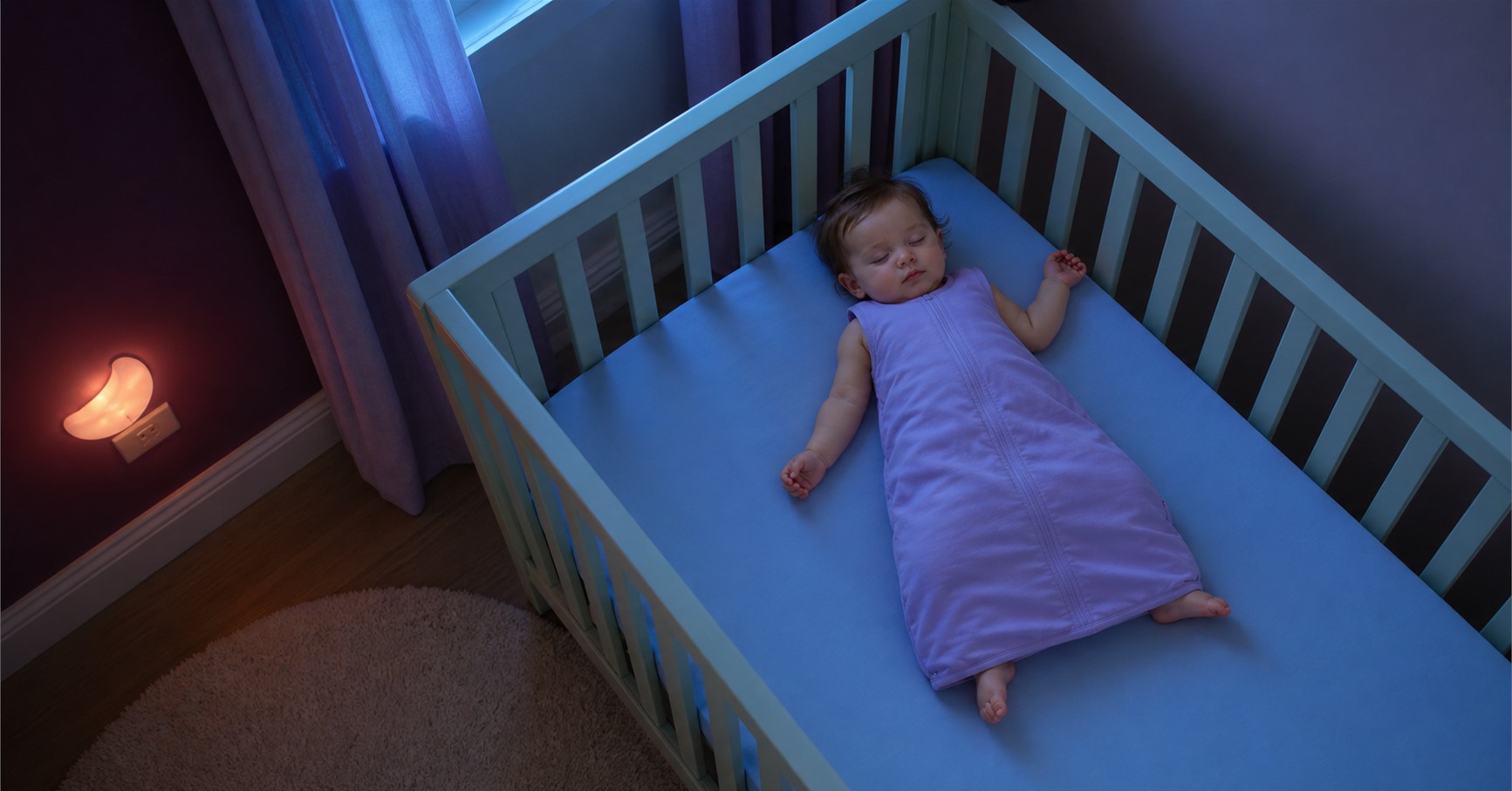
Usually, a baby sleeping in the corner of the crib is simply a baby who moved there. The safe response is not to add padding or keep sliding an independently rolling baby back to center. Put your baby down on their back for every sleep, use a firm, flat, tight-fitting crib mattress with only a snug fitted sheet, and keep the crib completely clear. If your baby can roll both ways alone, you can generally leave the position they choose. If they can roll only one way, you may turn them back onto their back.
I know the question under the question: Can the side of the crib hurt them, and am I supposed to fix this while they sleep? The useful answer comes from three checks—not from where the baby’s head happens to land: movement ability, breathing and comfort, and the integrity of the crib itself.
The crib-corner decision map
Leave, reposition, or stop using the crib?
Leave
Your baby rolled or scooted there, can roll both directions independently, is breathing normally, looks comfortable, and the crib is intact, correctly assembled, firm, fitted, and empty.
Reposition
Your baby can roll only one direction and has ended up on their stomach. Gently return them to their back. Keep placing every baby on the back at the beginning of every sleep.
Stop and inspect
The mattress leaves a gap, the fitted sheet lifts, hardware or slats are loose or broken, clothing can catch, or the baby appears trapped, distressed, unusually weak, or unable to breathe normally.


The corner is not a separate sleep surface
A crib mattress does not become softer, steeper, or less breathable at its edges. In a compliant, correctly assembled crib, the corner is simply where the mattress meets the crib sides. Babies may migrate there by pushing with their feet, turning their head repeatedly, wriggling during light sleep, or rolling and stopping when the rails provide a boundary. None of those movements asks for a pillow-sized solution.
What changes the answer is anything that alters the sleep surface or creates a place to wedge, cover, catch, or compress the baby. That includes loose blankets, pillows, stuffed toys, sleep positioners, wedges, rolled towels, padded bumpers, and improvised barriers. The Consumer Product Safety Commission’s phrase is wonderfully unglamorous: bare is best. For an infant, the crib needs a firm, tight-fitting mattress and a fitted sheet—nothing arranged around the corner to make it look cozier.
I would resist the decorating reflex here. A bare corner can look hard to an adult because adults imagine sleeping against it with adult shoulders, adult preferences, and a profound commitment to pillows. A baby who scooted there is not filing a request for upholstery.
First check: how does your baby move?
The most important developmental distinction is not age printed on a milestone chart. It is what your baby can actually do, consistently, on a firm floor while awake and unrestrained.
- Not rolling yet: place your baby on their back. If they somehow scoot sideways while remaining on their back and the crib is safe, the location alone does not require a rescue mission.
- Rolling only one way: continue back placement. If they roll onto their stomach in sleep, NICHD says you can reposition them to their back. Give generous supervised floor time while awake so they can practice the return movement.
- Rolling both ways independently: place them on their back at the start of sleep, then leave the position they choose. You do not need to spend the night playing silent crib chess.
If rolling is new and wakes your baby, this guide to helping a baby through nighttime rolling covers daytime practice and sleep disruption without changing the safe-sleep rules.
Clearly labeled hypothetical—not a personal memory or evidence
If this were Benjamin on my monitor
Imagine I had placed Benjamin in the center and now saw him asleep with one cheek near the slats. My first impulse might be to sneak in and restore the composition. Before moving him, I would ask: Did he get there himself? Can he roll both ways? Is his breathing ordinary? Is the crib bare and intact? If all four answers were yes, I would leave him. The hypothetical matters because it names the urge many of us have; the guidance comes from the safety sources, not from the scene.
One more rolling boundary matters: stop swaddling when your baby shows signs of trying to roll. A baby needs their arms and body free enough to respond after a position change. Do not tighten a swaddle, add a positioning product, or pin the baby to the center because movement makes the monitor view unsettling.

Second check: is your baby comfortable—or in trouble?
A baby sleeping with their head turned toward the rails, knees tucked, or body touching the crib side can look alarmingly compressed on a grainy monitor. Look for the baby’s condition rather than the geometry.
A home camera can show position, but it cannot prove that breathing is safe, prevent SIDS, or replace going into the room when something looks wrong. If a monitor image conflicts with your direct observation, trust the direct check. If your baby has repeated pauses, persistent noisy or labored breathing, unusual weakness, pain, asymmetric movement, or a new loss of a movement they previously used, contact the pediatric clinician.

Third check: does the crib pass the corner test?
A baby who repeatedly seeks one side may be giving you a useful reason to inspect the equipment closely. Do this in daylight, with the baby elsewhere, rather than attempting repairs around a sleeping infant.
The five-minute corner inspection
- Press the mattress edge. It should fit tightly without a space where the baby’s body or head could become trapped.
- Tug each sheet corner. The sheet should remain snug, wrap under the mattress, and resist being pulled loose.
- Check every slat. Look for cracks, looseness, missing pieces, or spacing that does not meet the crib’s requirements.
- Check hardware and mattress support. Nothing should wobble, protrude, sit in the wrong hole, or differ from the manufacturer’s assembly instructions.
- Clear the perimeter. Move monitor cords, window-blind cords, curtains, shelves, frames, and reachable objects well away from the crib.
- Check the crib model. Follow the manufacturer’s current instructions and confirm it has not been recalled.
CPSC specifies no more than 2 3/8 inches between crib slats and warns that broken hardware, bad assembly, and gaps can cause entrapment. Those are measurable equipment problems. “My baby likes the corner” is not, by itself, proof that the crib is defective.
If you find a gap, loose support, broken slat, missing fastener, lifted sheet, or other defect, stop using the crib until it is corrected exactly according to the manufacturer’s instructions. Do not bridge the gap with foam, towels, blankets, tape, or a liner. An improvised fix changes the sleep environment and may hide the problem rather than solve it.

What if an arm or leg slips through the slats?
This can be upsetting to see, especially when the limb looks more dramatic on infrared video than it does in the room. If your baby is calm and the limb is loose, you can gently guide it back through when necessary. If it is caught, swollen, discolored, painful, or cannot be released easily, support your baby and get prompt help rather than pulling harder.
Then inspect the crib. Confirm the slats are intact and correctly spaced, the mattress support is set correctly, and the crib is assembled according to its manual. Do not buy a bumper or liner to prevent another limb from passing through. Products that cover the rails do not improve the underlying crib and can introduce new hazards.
I would also notice the pattern. A single foot through a compliant slat is different from repeated wedging in a gap created by a mattress that is too small. One is a baby learning the boundaries of a legal sleep space; the other may be an equipment mismatch that needs immediate correction.
Why does my baby keep choosing the same corner?
Sometimes there is no grand explanation. Repeated leg pushes can send a baby along the same route. A baby may turn toward the door, a caregiver’s voice, or the direction from which they are usually placed down. The crib rails can provide a physical stopping point after a roll. Older babies may simply settle into a compact posture.
Before attributing the choice to comfort, check the room for something pulling attention or creating risk: a reachable cord, bright window, mobile, heater, fan blast, pet access, or object on a nearby dresser. Move hazards away. Do not rotate the baby’s sleep position to treat a medical concern or prop one side of the mattress. A crib surface stays flat and level.
If your baby always turns the head one way while awake too, seems unable to turn comfortably in the other direction, has a persistent head tilt, uses one side of the body differently, cries with movement, or loses a skill, mention that pattern to the pediatric clinician. The corner preference does not diagnose anything, but a consistent movement asymmetry is useful information to share.
A useful note for the pediatrician
Record what your baby does while awake: head turns both directions, rolls each way, reaches with both hands, bears weight similarly, and returns from tummy to back. Note when the pattern began and whether it is changing. A short factual description helps more than a monitor screenshot of one sleeping position.

Should I move my baby back to the center?
You can center your baby when you first place them down, but “center” is not a safe-sleep requirement. “Back, firm, flat, fitted, empty” is the meaningful foundation.
If your baby cannot yet roll both directions and turns onto their stomach, reposition to the back. If they can roll both directions, are sleeping comfortably, and the crib passes inspection, repeated recentering is usually unnecessary. It may wake the baby, wake you, and begin a nightly routine in which everyone except the fitted sheet has a job.
Do not hold your baby in one position with a product. The U.S. Food and Drug Administration and safe-sleep agencies have warned about infant sleep positioners because babies can suffocate or become trapped. No positioning gadget can promise to prevent SIDS, and a product marketed with reassuring language does not override the empty-crib rule.

Crib, bassinet, and play yard corners are not interchangeable
The movement question may look the same on a monitor, but the product instructions matter. A full-size crib is designed for a different stage and movement range than a bassinet. Many bassinets have specific limits tied to weight, pushing up, hands-and-knees movement, or rolling. A baby who has begun migrating forcefully into the side may be approaching a milestone that ends bassinet use even when the listed weight limit has not been reached.
Read the exact bassinet manual. If your baby meets any stop-use condition, move to another approved infant sleep product rather than trying to make the bassinet side firmer or keep the baby centered. Do not add a supplemental mattress, pad the mesh, or continue because the baby still technically fits from head to toe.
A play yard also needs the mattress or pad supplied or specifically approved by its manufacturer, attached exactly as directed. Adding a second mattress to reduce a perceived gap or create a softer landing can produce an entrapment space around the edges. The governing question is always, “Is this product being used within its instructions with only its approved sleep surface?”—not “Can I make this corner look more like my bed?”
Same bare rule, different stop-use rules
- Crib
- Confirm mattress fit, slats, hardware, support height, assembly, recall status, and the manufacturer’s age or size limitations.
- Bassinet
- Check the manual immediately when rolling, pushing up, or vigorous side movement begins; developmental stop-use rules may arrive before the weight limit.
- Play yard
- Use only the approved pad and fitted sheet configuration. Never stack mattresses or add edge fillers.
Four corner myths that create more work—or more risk
“The rails feel hard, so a thin cushion must be kinder”
Adult comfort logic is misleading in an infant crib. A soft object placed where the baby’s face may rest can obstruct airflow or create a wedge. The goal is not to prevent every harmless bump against a compliant rail. It is to protect a clear breathing space.
“A breathable label makes a liner part of the crib”
Marketing language does not turn an accessory into the firm, flat sleep surface the crib was tested to provide. “Breathable” also does not answer attachment, entanglement, looseness, climbing, or concealment of broken hardware. I would keep the inspection visible and the rails uncovered.
“If the baby’s face is close to the side, I must turn the head”
Start every sleep on the back and use the rolling rule. A two-way roller may turn the head or body into a chosen position. Repeatedly turning the head is not a substitute for checking breathing, development, and crib integrity—and may simply wake a baby who was breathing normally.
“The monitor will alert me if the corner becomes unsafe”
A consumer video monitor provides a view. It does not certify the crib, reliably diagnose breathing, or erase the need for a direct response when color, movement, sound, or behavior concerns you. The safe setup has to work even when the camera is off.
If the corner move keeps waking your baby
First decide whether the baby is waking because they reached the rails or whether they happened to reach the rails during a normal wake. Babies cycle through lighter sleep and may call out from wherever they stopped moving. Recenter-every-time can accidentally become the condition they wait for before returning to sleep.
During supervised awake floor time, give your baby room to practice rolling both directions, pivoting, and moving an arm out from under the body. Avoid practicing these skills inside the crib with toys or pillows. The crib remains a bare sleep space; the floor is the movement classroom.
At bedtime, keep the routine ordinary. Place your baby on the back in the crib, then respond according to ability and distress rather than mattress coordinates. For a capable two-way roller who is merely complaining, pause long enough to see whether they resettle. For a one-way roller found prone, reposition. For a trapped or distressed baby, go in promptly.
If waking remains frequent, look beyond the corner: timing, hunger, illness, temperature, a new skill, separation distress, or a sleep association may be doing more work than the rails. Change one relevant variable at a time. That keeps the corner from becoming a convenient suspect for every difficult night.
A tonight-only plan for the parent staring at the monitor
- Pause and look at the baby, not just the corner. Is color normal? Is breathing ordinary? Does the body look loose rather than trapped?
- Use the rolling rule. Two-way independent roller: leave the self-chosen position. One-way roller found prone: turn back.
- Keep the crib empty. Do not add anything tonight to soften, block, or fill the corner.
- Make a direct check if uncertain. Go into the room rather than enlarging pixels until they become a diagnosis.
- Inspect in daylight. Test the mattress fit, fitted sheet, slats, hardware, support, cords, and recall status before the next sleep.
This plan is intentionally less exciting than most products sold to worried parents. That is a feature. The safest response usually removes variables: a compliant crib, a correct mattress, one fitted sheet, back placement, and a developmentally accurate rolling decision.
Optional corner-view tool
Infant Optics DXR-8 PRO video baby monitor
If your fixed camera loses the crib corner as your baby becomes mobile, the DXR-8 PRO’s remote pan-and-tilt view can help you check position without entering the room and automatically recentering a peacefully sleeping, independently rolling baby. It is a better fit for this exact problem than any bumper, liner, wedge, or positioner because it adds nothing to the sleep space.
The specific reason to choose it is view control: the dedicated parent unit can redirect the camera toward whichever corner your baby selected. It does not detect breathing, prevent SIDS, prove the crib safe, or replace a direct check. Follow the manual and keep the camera and every cord at least three feet from the crib.
View the Infant Optics DXR-8 PRO on Amazon
As an Amazon Associate, SleepBaby may earn from qualifying purchases.
When the corner is no longer the main question
Call emergency services for blue or gray color, severe trouble breathing, limpness, unresponsiveness, or physical entrapment you cannot safely release. Do not wait for a monitor notification or search for a product.
Contact your baby’s clinician for repeated breathing pauses, persistent noisy or labored breathing, unusual weakness, clear pain, a strong and persistent movement asymmetry, or loss of a movement skill. Also ask for help if your baby has a medical condition and the care team has given positioning instructions that differ from general guidance; follow the individualized plan rather than improvising crib changes.
Stop using the crib until corrected if you find a mattress gap, a loose or broken slat, missing hardware, unstable support, a sheet that will not stay fitted, a reachable cord, or a recall affecting the model. The correct response to defective equipment is not more bedding. It is a safe alternate approved sleep space while the exact problem is resolved.
The monitor picture can stay crooked
Tonight, you may still place your baby neatly in the middle and later find the same small body tucked against the same rail. The picture has changed, but the questions are now simpler. Did you begin on the back? Can your baby roll both ways? Is breathing ordinary? Is the crib firm, fitted, intact, and empty?
If those answers are yes, I would let the corner be a corner. Your baby does not have to use the mattress evenly to use it safely. The open space beside them is not wasted, and the rails do not need decorating. Sometimes the most protective thing a parent can add to a crib is nothing at all.

The corner does not change the safe-sleep foundation
Start on the back; keep every corner bare
A mobile baby may choose an unexpected part of the mattress, but the sleep-space rules stay steady. This American Academy of Pediatrics video reinforces the firm, flat, empty setup that makes the rolling decision easier to evaluate.
Takeaway: place your baby on the back, keep the crib firm and empty, then use rolling ability, breathing, comfort, and crib integrity—not mattress coordinates—to decide whether to intervene.
Sources
Make tonight’s sleep question smaller
When one crib position turns into a whole night of checking, SleepBaby can help you separate the safety rule from the exhausting loop around it. Start with the corner checklist, keep the crib bare, and bring the rest of your baby’s sleep pattern into focus.