
The answer I would want at 2:11 a.m.
If your baby sleeps with both hands behind or above their head, you usually do not need to move the arms. Place your baby on their back on a firm, flat, level infant sleep surface with only a fitted sheet, and let the arms settle naturally. The pose alone does not prove discomfort, overheating, a named reflex, or a developmental problem.
What changes the answer is the pattern around the pose: whether both arms move similarly while your baby is awake, whether breathing and color look normal, whether one arm seems painful or weak, whether the head is nearly always turned one way, and whether rolling attempts mean it is time to stop swaddling.
Get emergency help now for blue or gray color, severe trouble breathing, unresponsiveness, seizure-like activity, a serious injury, or a baby who looks life-threateningly ill. A dramatic change in the baby comes before any discussion of sleep position.
The monitor can make an ordinary posture look like evidence from a crime scene. There is the round head, two elbows, and hands tucked somewhere near the hairline—and suddenly you are zooming in far enough to count pixels. I understand the private question beneath the search: Is my baby merely comfortable, or am I looking at a clue I should not ignore?
I would not try to read the whole answer from one frozen nighttime image. I would use the sleeping pose as a prompt to check two separate things: the safety of the sleep setup now, and the baby’s movement pattern when awake later. Those questions are far more useful than trying to assign meaning to where two small hands happened to land.

A pose is one frame; a pattern is the useful evidence
Hands behind the head can look unusually adult. That visual resemblance is charming, but it is not a medical interpretation. Babies move through light sleep, startle, stretch, flex, relax, and settle their limbs in ways that may look deliberate even when no deliberate choice is involved. A single pose cannot tell us that a baby is “self-soothing,” remembering how they were held, cooling themselves, or demonstrating a specific reflex. Those explanations may sound plausible, but plausible is not the same as supported.
Pose versus pattern
One sleeping pose
- Hands happen to rest near or behind the head
- Baby otherwise looks comfortable
- Breathing and color look typical
- Position changes at other sleeps
What I would do: leave the arms alone and keep the safe sleep surface unchanged.
A repeated body pattern
- One arm consistently moves less when awake
- Head nearly always turns or tilts one way
- Movement causes crying or the arm looks swollen
- There is a clear change from the baby’s baseline
What I would do: record the pattern and contact the pediatric clinician.
Sleep connection: do the safety check tonight; do the movement comparison when your baby is awake, calm, and easy to observe.
SleepBaby.org observation tool
That distinction keeps reassurance honest. I am not saying every unusual-looking posture is meaningless. I am saying the information lives in symmetry, comfort, movement, persistence, and associated symptoms—not in the visual novelty of two elbows pointing outward.
First, check the surface around those hands
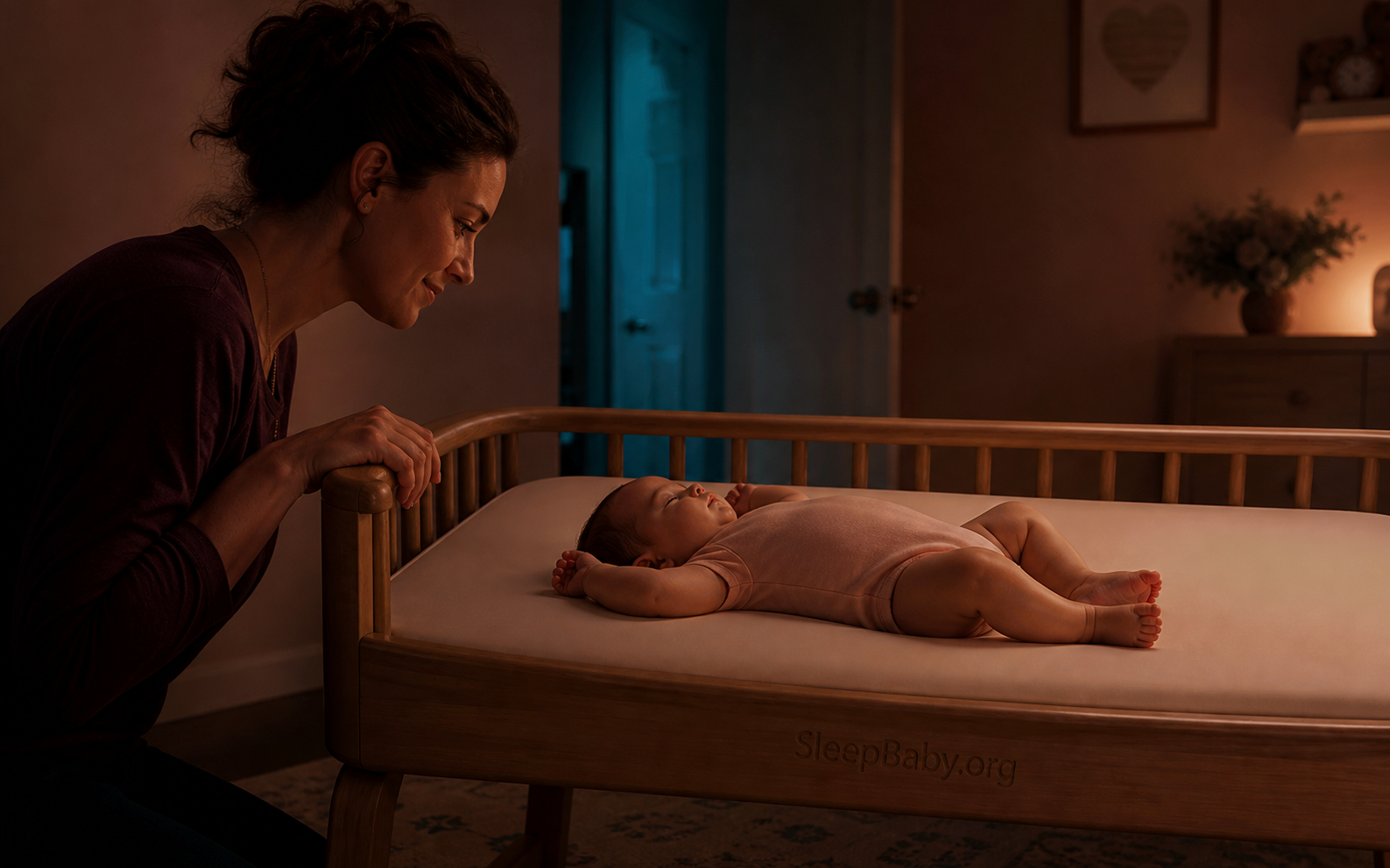
The safest response to a strange-looking sleep pose is not to add something to the crib. It is to make sure nothing extra is there. Place every infant on their back for naps and nighttime on a firm, flat, level, non-inclined surface designed for infant sleep. Use a fitted sheet and nothing else in the sleep area.
Do not add a pillow beneath the head or elbows. Do not use a wedge, side-sleeping prop, rolled towel, bumper, arm restraint, or positioner to keep the hands where you think they should be. Do not tuck a blanket around the arms. Weighted swaddles, weighted blankets, and weighted sleep clothing are not safe additions. If the baby fell asleep in a swing, bouncer, car seat, or stroller outside travel, move them to the firm flat sleep surface as soon as practical.
The 15-second empty-surface scan
- Back: I placed the baby on their back.
- Base: The mattress is firm, flat, level, and made for this crib, bassinet, portable crib, or play yard.
- Bare: Only the fitted sheet is in the sleep space.
- Breathing: Color and breathing look typical for this baby.
- Body free: Nothing pins, weights, or traps the head, neck, chest, or arms.
If those five checks are sound and both arms are simply resting near the head, I would not wake a comfortable baby to rearrange them.
If the separate bassinet itself is the part your newborn keeps rejecting, the next useful guide is how to troubleshoot bassinet sleep without changing the safe-sleep floor. That is a different problem from the arm pose, and keeping the two questions separate prevents a harmless-looking “solution” from making the surface less safe.
Watch the surface, not the pose
A safe-sleep reset for the moment your monitor makes you stare
This short CDC video reinforces the part of tonight’s check that matters regardless of where your baby’s hands land: back sleeping on a firm, flat, bare surface. It does not diagnose an arm posture or replace your pediatrician’s advice.
Takeaway: You do not need to pin comfortable arms into a preferred position. Keep the sleep surface safe, keep both arms free when rolling is approaching, and judge concern from the whole awake-and-asleep pattern.
Could this be a startle reflex or the fencing posture?
Young babies have primitive reflexes—automatic movement responses that are expected early in development. The Moro or startle reflex can send both arms outward before they come back toward the body. The tonic-neck reflex can create a “fencing” posture when a relaxed baby’s head turns to one side: the arm on the face side extends while the opposite arm bends.
Those facts help explain why infant limbs can look surprisingly choreographed. They do not let us identify a reflex from a still monitor image of two hands behind the head. Hands-up, elbows-out, and hands-behind-head are descriptive phrases, not diagnoses. I would resist the internet’s habit of giving every charming baby pose a confident biological backstory.
The more useful reflex question is whether responses and movement look broadly similar on both sides over time. The American Academy of Pediatrics notes that the Moro and tonic-neck reflexes should appear equally on both sides; if your baby moves one side better than the other or a reflex looks different on one side, tell the pediatrician. This is an awake-pattern observation, not something you need to test repeatedly or provoke at home.
Age and context change what I would ask next
In a young newborn, automatic arm movements and changing flexed postures are part of the ordinary background. Primitive reflexes are expected early and gradually become less prominent as voluntary control develops. That makes a brief, symmetrical hands-up pose less informative than the baby’s overall feeding, alertness, comfort, color, breathing, and movement between sleeps.
In an older baby who already reaches, rolls, props on both arms, and changes position independently, I would compare the sleep pose with those established awake skills. If both arms work freely during play and the hands simply drift behind the head during sleep, the awake function is reassuring context. If a previously active arm suddenly stays still or the baby stops using a skill they had, that change deserves clinical attention even if the sleeping pose itself looks peaceful.
Prematurity and medical history matter too. Corrected age may be relevant when discussing developmental expectations, while a history of birth injury, fracture, nerve injury, muscle tightness, surgery, or neurologic care may give the clinician a different reason to examine asymmetry. I would follow that child’s individualized plan rather than treating a general milestone page as a deadline.
Timing after an event also changes the threshold. A baby who has always rested with both arms overhead is a different situation from a baby who stops moving one arm after a fall, an awkward pull, or an unexplained episode. After an injury, do not keep lifting and rotating the arm to see whether it “still hurts.” Support the baby, note what changed, and seek medical advice. If there is obvious deformity, severe pain, concerning color, breathing trouble, or the baby appears seriously unwell, use urgent or emergency care.
This is why I keep returning to baseline. Age provides context; function provides evidence; change provides urgency. The hand position is only the doorway into those better questions.

What I would watch when the baby is awake
Sleep is a poor time to judge voluntary movement because the whole point is that the baby is not performing on request. Wait for an ordinary awake period when your baby is calm—not hungry enough to protest the entire experiment and not exhausted enough to fold back into sleep. Then watch without forcing any motion.
Five observations worth carrying to the pediatrician
- 1. Symmetry
- Do both arms flex, open, reach, and respond in broadly similar ways during ordinary movement?
- 2. Comfort
- Does touching, dressing, or moving one arm reliably cause crying, guarding, or a sudden change?
- 3. Neck range
- Does the baby comfortably look both ways, or is the head nearly always tilted or turned to the same side?
- 4. Appearance
- Is there swelling, redness, deformity, unusual color, or increasing flattening on one side of the head?
- 5. Change
- Is this the baby’s familiar pattern, or is one arm suddenly moving less after illness, injury, vaccination, or an unexplained event?
Sleep connection: observe later; do not repeatedly wake or manipulate a sleeping baby to collect better evidence.
SleepBaby.org five-observation field note
I care more about a new difference between sides than about whether both elbows make the monitor silhouette look theatrical. The CDC includes moving both arms and both legs among the movement milestones most babies demonstrate by two months, but milestone lists are screening conversations, not diagnostic scorecards. Prematurity, medical history, and individual development can change the context. If you are worried, bring the observation—not a conclusion—to the child’s clinician.
A clearly labeled hypothetical Kacey-and-Benjamin moment
Imagine I glance at the monitor and hypothetical Benjamin is asleep with both hands behind his head, looking like a tiny executive who has just concluded a difficult meeting. My first impulse is to walk in and arrange him into a pose that looks more “baby.”
Instead, I look at what matters: he was placed on his back; the bassinet is empty; his color and breathing look ordinary; nothing is pinning his body. In the next calm awake period, I see both arms moving freely and his head turning both directions. The hypothetical scene has done its job—not proved that the pose is normal, but shown which evidence would actually earn reassurance.
That is the shift I want for you too. The monitor image may begin the question. It does not get to write the diagnosis.
Let rolling—not the hands-up pose—decide when swaddling ends
Some parents arrive at this question because the baby has escaped an arm from the swaddle and placed it overhead. Others have an arms-up swaddle and wonder whether the posture is safe. The decision point is not whether your baby “likes” a particular arm position. It is whether your baby is showing any sign of attempting to roll.
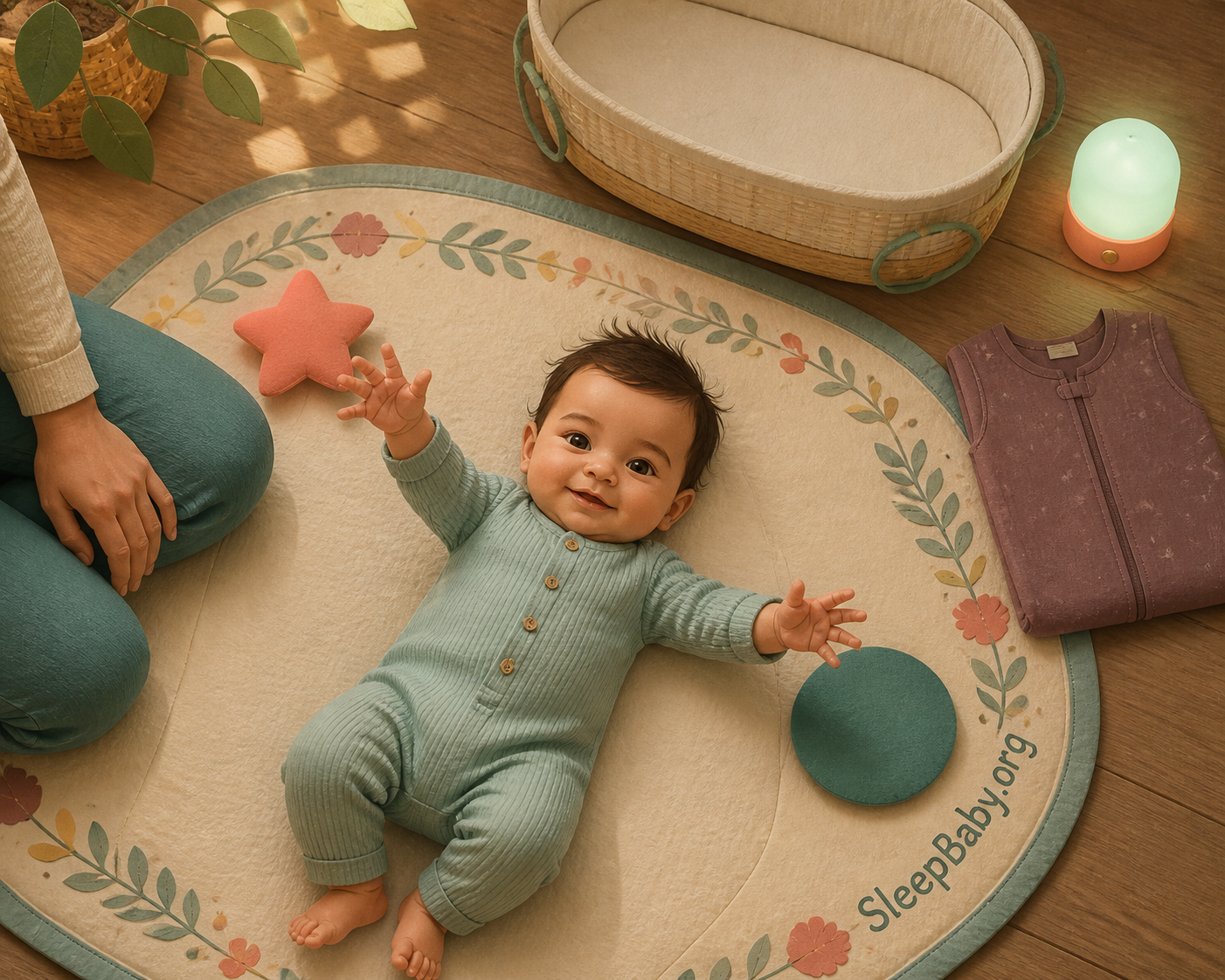
If you swaddle, always place the baby on the back. Use no weighted swaddle. As soon as the baby shows signs of trying to roll—which may occur earlier than a calendar estimate—stop swaddling and stop any product that compresses the arms, chest, or body. A baby who rolls while arm-restricted may not be able to use the arms to adjust position.
The arm-freedom decision path
- No rolling attempts: a correctly used, non-weighted swaddle may be optional, but it is not required to correct the hands-behind-head pose.
- Any sign of trying to roll: stop swaddling and every product that restrains or compresses the arms.
- Warmth still needed: choose correctly sized sleep clothing or an arms-free wearable blanket instead of loose bedding.
- Baby rolls independently: continue placing baby on the back; if the baby can roll both ways independently, follow current pediatric safe-sleep guidance rather than using positioners to hold one pose.
The goal is a safe surface and free movement, not symmetrical-looking elbows on the monitor.
When a one-sided preference deserves a closer look
Both hands behind the head is a different observation from one arm repeatedly staying in a different position or one side moving less. It is also different from a baby whose head nearly always turns or tilts toward the same shoulder. That persistent preference can be associated with tight or imbalanced neck muscles and positional head flattening, and it deserves a pediatric conversation rather than a home sleep-positioning gadget.
Look at your baby’s head after a bath, when wet hair makes the shape easier to see. Does the back look evenly rounded, or is one side becoming flatter? Do the ears look level, or does one seem shifted? During awake, supervised time, does your baby turn toward voices or interesting objects on both sides? Do not diagnose torticollis from these observations. Use them to decide whether to ask for an exam and, if appropriate, physical-therapy guidance.
Supervised tummy time while awake helps babies practice head control and reduces long periods of pressure on the back of the head. It is not a reason to place a baby prone for sleep. “Back to sleep, tummy to play” keeps the two jobs separate: the back-sleep position protects sleep; awake supervised floor time supports movement.
If an arm seems painful after a fall or an awkward lift, do not repeatedly move it to compare sides. Support the baby comfortably and seek medical guidance. If your baby is younger, medically complex, or recently ill, your clinician may want a lower threshold for evaluation. This guide cannot examine strength, reflexes, joints, nerves, or neck range.
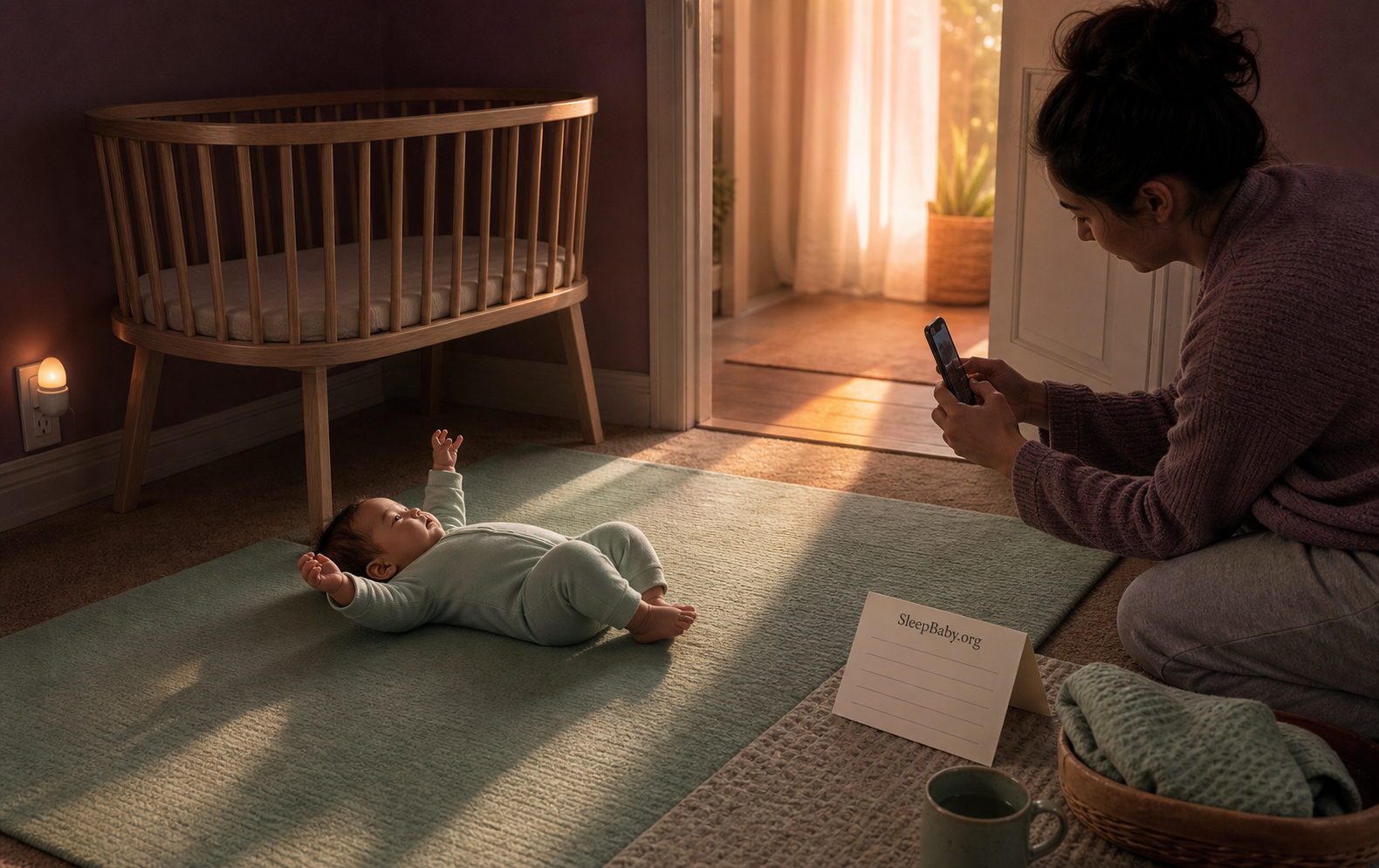
A clinician-ready note takes less than two minutes
When something happens mostly at night, memory becomes unreliable. By breakfast, “always” may mean twice and “never” may mean you did not see it during the three minutes you watched. I would write a tiny factual note rather than trying to keep a running courtroom argument in my head.
The two-minute movement note
- When: asleep, just waking, feeding, or calmly awake?
- Which side: both arms, right only, left only, or changing?
- What happened next: moved normally, stayed still, cried, startled, or returned to baseline?
- What came with it: head preference, swelling, fever, unusual color, breathing change, difficult waking, or nothing else?
- How long and how often: one brief moment, several sleeps, or a persistent awake pattern?
If safe to do so, a short video of spontaneous awake movement may help. Do not delay urgent care to collect evidence.
This note also protects against the opposite problem: becoming so reassured by a cute pose that you overlook a new functional change. “Both hands were behind the head” is a description. “The right arm has moved much less during three awake periods since yesterday” is a pattern a clinician can use.
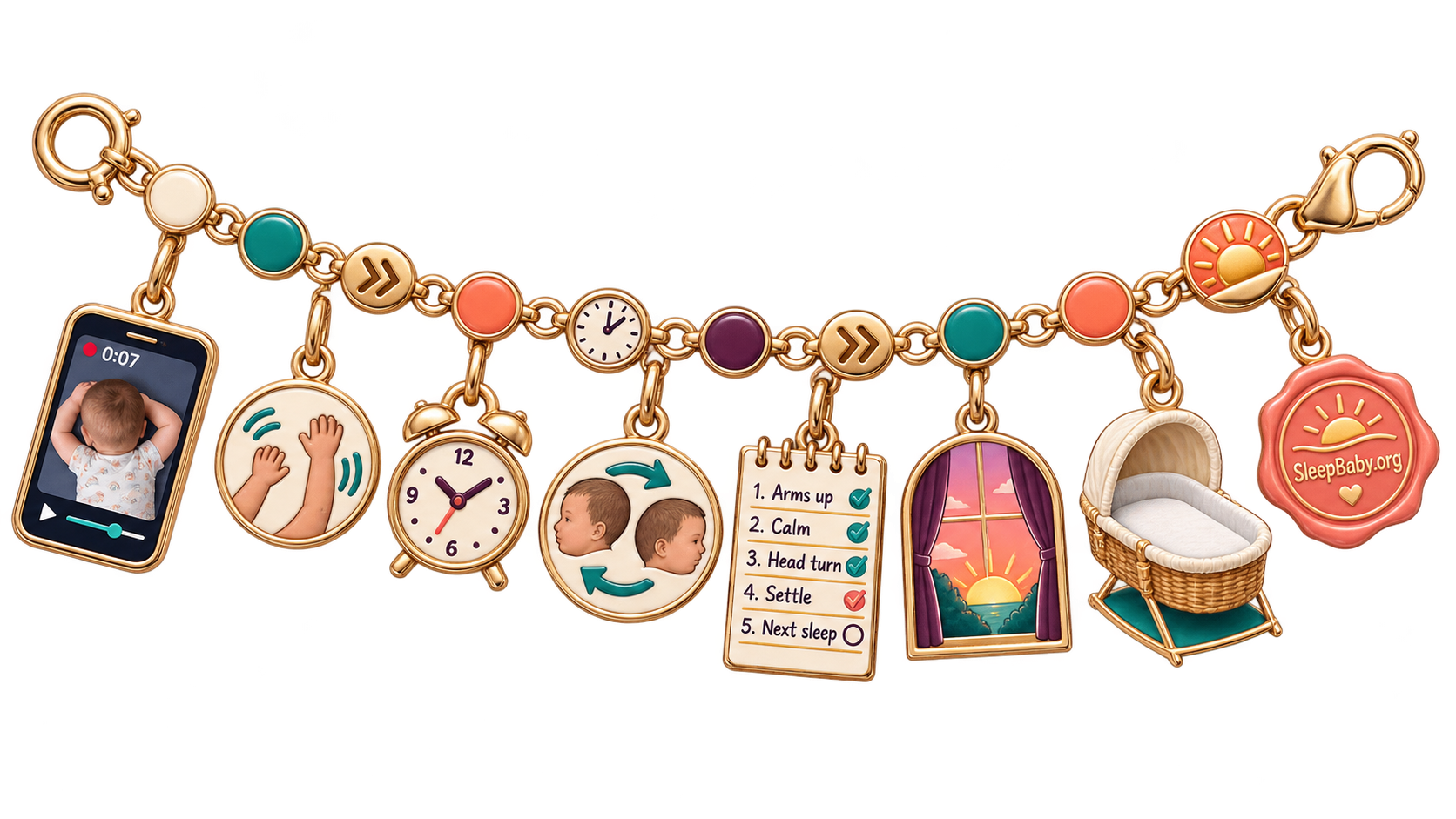
What I would not change tonight
I would not change five variables because the elbows looked unusual. I would not introduce a pillow, wedge, rolled blanket, or sleep positioner. I would not force the arms down, pin them inside clothing, or choose a tighter swaddle to stop the pose. I would not turn the baby onto the side or stomach to make the arms look more natural. And I would not use a consumer monitor reading to declare the posture safe or unsafe.
I would also avoid waking the baby every few minutes to compare arm placement. If the immediate safety scan passes, save the movement observation for awake time. Parent attention is a limited nighttime resource; spend it on the signals that can actually change the decision.
For most families, the practical plan is pleasantly undramatic:
- Keep the sleep surface back, firm, flat, level, and bare.
- Leave freely resting arms alone.
- Check ordinary awake movement on both sides later.
- Let rolling attempts end swaddling.
- Call when pain, weakness, persistent asymmetry, head preference, or another concerning change joins the picture.
A practical arms-free layer
Burt’s Bees Baby Beekeeper wearable blanket, lightweight 0.5 TOG
Once swaddling is no longer appropriate, the useful product job is not “fix the hands-behind-head pose.” It is replacing loose bedding with a correctly sized wearable layer that leaves both arms completely free. That makes the sleeveless Beekeeper a more sensible fit here than another swaddle, a positioner, or a monitor: it does not restrain the arms or pretend to interpret them.
The specific reason I would consider buying it is simple: it lets you preserve the warmth-and-clothing part of the routine while removing arm position from the product’s job. Follow the current size, fit, care, and temperature guidance. It does not prevent SIDS, treat posture or torticollis, monitor breathing, or replace a pediatric evaluation. No wearable layer makes an unsafe surface safe.
See the arms-free Beekeeper on Amazon
As an Amazon Associate, SleepBaby may earn from qualifying purchases.
The small questions that change the plan
Should I move my baby’s hands down after they fall asleep?
Usually not. If your baby was placed on the back, the sleep surface is safe and bare, both arms are free, and breathing and color look typical, moving the hands is unlikely to improve safety. Repeated repositioning may simply wake the baby. Move or wake the baby when another concern—not the aesthetic of the pose—requires it.
Does sleeping with arms up mean my baby is hot?
The arm pose alone cannot tell you. Check the baby’s chest or back rather than hands and feet, and look for sweating, a hot chest, flushed skin, or other signs of overheating. Adjust clothing and room conditions based on the whole baby and current pediatric guidance, not the location of the hands.
Does the pose mean my baby feels safe?
It may look relaxed, but we cannot infer an infant’s emotional state from this position alone. A more grounded reassurance is that your baby looks comfortable, breathes normally, has typical color, wakes and feeds as expected, and moves both arms freely when awake.
What if one hand is behind the head and the other never is?
Variation between sleeps is common and a single asymmetrical pose may mean very little. Persistent one-sided movement, a limp or painful arm, repeated head tilt, limited neck range, or increasing one-sided flattening is different. Record what you see during calm awake periods and discuss the pattern with the pediatrician.
Can I keep using an arms-up swaddle?
Only while swaddling remains developmentally appropriate and the product is used exactly as directed. At the first sign of attempting to roll, stop every swaddle or wearable that compresses the arms, chest, or body. “Arms up” is still arm restraint if the product prevents the baby from using the arms freely.
What if my baby rolls into this position?
Continue placing your baby on the back for every sleep. If your baby can roll both directions independently, current AAP guidance says you do not need to repeatedly turn them back, but the surface must remain firm, flat, level, and bare, and the arms must not be swaddled. Never use a positioner to prevent rolling.
Sources
- American Academy of Pediatrics, HealthyChildren.org. “Safe Sleep: 9 Ways to Reduce a Baby’s Risk of SIDS & Suffocation.”
- American Academy of Pediatrics, HealthyChildren.org. “Swaddling: Is it Safe for Your Baby?”
- American Academy of Pediatrics, HealthyChildren.org. “Newborn Reflexes.”
- MedlinePlus Medical Encyclopedia. “Infant Reflexes.”
- Centers for Disease Control and Prevention. “Milestones in Action: By 2 Months.”
- American Academy of Pediatrics, HealthyChildren.org. “When a Baby’s Head is Misshapen: Positional Skull Deformities.”
- American Academy of Pediatrics, HealthyChildren.org. “Putting Back-Sleeping Concerns to Rest.”
- American Academy of Pediatrics. “Safe Sleep: Back is Best, Avoid Soft Bedding, Inclined Surfaces & Bed Sharing.”
Read the primary guidance: AAP safe sleep · AAP swaddling · AAP newborn reflexes · MedlinePlus infant reflexes · CDC two-month milestones · AAP positional skull shape · AAP back-sleeping concerns · AAP back-is-best guidance.
When the monitor pose looks strange again tonight
You do not have to solve the secret meaning of two tiny hands. Check the surface. Check the baby. Let free arms rest. Then, in daylight, watch the pattern that can actually answer you.
That is how the same monitor image becomes smaller: not because you ignored it, but because you learned where the useful evidence lives.






What viewers said10 comments · 4 replies+
Archived comments from the original Baby Sleep Miracle presentation. Not independently verified by SleepBaby.org; individual experiences vary.
Thank you so much for this video! I had no idea about the dangers of baby swings :O
Hi Mary-Ann. I have a question: Is method in any way similar to the ones recommended by Dr Bucknam, Dr. Weissbluth or Dr. Karp? We tried those but none of them help.
Hi Regina, thank you for your question. The short answer is no. The techniques I share in my guide are based on newest scientific research and this is why I have never seen any approach similar to the one I recommend.
This method really works! I tried it on my son Jesus and after just one week he went from waking up more than 5 times a night to waking up just once or twice. You are a lifesaver, Mary-Ann!
I'm truly impressed with how much information you share in your video. And all for free! I can feel that you truly care about mothers like myself, and that's hard to find these days. I have recommended your site to several of my friends already.
Mary-Ann, our child suffers from autism. Is your approach still suited?
Chloe, I made sure my method can be used with any child, even babies who are special like yours. Please note that I'm not a doctor and that I always advice to consult with your physician because nothing is more important than the safety and well-being of your love.
Hallo Mary-Ann, I'm from Germany. Do you have your guide in German?
Hello Heide, we do! Normally you should already see our video in German. If not, please contact our support so they can guide you
Thenk you for your answer, Mary-Ann!
I just completed your approach and I have to say, it worked almost too well. Yes, it took a bit of getting used to with your bedtime routine but the difference is huge. My son George used to take 1 hours to go down and now he's firmly asleep in no more than 10 minutes! You're the best!
It seems I'm the only man watching this video, lol! What you shared about the 'emotional backpack' made immediate sense to me and I can't wait to help my little girl Mila to unpack it!
Hey there, just discovered your site and this really sounds different. Just wanted to say thanks for sharing :)
For everyone who's still thinking about getting Mary-Ann's guide I want to advise you to go ahead. I wasn't sure myself but now I'm so thankful I invested in this program. It made a huge difference in our life as a family and yes, my baby girl does sleep through the night now.