
The nursery is dark, the baby is finally quiet, and then you realize you cannot see whether the diaper tabs are straight without switching on a light bright enough to interrogate the furniture. That is usually the moment a red night-light begins to sound less like a decorating choice and more like equipment.
Yes, a baby can sleep with a red light, but the best default is still darkness. If you genuinely need visibility for a feed, diaper change, medication check, or safe walk across the room, a very dim red or amber light is a reasonable lower-impact choice. Red is not a sleep treatment, does not guarantee longer sleep, and should not be used to claim better melatonin production or SIDS protection. Brightness, distance, duration, daytime light, and a safe sleep setup matter more than the color name printed on the box.
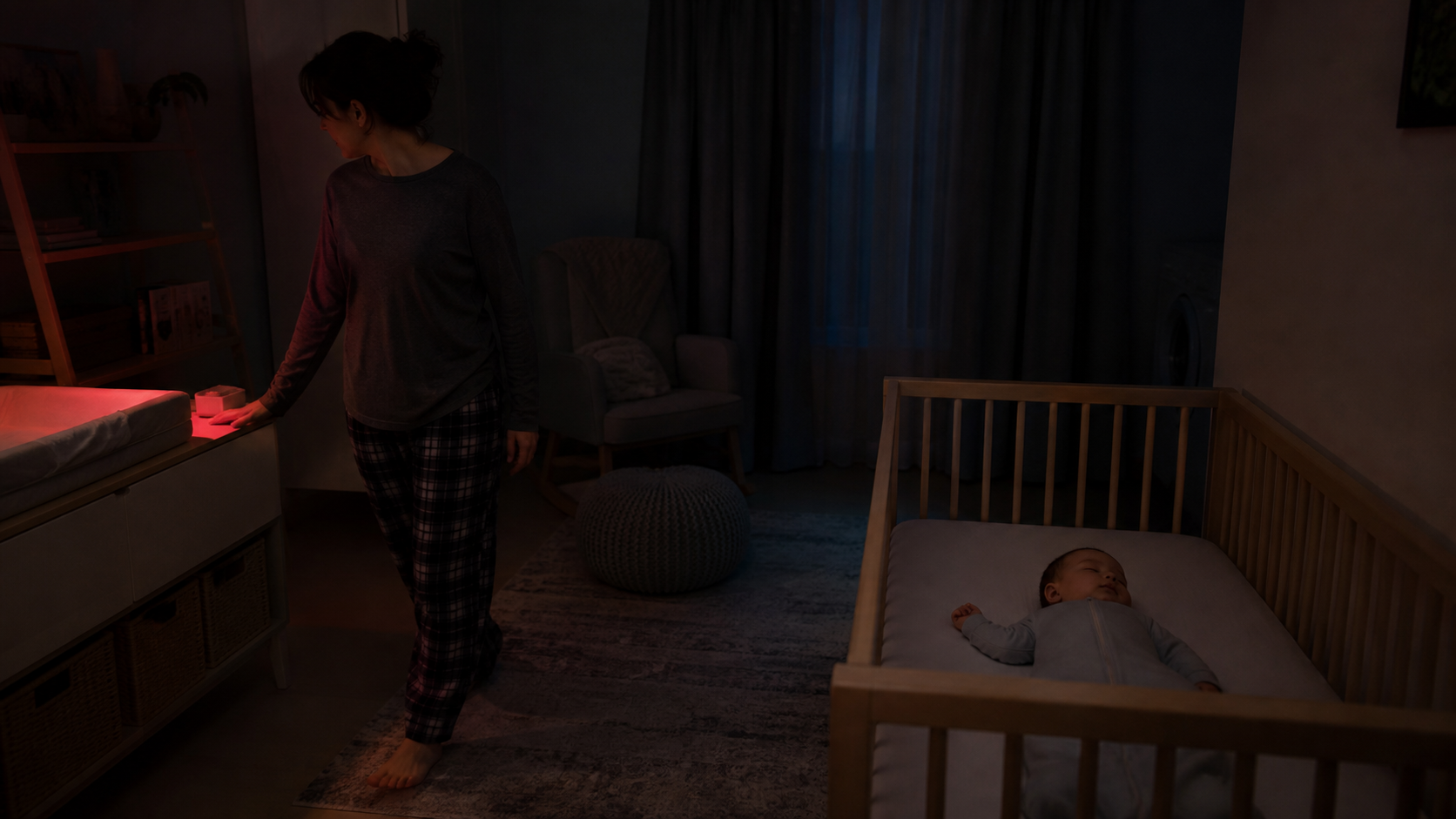
I would not ask, “Is red light good or bad?” as though the bulb gets one permanent moral grade. I would ask a narrower question: Is this the least light needed for this exact nighttime job? That question is much easier to answer at 2:08 a.m., when nobody wants a lecture on wavelengths and everybody would like to find the clean diaper.
The quick answer for tonight
If your baby is already asleep
Leave the room dark if you can move and monitor safely. There is no evidence-based reason to keep a red glow running simply because red is marketed as sleep-friendly.
If you need to feed or change your baby
Use the lowest red or amber setting that lets you complete the task, position it away from your baby’s face, and turn it down or off when you are finished.
If you need to assess color or illness
Use adequate neutral light. Red illumination can distort what skin, lips, vomit, urine, or a rash looks like. Trouble breathing, blue or gray color, unusual lethargy, or other urgent illness signs need prompt medical attention—not better nursery lighting.
Why red light gets recommended—and where the claim gets too big
Human circadian systems are especially responsive to short-wavelength, blue-rich light. That is why a low-output red or amber source can be less disruptive than a bright white or blue-rich source. But “red” is not a magic shield. Laboratory measurements of children’s night-lights show enormous variation between products. Some red-toned lights create relatively low circadian-effective exposure; others are simply too bright, too close, or on too long to deserve an automatic pass.
The Academy of Breastfeeding Medicine recommends minimizing nighttime illumination and notes that low-intensity red light may be useful when a caregiver needs light for feeding. I read that as a practical permission slip, not a prescription. It means you do not have to choose between total darkness and the overhead fixture that makes everyone look as though breakfast has been announced.
Research in young infants also supports protecting a clear contrast between brighter days and darker nights. In one observational study, infants who received more light earlier in the day slept more at night. That does not prove a red night-light improves sleep. It points to the larger rhythm: daytime should look and feel like daytime, while overnight care should stay quiet, dim, and boring.
A randomized study of hospitalized preterm infants compared red and white nursing light during brief care within a controlled light-dark setting and did not find significant differences in rest-activity patterns, crying, or weight gain. That finding is useful precisely because it is modest. It does not justify leaving a red lamp on all night, and it does not show that red light makes babies sleep longer. It reminds me not to turn a plausible biological idea into a promise the research has not made.
What the color can change—and what it cannot
| Red or amber light may help with | Red light cannot reliably do |
|---|---|
| Giving a caregiver enough visibility without bright white overhead light | Treat a sleep disorder or fix frequent waking |
| Keeping nighttime care visually quieter when used at low intensity | Guarantee melatonin release or longer sleep |
| Creating one repeatable “night mode” for feeds and changes | Prevent SIDS or make an unsafe sleep space safe |
| Reducing blue-rich exposure compared with many white LEDs | Compensate for a lamp that is bright, close, or left on unnecessarily |
SleepBaby.org teaching tool: separate the useful care job from the sleep claims.
Use the dim–distance–duration test
When I evaluate a nursery light, I ignore the soothing product name for a minute and look at three ordinary variables. They are not glamorous, which is probably why packaging prefers words like “dream glow.” Ordinary variables are still the ones that change the room.
- Dim: Start at the lowest setting. Increase it only until you can see your hands, the floor, and the care task. If you can comfortably read tiny print across the room, it is probably doing more than nighttime care requires.
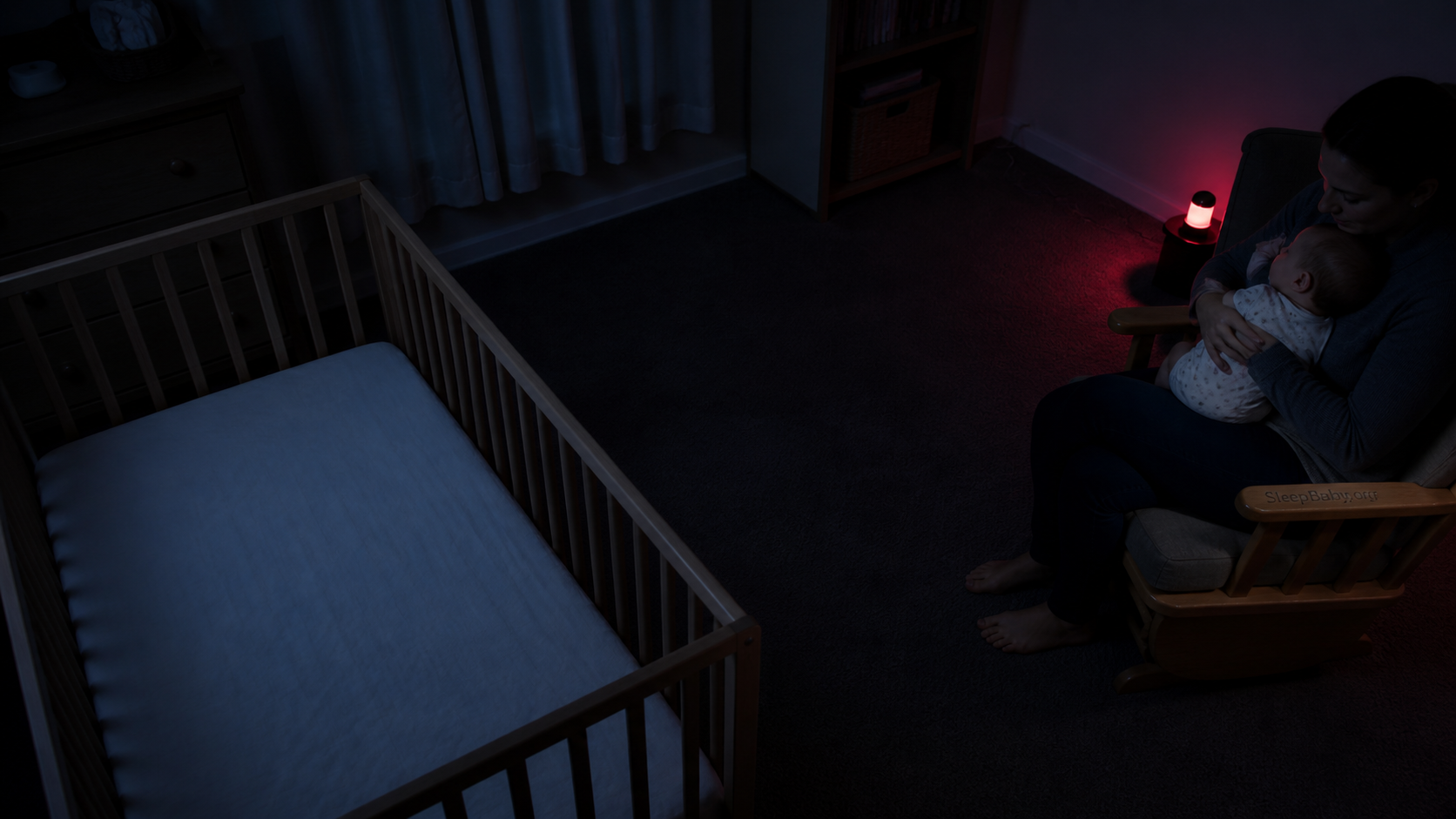
- Distance: Keep the source away from your baby’s face and outside the crib or bassinet. Aim it toward the floor or changing area rather than across the mattress. Greater distance usually reduces the light reaching your baby’s eyes.
- Duration: Use it for the task, then switch it off or return it to the lowest setting. Ten minutes of care light is a different exposure from eight continuous hours.
The fourth dial is daytime. Open curtains, go outside when practical, and let ordinary daytime activity create contrast. A dim night works best as part of a recognizable 24-hour pattern.
I would change one dial at a time. If you lower brightness, move the lamp, change bedtime, alter naps, introduce a new sound, and reorganize the entire nursery on Tuesday, Wednesday’s result will tell you almost nothing. Babies are already talented at producing data with no respect for experimental design.

A clearly labeled hypothetical: Kacey, Benjamin, and the glowing sock
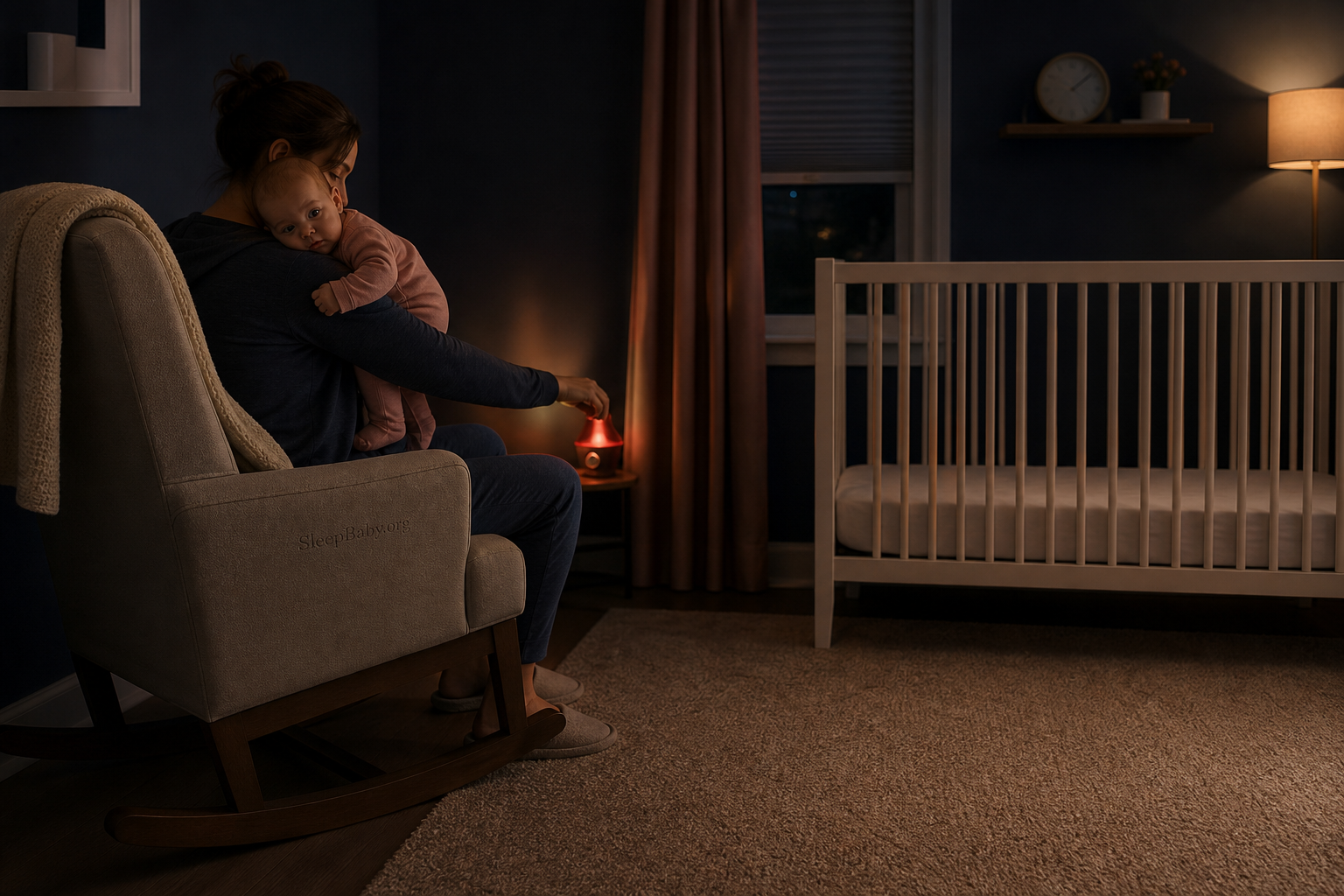
This is a hypothetical Kacey-and-Benjamin scene, not a claim about a real family event and not medical evidence.
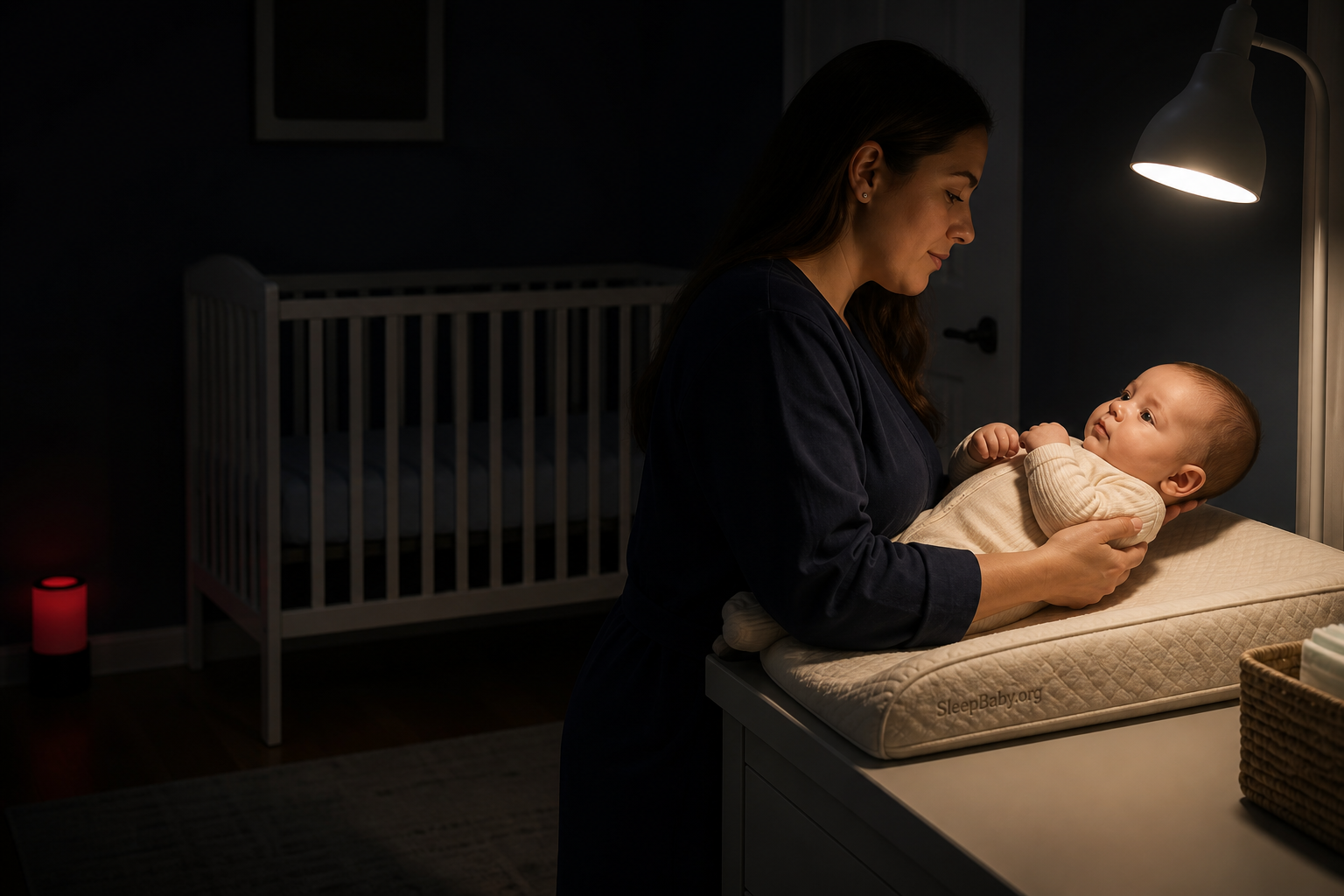
Imagine me at 2:17 a.m. with Benjamin against one shoulder, a clean diaper open on the changing pad, and a red lamp making one white sock glow like a tiny emergency beacon. I can see the buckle on the changing pad. I can see the floor. I cannot tell whether the sleeper is navy or black, and I do not need to. The light has completed its assignment.
Then imagine I leave the lamp blazing because red is “good for sleep.” The room is still illuminated, Benjamin can still look toward it, and I have quietly promoted a task light to an all-night employee. The useful distinction is not red versus forbidden. It is care light versus background light.
That is the part I want a tired parent to feel. You are not failing if you need to see. Darkness is not a purity test. Use enough light to care for your baby safely, and do not ask the light to solve a sleep pattern it cannot solve.
Should the red light stay on all night?
Usually, I would turn it off once the care task is finished. If a caregiver needs a continuous orientation light because of room layout, mobility, fall risk, shared-room care, or repeated feeds, keep it extremely dim, low, and directed away from the sleep surface. The goal is not theatrical darkness. It is to avoid unnecessary illumination while protecting safe movement.
Watch the actual room from your baby’s position. A lamp that looks faint from the doorway may be a bright point source from the crib. Reflective walls, mirrors, glossy furniture, and monitor LEDs can also change the effect. I would lie my head near crib-mattress height while the crib is empty and look toward the source. If the light pulls your eye immediately, lower it, shield it safely, redirect it, or move it farther away.
Do not drape fabric over a lamp, wedge a device into crib rails, or place loose material near a heat source. A clever lighting hack becomes substantially less clever when it introduces a fire, strangulation, or sleep-space hazard.
Where should a nursery light go?
Keep the sleep space simple
- Place baby on the back for every sleep on a firm, flat, level surface intended for infant sleep.
- Keep the crib or bassinet clear except for a fitted sheet.
- Keep lamps, smart lights, power adapters, cords, and batteries outside the sleep space and out of reach.
- Do not route a cord behind or beneath a crib where a growing baby may reach it later.
- Avoid direct light into the baby’s face; point the source toward the floor or care station.
- Keep the walking path visible enough that the caregiver can move without tripping.
The lamp cannot improve a sleep setup that is otherwise unsafe. Color is an environmental detail. Back placement, a clear sleep space, and a proper infant sleep surface remain the foundation.
A governed low-light recommendation
I like this recommendation only after the lighting decision is clear. A product cannot tell you how dim your room needs to be. It can give you better controls. If those controls remove a recurring burst of bright light from your night, they have a real job. If your current lamp already dims low, points away from the crib, and switches off easily, keep your money.
Red versus amber versus warm white
Red and amber are both reasonable low-blue choices when kept dim. Warm white can also work when its lowest setting is truly low and exposure is brief. I would choose the device you can control most reliably rather than buying by color name alone. A barely glowing warm lamp across the room may create less meaningful exposure than a saturated red source shining directly beside the crib.
Color appearance also changes at low brightness. Some “red” products lean magenta or contain additional wavelengths. Some amber products are visually comfortable but much brighter than expected. You do not need a home spectrometer. You do need to notice whether the light dominates the room, reaches your baby’s face, or remains on without a care reason.
Choose by the job, not the label
- I only need to cross the room.
- Try a very low, floor-directed red or amber orientation light.
- I need to feed.
- Use enough light to position yourself and your baby safely, then reduce or switch it off when settled.
- I need to change a diaper.
- A dim task light at the changing area is more useful than lighting the whole nursery.
- I need to check skin color, breathing, a rash, or vomit.
- Use adequate neutral light. Red light is the wrong tool for accurate color assessment.
- My baby wakes frequently.
- Do not assume the lamp is the cause or cure. Review feeding, schedule, comfort, illness, development, sleep associations, and age-appropriate waking patterns.
What about newborns?
Newborn circadian rhythms are still developing, so day–night contrast matters more than trying to engineer a perfect nighttime wavelength. Keep days appropriately bright and socially active. At night, feed responsively, follow medical feeding guidance, keep care calm, and minimize unnecessary stimulation. A dim red care light may help you see, but it must never make you delay a feed or miss a concern.
Very young babies may need to be awakened for feeds depending on age, birth history, weight gain, jaundice, and clinician guidance. Lighting advice does not override that plan. If your clinician has given feeding instructions, follow them even when the nursery is dark and the baby seems sleepy.
Could the light be causing wake-ups?
It is possible for any noticeable light to become stimulating or to cue observation, especially as babies become more visually interested. But frequent waking has many possible causes. I would not blame a red lamp based on one rough night. Instead, run a small comparison.
A simple three-night comparison
- Night one: Record the current light setting, placement, time on, bedtime, feeds, and wakings without changing anything.
- Night two: Lower the brightness or move the source farther away. Keep the rest of the routine as similar as real life permits.
- Night three: Use the light only during active care and switch it off afterward, if safe for the caregiver.
Look for a pattern, not a verdict. Teething, hunger, naps, illness, temperature, and ordinary baby unpredictability can easily overpower a small lighting change.
I would pay attention to settling time, how alert your baby becomes during care, and whether the light seems to invite staring. I would not treat one extra waking as a controlled laboratory finding. The household has not betrayed science; it is simply a household.
When red light is the wrong light
Red illumination makes color judgment difficult. If you are worried that your baby looks blue, gray, unusually pale, or mottled; if breathing looks hard or different; if your baby is unusually difficult to wake; or if you need to inspect a rash, injury, vomit, urine, or stool, switch on enough neutral light to assess the situation. Call emergency services for severe breathing difficulty, blue or gray lips or face, unresponsiveness, or another immediate emergency. Contact your pediatric clinician for illness concerns, feeding problems, fever guidance, or sleep changes that arrive with symptoms.
I would also avoid using any light product as evidence that a baby is safe. A glowing monitor, “sleep” mode, or red setting cannot assess breathing, replace supervision, or reduce SIDS risk. Product language can become very confident around exhausted parents. The biology is not obligated to follow the marketing department.
What changes when the baby shares your room?
Room-sharing often turns one small lamp into a negotiation between two sleep surfaces. The baby may be several feet from the source while the light is directly beside the adult bed, or the opposite may be true. I would set the light from the baby’s eye level first, then make sure the adult can still stand, feed, and return the baby safely. A caregiver stumbling in perfect darkness is not a sleep victory.
If one adult is sleeping while another handles a feed, aim the light at the chair, bottle-preparation surface, or changing station rather than washing the whole room in color. Close-range task lighting lets the active caregiver see without making every object visible. Keep feeding supplies organized before bedtime so the lamp does not have to compensate for a scavenger hunt.
Remember that room-sharing does not mean bed-sharing. After feeding or comforting, return your baby to the separate firm, flat, clear infant sleep surface. If you feel yourself becoming dangerously sleepy while holding or feeding your baby, put the baby in that safe space and get another adult’s help if available. A red light cannot make a sofa, recliner, or adult bed safe for infant sleep.
Keep the rule when the room changes
Travel
Hotel lamps, rental-house fixtures, and relatives’ nurseries can be astonishingly bright. Pack a controllable light only if you can place it safely, or use a familiar device at its lowest setting. Inspect cords, outlets, crib distance, and the walking path in the actual room. Do not assume a convenient shelf is out of reach once a baby can roll, crawl, pull up, or grab.
Power outages
A battery-powered care light can be useful, but button batteries and loose batteries create serious ingestion hazards. Use a product with a secured battery compartment, keep spare batteries locked away, and never leave a loose battery near the sleep area. If a button battery may have been swallowed, seek emergency help immediately.
Two caregivers, two brightness preferences
Agree on one care setting before bedtime. The useful standard is not which adult has superior night vision; it is the lowest level at which either caregiver can complete the task safely. Save that setting if the device allows it, or mark the dimmer position. Repeatedly testing six colors at 3 a.m. is a hobby nobody requested.
Older, mobile babies
Reassess placement before your baby appears capable of reaching the device. Cords and controls that were safely distant for a newborn may become fascinating targets for a baby who can stand. The light’s job stays the same, but the safe perimeter grows with the child.
Questions parents usually ask next
Does red light increase melatonin in babies?
There is not good evidence that a household red night-light should be used to increase infant melatonin. Red light may create less circadian-effective stimulation than many blue-rich white lights, especially when dim, but “less disruptive” is not the same as “melatonin treatment.”
What brightness should I use?
There is no single consumer percentage that translates across devices. Ten percent on one lamp may be brighter than fifty percent on another. Begin at the minimum and raise it only enough to complete the care task. Distance and direction change the actual exposure.
Can I use a red bulb in the overhead fixture?
You can, but an overhead source may illuminate the whole room more than necessary. A low, indirect task light is usually easier to aim and limit. If the overhead bulb is your only safe option, keep it as dim and brief as possible.
Will my baby become dependent on the red light?
A consistent environmental cue can become familiar, but dependence is not inevitable. If you want to remove it, reduce brightness and duration gradually or reserve it for active care. More importantly, do not let fear of a “sleep association” make nighttime care unsafe.
Should naps be in total darkness too?
Nap environments vary by child, household, and age. Darkness may help some babies settle, but daytime should still include ordinary light exposure and a recognizable day–night pattern. You do not have to make the entire day look like midnight.
Keep the lighting question inside the safe-sleep picture
Watch: the sleep space still matters more than the bulb color
This American Academy of Pediatrics video is a useful reset before you adjust any nursery light: keep the baby on a firm, flat, separate, clear sleep surface. A dim red setting may make care easier, but it never changes those boundaries.
Takeaway: Use light only to support safe care; do not let a lamp, monitor, or product become a substitute for a clear crib and direct observation.
Sources
- Daytime light exposure and infant nighttime sleep
- Academy of Breastfeeding Medicine protocol on nighttime breastfeeding care
- Laboratory characterization of children’s night-lights
- Red versus white nursing light in hospitalized preterm infants
- NICHD Safe to Sleep: safe sleep environment
- American Academy of Pediatrics: helping babies sleep
Let the light do one small job
Back in that dark nursery, the goal is not to win an argument about red bulbs. It is to see the diaper, find the floor, feed your baby, and let nighttime remain nighttime. I would keep the light dim, distant, and brief—and save my real attention for the baby in front of me.