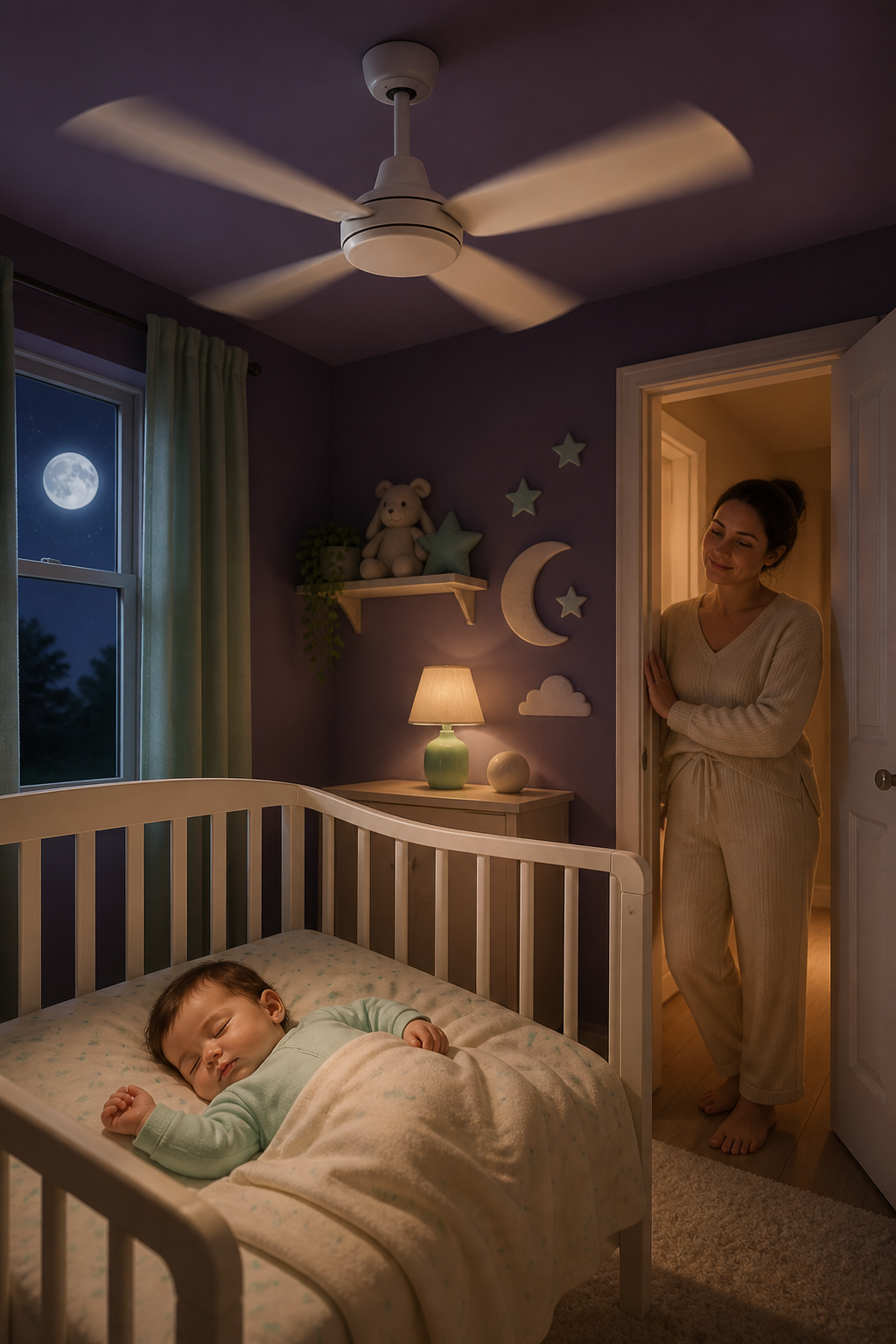
The answer I would want at 2 a.m.
I would leave a sound, properly mounted ceiling fan on if the room felt more comfortable with it. I would use a low or moderate speed, keep my baby on their back in an empty crib or bassinet with a firm, flat, safety-approved mattress and fitted sheet, and make sure the fan was not wobbling, clicking, loose, or subject to a recall. I would not point to the fan as protection from SIDS. The American Academy of Pediatrics reviewed the often-repeated fan study and concluded that the evidence is not strong enough to recommend a fan as a SIDS-risk-reduction strategy.
The practical question is not “Is air moving?” It is “Is the whole sleep setup safe, mechanically sound, and comfortable for this baby?” A fan can help with the comfort part. It cannot repair an unsafe sleep surface, remove loose bedding, place a baby on their back, or replace adult judgment during extreme heat.
SleepBaby.org · The original video
A little help
for the night ahead.
Take a moment to watch the original Baby Sleep Miracle presentation. Your article will be right here when you’re ready to keep reading.
Ready to get started?Take the next step with SleepBaby.
Help my baby sleep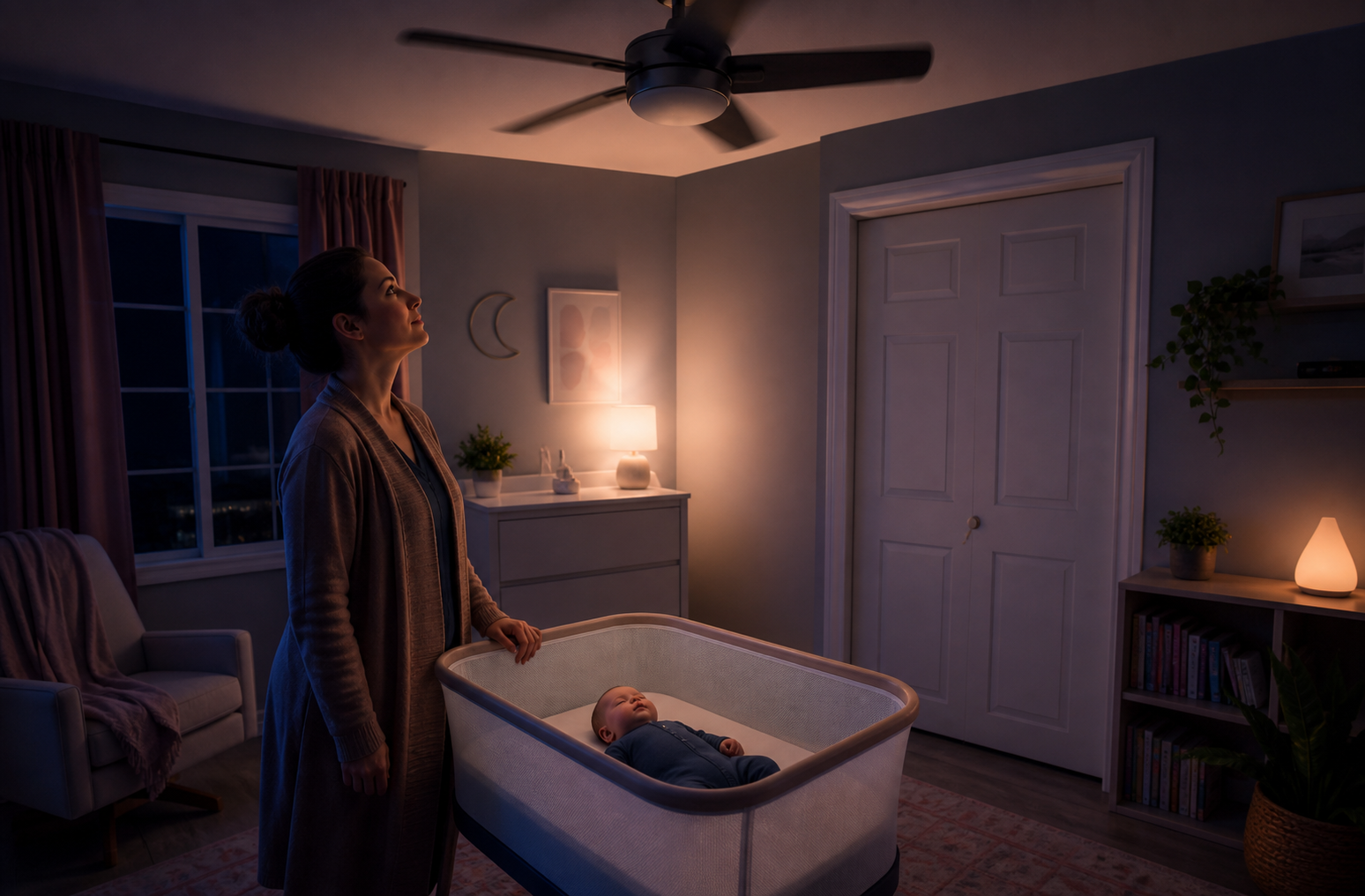
What matters more than the fan
I know why the fan question becomes magnetic. It is visible, it moves, and it feels like a switch you can control. Safe sleep is less visually dramatic. It is a collection of plain decisions repeated at every nap and every night. Those plain decisions carry the evidence.
- Back: place your baby on their back for every sleep unless your baby’s clinician has given you specific medical instructions.
- Surface: use a firm, flat, non-inclined mattress in a safety-approved crib, bassinet, portable crib, or play yard.
- Space: keep the sleep area empty except for the fitted sheet—no pillows, blankets, bumpers, toys, positioners, wedges, or weighted items.
- Room, not bed: keep the baby’s sleep space in your room when feasible, ideally for at least the first six months, without sharing the adult bed.
- Temperature: avoid overheating and head covering. Dress for the room rather than adding loose bedding.
If all five are right, the fan becomes a secondary comfort decision. If one is wrong, changing the fan speed is not the repair. That distinction is the center of this guide.
Does a ceiling fan reduce SIDS risk?
I would not tell a parent that it does. One observational study reported lower odds of SIDS in rooms where a fan was used. That finding is why the idea appears in parenting discussions. But an association in one study is not proof that the fan caused the difference.
The AAP’s evidence review points to several limits: possible recall bias, a small number of control families who used fans, little detail about the fans and their placement, and an uncertain biological mechanism. Its conclusion is direct: the available evidence does not support recommending a fan as a SIDS-risk-reduction strategy.
That is not the same as saying a fan is forbidden. It means we should keep the claim proportional. A fan may make a room feel more comfortable and circulate air. It should not be marketed in our minds as protective equipment. The meaningful SIDS-risk-reduction actions remain the established safe-sleep recommendations, including back sleeping, a firm flat empty surface, smoke-free care, room-sharing without bed-sharing, breastfeeding when possible, routine health care and immunizations, and offering a pacifier at sleep time when appropriate.
How cool should the room be?
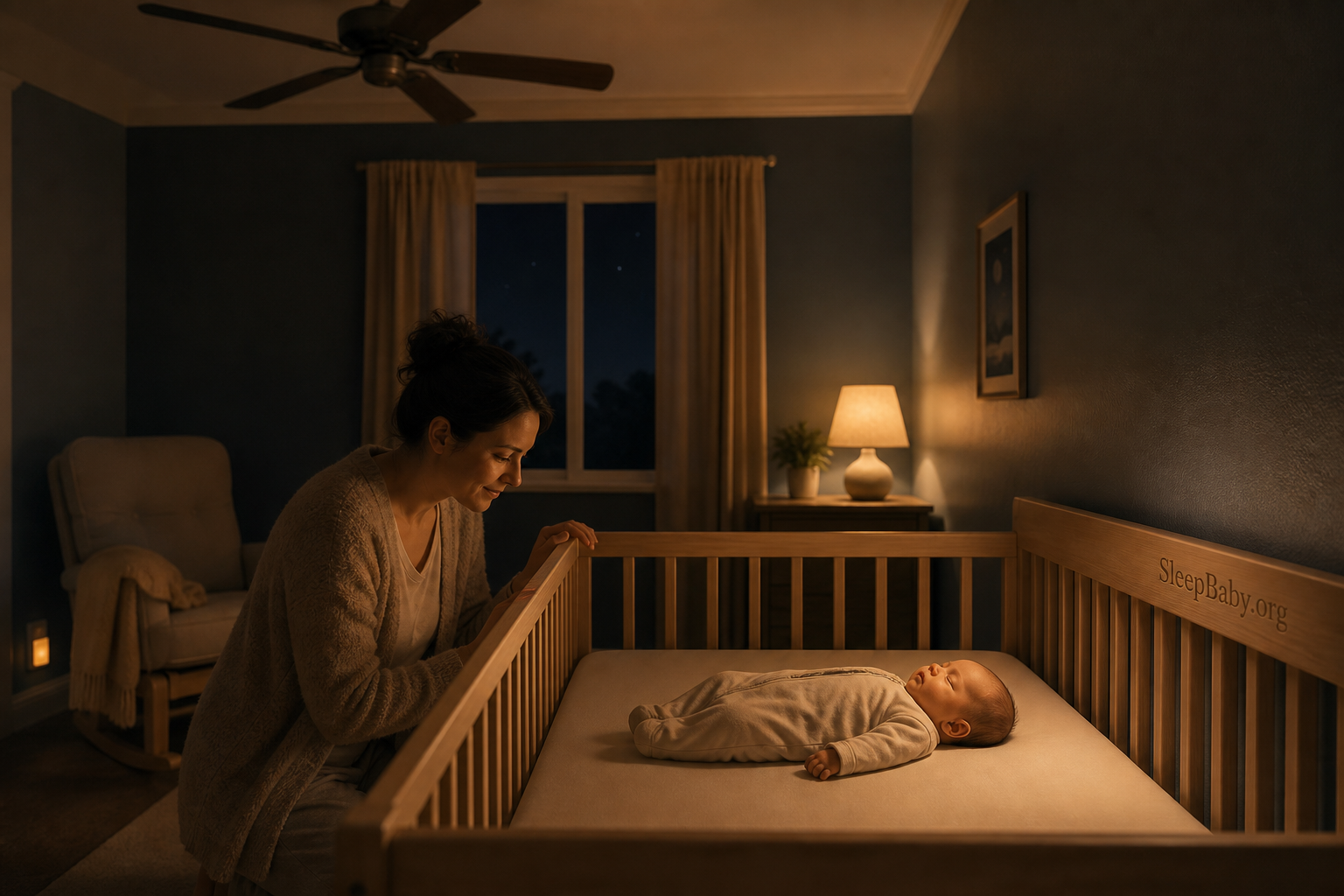
There is no single temperature number that works for every home, climate, baby, sleep sack, and ventilation pattern. The AAP does not give one universal thermostat target in its safe-sleep evidence base because studies have defined overheating in different ways. I would resist turning a number from a nursery graphic into a medical boundary.
Instead, use three kinds of information together:
- The room: check an independent room reading, not the thermostat in a distant hallway. Notice whether sunlight, a closed door, or a warm upper floor changes the nursery overnight.
- The clothing: choose light, fitted sleep clothing suitable for the room. Avoid hats indoors during sleep and do not add loose blankets.
- The baby: check the chest or back of the neck rather than hands and feet, which often feel cooler. Sweating or a hot chest can be signs that a baby is too warm.
A ceiling fan changes how air feels on skin, but it may not change the room’s measured temperature much. That is why “the fan is on” is not enough information. If your baby feels comfortably warm—not hot or sweaty—and is dressed appropriately on a safe surface, you do not need to manufacture a perfect number.
If the room is dangerously hot, a fan is not a substitute for effective cooling or a safer location. During extreme heat, follow local public-health guidance, use air conditioning or a designated cooling location when available, keep feeds appropriate, and seek medical advice promptly if your baby seems unwell. Young infants can become ill quickly, and this article is not a heat-illness triage tool.
Should the fan blow directly on the crib?
A ceiling fan does not create the same concentrated stream as a small fan clipped beside the crib, but the crib can still sit beneath a noticeable draft. I prefer gentle room circulation over a strong blast aimed at one sleeping spot. If papers flutter, the fitted sheet lifts, or your baby’s skin and clothing feel chilled while the rest of the room feels warm, lower the speed or reconsider the crib’s location.
Do not move a crib into a less safe location just to escape airflow. Keep it away from windows, blind cords, curtain cords, electrical cords, heaters, and anything a growing baby could reach. The right answer may be a lower fan speed, a different seasonal rotation, or an installer’s adjustment—not crowding the crib into a hazard.
Fan direction changes how air circulates, but direction labels are not infant-safety standards. Ceiling heights, blade pitch, room shape, vents, and fan models vary. Use the setting that produces comfortable, gentle circulation in your actual room.
Hypothetical Kacey-and-Benjamin scene—not evidence
The night I would stop negotiating with the fan
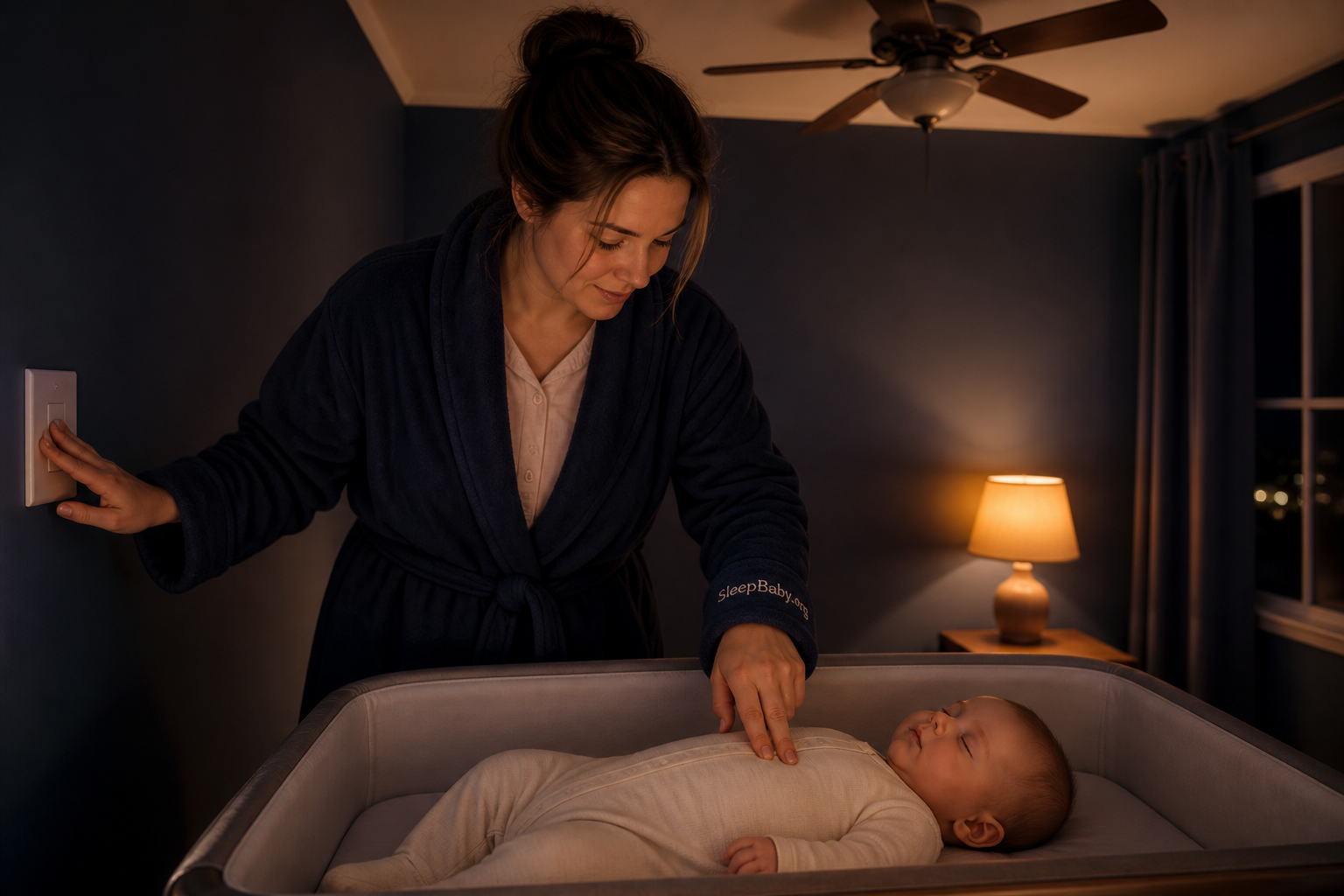
If I picture Benjamin asleep beside me on a muggy night, I can feel the familiar urge to keep adjusting things: fan low, fan medium, one layer, two layers, door open, door closed. In that hypothetical scene, I know I could spend half an hour treating each tiny change like a verdict on whether I am a careful mother.
I would want to interrupt myself. I would put my hand on his chest, look at the empty bassinet, confirm that he was on his back and comfortably dressed, and listen once for the fan’s steady sound. If the setup passed, I would let the room be ordinary. The fan would not be a promise. It would just be a fan doing a modest job.
That is the emotional skill hidden inside this question: learning which uncertainties require action and which can be held without another adjustment. I cannot make sleep risk-free. I can make the environment evidence-aligned, notice meaningful changes, and refuse to let a secondary detail displace the foundation.
Before you run the fan overnight, check the fan itself
Most ceiling-fan conversations focus on temperature and skip the object rotating overhead. I would not. The Consumer Product Safety Commission maintains ceiling-fan recall information, and product-specific failures can include blades or components separating. A recent recall is not proof that all fans are dangerous; it is a reminder that mechanical condition and exact model matter.
Stop and inspect if you notice
- new wobbling, scraping, grinding, clicking, or vibration;
- a visibly loose blade, cracked blade arm, drooping part, or loose canopy;
- a light kit or cover that shifts when the fan runs;
- burning odor, flickering, heat at a switch, or repeated electrical trips;
- a model that appears in a CPSC or manufacturer recall.
Use a qualified person when needed
Ceiling-fan mounting and electrical repair are not good places to improvise while sleep-deprived. If you cannot verify secure mounting to an appropriate fan-rated support, correct hardware, safe clearance, and sound wiring, use a qualified installer or electrician. Turn the fan off until the concern is resolved.
Keep the remote and any batteries out of reach. Button batteries are a serious ingestion hazard. Do not store a remote on the crib rail or a nearby surface your baby will soon reach. As mobility changes, repeat the room scan; yesterday’s unreachable object can become tomorrow’s target.
What about fan noise and sleep habits?
A steady fan hum may mask intermittent household sounds, and some families find it soothing. That does not mean your baby needs noise to sleep or that louder is better. Ceiling fans are not calibrated sound machines. If the motor is loud enough that you must raise your voice nearby, first ask whether the noise reflects a mechanical problem.
I would not chase silence or dependence anxiety. Babies learn sleep in varied environments, and a familiar hum can be one ordinary cue among many. The more durable cues are the sequence you control: feed as appropriate, dim the room, change the diaper, put on fitted sleep clothing, offer a calm phrase, and place the baby down safely. If the power goes out or you travel, the routine still exists even when the hum does not.
How the answer changes as your baby grows
Newborn and young infant
Keep the decision simple. Prioritize room-sharing, a bassinet or crib that meets current safety requirements, back placement, and minimal fitted clothing. Newborn hands and feet can feel cool even when the torso is comfortable. Use the chest check rather than adding bedding reflexively.
Rolling baby
Continue placing your baby on their back. If they can roll both ways independently, you do not need to keep turning them back, but the crib must remain empty. Stop swaddling when your baby shows signs of trying to roll, following product and pediatric guidance. The fan does not change those rules.
Pulling-to-stand baby
Lower the crib mattress according to the crib instructions and remove anything within reach, including dangling chains, remote holders, cords, wall decor, and monitor cables. A ceiling fan may be far overhead, but its controls and accessories may not be.
Toddler transition
Once your child moves beyond infant safe-sleep recommendations, room setup still matters. Fan stability, electrical safety, remote batteries, and access to switches remain practical hazards. Revisit the room instead of assuming the infant setup automatically fits a climbing toddler.
Troubleshooting the nights when the fan still feels wrong
The room reading looks comfortable, but my baby feels hot
Trust the baby-specific observation enough to investigate it. A room sensor reports the air near the sensor; it does not measure your baby, the warmth inside sleep clothing, fever, or a pocket of still air beside a wall. Check the chest, remove an unnecessary layer, and reassess. If your baby has a fever or seems ill, contact the clinician. Do not keep increasing fan speed as a substitute for evaluating symptoms.
The room reading looks warm, but my baby seems comfortable
Check where the sensor sits and whether sunlight, a vent, electronics, or an exterior wall is distorting it. Move it only to a secure, representative place outside the crib and out of reach. Look at the trend rather than reacting to one flicker. I would make a modest adjustment and observe again; I would not strip a baby down, add a device to the crib, or create a strong draft because one display crossed an internet number.
The fan is steady on low but wobbles on high
That is a mechanical question, not a sleep-training question. Stop using the speed that produces wobble and arrange an inspection. Do not assume wobble is normal because the fan has done it for years. Loose hardware, blade imbalance, an unsuitable electrical box, or wear can require correction. A nursery is not the place to accept an overhead component you do not trust.
The fan makes the baby wake more often
Test the simplest explanation without turning the night into an experiment. Use a gentler setting for several comparable sleeps while keeping feeding, clothing, light, and routine reasonably stable. If waking improves, you have learned something useful about comfort or noise. If it does not, return to broader causes—hunger, developmental change, schedule, illness, or ordinary infant variability. A ceiling fan is rarely the master explanation for every wake.
The power goes out and the room warms quickly
Have a plan that does not depend on one appliance. Know the coolest safe room or location available, keep appropriate lightweight sleep clothing accessible, and follow local emergency guidance. Never bring a fuel-burning generator, grill, or similar device indoors or near openings because carbon monoxide can be deadly. If indoor heat becomes dangerous or your baby develops concerning symptoms, move to effective cooling and seek help.
Grandparents insist the fan will “give the baby a chill”
I would make the conversation concrete: we are not using a powerful draft, we are dressing the baby for the room, and we are checking the torso rather than guessing from hands. Then I would show them the safe-sleep setup. Shared rules matter more than winning the fan argument. Write down the setting you use and the signs that mean “lower it,” “add or remove one fitted layer,” or “call us.”
This troubleshooting approach keeps the fan in its proper role. Observe the room, observe the baby, change one variable, and reassess. When the evidence points beyond comfort—a mechanical defect, illness sign, unsafe surface, or extreme temperature—leave the fan question behind and address the real problem.
As an Amazon Associate, SleepBaby may earn from qualifying purchases.
My useful add-on: measure the room instead of guessing from the breeze
For this exact question, I would choose the Govee H5075 Bluetooth Thermometer Hygrometer. It gives you a separate room-temperature and humidity reading and keeps a history in its app, so you can see whether the nursery actually changes overnight instead of treating fan speed as a temperature reading.
It fits better than buying a stronger fan because the parent’s unmet job is information, not more airflow. It also fits better than a wearable sensor for this use: the H5075 stays outside the sleep space and observes the room rather than adding something to the baby. Place it securely out of reach, never inside or attached to the crib, and treat its reading as context—not a diagnosis or a guarantee of safe sleep.
See the Govee H5075 Bluetooth Thermometer Hygrometer on Amazon
A decision tool for tonight
| What you find | What I would do |
|---|---|
| Fan is stable and quiet; room and baby feel comfortable | Leave it on at a gentle setting if you prefer. |
| Baby’s chest feels hot or baby is sweating | Remove a layer or lower the room heat, reassess, and contact the clinician if symptoms concern you. |
| Baby feels chilled while airflow is strong | Lower the speed or redirect circulation; do not add loose bedding. |
| Fan wobbles, clicks, smells hot, or has a loose part | Turn it off and arrange inspection or repair. |
| Exact model is recalled | Stop using it and follow the CPSC/manufacturer remedy. |
| Room remains dangerously hot | Use effective cooling or a cooler safe location; do not rely on the fan alone. |
| Sleep surface is soft, inclined, shared, or cluttered | Fix the sleep surface immediately; fan settings are secondary. |
Ceiling fan and baby sleep FAQ
Can a newborn sleep under a ceiling fan?
Generally, yes, when the fan is securely installed and operating normally and the room remains comfortable. Use gentle circulation, appropriate fitted clothing, and the full safe-sleep setup. Do not treat the fan as SIDS protection.
Can a ceiling fan make my baby sick?
A fan does not cause viral illness. Strong airflow can feel uncomfortable or cool skin, and a dirty fan can move settled dust, so clean it safely with power off and follow the manufacturer’s instructions. Persistent cough, breathing trouble, fever, feeding changes, or illness symptoms deserve clinical guidance rather than a fan theory.
Should I use a fan if my baby is congested?
A fan is not a treatment for congestion. Gentle circulation may make the room feel less stuffy, but avoid a strong draft and contact your baby’s clinician for breathing or feeding concerns. Seek urgent care for struggling breaths, ribs pulling in, blue or gray color, pauses in breathing, or difficulty waking.
Do I need a humidifier with a ceiling fan?
Not automatically. Measure the room and respond to an actual need. Humidifiers require meticulous cleaning and safe placement, and excessive humidity can support mold or dust mites. Ask your clinician if you are using one for symptoms.
Is low speed always best?
No universal speed fits every fan and room. Choose the lowest setting that creates comfortable circulation, then assess the room, clothing, and baby. Mechanical stability matters at every speed.
Should I leave the fan on all night?
You can if it is sound, unrecalled, securely installed, and comfortable. You can also turn it off. Safe sleep does not depend on keeping a fan running.
Watch the safe-sleep foundation
Build the crib before debating the breeze
This official CDC safe-sleep guidance shows the parts of the environment that carry the evidence. Use the fan only after this foundation is settled.
Takeaway: back, firm and flat, fitted sheet only, empty space, room-sharing—not fan speed—are the safe-sleep essentials.
Sources
- American Academy of Pediatrics: 2022 safe-sleep recommendations and evidence base
- CDC: Providing care for babies to sleep safely
- CDC: Helping babies sleep safely
- CPSC: Ceiling-fan recalls and product-safety information
- HealthyChildren.org: Protecting children from extreme heat
- Govee: H5075 Bluetooth hygrometer thermometer specifications
SleepBaby.org · The original video
A next step for
the next bedtime.
Still thinking about sleep? Watch the presentation here, then explore the SleepBaby program whenever you’re ready.
Ready to get started?Take the next step with SleepBaby.
Help my baby sleep