The wall is dry enough that the painter’s tape comes away cleanly. The nursery still has that unmistakable new-room smell, though, and the crib is sitting there looking completely ready for a baby who is currently asleep somewhere else. This is the exact moment when a parent starts wondering whether “dry” and “safe to sleep in” are secretly the same thing.
They are not. Do not put your baby back to sleep in a freshly painted room simply because the wall feels dry or the smell seems lighter. Keep your baby in a separate, approved sleep space while you exhaust the painted room’s air outdoors. Follow the exact paint or coating label, and treat the EPA and CPSC’s two-to-three days of strong continued ventilation as a practical floor for ordinary interior painting—not a universal clearance certificate.
I would wait longer if the label requires it, the room ventilates poorly, the odor or irritation continues, or an oil-based, alkyd, solvent-rich, or specialty coating was used. And if old paint was sanded, scraped, or demolished in a pre-1978 home, I would stop treating this as a simple fresh-paint question. Possible lead dust is a separate hazard that an open window cannot clear.
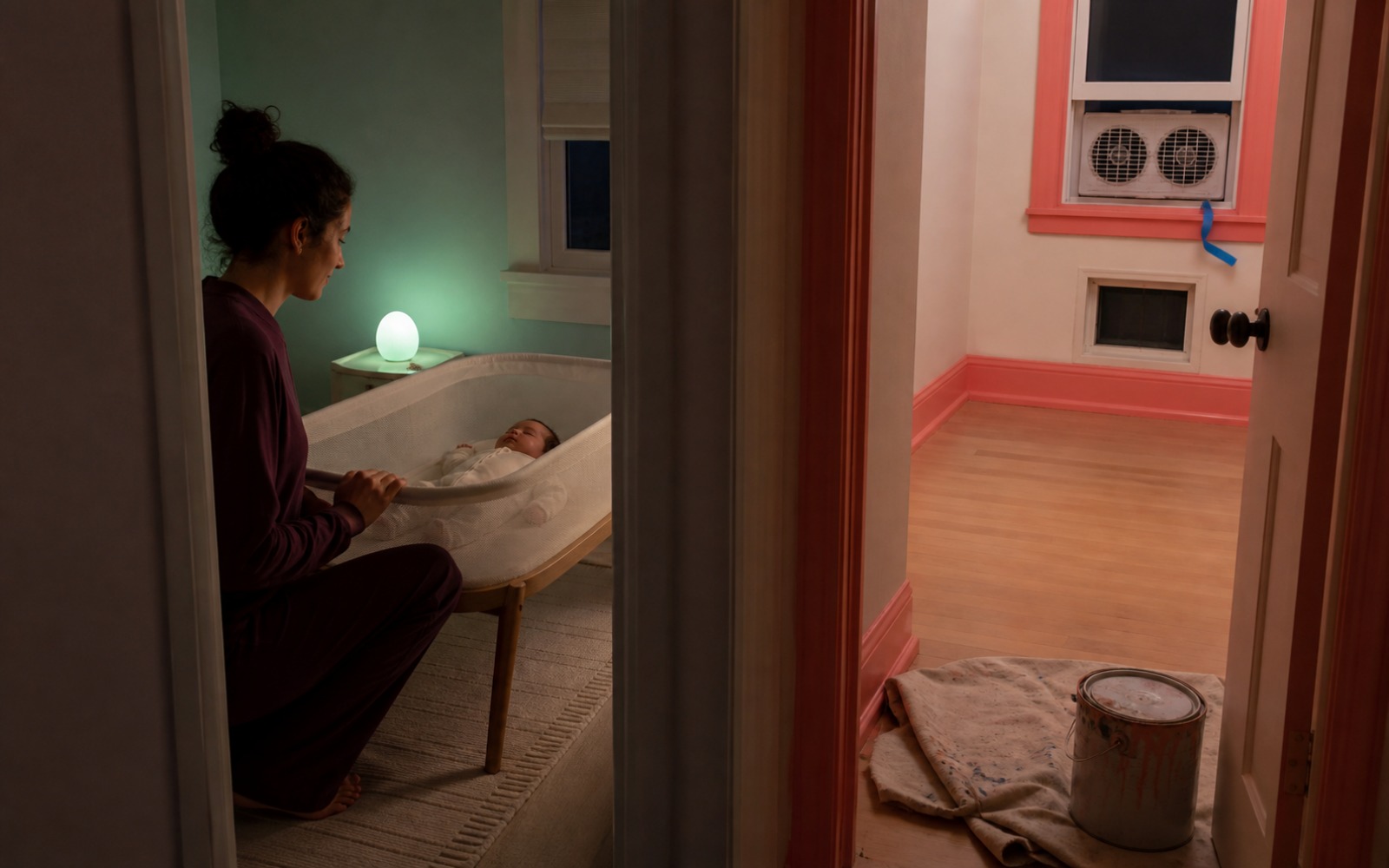
A dry wall is not the same as a ready room
Paint has several clocks, and they answer different questions. “Dry to the touch” usually tells you whether the surface can be handled without smearing. A recoat time tells you when another coat may go on. Full cure describes the coating reaching its intended hardness or performance. None of those phrases, by itself, is an infant air-quality clearance measurement.
The product also matters. Water-based or latex interior paint generally produces fewer and less intense vapors than oil-based or alkyd paint, but lower is not zero. “Low VOC” and “zero VOC” can be useful product-selection clues; they are not permission slips to put a baby back in a closed room while the paint is fresh. Colorants and other ingredients can change emissions, and the label remains the first product-specific instruction I would read.
I would be more conservative with oil-based, alkyd, solvent-rich, floor, cabinet, lacquer, epoxy, stain, sealer, or specialty products. If an exterior product was used indoors, or if the container cannot be identified, I would not invent a wait time from a blog post. I would contact the manufacturer or Poison Control with the exact product name and exposure details.
Three clocks, three different jobs
Do not ask a surface clock to answer an air question
Touch-dry
The surface can feel dry while vapors are still being released.
Recoat or cure
These times describe coating performance, not a baby-specific return threshold.
Return decision
Use the label, outdoor exhaust, elapsed ventilation time, room conditions, dust history, and symptoms together.
Sleep connection: the bedtime plan moves temporarily; it does not become less safe because the usual nursery is unavailable.
Created for SleepBaby.org
Use four gates instead of one timer
A universal “wait exactly 48 hours” answer is attractive because it turns a messy household decision into one number. The problem is that the number cannot see your paint can, the room’s airflow, the weather, the old surface underneath, or the person who develops a headache when the door opens. I trust a gate more than a countdown here.
The Painted-Room Return Gate
Four yeses before the first nap back
1. PRODUCT
I know the exact product, it was intended for indoor use, and I have followed its label.
No: unknown can, exterior coating indoors, specialty solvent product without clear instructions, or label time still running.
2. AIR
The room has had strong outward ventilation, not merely a closed door or ordinary recirculating air conditioning.
No: sealed windows, stagnant corners, continued strong odor or irritation, or a fan moving air deeper into the home.
3. DUST
No unresolved renovation dust, peeling old coating, sanding debris, or pre-1978 lead concern remains.
No: old paint was scraped or sanded and lead-safe containment, cleaning, or verification is incomplete.
4. BABY
My baby has a safe alternate sleep space until the first three gates pass, and nobody is having exposure symptoms.
No: the only backup is a swing, bouncer, sofa, adult bed, or other improvised surface—or someone feels unwell in the room.
The rule: one “no” keeps the nursery out of tonight’s sleep plan. It does not mean the room is ruined. It means the unanswered question still has a name.
Created for SleepBaby.org

What changes the clock after painting?
The two‑to‑three‑day ventilation guidance is a useful planning floor for ordinary indoor painting because it gives fresh air time to do actual work. I would begin that clock only when the room is receiving strong ventilation to the outdoors—not when the final brushstroke dries inside a closed room.
Then I would adjust for the room in front of me. A small interior nursery with one barely opening window behaves differently from a room with cross-ventilation. Humid, cold, or still weather can slow drying and make open-window ventilation harder. Multiple coats, painted closets, cabinetry, floors, or other coated surfaces add more material. Oil-based and solvent-rich products deserve stricter attention to their labels and manufacturer directions.
A qualitative timing map
What would make me wait longer?
| What I find | What it changes | My next move |
|---|---|---|
| Ordinary water-based interior wall paint, good exhaust, label followed | The EPA/CPSC two‑to‑three‑day ventilation floor may fit the practical plan. | Keep ventilating, then check all four gates rather than ending at the timer. |
| Oil, alkyd, solvent, stain, sealer, epoxy, floor, cabinet, or specialty coating | Vapors and label restrictions may differ substantially. | Use the exact label and manufacturer guidance; do not borrow a latex‑wall‑paint clock. |
| Poor airflow, closed window, high humidity, cold weather, or several coated surfaces | The room may need more ventilation time and a better exhaust path. | Keep the alternate sleep setup and improve outdoor exhaust safely. |
| Persistent odor, eye or airway irritation, headache, dizziness, nausea, or breathing symptoms | The room has not passed the BABY gate, regardless of the calendar. | Move to fresh air and use Poison Control, a clinician, or emergency care as the symptoms require. |
This is a decision aid, not a measured exposure chart or clearance standard. Created for SleepBaby.org.

For airflow, I want a real direction: room air goes outside. A fan pointed into the room may stir or redistribute air without exhausting it. A central air conditioner may cool the house while recirculating the same indoor air. EPA guidance also warns against letting return vents pull work-area air through the home. This is not the moment for an improvised HVAC experiment; isolate the work area and use safe outdoor exhaust that fits the home.
Weather and window safety still count. Secure any fan so it cannot fall. Keep cords and moving parts inaccessible. Protect the opening from a child. If rain, outdoor smoke, extreme heat, or another condition makes open-window ventilation unsafe, keep the baby elsewhere and ask the product manufacturer or a qualified indoor-air or building professional how to ventilate that room appropriately.
Give the air a route
“Window open” and “air moving outside” are not always the same setup
- Choose the exhaust opening. Place and secure the fan so it blows painted-room air outdoors, following the fan and window instructions. A curtain fluttering toward the crib is movement; it is not proof of outward exhaust.
- Provide cleaner replacement air. When weather and outdoor air quality allow, another open window or a controlled opening to a cleaner area lets fresh air replace what the exhaust fan removes. Keep the work area separated enough that fumes are not simply pushed into bedrooms, halls, or the HVAC return.
- Keep the route working. Painted closets, shelves, or cabinets may need their own label-directed ventilation. Do not block the exhaust with furniture or fabric, and do not leave a fan, cord, open window, tool, or paint supply accessible to a child.
I would sketch this path with one finger before I trusted it: cleaner air enters, crosses the painted surfaces, and leaves through the fan. If I cannot tell where the air is coming from or where it is going, I do not count the room as well ventilated yet.
The baby remains in the alternate approved sleep space for the entire ventilation period. Created for SleepBaby.org.

The smell can inform you, but it cannot clear the room
A strong paint smell is a good reason to stay out and keep ventilating. A faint smell does not prove the opposite. People perceive odors differently, some compounds have little odor, and fragrance or an open container of something else can change what a room smells like without answering what remains in the air.
Odor is not the control
What helps, what may supplement, and what can mislead
- Primary control: source reduction and outdoor exhaust
- Choose an appropriate interior product, follow the label, keep people away during the work, and move room air outdoors.
- Possible supplement: a suitable air cleaner
- A correctly selected unit may supplement a plan, but it does not replace outdoor exhaust or establish a baby-specific return threshold.
- Not clearance: vinegar, baking soda, charcoal bowls, fragrance, or an odor absorber
- A changed smell is not proof that the room has passed the product, air, dust, and baby gates.
- Not certification: a consumer VOC monitor
- A consumer reading can provide limited information, but it does not create an infant exposure standard or certify safe re-entry.
I understand the appeal of a bowl that promises to absorb the problem while everyone goes to bed. It is a wonderfully tidy household plot. The air, unfortunately, has not agreed to that plot. I would rather keep the baby elsewhere and use the boring controls that have a clear job.
Where should your baby sleep while you wait?
The alternate room does not need to become a miniature version of the nursery. It needs one approved infant sleep surface and enough room for the caregiver to use it correctly. A crib, bassinet, or portable play yard that meets applicable safety standards can work. Place your baby on their back on a firm, flat, level surface with only a fitted sheet.
Do not let a painting project quietly turn a swing, bouncer, stroller, car seat outside travel, sofa, recliner, or adult bed into the overnight plan. The inconvenience is real. The safe-sleep boundary does not become negotiable because the nursery is unavailable.
The room you can use tonight
Move the sleep setup, not the safety rules
- Approved crib, bassinet, or portable play yard assembled according to its instructions.
- Firm, flat, level mattress or pad intended for that product, with its fitted sheet only.
- Baby placed on the back for every sleep; the space stays empty of pillows, blankets, bumpers, positioners, and toys.
- Smoke-free air, a comfortable temperature, and cords, fans, heaters, and renovation materials kept inaccessible.
- A familiar short bedtime cue—feeding as needed, pajamas, a song, a phrase—without trying to recreate every decorative object.
If temporary room sharing raises a new set of practical questions, this guide can help you set up a separate infant sleep space in the caregiver’s room. Room sharing means a separate baby sleep surface, not sharing the adult mattress.
I would also tell myself something easy to forget while the house is rearranged: a few nights in a different safe room do not erase a bedtime routine. The routine lives partly in sequence and response, not in one wall color. Keep the parts your baby recognizes and let the crib location be temporarily boring.
Old paint dust is a different problem
If the work involved sanding, scraping, cutting, drilling, demolition, or repairing painted surfaces in a home built before 1978, fresh-paint ventilation is only one part of the picture. Older paint may contain lead. Disturbing it can create contaminated chips and fine dust that settle on floors, window troughs, trim, furniture, toys, clothing, and hands.
Lead dust does not become safe because the new topcoat dried or the room smells fine. Keep children and pregnant people away from the work area. Use an EPA-certified lead-safe professional when the work falls under those requirements, and follow lead-safe containment, cleaning, and verification practices. If exposure may have occurred, contact your child’s clinician; a blood lead test is the way to determine a child’s blood lead level.

Watch the hazard split happen
Why old-paint dust changes the whole return plan
EPA references this Hometime TV lead-safe remodeling video to show how containment and cleanup differ from simply airing out a freshly painted room. The written guidance above remains the safety instruction; the video is a visual supplement.
SleepBaby takeaway: contain the work, keep children out, clean with lead-safe methods, and verify the dust problem. Ventilation alone is not lead clearance.
Creator: Hometime TV · Watch on YouTube

What symptoms would make me stop guessing?
If anyone develops eye watering, nose or throat irritation, headache, dizziness, nausea, coughing, or breathing discomfort in or after being in the painted room, move them to fresh air and stop the exposure. Do not use the absence of symptoms in one adult as proof that a baby should sleep there.
Commerce-free safety lane
Fresh air first; then match the help to the symptom
- Exposure question or mild symptoms: contact Poison Control at 1-800-222-1222 in the United States or use webPOISONCONTROL. Have the paint container or product name available.
- Persistent symptoms or concern about your baby: call your pediatric clinician and explain the product, timing, room conditions, and symptoms.
- Severe breathing trouble, collapse, seizure, or a person who is difficult to wake: call emergency services now.
- Possible lead-dust exposure: contact the child’s clinician; do not wait for symptoms, because lead exposure may not look obvious.
This is where my editorial judgment becomes very simple: I would rather make one cautious phone call with the paint label in hand than keep converting the nursery door into a home toxicology experiment. You are not required to prove the room is dangerous before asking an exposure question.
Make the outdoor-exhaust step easier—not more magical
The most useful equipment in this article has one plain job: help room air move outside while your baby sleeps somewhere else. It does not decide when the baby returns. The label, ventilation history, dust history, room conditions, and symptoms still make that decision together.
A practical outward-airflow tool
Air King 9166F 20-Inch Whole House Window Fan
EPA and CPSC painting guidance specifically points to a box or window fan blowing room air outdoors. That makes a window-mounted exhaust fan a stronger fit here than an odor absorber, a consumer VOC monitor, another crib product, or an air purifier presented as a substitute for source control.
If your window fits the manufacturer’s installation requirements and the unit can be secured with its cord inaccessible, this fan can turn “keep ventilating” into a stable, repeatable setup instead of asking a loose floor fan to balance near an open nursery window. That exact practicality is why I would consider it for this job.
Use boundary: your baby sleeps elsewhere while the fan operates. Follow the manufacturer’s installation and operating instructions. A fan does not certify the air, remove lead or asbestos dust, replace the coating label, shorten a required wait, or guarantee a safe return time.
See the Air King 9166F window fan on Amazon
As an Amazon Associate, SleepBaby may earn from qualifying purchases.
Before the first nap back
Once the room looks finished, the urge is to move everything back in and declare the project over. I would do the opposite: make the first return deliberately uneventful. Let the room prove that its basic conditions are stable before adding decorative layers or leaving your baby there for a long overnight stretch.
-
Read the exact label one more time.
Confirm the product, indoor use, ventilation instructions, and any occupancy or cure restrictions. A photo of the label is useful if the can is being stored. -
Confirm the air path.
The room has received sustained outdoor exhaust, not just cooling or an open door. No one experiences irritation when entering. -
Close the dust question.
Floors, trim, sills, furniture, toys, and textiles are clean. Any pre-1978 disturbance has been handled through the correct lead-safe path. -
Rebuild only the safe sleep space.
Firm, flat, level surface; fitted sheet; nothing else in the crib. Keep fan cords, monitor cords, paint supplies, tools, and window hazards inaccessible. -
Keep the backup available.
If the room still smells strong, someone feels unwell, the label is unclear, or a gate reopens, move sleep back to the alternate approved space without treating that as a failure.


The doorway looks different once you have a gate
At the beginning, the nursery doorway held one giant question: Is it safe yet? By the end, I want that question broken into pieces you can actually answer. You know the product. You know where the air went. You know whether old dust belongs in the story. You know where your baby can sleep until those answers line up.
The painted wall may still look exactly as it did when you first stood there with the tape curling under the window. What changed is that “dry” no longer has to carry a job it cannot do. The room returns to bedtime only after the product, air, dust, and baby gates agree. Until then, closing that door and using the safe room you already prepared is not overreacting. It is the plan.
Sources
- U.S. EPA: Addressing Indoor Environmental Concerns During Remodeling
- U.S. EPA: Volatile Organic Compounds’ Impact on Indoor Air Quality
- U.S. EPA and CPSC: Healthy Indoor Painting Practices
- Poison Control: Paints for Indoor Use—When Should I Be Worried?
- CDC: About Lead in Paint
- American Academy of Pediatrics / HealthyChildren.org: Keeping Kids Safe During Home Renovations
- ATSDR: In the Baby’s Room
- NIH Safe to Sleep: Ways to Reduce Baby’s Risk
- U.S. EPA: Lead-Safe Renovations for DIYers
- U.S. EPA: Steps to Lead Safe Renovation, Repair and Painting
When the nursery door is still closed
Make the room you can use feel like bedtime
SleepBaby helps you keep the rest of the night recognizable while the usual room is unavailable—one safe sleep space, one familiar sequence, and fewer decisions made in a hallway that smells faintly like eggshell white. The nursery can wait for its gates. Bedtime still gets a plan.
SleepBaby does not test indoor air, clear renovation hazards, or replace paint-label, Poison Control, clinician, or lead-safe guidance.





What viewers said10 comments · 4 replies+
Archived comments from the original Baby Sleep Miracle presentation. Not independently verified by SleepBaby.org; individual experiences vary.
Thank you so much for this video! I had no idea about the dangers of baby swings :O
Hi Mary-Ann. I have a question: Is method in any way similar to the ones recommended by Dr Bucknam, Dr. Weissbluth or Dr. Karp? We tried those but none of them help.
Hi Regina, thank you for your question. The short answer is no. The techniques I share in my guide are based on newest scientific research and this is why I have never seen any approach similar to the one I recommend.
This method really works! I tried it on my son Jesus and after just one week he went from waking up more than 5 times a night to waking up just once or twice. You are a lifesaver, Mary-Ann!
I'm truly impressed with how much information you share in your video. And all for free! I can feel that you truly care about mothers like myself, and that's hard to find these days. I have recommended your site to several of my friends already.
Mary-Ann, our child suffers from autism. Is your approach still suited?
Chloe, I made sure my method can be used with any child, even babies who are special like yours. Please note that I'm not a doctor and that I always advice to consult with your physician because nothing is more important than the safety and well-being of your love.
Hallo Mary-Ann, I'm from Germany. Do you have your guide in German?
Hello Heide, we do! Normally you should already see our video in German. If not, please contact our support so they can guide you
Thenk you for your answer, Mary-Ann!
I just completed your approach and I have to say, it worked almost too well. Yes, it took a bit of getting used to with your bedtime routine but the difference is huge. My son George used to take 1 hours to go down and now he's firmly asleep in no more than 10 minutes! You're the best!
It seems I'm the only man watching this video, lol! What you shared about the 'emotional backpack' made immediate sense to me and I can't wait to help my little girl Mila to unpack it!
Hey there, just discovered your site and this really sounds different. Just wanted to say thanks for sharing :)
For everyone who's still thinking about getting Mary-Ann's guide I want to advise you to go ahead. I wasn't sure myself but now I'm so thankful I invested in this program. It made a huge difference in our life as a family and yes, my baby girl does sleep through the night now.