
The answer for the third unexpected wake
An 8-month sleep regression can look very real, but it is not a diagnosis or a guaranteed stage every baby follows. Around 8 to 10 months, sleep may wobble while separation protest, sitting or pulling to stand, changing nap pressure, illness, discomfort, feeding needs, and settling habits overlap. The useful move is not to blame one developmental “leap” or rebuild the whole schedule overnight. Keep sleep safe, identify exactly what changed, rule out body and feeding concerns, choose the strongest clue, and test one small adjustment for several days.
Call for urgent medical guidance if your baby has trouble breathing, blue or gray color, unusual difficulty waking, signs of dehydration, repeated vomiting, severe or persistent pain, seizure-like activity, a serious injury, or looks very ill. Contact the pediatric clinician for fever, poor intake, new loud snoring or breathing pauses, persistent ear-pain clues, loss of a skill, or a sleep change that feels medically different from your baby’s usual rough night.
The search often starts with a monitor glow and a strange piece of arithmetic: this baby slept a usable stretch last week, so how are we awake again? Maybe bedtime now ends in a protest. Maybe the first wake arrives before you have put away the dinner dishes. Maybe naps have become thirty-minute negotiations and the crib is apparently a midnight standing-practice studio.
I would take the word regression lightly and the change itself seriously. “Regression” can make it sound as if your baby has lost sleep knowledge. More often, the old arrangement is meeting a newly complicated baby: one who notices departures, moves differently, tolerates different stretches awake, or needs a response that no longer fits the newborn version of the night.
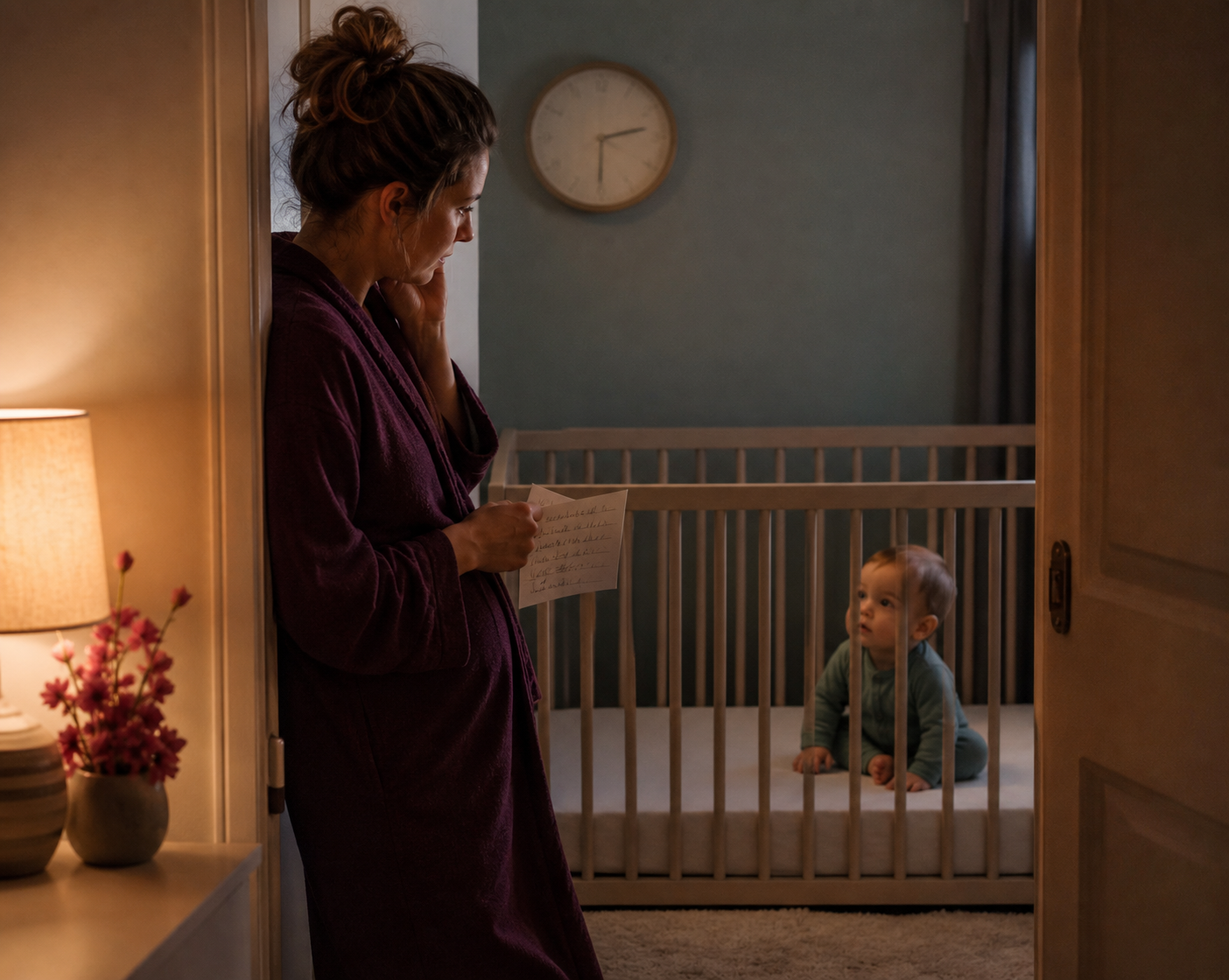
First, name the change instead of naming the phase
“Sleep is terrible” is emotionally accurate and diagnostically useless. I would write one sentence that a second caregiver could recognize without interpretation: “She now wakes forty minutes after bedtime,” “He stands and cries but cannot sit back down,” “She settles normally, then wakes every two hours looking for me,” or “The second nap moved later and bedtime has become a long party.”
That sentence protects you from changing five things at once. It also separates a developmental story from a schedule story. A baby who cries when you step away is giving different information from a baby who happily practices standing for an hour. A baby who suddenly cannot breathe comfortably through the nose is giving different information again.
The four-line change decoder
- Before: What did settling, naps, and night waking look like during the last reasonably typical week?
- Now: Which exact part changed—falling asleep, false starts, wake frequency, long wakes, early morning, or naps?
- Alongside it: Is there separation protest, a new movement, schedule drift, illness/discomfort, feeding change, or a new settling condition?
- Smallest test: What one safe change would distinguish the leading explanation from the runners-up?
Tonight connection: record the wake you actually saw, not the phase you fear you are in.
SleepBaby.org change-decoder tool

Check the baby before you edit the clock
A developmental explanation should never become a reason to overlook illness. Start with the ordinary physical checks: temperature when appropriate, breathing, congestion, feeding and wet diapers, vomiting or diarrhea, rash, obvious pain, and whether your baby is alert and recognizable while awake. Teething may bring mild gum discomfort, but fever, marked illness, severe crying, or poor intake deserves its own explanation.
Night feeds also belong in the body column, not in a moral debate about whether an eight-month-old “should” need them. Feeding needs depend on growth, daytime intake, milk supply or formula pattern, medical history, and the plan you have with your child’s clinician. If you are considering dropping a feed, especially after growth or feeding concerns, ask the clinician who knows that context. A birthday does not automatically cancel hunger.
I would also protect the exhausted adult from unsafe improvisation. Place your baby on their back for every sleep on a firm, flat, level, noninclined infant sleep surface with only a fitted sheet. Keep pillows, blankets, bumpers, toys, positioners, and weighted products out. Stop swaddling as soon as rolling attempts begin. If your baby can roll both directions independently and rolls after being placed on the back, the American Academy of Pediatrics says you do not need to repeatedly turn them back; the space must remain bare.
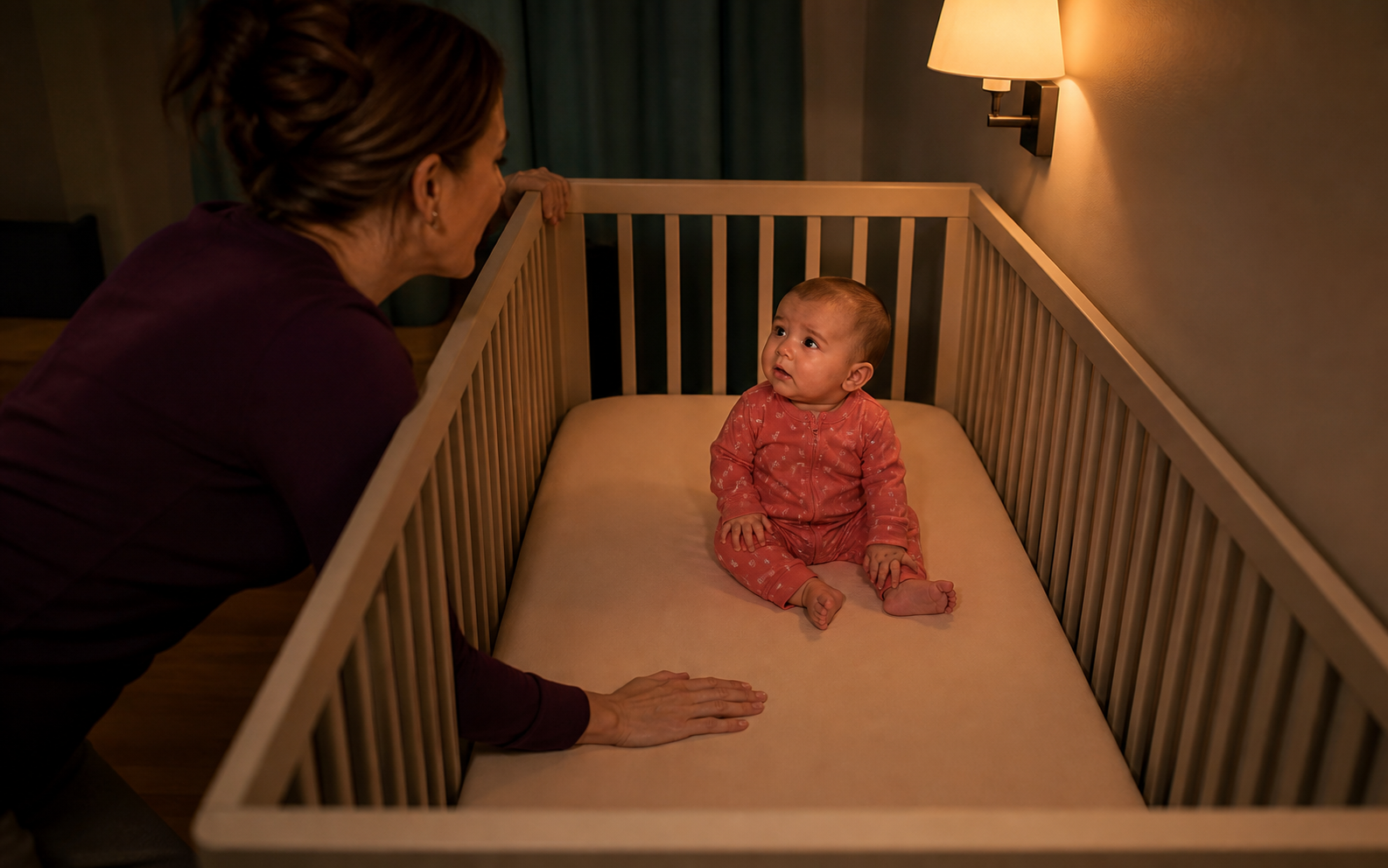
Sort the strongest clue: separation, skills, timing, or settling
At nine months, the CDC lists reacting when a caregiver leaves among common social-emotional milestones. The AAP notes that separation anxiety can disturb sleep in the second half of the first year. That makes separation a credible clue when your baby is calm in your arms, distressed as you leave, watching the doorway, or suddenly demanding one particular caregiver. It does not make every wake separation anxiety.
Daytime practice helps here. Play brief peek-a-boo. Say a simple goodbye before stepping away rather than vanishing. Return predictably. At bedtime, use a short phrase and a response you can repeat without inventing a new ceremony at each wake. Loving and consistent can include picking up, patting in the crib, or a gradual behavioral plan; the useful feature is that the response is understandable and repeatable.
Motor practice has a different texture. A baby may sit, crawl, pull to stand, or bounce against the rail with an enthusiasm badly matched to the hour. Give generous supervised floor practice in daylight. If your baby can pull up but cannot reliably lower down, practice bending knees and returning to sitting while awake. Do not add a restraint, bumper, positioner, or soft landing object to the crib.
What does the wake seem to be asking for?
“Where did you go?”
Clinginess, doorway watching, quick calming with reunion. Try predictable departures, a steady phrase, and repeatable reassurance.
“Look what I can do.”
Sitting, crawling, standing, getting stuck. Add daytime motor practice; keep the crib empty and boring.
“I’m not sleepy yet.”
Cheerful long wakes, nap refusal, bedtime drifting. Inspect total sleep opportunity and the last nap before moving bedtime modestly.
“Something feels wrong.”
Pain, poor intake, fever, congestion, breathing change, unusual distress. Stop schedule testing and address health.

When the old schedule no longer carries the new day
Infants from 4 to 12 months generally need 12 to 16 hours of sleep in 24 hours, including naps, according to the AASM. That wide range matters. A sample schedule is a planning tool, not a test your baby passes. Around eight months, many babies are moving toward two naps, while others still need a third nap or an earlier bedtime during the transition.
Look at the whole 24-hour pattern before lengthening every wake window. If the third nap is becoming impossible and bedtime is drifting late, a two-nap transition may be starting. If naps are short, bedtime is frantic, and your baby melts down before the usual sleep time, stretching the day harder can make the problem worse. If the night contains a long, cheerful party and your baby has generous daytime sleep plus a very long night opportunity, there may be more time in bed than current sleep need supports.
The verified sample sleep schedule for an 8-month-old can help you see one possible two-nap shape after you have identified schedule pressure. Use it as a sketch. Keep your baby’s morning, nap response, feeding plan, and total sleep in view.
I would resist moving bedtime by an hour based on one night. Ten or fifteen minutes can answer a question without throwing the whole day into the air. Keep morning wake time and the bedtime sequence reasonably stable while testing timing. Otherwise, every data point comes from a different experiment.
Three rough nights that need three different answers
Examples are useful only when they show why the same search term can hide different jobs. These are hypothetical patterns, not schedules to copy and not diagnoses.
Pattern A: the bedtime boomerang
A baby falls asleep at the normal time, wakes crying thirty-five minutes later, and needs the full bedtime process again. The day included two unusually short naps and a long final stretch awake. There is no fever, breathing problem, feeding change, or new pain clue.
Leading theory: the false start may be connected to overtired schedule pressure. Small test: move bedtime 10–20 minutes earlier or protect the second nap for several days while keeping the response and routine unchanged. What would change my mind: the false start persists regardless of daytime sleep, or health symptoms appear.
Pattern B: the standing summons
A baby who recently learned to pull up stands at bedtime and again overnight, then cries because getting down is harder than getting up. Naps and total sleep opportunity look similar to the previous week. The baby is cheerful while practicing the same movement during the day.
Leading theory: motor practice and being stuck are stronger clues than a schedule failure. Small test: practice lowering from standing repeatedly while awake, then use one calm response overnight. What would change my mind: one-sided movement, pain, loss of a skill, unusual stiffness or floppiness, or another developmental concern belongs with the clinician.
Pattern C: the doorway alarm
A baby settles while the caregiver is beside the crib, cries as soon as the caregiver turns toward the door, and calms quickly at reunion. Similar protest appears during daytime departures. The baby can move comfortably and seems well.
Leading theory: separation protest is the repeated clue. Small test: practice brief announced departures and returns during the day, then use the same short goodbye and reassurance at night. What would change my mind: distress also appears while the caregiver is present, or pain, breathing, feeding, and illness clues emerge.
The point is not to become certain from one pattern. It is to choose a first explanation with enough evidence to justify one modest test. Good troubleshooting is allowed to be wrong. It simply has to be small enough to reverse.
Is this the two-nap transition—or a temporary messy week?
A nap transition is not defined by age alone. I would look for a cluster that repeats across at least several days: the third nap is consistently refused or pushes bedtime very late, the first two naps can carry enough daytime sleep, and the baby tolerates slightly longer awake stretches without unraveling. One skipped nap after an appointment, a car snooze, or an exciting day is not a transition.
During the in-between period, the day may need two shapes. On a strong-nap day, use two naps and the usual bedtime. On a short-nap day, offer a brief third nap or an earlier bedtime rather than forcing an enormous final awake stretch. This is not inconsistency in the harmful sense; it is a stable decision rule responding to different inputs.
The two-shape bridge
If the first two naps are restorative: skip the third nap and use a reasonable bedtime.
If one or both naps collapse: use a short bridge nap when it works, or bring bedtime earlier.
If every nap becomes a fight after stretching awake time: step back. Readiness is not proven by enduring exhaustion.
If nights worsen while daytime sleep remains generous: inspect total sleep opportunity rather than automatically adding more.
Feeding still anchors the day. Do not compress milk feeds or solids to force a nap template, and do not use solids as a sleep-through-the-night strategy. If a new two-nap shape makes it difficult to meet the feeding plan, the schedule needs to yield.
A seven-night reset without pretending night seven is magic
A consistent bedtime routine has evidence behind it, but not as a countdown promise. In a randomized study of families with children 8 to 18 months, the fastest caregiver-reported improvements occurred during the first several nights, with smaller changes continuing across two weeks. That tells me routines can help relatively quickly for some families. It does not tell me your baby’s regression must end in three nights.
The steady-floor reset
- Nights 1–2: record the baseline and protect the same safe routine. Do not fix the schedule from one wake.
- Nights 3–5: test one leading clue—brief separation reassurance, daytime skill practice, or one modest timing adjustment.
- Nights 6–7: compare settling time, false starts, wake duration, and daytime mood with the baseline.
- Afterward: keep a useful change, reverse an unhelpful one, or take a concise pattern to the pediatric clinician.
Do not wait seven nights when health, feeding, breathing, pain, safety, or developmental concerns appear.
SleepBaby.org one-variable reset

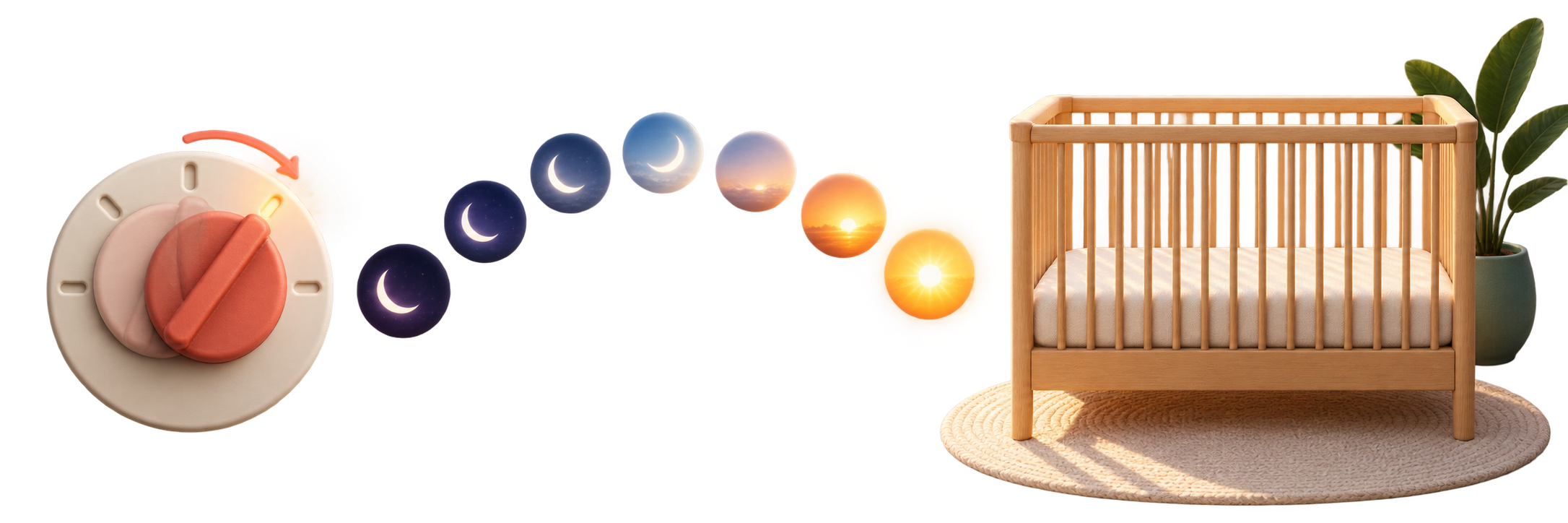
The night I would stop trying to win every wake
Clearly labeled hypothetical Kacey-and-Benjamin scene
Imagine Benjamin at eight months in a hypothetical night: he has discovered pulling to stand and treats 1:38 a.m. as a reasonable rehearsal. I lower him, change the white-noise setting, offer an extra feed, move bedtime in my head, and wonder whether the second nap ruined our lives—all before he has finished one indignant lap of the crib rail.
The useful version of me would do less. I would check that he is well and the crib is bare, help him down once, use the same quiet phrase, and save the motor practice for daylight. In the morning I would ask whether standing was the repeated clue. This scene is hypothetical, not evidence about Benjamin or a promise about another baby. Its job is to show why one clear theory beats six panicked fixes.
That distinction matters to me because broken sleep makes activity feel like responsibility. If I am awake, surely I should be solving. But some nights the responsible work is holding safety and response steady while the pattern reveals itself.
What progress looks like before sleep is “fixed”
Parents often miss improvement because they are waiting for an uninterrupted night. I would watch smaller markers: bedtime takes fifteen minutes instead of forty; the first stretch grows; a wake still happens but resettling is shorter; standing practice moves into daylight; one caregiver can use the same response; naps become predictable enough to plan the next one; or the baby wakes with less distress.
Track only what will change a decision. A seven-column spreadsheet can become another person waking you. Four lines are enough: bedtime and nap shape, the exact wakes, the response used, and how the baby seemed the next day. Add health or feeding observations when relevant. If the record shows no movement after a consistent test, that is useful evidence—not failure.
- Keep going when the targeted problem is gradually shrinking and daytime mood remains workable.
- Reverse the test when sleep clearly worsens, distress increases, or the schedule creates a new problem.
- Change the theory when the repeated clue no longer matches the explanation you started with.
- Call the clinician when health, feeding, breathing, pain, development, or persistent severe disruption enters the picture.
I would also review the adult side. If you are so depleted that you may fall asleep holding the baby on a sofa or armchair, arrange shifts, place the baby in the safe crib even if they protest, and ask for help. The goal is not merely better infant sleep. It is a night the household can navigate without someone making an unsafe decision from exhaustion.
You can respond warmly without creating a nightly obstacle course
Families differ in how they want to respond to crying and how much independent settling they want to practice. There is no single required method in this article. You may offer hands-on reassurance, pick up and put down, sit nearby and fade support gradually, use timed checks, or preserve the approach that already fits your family. If sleep training is something you are considering, behavioral approaches have been studied in infants around this age, but the choice still belongs inside your baby’s health, feeding, temperament, and family context.
Whichever route you choose, define it before the wake. “We will pause for a moment, check the monitor, then go in and use the same phrase and pat” is a plan. “We will try anything that might stop the crying fastest” is understandable at 3 a.m. and difficult to repeat. A written two-sentence handoff can prevent caregivers from accidentally running competing experiments.
Tonight’s caregiver handoff
“We think the strongest clue is ________. We are keeping the safe setup and routine the same. At wakes, we will ________. The one thing we changed is ________. We will revisit it after ________ days unless a health or feeding concern appears.”
When “regression” has lasted too long—or is the wrong label
There is no evidence-based expiration date that separates a normal regression from a problem. Contact your pediatric clinician when waking remains severe or progressively worsens, daytime functioning or feeding suffers, your baby snores loudly or has breathing pauses, pain seems persistent, you suspect an ear infection or reflux problem, or your own exhaustion is becoming unsafe. Bring the before/now pattern, nap timing, feeding context, symptoms, and a short description or video of any unusual movement or breathing.
Development deserves the same specificity. The CDC recommends talking with the doctor if your baby has lost a skill, is not meeting milestones, or you have another concern. A sleep wobble does not prove development is advancing, and disrupted sleep should not be used to dismiss a developmental worry.


One cue worth keeping boring
Yogasleep Hushh portable white noise machine
During an eight-month sleep wobble, I would rather preserve one familiar cue than add a complicated new system. The rechargeable Hushh can carry the same simple, low-volume sound between the nursery and another safe sleep location. Its physical controls, child lock, and limited sound choices make it a better fit for this job than a feature-heavy app that invites a new setting at every wake.
Buy it for consistency and portability—not because white noise treats a regression or guarantees sleep. Keep the machine and charging cord outside the crib, place it at a conservative distance, and use a low volume. It is not a monitor, medical device, sleep-training method, or SIDS-prevention product.
See the Yogasleep Hushh on Amazon
As an Amazon Associate, SleepBaby may earn from qualifying purchases.
Sources
- Centers for Disease Control and Prevention. “Milestones by 9 Months.”
- American Academy of Pediatrics, HealthyChildren.org. “Separation Anxiety & Sleeping Trouble in Young Children.”
- American Academy of Pediatrics, HealthyChildren.org. “Emotional and Social Development: 8 to 12 Months.”
- American Academy of Sleep Medicine. “Recommended Amount of Sleep for Pediatric Populations.”
- American Academy of Pediatrics, HealthyChildren.org. “Getting Your Baby to Sleep.”
- American Academy of Pediatrics, HealthyChildren.org. “Safe Sleep: 9 Ways to Reduce a Baby’s Risk of SIDS & Suffocation.”
- Mindell JA et al. “Implementation of a nightly bedtime routine: How quickly do things improve?”
- Pecora G et al. “Infant sleep and development: Concurrent and longitudinal relations during the first 8 months of life.”
- Hall WA et al. “A randomized controlled trial of an intervention for infants’ behavioral sleep problems.”
- Galland BC et al. “Reference values and changes in infant sleep-wake behaviour during the first 12 months of life.”
When the monitor lights again tonight
You do not need to prove whether this is the official eight-month regression. Check the baby. Protect the sleep space. Name the change. Follow the strongest clue, and let one small test answer before you make another.
The third wake may still be difficult. It becomes less mysterious once it is no longer carrying every possible explanation at once.






What viewers said10 comments · 4 replies+
Archived comments from the original Baby Sleep Miracle presentation. Not independently verified by SleepBaby.org; individual experiences vary.
Thank you so much for this video! I had no idea about the dangers of baby swings :O
Hi Mary-Ann. I have a question: Is method in any way similar to the ones recommended by Dr Bucknam, Dr. Weissbluth or Dr. Karp? We tried those but none of them help.
Hi Regina, thank you for your question. The short answer is no. The techniques I share in my guide are based on newest scientific research and this is why I have never seen any approach similar to the one I recommend.
This method really works! I tried it on my son Jesus and after just one week he went from waking up more than 5 times a night to waking up just once or twice. You are a lifesaver, Mary-Ann!
I'm truly impressed with how much information you share in your video. And all for free! I can feel that you truly care about mothers like myself, and that's hard to find these days. I have recommended your site to several of my friends already.
Mary-Ann, our child suffers from autism. Is your approach still suited?
Chloe, I made sure my method can be used with any child, even babies who are special like yours. Please note that I'm not a doctor and that I always advice to consult with your physician because nothing is more important than the safety and well-being of your love.
Hallo Mary-Ann, I'm from Germany. Do you have your guide in German?
Hello Heide, we do! Normally you should already see our video in German. If not, please contact our support so they can guide you
Thenk you for your answer, Mary-Ann!
I just completed your approach and I have to say, it worked almost too well. Yes, it took a bit of getting used to with your bedtime routine but the difference is huge. My son George used to take 1 hours to go down and now he's firmly asleep in no more than 10 minutes! You're the best!
It seems I'm the only man watching this video, lol! What you shared about the 'emotional backpack' made immediate sense to me and I can't wait to help my little girl Mila to unpack it!
Hey there, just discovered your site and this really sounds different. Just wanted to say thanks for sharing :)
For everyone who's still thinking about getting Mary-Ann's guide I want to advise you to go ahead. I wasn't sure myself but now I'm so thankful I invested in this program. It made a huge difference in our life as a family and yes, my baby girl does sleep through the night now.