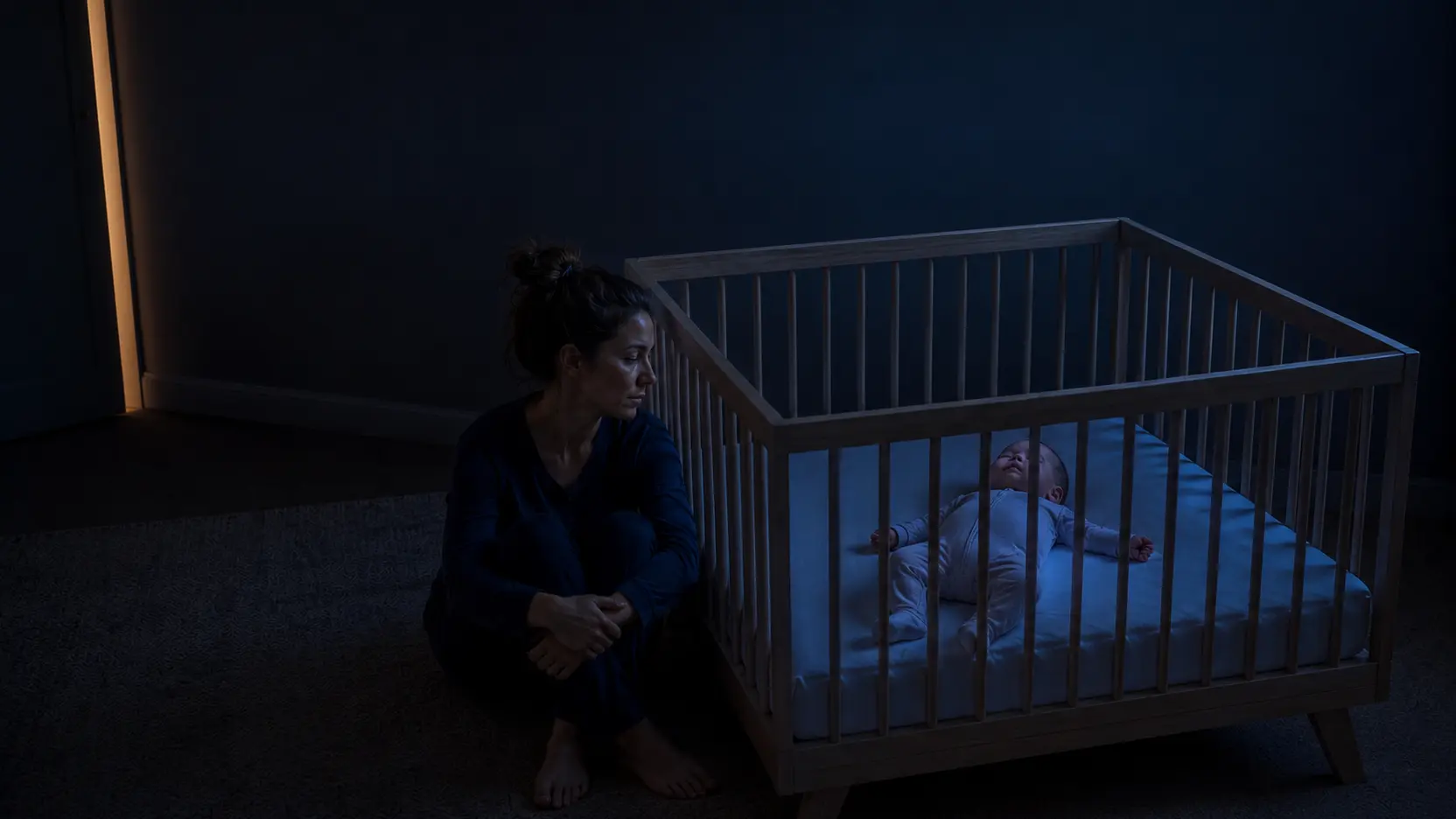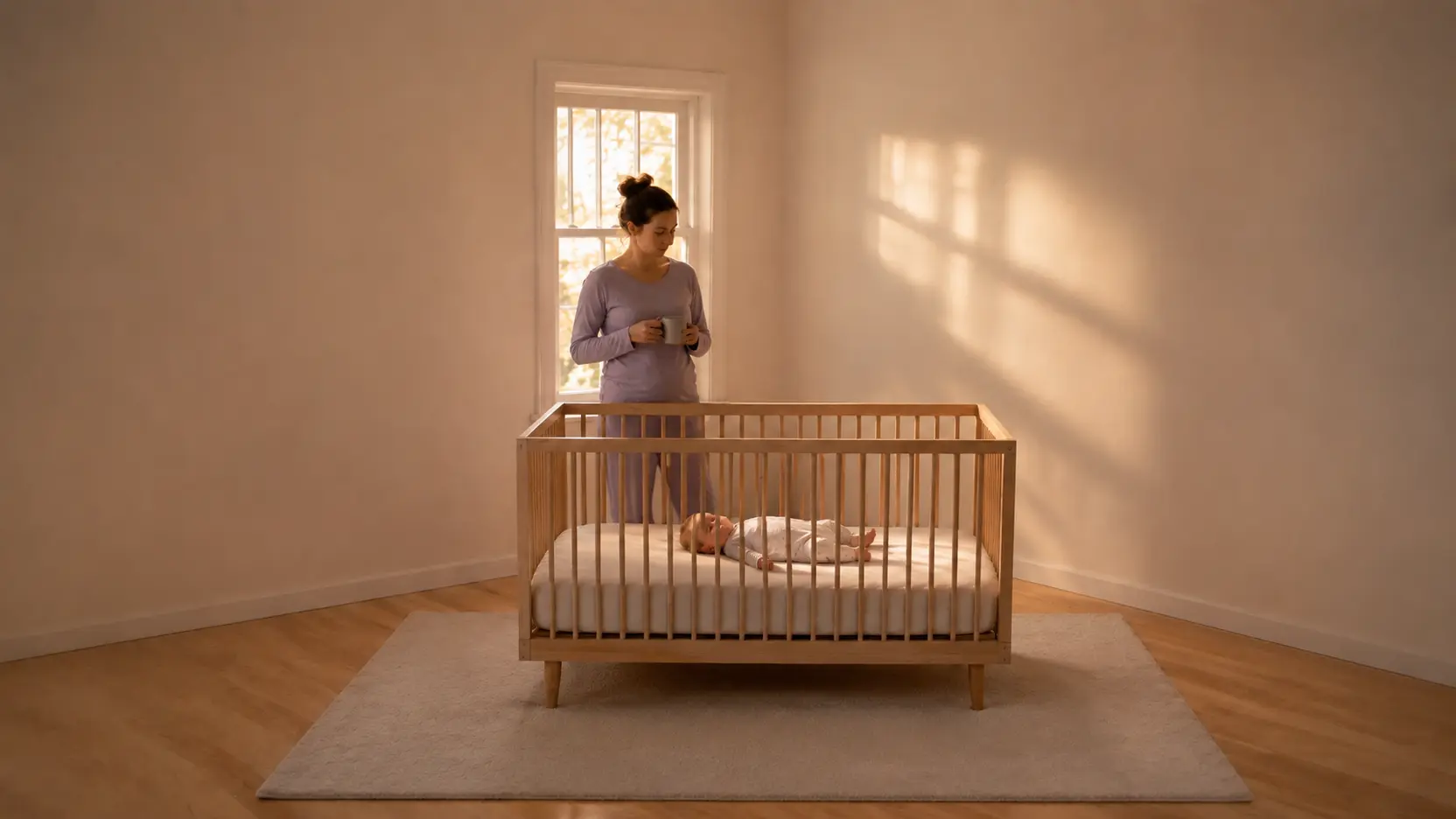

Scrape. Pause. Scrape-scrape. The baby monitor makes a tiny hand moving across a fitted sheet sound like someone is sanding the crib at midnight. If your baby scratches the bed while sleeping, the sound alone cannot tell you why. Brief finger-raking, arm movement, or whole-body motion can happen during active sleep and sleep transitions. Repeated scratching can also point to itchy skin, heat, or irritation. What matters is the whole pattern: what moves, when it happens, what the skin looks like, and whether the movement causes injury or disrupts sleep.
I would not begin by trying to make the crib quieter. I would begin by watching one episode in enough light to see whether the baby is scratching the sheet, scratching the skin, or moving the whole body in a rhythm that happens to drag a hand across the mattress. Those are different questions, and they deserve different next steps.
The useful answer in four clues
Look at movement, timing, skin, and impact
Fingers raking the sheet, wakeful skin-scratching, or a repeated head, arm, or body rhythm?
Falling asleep, a brief arousal, active sleep, or long repeated clusters?
Clear and comfortable, or dry, hot, inflamed, broken, crusted, or visibly itchy?
Baby stays asleep and unhurt, or wakes, seems distressed, gets injured, or changes during the day?
What would change my mind: skin damage, a worsening rash, repeated sleep disruption, daytime effects, a pattern that looks seizure-like, or any breathing or color change.
SleepBaby.org original teaching component · The sound starts the question; the pattern answers it.

Start with the movement, not the noise
A fitted sheet is a surprisingly good percussion instrument. A relaxed hand opening and closing can make a sharp rasp. A forearm sliding during a brief arousal can sound deliberate. A baby rocking the trunk may drag the same fingertips over the same patch of fabric until the monitor turns it into a tiny repetitive broadcast. None of those sounds tells you, by itself, whether the baby is uncomfortable.
The first distinction I would make is simple: Is the baby using the hand against the mattress, or using the hand against the body? Sheet-raking without redness, wakefulness, or distress belongs in the movement branch. Repeated rubbing of the cheeks, scalp, neck, wrists, ankles, or another skin area—especially when the baby also scratches while awake—belongs in the itch branch. Whole-body rocking, head rolling, head banging, or repeated limb movement belongs in a third branch that a clinician may describe as a sleep-related rhythmic movement.
These branches can overlap. A warm, itchy baby may move more during light sleep. A baby who makes ordinary active-sleep movements may happen to have one dry patch. The job is not to force one label onto a complicated night. The job is to notice which detail carries the most weight.

Active sleep can be surprisingly active
Newborn sleep does not look like adult sleep performed by a smaller person. During active, or REM, sleep, a newborn may twitch or jerk the arms and legs, move the eyes beneath closed lids, make expressions, and breathe less regularly than during quiet sleep. Those movements settle as the baby moves into deeper non-REM sleep.3 A hand sliding across the mattress can be one small part of that busy phase.
This is why timing helps. If the sound appears while your baby is falling asleep, briefly surfaces between cycles, and then disappears as the body becomes still, I would put more weight on a sleep-transition explanation. Our guide to how baby sleep cycles change by age gives that movement a wider frame. If the sound seems to appear at every little surfacing, the explanation of why babies briefly wake between sleep cycles may help you separate a normal arousal from a night that is truly fragmented.
Normal-looking movement is not a command to ignore your instincts. I would still look at the baby, not just the app. A brief, variable motion that fades as sleep deepens is different from a rigid, highly repetitive episode that keeps returning in the same form. It is also different from scratching that leaves marks or repeatedly wakes a baby who looks uncomfortable.
The phrase self-soothing gets attached to almost every repetitive thing a baby does, sometimes with the precision of a label maker in a windstorm. I would use it carefully here. A movement may be settling or sensory without being a skill you need to encourage, stop, or interpret as a sleep-training verdict. If the baby is safe, comfortable, sleeping, and uninjured, observation may be the most useful action.

When the scratching is part of a repeated rhythm
Some babies and children repeat movements around sleep: body rocking, head rolling, head banging, leg rolling, or other patterned motion.78 Research reviews describe sleep-related rhythmic movements as common early in life and often benign or self-resolving.456 The word disorder is reserved for a different situation—when the movement significantly disrupts sleep, affects daytime function, or causes injury.4
That distinction is one of the most helpful in this whole article. Intensity can be startling without being harmful. A soft hand scraping a loud sheet may wake the adults while the baby sleeps peacefully. On the other hand, a motion that looks modest on camera may matter if it happens for long stretches, repeatedly wakes the baby, breaks skin, causes swelling, or changes how the child functions during the day.
Intensity is not the same as impact
Let consequence—not volume—set the next step
-
Notice: A brief movement happens, baby remains asleep, skin stays intact, and the pattern does not grow. Observe without adding a new crib item.
-
Document: The motion repeats or is hard to describe. Note timing and context; save a short clip if doing so does not delay care.
-
Discuss: Sleep is repeatedly disrupted, the baby seems distressed, the pattern persists or changes, daytime behavior is affected, or skin is injured.
-
Act urgently: The episode includes breathing trouble, choking, blue color, prolonged seizure-like activity, repeated episodes without recovery, or the child is difficult to wake or very unwell.
SleepBaby.org original decision tool · A calm ladder keeps an alarming sound from flattening every possibility into the same answer.
A 2023 clinical review notes that home video can support a clinician’s assessment of rhythmic movements. When the history is unclear or another sleep condition or seizure disorder is suspected, video-polysomnography may be considered by the treating team.4 That does not mean every sheet scrape needs a sleep study. It means a clear description—and sometimes a short clip—can keep the conversation anchored in what actually happened.
I would not try to diagnose rhythmic movement disorder from an app alert, a single noisy night, or a written checklist. I would use the research for the part it can answer: many rhythmic movements are benign; injury, interference, persistence, and diagnostic uncertainty are the details that move the question into a clinician’s office.

When the baby is itchy, the skin usually leaves clues
If the hand keeps returning to the face, scalp, neck, wrists, ankles, or another body area, I would inspect the skin in daylight. Eczema and other irritation can produce dry, itchy patches, and itching can interrupt sleep. Scratching can also worsen the itch-scratch cycle, open the skin, and create an opportunity for infection.910
Look for dryness, redness, roughness, swelling, weeping, crusting, blisters, or small breaks in the skin. Also notice what is not visible in the crib: Does the baby rub the same place during feeding or play? Did the scratching begin with a new detergent, fragranced product, woolly layer, warm room, or sweaty night? The American Academy of Dermatology lists overheating, rough-feeling fabric, and fragranced skin products among common eczema triggers.9
I would resist the urge to turn every dry patch into a home dermatology experiment at bedtime. Use the skin-care plan your child’s clinician has recommended. If there is no plan, the itch is persistent, or the skin is worsening, ask the pediatrician or dermatologist what the rash is and how it should be treated. This article can help you notice the pattern; it cannot examine the skin or choose medicine for your baby.
Two different trails
Follow the hand to the sheet—or to the skin
The hand meets the fitted sheet
- Brief or variable motion
- Clusters near falling asleep or arousal
- No marks on the baby
- Baby remains relaxed or returns to still sleep
Useful next move: observe timing and impact.
The hand returns to the body
- Same skin area repeatedly rubbed
- Scratching also appears while awake
- Dryness, rash, heat, sweat, or irritation
- Broken skin, crusting, pain, or sleep loss
Useful next move: inspect the skin and contact the clinician when indicated.
The two trails can overlap. Use the branch that explains the most important detail, not the one with the tidiest label.
Heat deserves its own quick check because a sweaty baby may rub or scratch more even without eczema. Feel the chest or upper back rather than using cool hands or feet as your thermometer. If sweating is part of the night, our guide to what nighttime sweating can mean helps separate room comfort from symptoms that need medical attention. On genuinely hot nights, adjust clothing without adding loose bedding.
Keeping nails short and smooth can reduce accidental scratches, but nail care is not a diagnosis or a complete treatment for significant itch. If the baby is repeatedly drawing blood, the priority is finding and treating the reason—not merely making the nails less efficient.


Do not solve the scratching sound by adding something to the crib
This is the safety boundary I would make nonnegotiable: do not add a bumper, padded liner, blanket, folded towel, loose cloth, pillow, positioner, stuffed item, or improvised barrier to quiet the scrape or cushion the crib. For an infant, the safe sleep area is a safety-approved firm, flat, level surface covered only by a fitted sheet. Place the baby on the back for every sleep and keep soft or loose objects out.12
The crib can look almost offensively plain when you are worried about a sound. Plain is still the point. A product marketed as breathable, protective, cozy, sensory, or soothing does not become part of the recommended infant setup because the baby’s hand keeps finding the rails or sheet. The evidence-supported response is to keep the sleep space bare and work out whether the baby is moving, itching, or getting hurt.
If the fitted sheet is rough, damaged, badly sized, bunched, or not intended for that mattress, replace it with a snug sheet that fits the sleep product exactly. Do not layer a softer sheet on top, tuck loose fabric beneath the baby, or add a pad. The mattress and fitted sheet need to remain smooth, secure, and used as the manufacturer directs.
Monitors and cords stay outside the sleep space. NICHD’s Safe to Sleep FAQ advises placing monitors at least three feet away from a crib, bassinet, play yard, or other sleep environment.2 Follow the monitor manufacturer’s installation instructions as well. A clear camera view can help you observe; it cannot compensate for a loose cord or an unsafe crib.
The sleep setup does not change
Back, firm, flat, level, fitted, empty
Firm surface
Flat and level
One fitted sheet
Nothing else inside
The scratching-specific rule: investigate the baby; do not decorate the hazard away.
Watch before adding anything to the crib
NICHD’s clear-crib reminder applies to scratching nights too
The baby may sound busy, but the sleep space should stay simple. This official Safe to Sleep video reinforces the firm, flat, empty setup while you investigate the movement itself.
Takeaway: keep the crib bare; observe the hand, body, skin, and impact instead.
If the player does not load, the complete safe-sleep guidance is written above. Watch the NICHD video on YouTube.

Before you try to stop the scratching, compare the context
A behavior can look completely different once you know what changed around it. If the scratching started last night, I would not immediately assume the baby developed a new sleep problem last night. I would ask what else changed: a different fitted sheet, a warmer room, new pajamas, a fragranced product, a detergent switch, a new sleep space, a rash, an illness, or simply a night with more brief arousals.
This comparison is especially useful because the sound itself is so dependent on the surface. One snug cotton sheet may whisper when a hand crosses it; another may rasp like paper. A portable play-yard pad and a crib mattress can turn the same motion into two different noises. If the sound appears only on one sleep surface, inspect that product in good light. Confirm that the sheet is the correct size, lies smooth and tight, has no rough seam or damaged area, and is allowed by the manufacturer. Check the mattress or pad for damage without adding a topper or substitute surface.
If the same hand movement follows the baby across safe sleep spaces, that makes a one-sheet explanation less persuasive—but it still does not establish a diagnosis. You are simply narrowing the question. Is the baby repeating a familiar motion wherever sleep happens? Is the hand seeking the same itchy skin area? Does the movement happen at a predictable sleep transition? Each answer gives the pediatrician more to work with than “the crib sounded strange.”
Same scrape · four useful comparisons
Change one question at a time
Surface to surface
Does the noise happen only on one correctly fitted sheet or in every safe sleep space?
Night to day
Does the baby scratch the same skin area while awake, or only rake the sheet during sleep?
Cool to warm
Does the pattern increase with sweat, heavier clothing, a warmer room, or a flare of dry skin?
One night to the next
Is it brief and stable, or becoming longer, more frequent, more disruptive, or more injurious?
A comparison changes the quality of the observation. It does not authorize unsafe experiments or prove a cause.
Compare nighttime movement with daytime skin behavior
Skin itch rarely respects a strict bedtime appointment. A baby with a genuinely itchy cheek, scalp, wrist, or ankle may rub that area during feeds, cuddles, floor play, or car rides too. You may see redness after scratching, a rough patch before scratching, or a hand that repeatedly finds the same location. That pattern makes a skin evaluation more useful than a sleep-schedule overhaul.
Sheet-raking may be the opposite: it appears only when the hand meets the mattress, stops when the baby moves into deeper sleep, and leaves the baby’s skin untouched. I would not call that proof of self-soothing, because we cannot ask the baby what the motion is doing. I would simply describe it accurately and avoid solving a harmless movement that is bothering the monitor more than the child.
If the baby scratches both the sheet and the skin, start with the part that creates harm or discomfort. A minor sheet noise does not lower the importance of broken skin. A dry patch does not automatically explain a rigid repeated movement. The branches are allowed to coexist; your response should follow the detail with the highest consequence.
Compare the room without turning bedtime into an experiment
A simple room check is different from changing five variables at once. Feel the baby’s chest or upper back. Look for sweat. Confirm that sleep clothing suits the room and that the head and face are uncovered. Notice whether a heater vent, direct airflow, rough sleeve, or new laundry product lines up with the change. Then make the smallest appropriate adjustment while keeping every safe-sleep rule fixed.
I would not change the sheet, detergent, pajamas, bedtime, sound machine, and skin products all in one evening unless an immediate safety or medical issue required it. If the scratching improves, you will have no idea which change mattered. If it worsens, you will have five suspects and one increasingly offended household. One relevant change gives you information; a complete nursery reboot mostly gives you laundry.
Compare a short run of nights, not every minute of sleep
For a baby who is safe, comfortable, and uninjured, two or three brief notes may show whether the pattern is stable. Record approximate time, what the body did, how long it lasted, whether the baby woke, and what the skin looked like the next day. You do not need to tally every finger movement or stay awake waiting for the fitted sheet to make its case.
Stop observing and contact the clinician sooner if the movement causes injury, repeatedly breaks sleep, is escalating quickly, appears with significant itch or rash, affects feeding or daytime alertness, or simply looks unlike your baby’s ordinary movement in a way that concerns you. A trend is useful only when it does not postpone the care the baby needs.
The comparison also protects against a common mental trap: treating one quiet night as proof that a condition is gone or one loud night as proof that something serious has begun. Babies have variable sleep. The question is not whether tonight matched yesterday perfectly. It is whether the pattern is harmless and stable, or whether impact and associated signs are moving it into a different branch.
The four-frame crib-side observation
If the movement is not urgent, one short observation is usually more useful than a week of increasingly elaborate guesses. I call this a four-frame observation because it keeps the note small enough to finish at night and specific enough to help in daylight. You are not trying to monitor every breath or build a case. You are capturing the few details that separate the branches.
One episode · four frames
Write what happened, not what you fear it means
Frame 1 · Movement
Which fingers, hand, limb, head, or body part moved? Was the motion variable or identical each time?
Frame 2 · Timing
Falling asleep, light sleep, a brief arousal, or fully awake? About how long, and did it stop on its own?
Frame 3 · Skin and comfort
Where did the hand go? Any rash, sweat, broken skin, pain, crying, or daytime scratching?
Frame 4 · Impact and change
Did it wake or injure the baby? Is it new, increasing, affecting the day, or paired with another symptom?
A clinician-ready sentence: “At about 10:20 p.m., while falling asleep, the right hand raked the fitted sheet in short clusters for about a minute. The baby stayed relaxed and asleep; the skin was clear, and it stopped without intervention.”
Change every detail to match your child. The structure is useful only when the observation is honest.
If the episode is safe to record, frame the whole body rather than zooming tightly onto the hand. A full view shows whether the movement is local or part of a larger rhythm. Record only long enough to show the pattern. Do not delay urgent care to take a video, and do not place a phone, camera, light, cord, or other object inside the crib.
Include what happened immediately before and after the movement. Did the baby turn the head, open the hand, briefly stir, and then become still? Did the motion begin after a cough, cry, feed, room-temperature change, or visible skin rub? That sequence can help a clinician interpret a home video without asking you to name the movement first.4 Do not test the pattern by holding a limb, waking the baby, or changing the crib setup. If the episode ends safely, write down the natural sequence—including an honest “I could not see that part” when the view was unclear.

What to do tonight, in order
When you are tired, sequence matters. I would rather give you five useful moves than fifteen ideas competing for the same 2 a.m. brain cell.
Tonight’s order of operations
Safety first, then one observation, then the smallest fitting response
-
Check the baby, not only the sound. Look at breathing, color, responsiveness, body position, the exact movement, and whether the baby appears distressed.
-
Keep the sleep space unchanged. Back, firm, flat, level, one fitted sheet, nothing else. Correct only an actual setup defect.
-
Choose the branch. Sheet movement, skin scratching, repeated body rhythm, or concerning episode? Do not make all four mean the same thing.
-
Record one clean observation. Movement, timing, skin and comfort, impact and change. Add a short whole-body video only when safe.
-
Match the response to impact. Observe a brief harmless pattern, address the skin or room clue, contact the clinician for persistent or disruptive symptoms, or seek urgent help for red flags.
You do not need to keep a nightly dossier if the behavior is brief, unchanged, harmless, and easy to explain. A single accurate note can be enough. If the behavior is becoming more frequent, longer, or harder to interrupt—or if it begins to affect skin, sleep, feeding, alertness, or daytime behavior—bring the pattern to the pediatrician.
If what you saw was more like a jump or jerk than a scratch, describe that movement precisely when you contact the clinician. A different motion may need a different question, and no related article should substitute for care when the episode is concerning.
When to call the pediatrician—and when not to wait
Contact your baby’s clinician when scratching or rhythmic movement repeatedly disrupts sleep, causes injury, becomes more frequent or intense, persists in a way that concerns you, or affects the child during the day. Also call for significant or persistent itch, a new or worsening rash, open skin, pain, or possible infection. Oozing, crusting, pus bumps, blisters, spreading redness, fever, or a child who looks unwell deserve prompt medical guidance.10
For a movement that might be seizure-like, seek emergency help if it lasts more than five minutes or is unusually severe, including difficulty breathing, choking, blue skin color, or several seizures in a row.11 Call emergency services for a child who is not breathing normally, turns blue, is unresponsive, or appears to have a life-threatening emergency. Do not delay emergency care to record video, finish a checklist, or search for a more comforting explanation.
What bed-scratching does not prove
A single sleep behavior does not diagnose autism. If you have a developmental concern, bring the full pattern—not one midnight noise—to the pediatrician. Do not let an internet shortcut turn the sound of a hand on a sheet into a label for your child.
Scratching the neck does not prove teething. A baby can touch the neck for many reasons, including ordinary exploration or skin irritation. Look at the skin, context, and other symptoms. Teething may coexist with a restless night, but coexistence is not an explanation.
The sheet sound also does not diagnose reflux or another named syndrome. Describe the actual movement, feeding, comfort, and timing to the clinician instead of attaching a syndrome name at home.
I know why these searches become sticky. A parent starts with “Why is that hand making noise?” and three tabs later is reading about conditions that were never supported by the original detail. This is where I would stop the escalation and return to the four frames. What moved? When? What did the skin show? What changed for the baby? A specific observation is kinder and more useful than a frightening guess.
Common questions about scratching during sleep
Is it normal for a baby to scratch the mattress or fitted sheet?
It can be. Brief hand or arm movements may occur during active sleep, settling, or a short arousal, and the sheet can make them sound dramatic. “Normal” becomes less convincing when the movement injures the baby, repeatedly disrupts sleep, changes significantly, affects the day, or appears with another concerning sign.
Why does my baby scratch me while falling asleep?
A baby may grasp, rub, rake fingers, or seek sensory contact while settling in your arms. Check whether the baby is reaching for your clothing or skin, scratching their own skin, or showing discomfort. Keep nails smooth, redirect the hand gently if needed, and do not treat scratching a caregiver as proof of a developmental or medical condition.
Should I wake my baby when I hear scratching?
Not automatically. First look at breathing, color, position, the movement, and comfort. A relaxed baby making a brief harmless motion may not need intervention. Wake or intervene when required for safety, injury, distress, a concerning episode, or the care plan your clinician has given you.
Can I use mittens, a bumper, or extra-soft padding to stop it?
Do not add a bumper, pad, loose cloth, blanket, or other object to an infant sleep space. Use only the fitted sheet on the approved mattress. Ask your baby’s clinician how to manage significant skin scratching rather than improvising a sleep accessory. Any clothing or hand covering must be age-appropriate, secure, and consistent with your clinician’s guidance and the manufacturer’s instructions.
What if the sound happens at nearly the same time every night?
Timing can point to a recurring sleep transition, room-temperature change, care routine, or skin trigger. Note what happens immediately before and after. A repeated time is a clue, not a diagnosis. If the episodes are disruptive, injurious, or otherwise concerning, share the pattern with the pediatrician.
A practical way to catch the movement you keep missing
My article-specific pick: Nanit Smart Baby Video Monitor with Floor Stand
If the scratching stops every time you reach the crib, an overhead night view can answer a very specific question: is the hand briefly raking the fitted sheet, is the baby scratching the skin while awake, or is the sound part of a larger repeated movement? The Nanit’s 1080p camera, infrared night view, and floor stand with concealed cord covers make it a stronger fit for that job than a paper log, which cannot show the motion, or any padded crib product, which does not belong in the infant sleep space.
The most useful reason to buy it here is not a promise of better sleep or a diagnosis. It is the chance to review a movement that ends before you enter the room and, when appropriate, share a short representative clip with your child’s clinician. Full video-history and clip features can require a paid Insights plan. Install the stand and cord covers exactly as directed, keep all monitor parts and cords outside the sleep space, and remember that a camera does not replace safe-sleep practices or medical care.
See the Nanit camera and floor stand on Amazon
As an Amazon Associate, SleepBaby may earn from qualifying purchases.
Sources
- NICHD Safe to Sleep: Safe Sleep Environment for Baby.
- NICHD Safe to Sleep: Frequently Asked Questions.
- American Academy of Pediatrics: Stages of Newborn Sleep.
- Lam N, Veeravigrom M. Sleep-related rhythmic movement disorder in children: a mini-review.
- DelRosso LM, Cano-Pumarega I, Anguizola E S. Sleep-Related Rhythmic Movement Disorder.
- Gwyther AR, Walters AS. Current Concepts of the Pathophysiology, Diagnosis and Treatment of Rhythmic Movement Disorders in Sleep.
- Hoban TF. Rhythmic movement disorder in children.
- Stepanova I, Nevsimalova S, Hanusova J. Rhythmic movement disorder in sleep persisting into childhood and adulthood.
- American Academy of Dermatology: What can help a child with eczema sleep?.
- American Academy of Pediatrics: How to Treat and Control Eczema Rashes in Children.
- American Academy of Pediatrics: Seizures and Epilepsy in Children.
From scrape-scrape to a clearer night plan
You do not need to solve every sound before you can protect the next sleep
The sheet may still sound enormous through the monitor tonight. Now you have a smaller, steadier job: keep the crib safe, see what actually moves, check the skin, and let impact decide the next step. When the scratching question is settled but the rest of the night still feels tangled, SleepBaby can help you build the wider bedtime picture one practical choice at a time.
SleepBaby provides educational sleep guidance, not diagnosis or emergency care.