
Clearly disclosed SleepBaby editorial composite
At 1:43 a.m., the swing motor is the steadiest sound in the room. For this disclosed composite, imagine me—Kacey—at the edge of the swing as Benjamin closes his eyes before the second arc, my shoulders drop, and the empty bassinet three steps away suddenly feels absurdly far. I understand the bargain a tired brain tries to make in that moment: if I stay right here and watch every breath, surely I can leave him where he finally settled.
A baby should not keep sleeping in a swing, even for a short nap, even with the harness fastened, the motor off, or an adult watching. If your baby is asleep there now, move them as soon as practical to a crib, bassinet, portable crib, play yard, or bedside sleeper that meets current requirements. Place your baby on their back on the firm, flat, level, non-inclined surface with only a fitted sheet. Your baby may wake during the move. That is maddening at 1:43 a.m.; it still does not make the swing a safe sleep surface.
I am not going to hand you that safety sentence and disappear. The real question is what to do when the swing is the only place sleep seems to happen and you are running out of alert minutes. We can protect the sleep happening now, then build the next sleep around one portable cue instead of trying to change the whole night at once.
THE ANSWER FOR THIS SLEEP
Move the baby, not the safety line
Destination: a current crib, bassinet, portable crib, play yard, or bedside sleeper used exactly as directed.
Position: on the back for every sleep.
Surface: firm, flat, level, non-inclined, and bare except for the fitted sheet.
Do not add a pillow, blanket, wedge, rolled towel, positioner, nest, lounger, parent shirt, aftermarket insert, or padding to make the landing feel more like the swing.

If your baby is asleep in the swing right now
First, make the safe destination ready before you lift. Check that the sleep product is assembled and used within its instructions, that the mattress and fitted sheet belong with it, and that the surface is empty. If you use a bedside sleeper or play yard, confirm the exact product is approved for infant sleep and that you have not added a separate mattress or insert.
Unfasten the restraint without rushing, support your baby’s head and body, lift smoothly, and place your baby on their back. You do not have to wait for a mythical “deep sleep” minute or perform a complicated transfer test. A steady hand on the chest for a brief moment can make the change less abrupt, but remove your hand before you step away and keep the sleep space bare.
The three-stop handoff
- See sleep in the swing. Do not wait for the nap to become “long enough” to matter.
- Lift and move. Support the baby and accept that waking is possible.
- Land flat. Back down, fitted sheet only, on the approved infant sleep surface.
Sleep connection: the soothing routine can be rebuilt. The safe destination stays fixed tonight.
SleepBaby.org original teaching component
If your baby cries after the move, respond. A young infant may need feeding, a diaper change, warmth adjusted through clothing, help with burping, or simply another round of calm holding. This article is not a cry-it-out plan, and a newborn does not need to prove a “self-soothing” skill. The boundary is narrower: settling can be responsive; sleep still happens on the safe surface.
Call emergency services now for severe breathing trouble, blue or gray color, a seizure, unresponsiveness, or extreme difficulty waking. Those signs are not a transfer problem to troubleshoot at home.
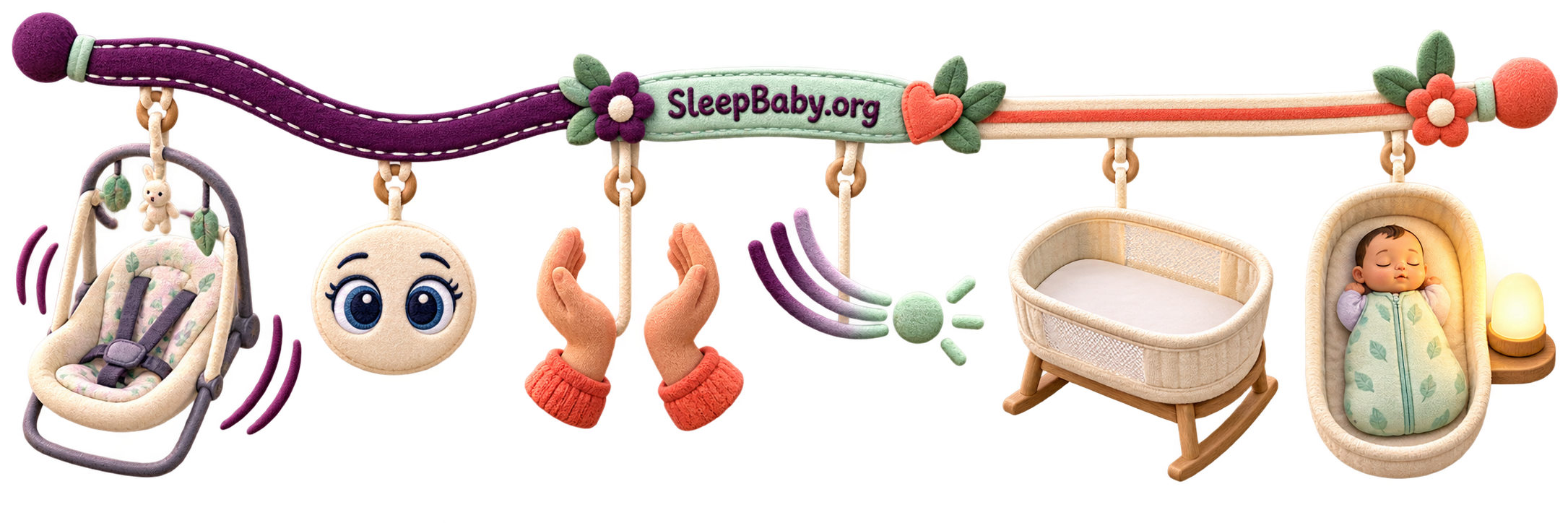
Why the still mattress can feel like a different planet
A swing changes several things at once. It repeats motion. It makes a consistent mechanical sound. Its seat touches more of the baby’s body than a flat mattress. The caregiver may also place the baby there at a different point in the tiredness cycle—perhaps after feeding, rocking, or a long stretch of fussing. When you transfer the baby, motion, body support, temperature, sound, and caregiver contact may all change in a few seconds.
That explains why a baby may wake. It does not prove the baby has reflux, colic, sensory needs, a sleep disorder, or an inability to self-soothe. It also does not mean the crib or bassinet is “too hard.” A firm infant mattress is supposed to feel different from a padded, contoured seat.
I would resist the phrase “the swing mimics the womb” as if it settles the whole question. It is tidy language for a messy household observation. Your baby may like motion, sound, containment, timing, contact, or some combination you cannot isolate at 2 a.m. We do not need a perfect explanation before making the safer decision.
What can travel—and what must stop
| A cue you can carry over | An unsafe feature you cannot use for sleep |
|---|---|
| The same short phrase or song | The inclined or contoured seat |
| One steady external sound, placed out of reach | Motorized motion during sleep |
| A familiar sleep sack when appropriate and correctly sized | The swing harness as a sleep safeguard |
| A repeatable order: feed, change, wind down, land | Padding, inserts, wedges, or rolled blankets |
Tonight’s distinction: keep a cue; retire the seat from sleep.
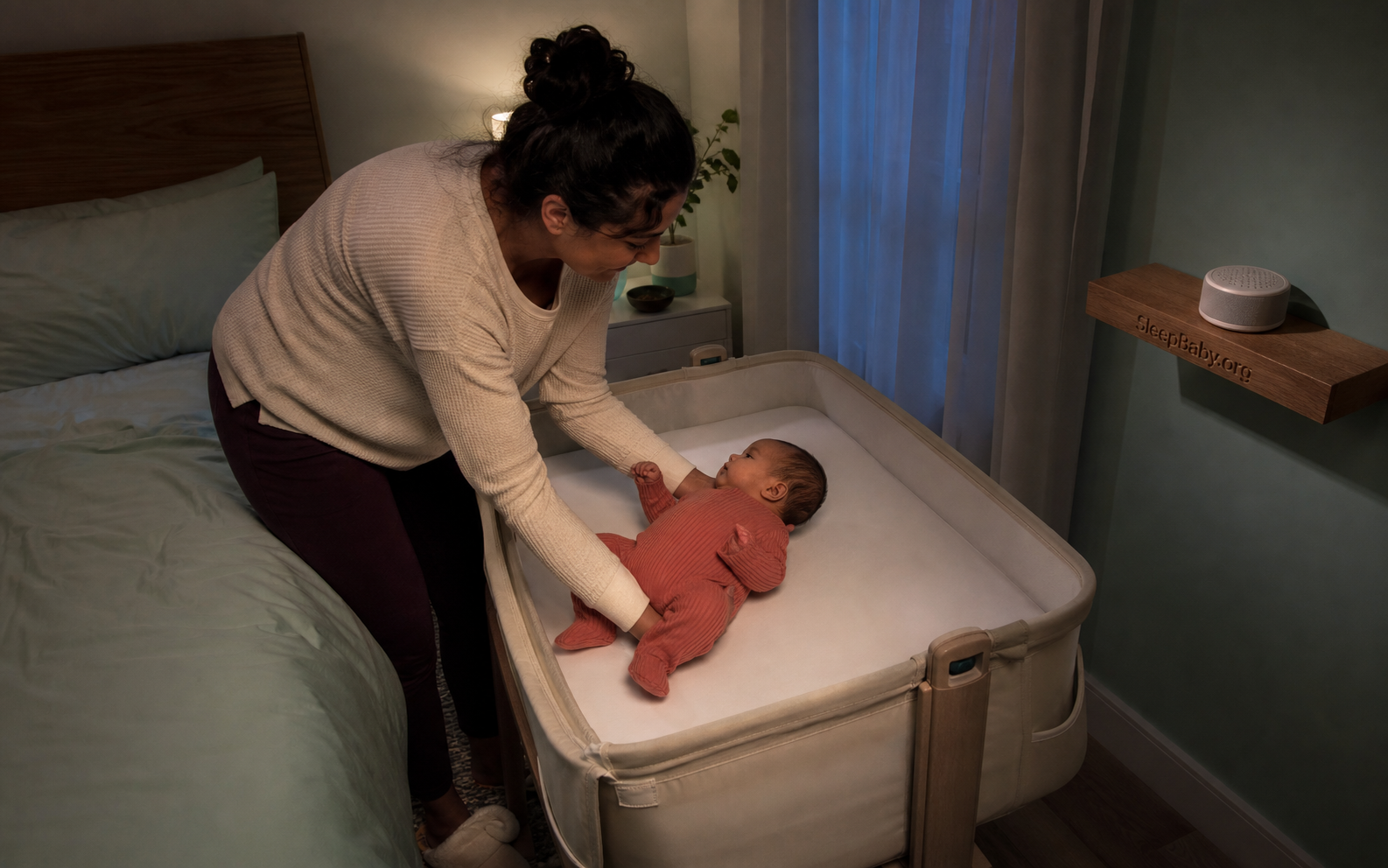
A motion-to-still handoff that changes one thing at a time
The swing cannot be a sleep-training step, even at lower speeds. Instead, build the bridge outside the seat. I would choose one cue that can exist beside both the awake settling routine and the safe sleep surface, then keep the landing boringly consistent. The purpose is not to guarantee that your baby stays asleep. It is to stop making five changes at once while preserving the safety boundary.
The one-change landing sequence
- Choose the legal destination first. Confirm the crib, bassinet, portable crib, play yard, or bedside sleeper is ready within its instructions, with only its fitted sheet.
- Keep one cue. Use the same brief song, phrase, or low external sound during wind-down. Keep sound devices and cords outside the sleep space and out of reach.
- Do motion in alert arms. If swaying helps, sway while you are fully awake and attending to the baby. Stop before the flat landing; the swing is not the bridge.
- Make one calm landing. Support head and body, place the baby on the back, pause with a steady hand, then release.
- If the baby wakes, check the whole situation. Feeding, diaper, temperature, clothing, congestion, pain, vomiting, breathing, wake time, and product fit matter more than another transfer trick.
- Use another alert adult when fatigue is winning. A brief reset in the safe sleep space is safer than drifting off while holding the baby on a couch or chair.
SleepBaby.org original teaching component
For a newborn, “practice” may mean only one or two calm landings before the next feed. Frequent waking is not evidence that you failed. If your baby is old enough that you are considering a formal sleep-training approach, discuss age, feeding, growth, health, and temperament with your pediatric clinician first; do not use continued swing sleep as the bridge to that plan.
THE HANDOFF LINE
The baby may wake. The safety boundary does not.
The cue begins outside sleep.
Motion stops before landing.
Back down on the bare surface.
This is the sentence I would keep beside me when a successful transfer lasts only four minutes. Waking changes the next caregiving step; it does not change where infant sleep belongs.
SleepBaby.org original teaching component
Which sleep should you practice first?
The safe-surface rule applies to every sleep, so choosing a practice window is not permission to use the swing for the other naps. It is simply a way to decide when you have the most patience and the best chance to notice what is actually making the landing hard. I would choose one sleep when the baby is usually fed, another alert adult can help if possible, and you are not already at the edge of falling asleep yourself.
For one family, that may be the first nap of the day, before the accumulated fussiness of the afternoon. For another, bedtime may work better because the room is already dim and the same caregiver can repeat the same short wind-down. There is no prize for starting with the hardest transfer. The useful question is: When can we make a safe landing without also changing feeding, room, clothing, sound, and timing?
With a newborn, keep the experiment very small. Feed responsively, handle burping and diaper needs, use the safe sleep space near you when appropriate, and try one calm landing. If the baby wakes hungry or needs contact again, respond. Do not stretch feeds, cap naps, or hold a crying newborn to a schedule just to make a transition plan look tidy. The point is to learn the landing, not to make a young baby perform independence.
Measure progress by whether the plan becomes safer and easier to repeat, not by whether the baby stays asleep on the first try. A useful first win may be a full feed followed by one calm bassinet landing, a shorter settling loop, or recognizing that a late attempt is consistently harder than an earlier one. One successful transfer does not prove the problem is solved, and one immediate wake-up does not prove the safe surface will never work. Keep the destination fixed, respond to the baby in front of you, and let several ordinary attempts show you which cue or caregiving need deserves attention.
Patterns matter more than a single rough night. If the first nap repeatedly goes better after a full feed, that is useful. If every flat landing brings coughing, choking during feeds, forceful vomiting, breathing changes, obvious pain, or unusual difficulty waking, stop treating it as a routine problem and call the pediatric clinician. If the bassinet has been outgrown or no longer fits the manufacturer’s instructions, stop using that product and move to another compliant infant sleep space.
And if a landing fails three times while your own eyes are closing, the next move is not a fourth heroic transfer on the sofa. Put the baby on the safe surface, wake another adult if one is available, and shorten the loop. A baby crying in a clear, approved sleep space while you regain enough alertness to respond is safer than a quiet baby in your arms when you drift off.

When every landing seems to fail
A baby who wakes on every transfer is not giving you one neat clue. Start with the ordinary needs that change the next decision. Was the feed complete for this baby? Is the diaper uncomfortable? Is the room or sleepwear too warm or cold? Is the baby congested, coughing, arching repeatedly, vomiting forcefully, breathing differently, or seeming painful? Is the bassinet being used within its weight, developmental, and assembly limits? Is the baby simply not ready for sleep yet—or already so tired that every transition feels enormous?
I would change the clearest mismatch, not six variables. If feeding looks unfinished, address feeding. If the product is outgrown or assembled incorrectly, stop using it and follow the manufacturer. If the baby seems ill or in pain, call the clinician rather than buying another sleep gadget. If everything looks ordinary, repeat the same short wind-down and landing instead of cycling through a warmer room, a new swaddle, louder sound, a later bedtime, a different mattress, and a whispered negotiation with the ceiling.
If the safe surface itself is the fight, use the Feed-Feel-Fit-Land check for a baby who refuses the bassinet. It answers the next practical question after the swing-sleep boundary is clear. The link belongs here, in troubleshooting—not inside the urgent safety answer.
What does not make swing sleep safe
The swing may be new, expensive, correctly assembled, or beloved during awake time. None of those facts turns its seat into a firm, flat infant sleep surface. The same is true after a recall check: “not recalled” means the exact model is not on the recall list you checked; it does not mean the product is approved for infant sleep.
The false-safety decoder
- “I will watch the whole nap.”
- Supervision cannot change the angle or make a sitting device an approved sleep surface.
- “The harness is snug.”
- The restraint is required for awake use as directed; it does not make sleep in the seat safe.
- “The motor is off or on the lowest speed.”
- Stopping or slowing motion does not flatten the seat.
- “It is only a ten-minute nap.”
- There is no short-nap exception in the safe-sleep guidance.
- “The monitor tracks breathing.”
- A consumer monitor does not convert the product or replace the safe-sleep environment.
- “This model was not recalled.”
- Continue to follow the manual for awake use, but move every sleep to the approved flat surface.

Reflux, discomfort, and the point to call
Some babies seem calmer upright and more uncomfortable after a flat landing. That is a reason to look at feeding and symptoms, not a reason to incline the sleep space or use the swing as treatment. The American Academy of Pediatrics advises back sleep on a firm, flat surface even for babies with reflux. Do not add a wedge, raise one end of the mattress, or use a sleep positioner.
Bring the pattern to your pediatric clinician if flat sleep repeatedly comes with distress, feeding trouble, poor intake, frequent forceful vomiting, coughing or choking during feeds, pain-like crying, poor weight gain, or a sudden change from the baby’s usual behavior. A clinician can evaluate the baby and the feeding picture; the swing cannot diagnose or treat the cause.
Body clue and care gate
Emergency now
Severe breathing trouble, blue or gray color, seizure, unresponsiveness, or extreme difficulty waking.
Call promptly
Breathing changes, repeated forceful vomiting, poor feeding, fewer wet diapers, unusual sleepiness, significant pain, fever in a young infant, or a sudden concerning change.
Discuss routinely
Repeated distress when flat, feeding questions, growth concerns, uncertainty about the sleep product, or a transition that remains unmanageable despite a consistent safe setup.
Written safety rule: if you are unsure how urgent a symptom is, contact your child’s clinician or local urgent service rather than using the swing to test whether the symptom improves.
The swing can stay, but its job changes
If you keep the swing, make it an awake-use product. Use it only while your baby is awake and directly supervised, with the original restraint, exact recline, and weight and developmental limits in the manual. Stop use when the instructions require it. Do not add aftermarket padding, head supports, blankets, toys, or inserts unless the manufacturer specifically supplied and directs them for that model.
Find the label with the manufacturer, model name or number, and date code. Search the U.S. Consumer Product Safety Commission recall database for that exact identity. The Fisher-Price Snuga recall is a useful reminder to check the precise model rather than treating a whole brand as recalled—or treating every other model as a sleep product. Follow any recall remedy exactly. A repair, refund, or removed insert addresses the recall terms; it does not create permission for swing sleep.
I would also choose a simple stopping cue for adults: when the eyelids close, the swing’s awake job is over. That keeps the rule attached to an observable moment instead of asking an exhausted person to remember how many minutes have passed.
A PORTABLE CUE FOR THE SAFE LANDING
Hatch Go Portable Sound Machine — Putty
If the swing’s hum has become part of the cue, Hatch Go lets you keep one familiar sound while retiring the unsafe seat from sleep. Hatch describes ten sounds, simple three-button control, a rechargeable battery, and no required app, Wi-Fi, or Bluetooth connection. That makes it easier to choose one sound and carry the same cue from the living room wind-down to the existing compliant crib or bassinet.
I prefer this fit to recommending another moving seat or automatically sending a family toward an expensive smart bassinet. It preserves the useful auditory cue without preserving the inclined seat, and it does not require replacing a safe sleep surface that already fits the baby and the home.
Important: this is a portable cue, not an infant sleep surface, medical device, SIDS-reduction product, or guarantee of settling. Place it outside the crib or bassinet with the ring and charging cord out of reach, use the lowest useful volume, and follow the manufacturer’s instructions.
As an Amazon Associate, SleepBaby may earn from qualifying purchases.
Existing optional shopping paths preserved from this article
These reader paths were already present in the public article and remain unchanged while the new article-specific recommendation is added.
- Browse baby sleep essentials on Amazon
- Browse smart bassinets on Amazon
- Browse newborn care essentials on Amazon
As an Amazon Associate, SleepBaby.org may earn from qualifying purchases.
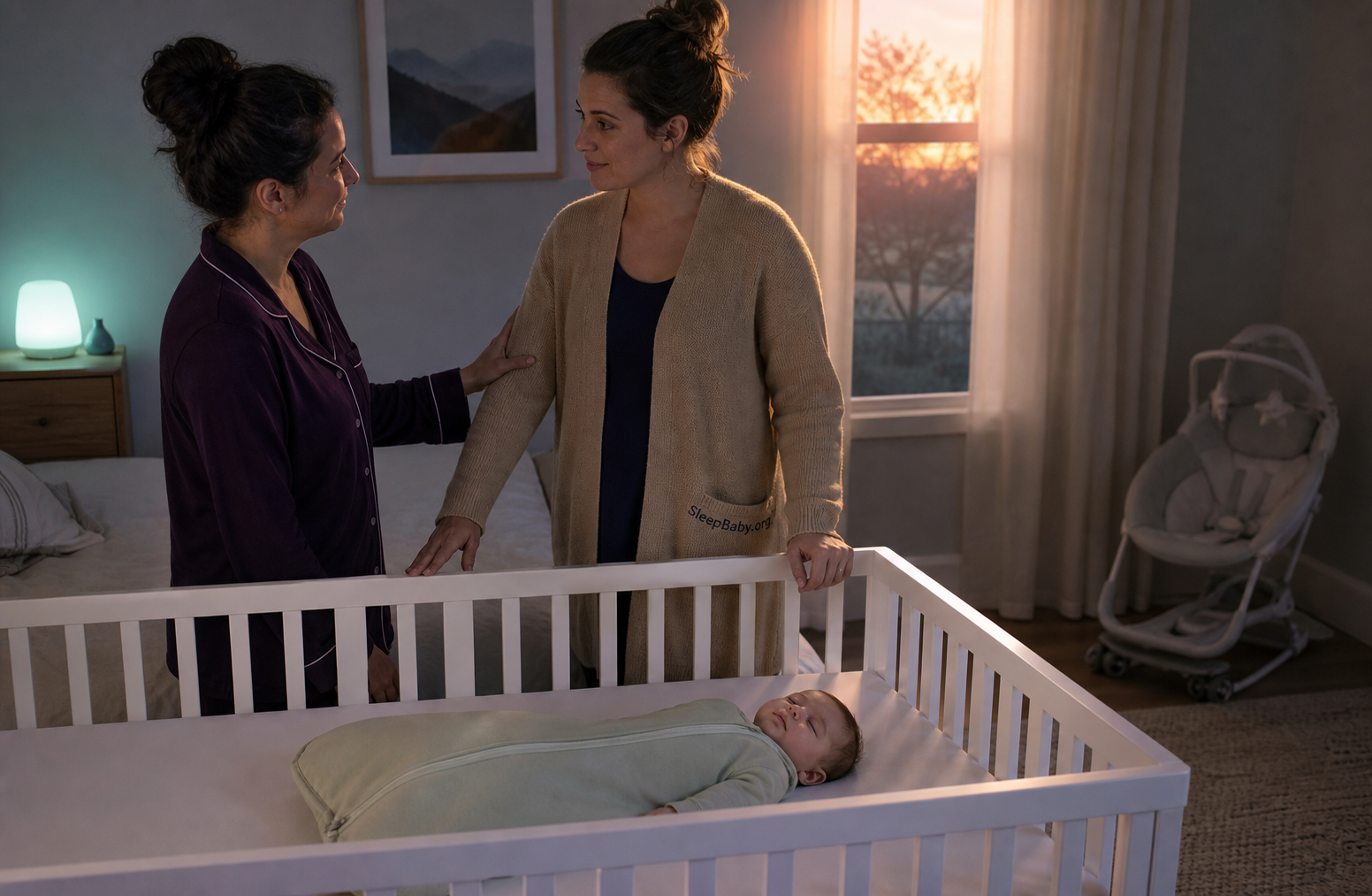

WATCH THE SURFACE, NOT THE SETTLING TRICK
Safe Sleep for Your Baby in 60 seconds
The transition can change sound, timing, and the way you hold your baby. It cannot change the destination. This concise NICHD Safe to Sleep video shows the firm, flat, level, separate sleep-space boundary that anchors the whole handoff.
From NICHD Safe to Sleep, U.S. Department of Health and Human Services. Watch on YouTube.
Takeaway: The baby may wake during the move. The safe surface does not become optional.
The hum is no longer the bed
Return to that 1:43 a.m. composite room. The motor is still humming, the bassinet is still three steps away, and Benjamin may still open his eyes during the lift. The changed part is not that I have discovered a perfect transfer. It is that I have stopped asking supervision to do a job it cannot do.
I can keep one quiet sound outside the bassinet. I can hold him responsively, check feeding and comfort, and try the landing again. I can put him down safely when my own alertness is thinning. I can ask another adult to take the next loop. And I can call the pediatric clinician when his body—not merely his preference for motion—gives me a reason.
The swing did not betray you by working so well. It showed you that motion or sound may be a strong settling cue. Keep the clue. Change the sleep location. In time, the hum can become something that happens near the bed instead of being the bed.
Sources
- American Academy of Pediatrics. Sleep-Related Infant Deaths: Updated 2022 Recommendations for Reducing Infant Deaths in the Sleep Environment.
- HealthyChildren.org. Safe Sleep: 9 Ways to Reduce a Baby’s Risk of SIDS & Suffocation.
- U.S. Consumer Product Safety Commission. Safe Sleep—Cribs and Infant Products.
- NICHD Safe to Sleep. Safe Sleep Environment for Baby.
- American Academy of Pediatrics. Evidence Base for 2022 Updated Recommendations for a Safe Infant Sleeping Environment.
- Liaw P, Moon RY, Han A, Colvin JD. Infant Deaths in Sitting Devices. Pediatrics. 2019.
- U.S. Consumer Product Safety Commission. Fisher-Price Snuga Infant Swing recall.
- HealthyChildren.org. What is the safest sleep solution for my baby with reflux?
- Hatch. Hatch Go product information.
- U.S. Patent and Trademark Office TTAB record. Hatch Go Putty ASIN identity exhibit.
WHEN THE MOTOR GOES QUIET
Build a bedtime that does not depend on the seat
When the only successful sleep happens in the swing, every transfer can feel like choosing between safety and the last scrap of rest in the house. You now have a smaller next step: keep one portable cue, make the flat landing, and change only the clearest mismatch. SleepBaby can help you turn that safe floor into a calmer, repeatable plan for the rest of the night.





What viewers said10 comments · 4 replies+
Archived comments from the original Baby Sleep Miracle presentation. Not independently verified by SleepBaby.org; individual experiences vary.
Thank you so much for this video! I had no idea about the dangers of baby swings :O
Hi Mary-Ann. I have a question: Is method in any way similar to the ones recommended by Dr Bucknam, Dr. Weissbluth or Dr. Karp? We tried those but none of them help.
Hi Regina, thank you for your question. The short answer is no. The techniques I share in my guide are based on newest scientific research and this is why I have never seen any approach similar to the one I recommend.
This method really works! I tried it on my son Jesus and after just one week he went from waking up more than 5 times a night to waking up just once or twice. You are a lifesaver, Mary-Ann!
I'm truly impressed with how much information you share in your video. And all for free! I can feel that you truly care about mothers like myself, and that's hard to find these days. I have recommended your site to several of my friends already.
Mary-Ann, our child suffers from autism. Is your approach still suited?
Chloe, I made sure my method can be used with any child, even babies who are special like yours. Please note that I'm not a doctor and that I always advice to consult with your physician because nothing is more important than the safety and well-being of your love.
Hallo Mary-Ann, I'm from Germany. Do you have your guide in German?
Hello Heide, we do! Normally you should already see our video in German. If not, please contact our support so they can guide you
Thenk you for your answer, Mary-Ann!
I just completed your approach and I have to say, it worked almost too well. Yes, it took a bit of getting used to with your bedtime routine but the difference is huge. My son George used to take 1 hours to go down and now he's firmly asleep in no more than 10 minutes! You're the best!
It seems I'm the only man watching this video, lol! What you shared about the 'emotional backpack' made immediate sense to me and I can't wait to help my little girl Mila to unpack it!
Hey there, just discovered your site and this really sounds different. Just wanted to say thanks for sharing :)
For everyone who's still thinking about getting Mary-Ann's guide I want to advise you to go ahead. I wasn't sure myself but now I'm so thankful I invested in this program. It made a huge difference in our life as a family and yes, my baby girl does sleep through the night now.