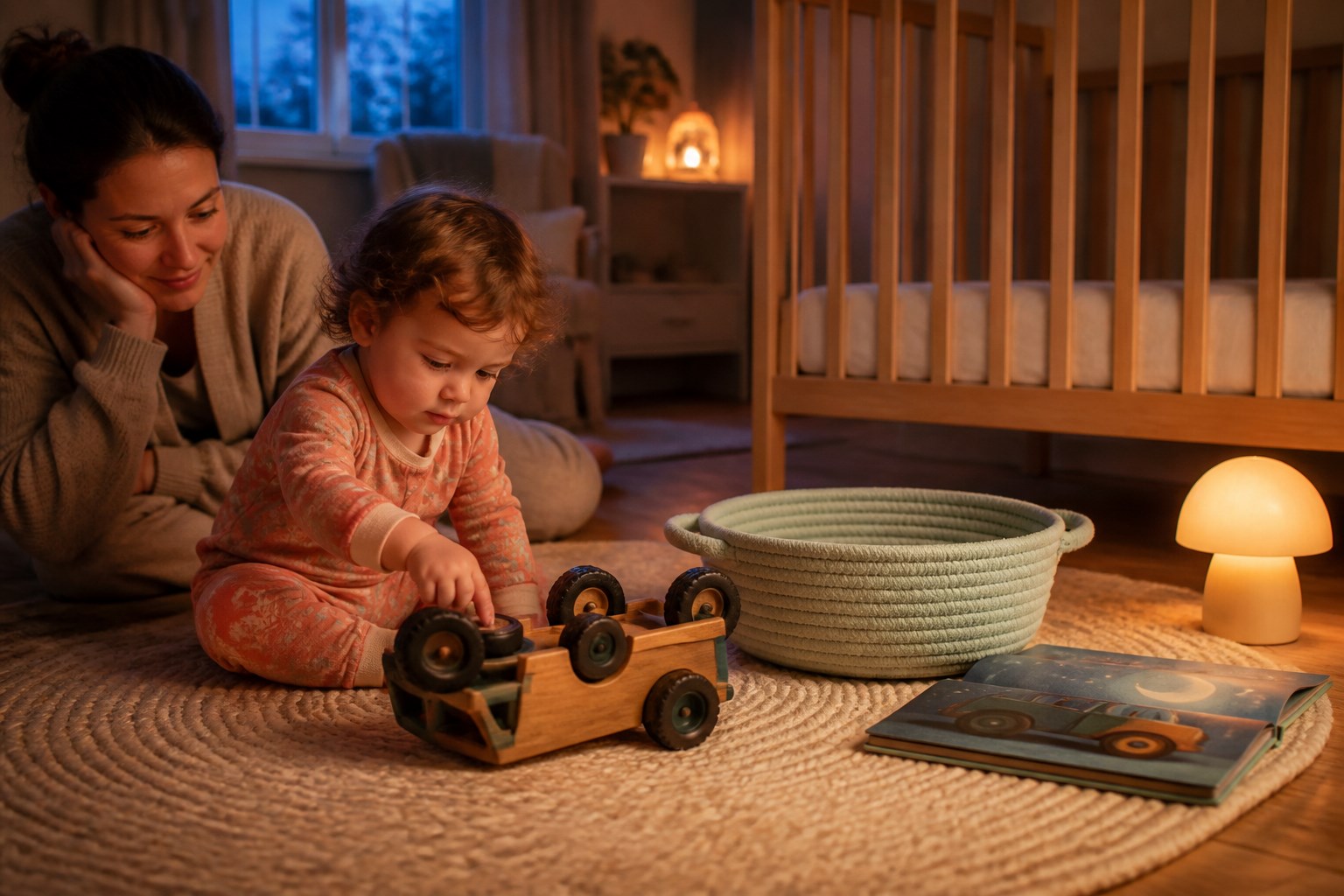
A baby or toddler who loves spinning toy wheels is often exploring motion, cause and effect, and the delicious power of making the same interesting thing happen again. That interest can fit comfortably inside ordinary play. By itself, though, it cannot prove that development is typical, and it cannot diagnose autism or any other condition.
The useful question is not, “How many wheel spins are too many?” There is no trustworthy cutoff. Look at the whole child: the range of play, communication and shared enjoyment, flexibility when something changes, emerging skills, safety, and whether the interest is crowding out daily life.
I know how oddly intense this can look from the adult side of the rug. A small person may turn over a perfectly good truck, ignore the cargo bed, and study one axle with the solemn focus of a laboratory director. Your job is not to wrestle the truck upright and make play look more conventional. It is to notice what else is happening, join without taking over, and widen the game one small step at a time. That distinction keeps curiosity available while giving genuine developmental concerns the calm, specific attention they deserve from you and the pediatrician.
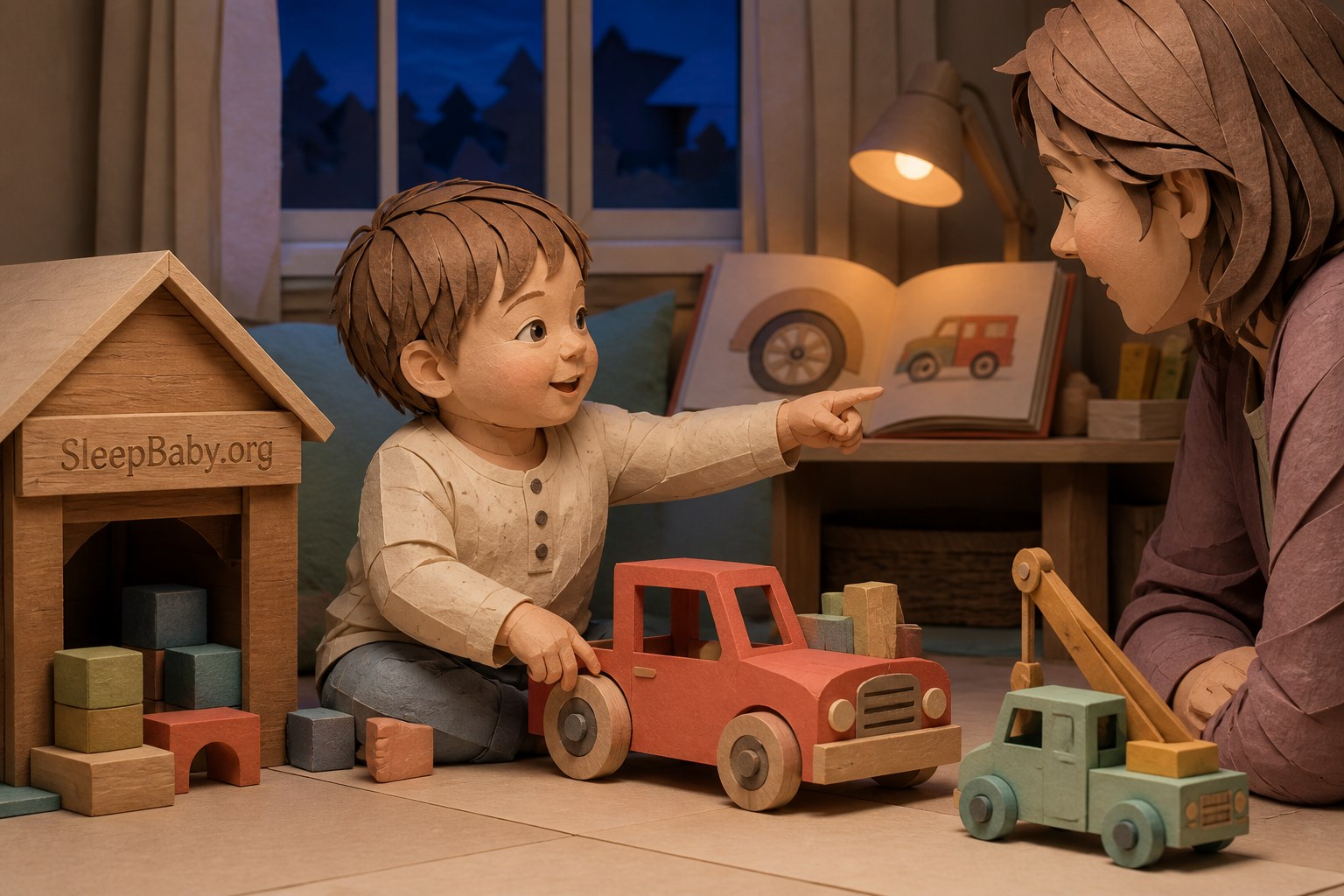
Why wheels can hold a baby’s attention
Wheels offer unusually clear feedback. A fingertip moves; the circle turns. Push harder and it moves faster. Stop the hand and the motion changes. For a young child who is learning what actions do, that is a tidy little experiment with an immediate result.
Repetition also gives the child control. Adults may see “the same thing again,” while the child may be comparing speed, angle, sound, wobble, shadow, or how long the wheel continues after the push. We cannot know the exact reason from across the room, so treat these as plausible explanations rather than hidden diagnoses.
Early-childhood educators sometimes describe repeated interests in movement as play schemas, such as rotation or trajectory. That can be a useful lens for choosing the next activity. It is not a medical label, a developmental score, or a reason to explain away other concerns. The plain-English version works beautifully: your child may be learning what round things do.
Repetitive behavior is not exclusive to autism. A descriptive study of typically developing two-year-olds found that several kinds of repetitive behavior were commonly reported, supporting the idea that these behaviors occur on a continuum. The study does not give us a wheel-specific “normal” number, and no responsible article should invent one.

When repeated wheel play fits ordinary exploration
Wheel play is easier to understand when you watch it in context. A child may adore spinning wheels and also push the car across the floor, load blocks into it, bring it to you, copy a sound, notice another child, accept a turn, or wander off to investigate a spoon. That variety matters more than whether wheels happen to be the current favorite.
Transitions do not have to be graceful to count as flexible. Toddlers are allowed to dislike stopping. A protest that softens with a warning, a little help, and a clear next step is different from a pattern of prolonged, intense distress that repeatedly makes meals, childcare, leaving home, or sleep impossible.
Two patterns, not two verdicts
What you may notice—and what changes the next step
Often compatible with ordinary exploration
- The child enjoys wheels and also explores other actions, toys, or people.
- The play sometimes becomes shared through showing, copying, rolling, taking turns, or enjoying your narration.
- With realistic support, the child can move on—even if there is a protest.
- The interest is not creating an ongoing safety problem or displacing everyday participation.
- Skills expected for the child’s age continue to appear, with no loss of skills already used.
Worth discussing with the pediatrician
- The wheel focus appears with missed or lost communication, social, movement, or play skills.
- You rarely see age-expected gestures, shared attention, social response, or flexible play.
- The play is rigid across settings, interruption brings prolonged intense distress, or safe disengagement is very hard.
- Eating, leaving home, childcare, sleep, family participation, or access to other play is repeatedly limited.
- The pattern changes suddenly, includes unresponsive episodes or injury, or simply sits badly with what you know about your child.
The right-hand column is a route to conversation, not a diagnosis. You do not need to assemble enough evidence to “earn” a pediatric question.
Does spinning wheels mean autism?
No single wheel behavior answers that question. The Centers for Disease Control and Prevention describes autism as a broader developmental pattern involving social communication and interaction differences together with restricted or repetitive behaviors or interests. Focusing on parts of objects, including wheels, is one possible example in a much larger picture. Children do not have to show every example, and a list of examples is not a home diagnostic tool.
This is where online advice often veers into one of two ditches. One side says, “All toddlers do that, so ignore it.” The other says, “That is an autism sign,” as though a toy wheel carries a diagnosis in its hubcap. Neither is careful enough.
Researchers have studied repeated object actions such as spinning, rotating, and unusual visual inspection. One prospective study found group-level differences in an enriched cohort that included infants with an older autistic sibling. That is useful research about development over time. It is not a community screening rule, and it does not let a parent infer an individual child’s diagnosis from rotating an object.
Age matters, too. The CDC’s 18-month milestones include simple functional play such as pushing a toy car. At age two, milestone examples include trying switches or knobs and combining more than one toy. These are monitoring examples, not pass-fail assignments. A baby, an 18-month-old, and a three-year-old should not all be measured against the same play expectations.
Notice the breadth: Does your child point or gesture in ways that fit their age? Bring you things to show? Respond to familiar people? Copy actions? Use sounds or words? Combine toys? Invite you into a moment? You are looking for a developing pattern, not conducting a living-room examination. Do not force eye contact, pretend play, speech, or turn-taking to see whether your child can “perform” on demand.
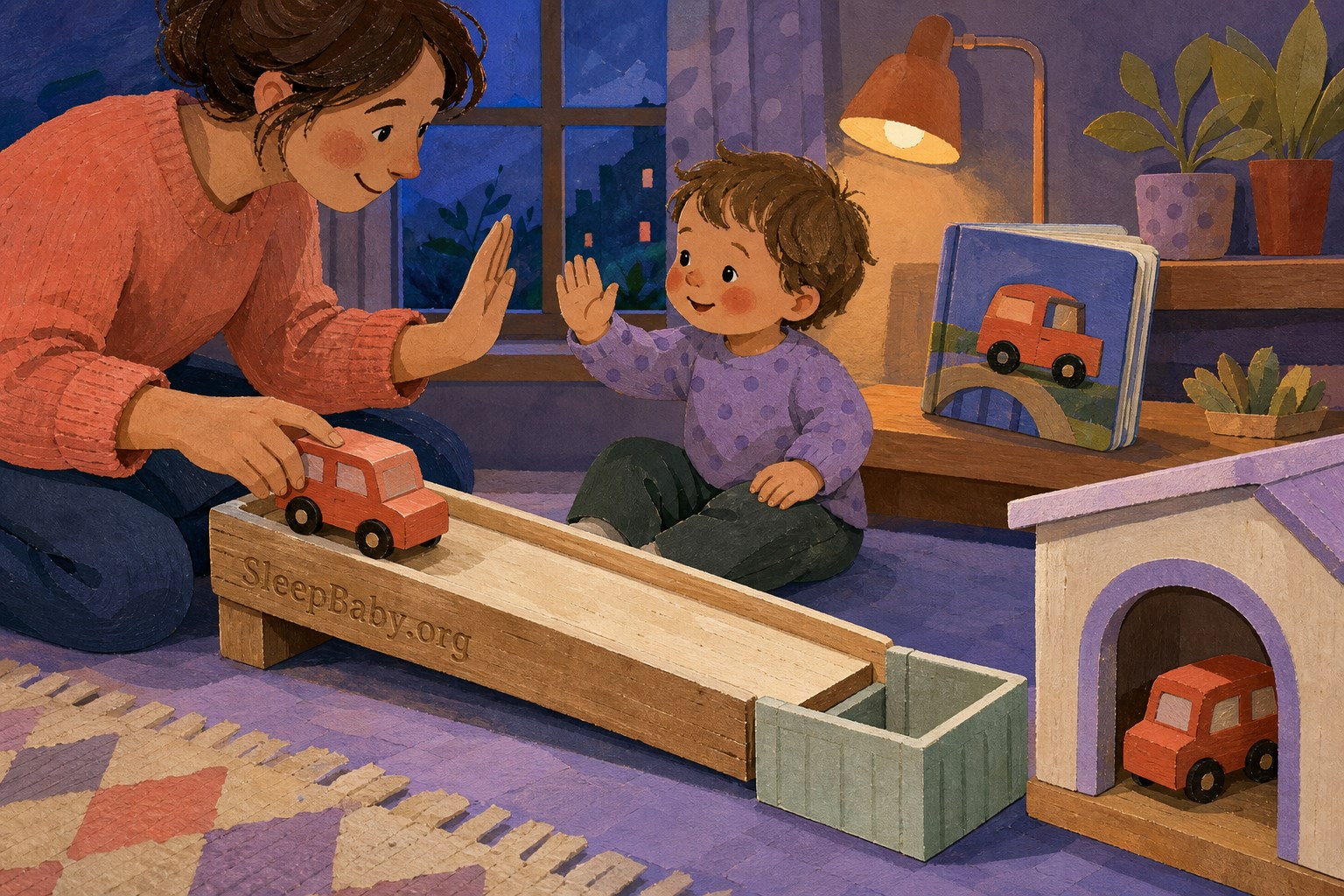
What to notice for three to seven ordinary days
If you are unsure, make brief notes during normal life for a few days. This is not a test and does not need a spreadsheet worthy of a grant committee. A few concrete examples will tell you—and a pediatrician—more than the word “obsessed.” Stop observing and seek help sooner if a skill is lost, safety is involved, or a change alarms you.
Describe; do not label
Six details that make an observation useful
- Context. Note which objects invite spinning and whether it appears during free play, fatigue, waiting, transitions, or many unrelated settings.
- Range. Notice other actions: pushing, loading, crashing, parking, pretending, building, or combining toys.
- Connection. Record showing, pointing, looking, bringing, imitating, gesturing, vocalizing, or inviting another person in—without demanding any one behavior.
- Transition. Write what warning was given, what happened when play stopped, how intense the distress was, and how long recovery took.
- Function and safety. Note concrete effects on meals, leaving, childcare, bedtime, family life, or safe play.
- Development over time. List new skills you are seeing and any skill that has disappeared.
“Spun the stroller wheel for eight minutes while we waited, then came when I offered shoes” is useful. “Acted weird and obsessive” is not.
Keep these notes private. There is no need to upload a child’s developmental details into a quiz, app, or comment box to get an answer. Bring the examples to the child’s clinician if you want another set of trained eyes.
How to redirect repetitive wheel play without banning it
Try join, stretch, then switch. It is a respectful sequence, not a therapy protocol. The goal is to make play broader and transitions more workable while leaving a safe interest intact.
One small step at a time
1 · Join
Enter the game gently
Sit nearby, copy one action, or narrate a visible property: “Fast wheel. Now it stopped.” If your child welcomes it, roll a car back and forth. Connection comes before correction.
2 · Stretch
Add one nearby possibility
Offer a ramp, cargo block, tunnel, parking space, or turn. Keep the wheel central while the play gains a route, a person, a word, or a tiny bit of pretend.
3 · Switch
Make the ending concrete
Preview the last action—“two more rolls, then park”—and offer two bounded next choices. A parking basket makes stopping feel like the next scene, not the disappearance of a beloved object.
If joining makes your child tense or pushes you away, back up. Warm observation counts as connection. If adding a ramp is welcomed but adding a passenger is not, keep the ramp. The smallest successful stretch is more useful than an elaborate adult plan that converts play into work.
Six ways to widen wheel play
- Build a low ramp. Compare fast and slow, high and low, or near and far. Keep the setup sturdy and age-appropriate.
- Add a simple delivery. Load one block or toy animal, drive it somewhere, and unload it. The vehicle now connects with another object and a beginning-to-end action.
- Open a car wash or repair spot. A cloth, soft brush, and pretend tool can add imitation and a practical sequence without demanding a full story.
- Make a parking challenge. Draw or tape wide bays on paper and park by color, size, or “home.” Avoid turning every choice into a quiz.
- Carry roundness elsewhere. Roll a large ball, push a sturdy cart, trace circles, or notice a wheel outdoors from a safe distance. Similarity can open the interest without erasing it.
- Choose a wheel-themed book. Let the child point, turn pages, imitate sounds, or simply listen. One playful question is enough; a rapid-fire comprehension interview is not required.
The American Academy of Pediatrics encourages caregivers to follow a toddler’s interests, describe what is happening, wonder about what comes next, and offer related materials. That is the spirit here. You are not tricking a child away from wheels. You are using the open door the child already gave you.

When stopping wheel play becomes the hard part
Sometimes the concern is less about how a child plays and more about what happens when play ends. Start by checking the adult side of the transition. Was the stop sudden? Was the child hungry, tired, or already stretched thin? Did “time to go” mean five different actions with no visible first step? Even a flexible child can unravel when an absorbing activity vanishes without a bridge.
Use a short warning the child can understand. “Two more rolls, then shoes” is clearer than “We’re leaving soon.” Follow through calmly. If counting winds the child up, use one last concrete job: park the truck, put the wheel book in the basket, or wave goodbye to the stroller.
Offer bounded choice about the next step, not about whether the transition happens: “Carry the red car or the blue car to the basket?” “Walk to pajamas or ride on my feet?” A choice can return a little control without reopening the entire negotiation.
Do not declare war on the toy. Confiscating every wheeled object because a child repeats the play may remove a genuine source of learning and pleasure without addressing the transition skill. Keep safety limits firm, but aim to teach an ending the child can recognize.
Can wheel play make bedtime harder?
Wheel play does not inherently cause a sleep problem. There is no good evidence that spinning toy wheels depletes melatonin, creates a special cortisol surge, or “overstimulates” every toddler. The useful sleep connection is simpler: a highly absorbing or energetic activity can repeatedly crowd the bedtime sequence or make an abrupt transition harder for this particular child.
Consistent bedtime routines are associated with better sleep outcomes, and a randomized trial found improvements after families introduced a simple nightly routine. Those studies concern routines broadly; they do not prove a wheel-specific mechanism. Use a predictable sequence because children benefit from recognizable transitions, not because a parked toy car is a treatment.
When wheels keep rolling into bedtime
A four-stop evening handoff
- Move the big motion earlier. Use ramps, ride-ons, crashes, and fast rolling before the final part of the evening when possible.
- Give one clear warning. Name the final action: “One slow roll, then park.” Keep the wording familiar.
- Park instead of snatch. Put the vehicle in the same garage, shelf, or basket. If it helps, carry the theme into one calm wheel book.
- Return to the familiar route. Continue the family’s ordinary pajamas, teeth, story, and bed sequence. Judge the plan by a more workable transition and adequate sleep—not by whether the interest disappears.
For a two-year-old whose whole sleep day needs adjusting, this flexible two-year-old sleep schedule can help you look at nap and bedtime timing separately from the wheel interest. If the bedtime itself feels hard to place, use the broader guide to choosing a bedtime from sleep cues and the day’s rhythm.

When to talk with the pediatrician
Bring up the pattern whenever you remain concerned. You do not need to wait until the next standard screening age or until the behavior becomes severe. The American Academy of Pediatrics recommends developmental surveillance at every health supervision visit, standardized general developmental screening at 9, 18, and 30 months, and autism-specific screening at 18 and 24 months. Screening is also appropriate whenever a concern arises.
Ask sooner if the wheel interest comes with communication, shared-attention, social-response, movement, or play differences; if participation in daily life is narrowing; if transitions cause prolonged intense distress; or if the child is not meeting expected milestones. If a child has lost a skill they previously used, contact the pediatrician promptly rather than watching for another week.
Describe what you saw: frequency, setting, play variety, response to another person, distress, recovery, functional effect, and any other developmental change. Ask whether a validated developmental screen or referral is appropriate. If a delay is identified, families can be referred for evaluation and early intervention without waiting for an autism diagnosis.
A pediatric screen is a process, not a verdict
What developmental screening actually looks like
A wheel interest is not a screening result. This short American Academy of Pediatrics video explains how screening helps a clinician look at development in a standard, structured way.
Takeaway: bring concrete observations and ask for a validated screen. You do not need to arrive with a diagnosis to prove.
Watch “The Developmental Screening Process” on the AAP’s YouTube channel if the embedded player is unavailable.
For more age-appropriate context beyond this one interest, browse SleepBaby’s development and behavior library. Use it to prepare better questions, never to replace a child-specific clinical assessment.
Toy-wheel safety: the part that does need a firm boundary
A fascination with wheels can pull a child toward objects that were not designed for play. Keep real vehicles, moving exercise equipment, strollers, carts, garage mechanisms, and machinery inaccessible unless an adult is actively supervising an appropriate interaction. “He only wants to spin it” does not make a moving or load-bearing part safe.
Use intact, age-appropriate toys and follow the manufacturer’s age and safety information. The U.S. Consumer Product Safety Commission advises keeping small balls and toys with small parts away from children younger than three. Retire a toy if a wheel loosens, an axle cracks, a sharp edge appears, or small hardware becomes accessible.
Battery compartments should stay secured and require a tool to open. Button and coin batteries can cause devastating internal injury if swallowed; suspected ingestion is an emergency. Loose high-powered magnets and magnet-containing toy parts also need to remain inaccessible because more than one swallowed magnet—or a magnet with another metal object—can trap tissue between them.
For age-appropriate riding toys, follow the product instructions and use the recommended safety gear. Safety is the place for a confident no. Harmless repetition is not.

Questions parents ask
Is it normal for a baby to spin toy wheels?
It can be part of ordinary exploratory play. Look at age, play variety, communication, shared attention, transitions, development over time, and daily function. No reliable wheel-spin cutoff separates “normal” from “concerning.”
Does playing with wheels mean autism?
No. Focusing on object parts such as wheels can appear among autism-related repetitive behaviors, but one behavior cannot diagnose or rule out autism. A clinician considers the broader developmental pattern and uses validated screening when appropriate.
Should I stop repetitive wheel play?
Usually not if it is safe and not substantially limiting daily life. Join briefly, add one related possibility, and teach a predictable ending. Set firm limits around unsafe objects, loose parts, batteries, magnets, real vehicles, or machinery.
What can I offer a toddler who only wants to spin wheels?
Try a sturdy ramp, simple cargo, a car wash, parking spaces, a large rolling ball, or a wheel-themed book. Add only one thing at a time. The aim is broader play and connection, not forcing a performance.
Can wheel play make bedtime harder?
Not inherently. It matters when active or absorbing play repeatedly delays the bedtime sequence or stopping becomes a nightly battle. Move the energetic version earlier, preview one final roll, park the toy, and continue the family’s familiar routine.
Most of all, keep your interpretation proportional. A wheel can be fascinating without being a warning siren. A reassuring moment does not erase a broader concern, either. Notice the child in front of you, protect the joy in safe play, and ask for help when the whole pattern—not one spinning object—changes the answer.
Sources
- CDC: Signs and Symptoms of Autism Spectrum Disorder
- CDC: Milestones by 18 Months
- CDC: Milestones by 2 Years
- AAP: Promoting Optimal Development Through Surveillance and Screening
- Arnott et al.: Repetitive Behaviours in Typically Developing 2-Year-Olds
- Miller et al.: Repetitive Object Behavior in an Enriched Infant Cohort
- AAP HealthyChildren: Playing Is How Toddlers Learn
- CPSC: Toy Safety
- CPSC: Button and Coin Battery Safety
- Mindell et al.: Bedtime Routines and Sleep Outcomes
- Mindell et al.: Randomized Trial of a Nightly Bedtime Routine
- AAP HealthyChildren: Brush, Book, Bed






What viewers said10 comments · 4 replies+
Archived comments from the original Baby Sleep Miracle presentation. Not independently verified by SleepBaby.org; individual experiences vary.
Thank you so much for this video! I had no idea about the dangers of baby swings :O
Hi Mary-Ann. I have a question: Is method in any way similar to the ones recommended by Dr Bucknam, Dr. Weissbluth or Dr. Karp? We tried those but none of them help.
Hi Regina, thank you for your question. The short answer is no. The techniques I share in my guide are based on newest scientific research and this is why I have never seen any approach similar to the one I recommend.
This method really works! I tried it on my son Jesus and after just one week he went from waking up more than 5 times a night to waking up just once or twice. You are a lifesaver, Mary-Ann!
I'm truly impressed with how much information you share in your video. And all for free! I can feel that you truly care about mothers like myself, and that's hard to find these days. I have recommended your site to several of my friends already.
Mary-Ann, our child suffers from autism. Is your approach still suited?
Chloe, I made sure my method can be used with any child, even babies who are special like yours. Please note that I'm not a doctor and that I always advice to consult with your physician because nothing is more important than the safety and well-being of your love.
Hallo Mary-Ann, I'm from Germany. Do you have your guide in German?
Hello Heide, we do! Normally you should already see our video in German. If not, please contact our support so they can guide you
Thenk you for your answer, Mary-Ann!
I just completed your approach and I have to say, it worked almost too well. Yes, it took a bit of getting used to with your bedtime routine but the difference is huge. My son George used to take 1 hours to go down and now he's firmly asleep in no more than 10 minutes! You're the best!
It seems I'm the only man watching this video, lol! What you shared about the 'emotional backpack' made immediate sense to me and I can't wait to help my little girl Mila to unpack it!
Hey there, just discovered your site and this really sounds different. Just wanted to say thanks for sharing :)
For everyone who's still thinking about getting Mary-Ann's guide I want to advise you to go ahead. I wasn't sure myself but now I'm so thankful I invested in this program. It made a huge difference in our life as a family and yes, my baby girl does sleep through the night now.