
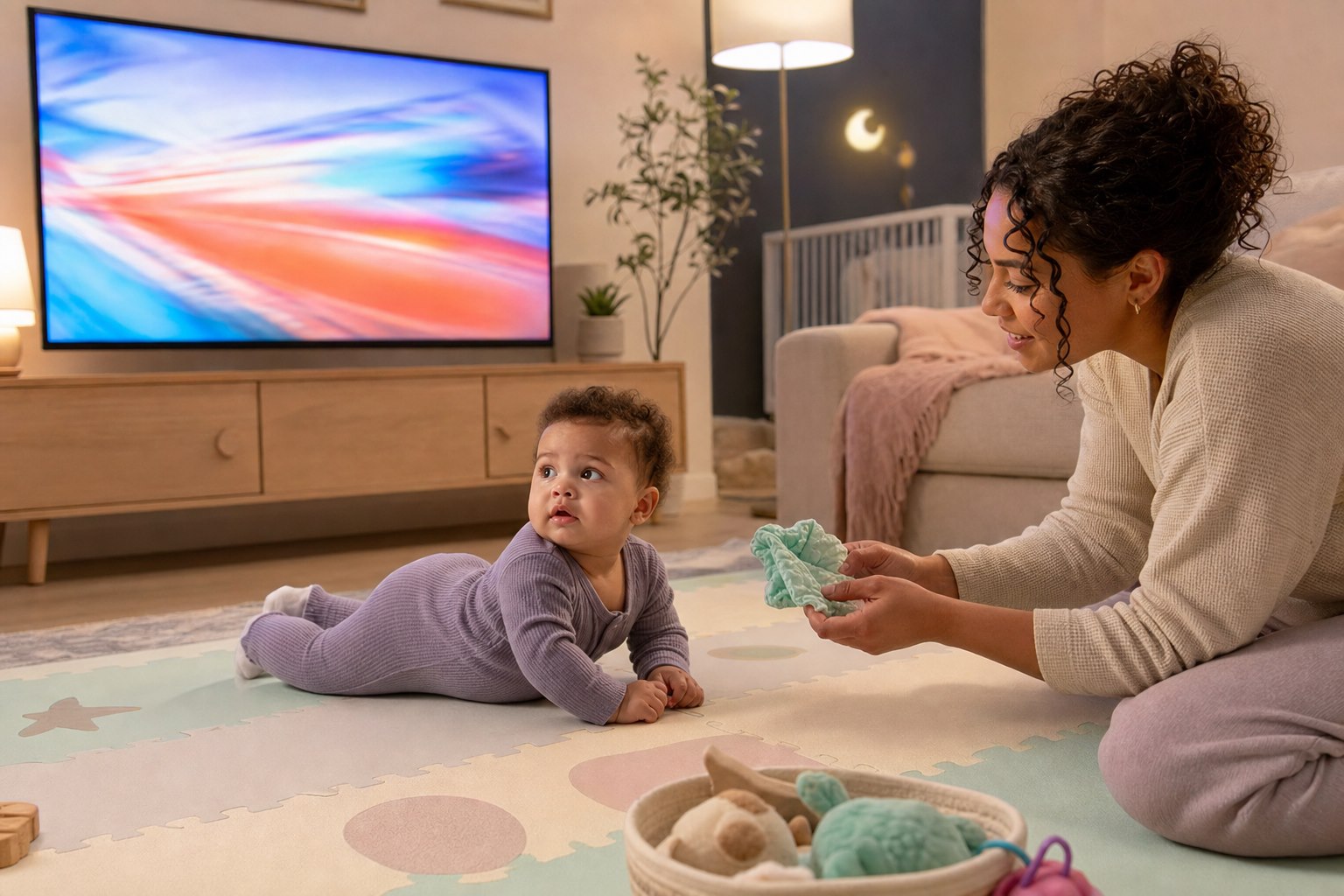
If your baby keeps swiveling toward the TV, taking a break from the screen can feel impossible. The good news is that fascination is not the same thing as damage. A television is engineered to win attention; your job is not to out-muscle it, but to make the next human thing easier to notice.
Composite-mom scene: I once turned around with a half-made bottle and realized the smallest person in the house had become its most committed sports-bar regular. The television had slipped from background noise into the brightest, fastest thing in the room.
I want you to notice the pattern without blaming yourself. You are not diagnosing an addiction from one intense stare. I would start with one return trip: lower the screen, offer your face, voice or a simple object, and see whether attention can move.
Quick answer: babies are drawn to motion, contrast, voices and scene changes. That pull alone does not diagnose addiction, speech delay, autism or a developmental problem. What matters is the whole pattern: can your baby still shift to a face or toy, what is the screen crowding out, and is TV becoming the default way your family calms down or gets to sleep?
The TV Magnet Check
Instead of asking, “Is my baby obsessed?” ask three calmer questions:
- Shift: can attention move from the TV to your face, a song or a floor toy?
- Seek: does your baby still look for people, voices and back-and-forth play?
- Crowd-out: what disappears when the TV is on: talking, reading, crawling, winding down, or all three?
If the answer to the first two is still mostly yes, you are likely seeing normal attention capture, not a diagnosis. If the third answer is “everything,” the screen has become a household habit worth changing.
(A tiny disclosure because this matters: the voice in this article is a composite mom scene, not an author biography. It is invented but plausible, because a lot of parenting truth lives in the same kitchen.)
Last Tuesday, I had one hand on a bottle and one eye on a frying pan when the baby did that impossible little neck turn toward a sports replay. Apparently the smallest person in the house had become our most committed sports-bar regular. I laughed, then immediately got the guilt stomach-drop: Did I do this? Did I already make a problem?
The answer is usually less dramatic and more useful. Screens are sticky because they are designed to be sticky. Bright movement, sudden sound, faces on a flat plane, and constant novelty are attention magnets. Babies are built to notice movement and human voices; television simply turns those dials all the way up.
What the current guidance actually says
The American Academy of Pediatrics has shifted away from a single clock-only rule and toward a more practical infant lens: the child, the content, calm, crowding out and communication. That framing is better because it answers the real family question, not just the timer on the wall.
Child
Age matters, but so does the baby’s behavior in the room. A baby who briefly glances at a screen is not the same as a baby whose attention cannot leave it.
Content
Video chat is different from passive entertainment. Cartoons and nursery-rhyme loops may feel baby-made, but that does not make them baby-learning tools.
Calm
If screens become the only way to soothe a baby, the screen may be crowding out the chance to practice settling with a caregiver’s help.
Crowding out
This is the hidden one. The issue is often not just what the baby is watching; it is what the watching replaces: talking, singing, reading, crawling, eye contact, and a repeatable bedtime rhythm.
Communication
Back-and-forth interaction is the actual work of early development. A baby can watch a screen and still miss the richer human loop.
The World Health Organization is also clear that young children need less sitting and more play. For infants and one-year-olds, less sedentary screen time is better; for two-year-olds, one hour is the upper ceiling and less is still preferable. None of that means your baby is ruined because you used the TV while making dinner. It does mean the TV should not become the family operating system.
The 5 C’s, remoted down
Picture the remote as a decision tool instead of a guilt trigger.
- Child: Who is actually in front of the screen?
- Content: Is this a video chat, a short shared clip, or passive background TV?
- Calm: Is the screen calming, or is it the only brake pedal the house has?
- Crowding out: What gets squeezed out when the screen comes on?
- Communication: Are there still real back-and-forth moments after the screen goes dark?
Watch the AAP?s 30-second reset
SleepBaby takeaway: The AAP?s Dr. David Hill makes the useful replacement clear: talking, reading, playing and singing with a parent teach a young child more than an app. Choose media deliberately and set boundaries.
A realistic seven-day reset
You do not need a perfect household overnight. You need a small, repeatable pattern that helps the baby’s attention find humans again.
Day 1: Move the screen out of the center of the room
If the TV is the visual boss of the living room, it will keep winning. Change the furniture angle, reduce the screen’s line of sight, and park the remote somewhere boring and consistent.
Day 2: Replace one screen moment with one human cue
Choose the easiest win, not the noblest one. A song while the bottle warms. A face at the window. Two minutes of floor time before the TV flips on.
Day 3: Add a handoff phrase
Babies love predictability even when they seem to fight it. Try the same sentence each time: “TV off, faces on.” The words are less important than the rhythm.
Day 4: Stop using the TV as the default calm button
If every cranky moment gets immediate screen rescue, the screen becomes the answer to all discomfort. Pick one non-screen soothing step first: hold, sway, sing, snack, diaper, outside light, or a toy rotation.
Day 5: Protect the background
Background television and phone scrolling count more than people like to admit. If you are talking to the baby while the TV is on, your words have to compete with a bright rectangle. Turn the room into a place where your voice wins by default.
Day 6: Give the baby something the TV cannot do
Faces, touch, repetition, and shared attention are the real competitors. Read the same board book again. Sing the same ridiculous song. Babies are not bored by love the way adults are bored by repetition.
Day 7: Notice the shift instead of chasing perfection
The goal is not zero TV forever. The goal is to see whether the baby’s attention can reattach to people and play when the screen is less central.
That seven-day reset works because it changes the whole system, not because it magically persuades a baby to care less about flashing pixels. And yes, you may still get a protest. Babies are small, not oblivious.
What about bedtime?
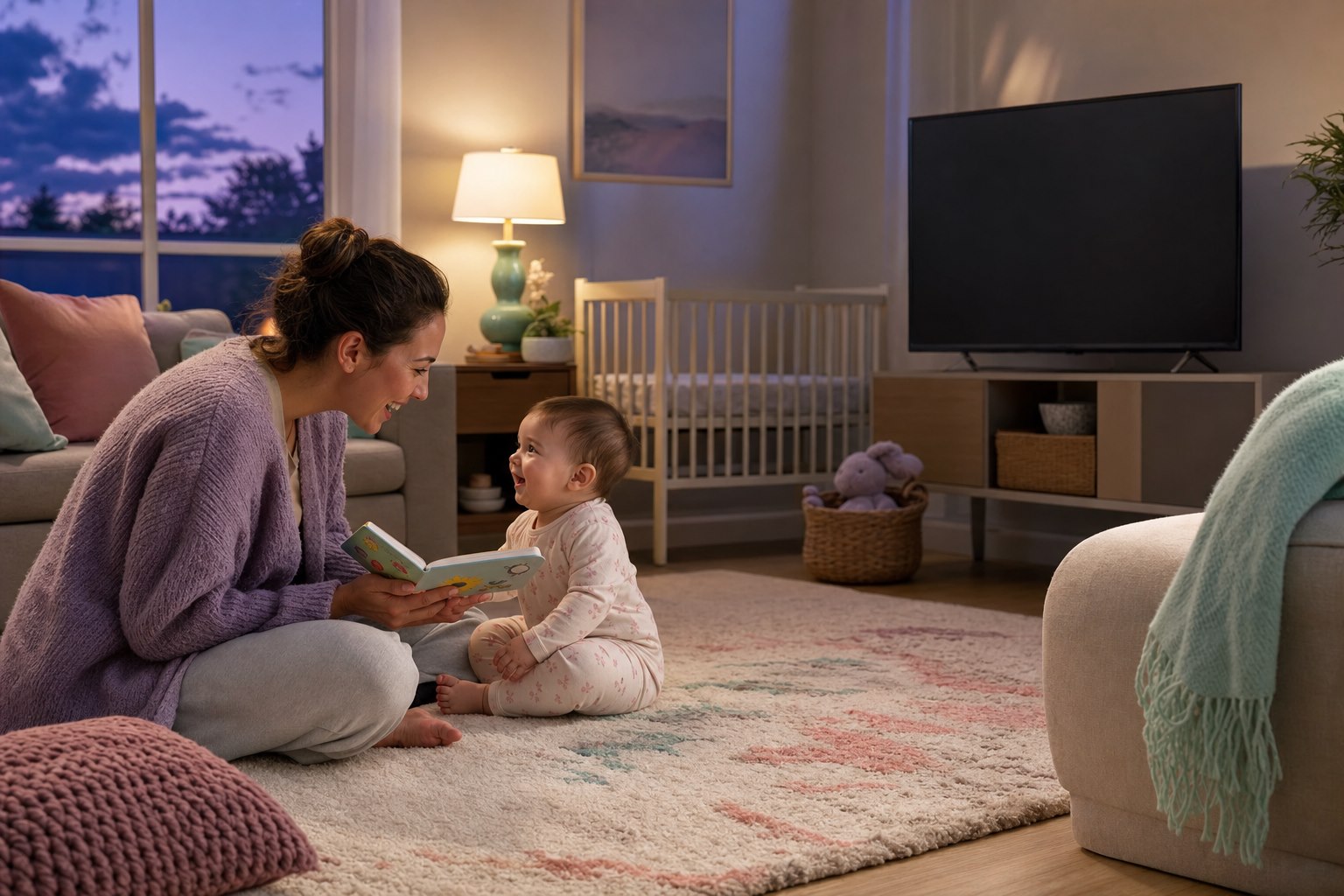
This is where the TV problem often turns into the real sleep problem. If the screen has become the baby’s off-switch, turning it off can feel like yanking away the only bridge to sleep. That is not a moral failure; it is a cue problem.
Start by building a replacement bridge before you remove the old one. If the sequence has always been glow, then drowsy, then sleep, create a new order: dimmer light, same song, same chair, same hand on the back, same final phrase. The baby is learning the path, not the lecture.
Screen-to-sleep exit ramp
- Notice the moment the TV is about to become the sleep cue.
- Swap the screen for one predictable human action.
- Repeat the replacement cue every night until the baby recognizes it.
- Keep the transition boring, gentle and consistent.
If the remote is under a cushion and the baby keeps looking at the blank rectangle, that is the point at which the room needs a new script, not more willpower. SleepBaby can help build that gentler wind-down when the glow is gone, because some families do not need more guilt; they need a repeatable sequence.
When to worry less, and when to call the pediatrician
Worry less if your baby only glances at TV, still seeks faces, still plays, and can shift when the room changes. Worry more if you are seeing broader developmental concerns: loss of skills, poor response to people, feeding problems, sleep problems that feel extreme, or anything that makes you uneasy beyond the screen itself.
And please do not use television as a diagnosis machine. A baby staring hard at a screen cannot tell you whether there is autism, speech delay, addiction or another issue. It can only tell you that the screen is doing what screens do best: grabbing attention.
Two physical hazards people forget
Remote controls and batteries
Remote controls can hide button or coin batteries. Keep the compartment secure. A battery that no longer powers the device can still injure a child if swallowed.
TV and furniture tip-overs
As babies become mobile, anchor televisions and furniture. Reaching, climbing and pulling are not abstract future events; they start sooner than most living rooms are ready for.
It is a strange little parenting rite: the baby discovers the remote, the parent hides the remote, and suddenly the remote has become the most interesting object in the house. The joke is funny until it isn’t, which is why the battery check matters.
The part nobody says out loud
Sometimes the TV obsession is not really about the TV. It is about the parent needing five uninterrupted minutes to cook, shower, answer a text, or simply stop being physically touched for a minute. That is not failure. That is family life under load.
So if you need to use the screen, use it deliberately. Put it in one place, at one time, with one plan for what happens after. The TV is a tool, not a babysitter with a permanent contract.
Final thought
Your baby is not more powerful than a relationship. The room can be redesigned. The routine can be redesigned. And if the television has quietly become the baby’s favorite tiny planet, you can still shift the orbit without shame.
SleepBaby bridge: if the screen has become the family’s bedtime off-switch, the next step is not perfection; it is a calmer repeatable wind-down. When you are ready, build the new cue before the old one disappears.
Sources
- American Academy of Pediatrics, Helping Kids Thrive in a Digital World: AAP Policy Explained, reviewed 2026-07-26.
- American Academy of Pediatrics, Kids & Screen Time: The 5 C’s Questions to Ask for Infants, reviewed 2026-07-26.
- World Health Organization, To grow up healthy, children need to sit less and play more, reviewed 2026-07-26.
- American Academy of Pediatrics, How Small Batteries Can Become Dangerous to Children, reviewed 2026-07-26.
- American Academy of Pediatrics, Preventing Furniture and TV Tip-Overs, reviewed 2026-07-26.
- American Academy of Pediatrics, Toddler Media | American Academy of Pediatrics (AAP), reviewed 2026-07-26.






What viewers said10 comments · 4 replies+
Archived comments from the original Baby Sleep Miracle presentation. Not independently verified by SleepBaby.org; individual experiences vary.
Thank you so much for this video! I had no idea about the dangers of baby swings :O
Hi Mary-Ann. I have a question: Is method in any way similar to the ones recommended by Dr Bucknam, Dr. Weissbluth or Dr. Karp? We tried those but none of them help.
Hi Regina, thank you for your question. The short answer is no. The techniques I share in my guide are based on newest scientific research and this is why I have never seen any approach similar to the one I recommend.
This method really works! I tried it on my son Jesus and after just one week he went from waking up more than 5 times a night to waking up just once or twice. You are a lifesaver, Mary-Ann!
I'm truly impressed with how much information you share in your video. And all for free! I can feel that you truly care about mothers like myself, and that's hard to find these days. I have recommended your site to several of my friends already.
Mary-Ann, our child suffers from autism. Is your approach still suited?
Chloe, I made sure my method can be used with any child, even babies who are special like yours. Please note that I'm not a doctor and that I always advice to consult with your physician because nothing is more important than the safety and well-being of your love.
Hallo Mary-Ann, I'm from Germany. Do you have your guide in German?
Hello Heide, we do! Normally you should already see our video in German. If not, please contact our support so they can guide you
Thenk you for your answer, Mary-Ann!
I just completed your approach and I have to say, it worked almost too well. Yes, it took a bit of getting used to with your bedtime routine but the difference is huge. My son George used to take 1 hours to go down and now he's firmly asleep in no more than 10 minutes! You're the best!
It seems I'm the only man watching this video, lol! What you shared about the 'emotional backpack' made immediate sense to me and I can't wait to help my little girl Mila to unpack it!
Hey there, just discovered your site and this really sounds different. Just wanted to say thanks for sharing :)
For everyone who's still thinking about getting Mary-Ann's guide I want to advise you to go ahead. I wasn't sure myself but now I'm so thankful I invested in this program. It made a huge difference in our life as a family and yes, my baby girl does sleep through the night now.