The ceiling fan has been promoted to headliner
Picture this composite-mom scene: I am leaning over the play mat with a crinkle book, two excellent eyebrows, and what I consider championship-level peekaboo. My baby looks past the entire production and locks onto the ceiling fan.
The fan has no facial expressions, no snack credentials, and has never changed a diaper. Still, one slow turn of those blades and apparently I have been bumped from the program.
That is usually ordinary baby behavior. A ceiling fan offers a developing visual system a rare combination: bold contrast against a plain ceiling, repeated motion, a predictable path, and a large object that stays in view. The fascination is especially reassuring when it is flexible—your baby can watch the fan and also return attention to a face, voice, toy, feed, or activity.
I want you to watch the whole pattern, not put the fan on trial. The most useful questions are whether attention can move, whether both eyes appear comfortable and coordinated, and whether your baby turns and moves easily to both sides.
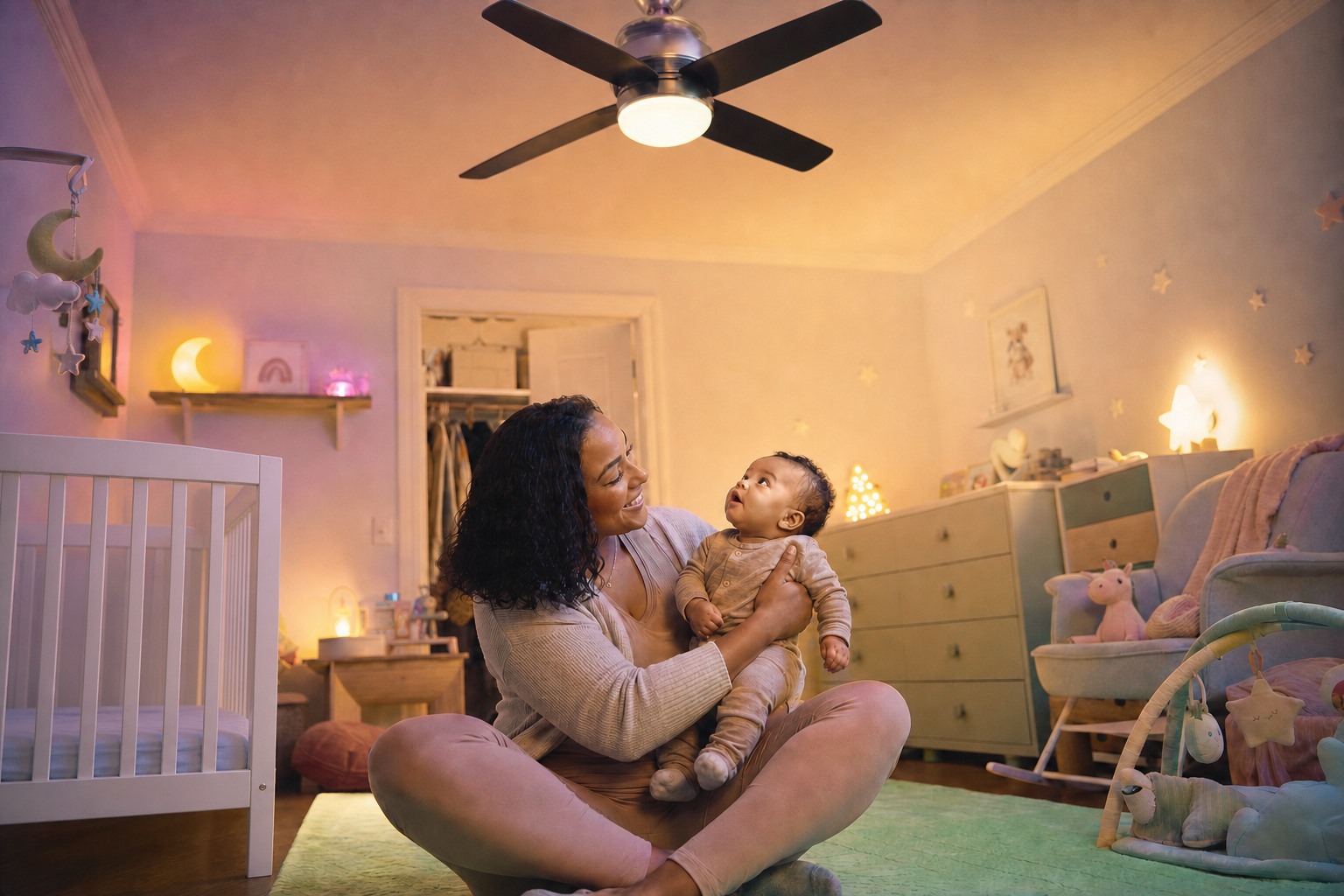
The Four-Return Fan Check
A favorite object is not the same as a closed loop. What matters is the range your baby shows across ordinary life.
This is not a pass-fail home exam. Try it during a calm, alert moment, stop if your baby is tired or upset, and notice patterns over days rather than demanding a performance on cue.
Why a spinning fan is visual catnip
The American Academy of Pediatrics explains that newborn vision begins with light, large shapes, faces, and movement while distance detail is still blurry. Focusing and tracking become more coordinated over the first months. A dark fan against a light ceiling is therefore unusually easy visual work: large edges, high contrast, steady repetition, and no clutter competing around it.
The motion matters too. A fan repeats the same sweep again and again, so your baby gets another chance to find it even if their eyes briefly lose the blade. It is predictable without being completely still. To a young brain learning what motion looks like, that can be more satisfying than a toy that disappears every time a wobbly hand knocks it sideways.
Some babies stare longer when they are quietly alert; others find the rhythm calming when they are tired. Neither response proves that the fan is creating a developmental benefit or a sleep dependency. It is simply one strong stimulus in the room.
You are not missing a secret diagnosis because the fan won one glance. Babies are learning how to aim two eyes, hold a target, follow motion, and then release that target for the next interesting thing. The fan makes those developing skills unusually visible because it is big, repetitive, and almost always framed against a blank ceiling.
What fan fascination can look like across the first year
Age can change the flavor of the fascination, but it should not be used as a rigid deadline. A newborn may notice a fan mainly as a dark moving shape. Over the next few months, steadier tracking can make the circular sweep easier to follow. Later, a baby may grin, kick, reach upward, babble at it, or look between the fan and you as if asking whether you also see this magnificent household celebrity.
How the fan show may change
The reassuring direction is expansion. The fan can remain beloved while faces, sounds, toys, rooms, and social games keep joining the world.
I do not want you comparing a six-week-old’s brief stare with a nine-month-old’s excited squeal as if one chart can grade both babies. Start with what is changing for your child: Is tracking getting smoother? Are more people and objects entering the picture? Is your baby using new ways to share interest with you?
If the attraction is mostly the attached light, our guide to a baby who is obsessed with lights separates ordinary brightness-seeking from eye-comfort warning signs. If a screen has become the main moving target, the baby-obsessed-with-TV guide handles that different, faster, sound-filled intent. A ceiling fan, lamp, and television may all win attention, but they do not create identical decisions.
Flexible attention is more useful than a stopwatch
Parents often ask how long is “too long” to stare. There is no evidence-based fan timer. Ten seconds during a feed and several minutes during floor play do not mean the same thing, and a baby who is tired, newly awake, or lying directly beneath the fan may naturally watch longer.
I recommend replacing duration with range. Across a normal day, does your baby also notice faces, react to familiar voices, follow another slowly moving object, look around in new places, and keep adding interests? A fan can be the favorite visual event without being the only one.
If you want to experiment, switch the fan off once while your baby is awake and calm. Do not wave the remote like a magician. Simply see whether attention moves to the stationary blades, the light fixture, the ceiling contrast, your face, or something else. The result can tell you which feature is interesting; it cannot diagnose your baby.
Before you change the room, try one small shared-attention game. Sit where your face can enter the same line of sight, say one warm sentence, and slowly bring a simple book or toy into view. If your baby looks from fan to you and back again, that back-and-forth is useful information. If they ignore you once because they are tired, hungry, or gloriously committed to the matinee, that is not a verdict either.
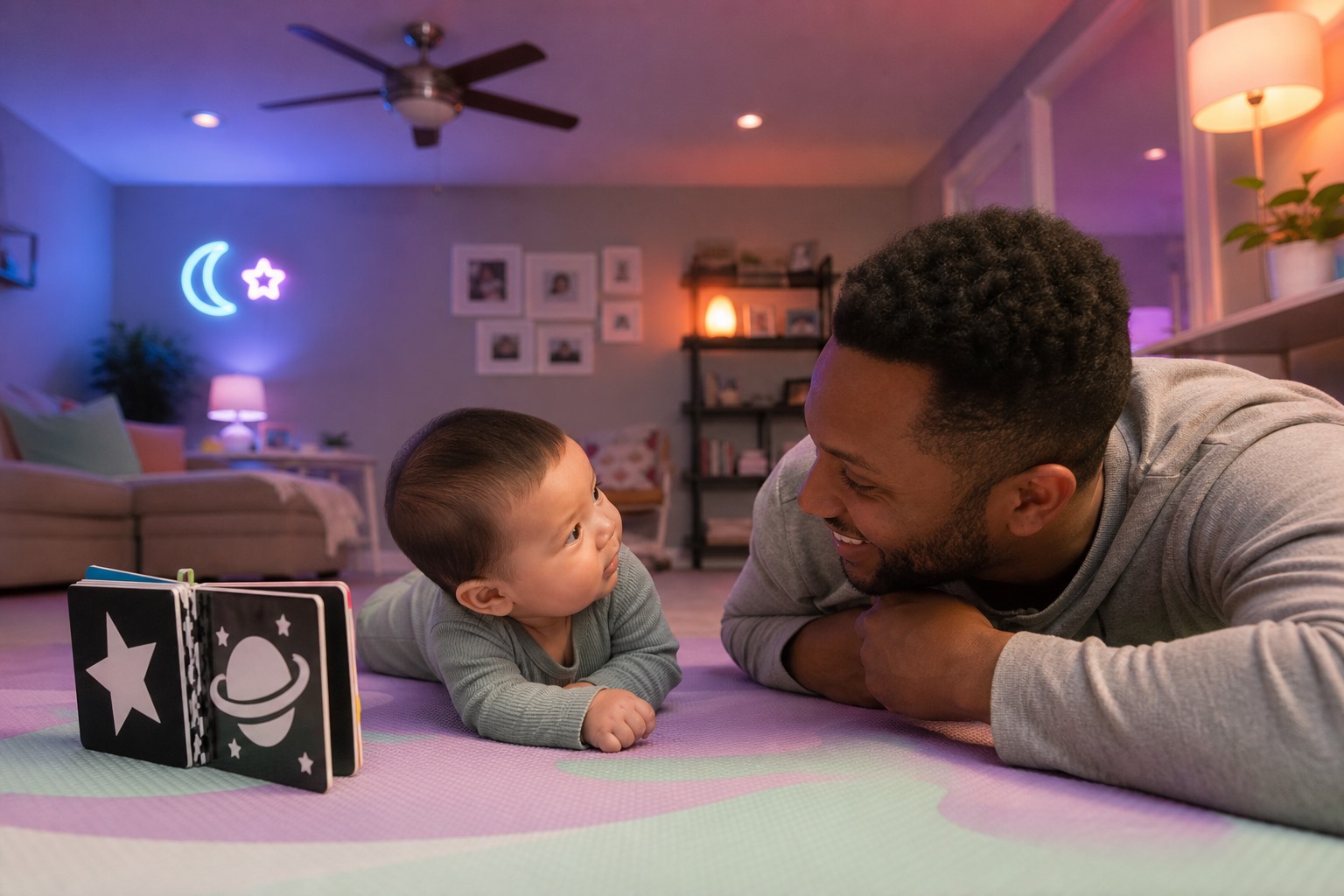
Turn the fan into a supervised awake-time game
You do not need to ban the object that makes your baby light up. During awake floor play, you can narrate what is happening: “The fan is moving. Now it is slowing. Now it stopped.” Pause and wait for a look, sound, kick, or change in expression. Then answer that response. The goal is not to teach fan vocabulary; it is to let a solitary visual attraction become a little social exchange.
Keep the game gentle. Do not flick the light repeatedly, run the fan at an unsafe speed, lift a baby toward moving blades, or use a long dangling pull chain as a toy. If your baby becomes overstimulated, turn away from the fan and lower the room’s visual activity rather than trying to out-perform it with a brighter object.
The one-sided check parents often miss
A fan is overhead, so it can expose a preference that was already there. If your baby nearly always watches it with the head turned to the same side, look beyond the fan: during feeds, diaper changes, floor play, and cuddles, do they also resist turning the other way? Does the head repeatedly tilt? Is one side of the back of the head becoming flatter?
A consistent one-sided head preference can sometimes accompany neck tightness or positional flattening. That is a reason to mention the pattern to your pediatrician or pediatric physical therapist, not a reason to stretch or reposition a baby forcefully based on an internet article. A short video from ordinary play can help show what you mean.
Offer interesting faces and toys from both sides during supervised awake time, and give your baby regular, developmentally appropriate floor play. Keep sleep positioning separate: always follow current safe-sleep guidance and never use pillows, wedges, positioners, or rolled towels to hold an infant’s head in place.
A fan fascination still needs an ordinary room-safety sweep
The funny part of this topic is the baby’s devotion. The unfunny part is that babies grow. The newborn who can only gaze upward becomes the rolling baby, then the reaching baby, then the toddler who believes a chair is a licensed ladder. A safe fan setup has to anticipate the next skill, not merely the one you saw this morning.
The four-corner fan-room sweep
Pay special attention to pull chains and nearby cords. The fan may be out of reach while a dangling control or lamp cord is not. Our baby-obsessed-with-cords guide covers that mouthing-and-entanglement problem directly. For the crib itself, use the separate guide to what babies can safely sleep with rather than improvising a prop to block the fan view.
If the room feels visually busy at nap time, dimming the environment can help mark a transition, but darkness is not a punishment for liking the fan. The guide to whether a baby should sleep in a dark room during the day explains that decision without turning this article into a second sleep-environment guide.
What about fans and SIDS?
A frequently cited 2008 case-control study found an association between fan use during sleep and lower SIDS odds in the homes studied. That result is interesting, but it is observational: it cannot prove that a fan itself prevented a death, and it does not replace the recommendations with stronger evidence behind them.
The American Academy of Pediatrics’ safe-sleep foundation remains the priority: place baby on the back for every sleep, use a firm and flat approved sleep surface, keep the sleep space free of loose bedding and soft objects, avoid overheating and smoke exposure, and follow room-sharing guidance. A fan is a room feature, not a protective shield around an unsafe setup.
This distinction matters because the original version of this page let a cute daytime behavior drift into a sweeping SIDS promise. We are not doing that. The full discussion of airflow, room comfort, fan speed, overnight use, and the limits of the study belongs in the dedicated fan-sleep guide; here, the safe answer is simply not to turn fascination into proof.
When the fan deserves a pediatric conversation
The fan interest alone is rarely the concern. Bring it up when it arrives with a broader pattern:
- Your baby rarely shifts attention from the fan to faces, voices, or other clear objects across different settings.
- By around 3 months, you are not seeing the baby focus on faces or close objects and follow a moving target with their eyes.
- One eye repeatedly turns in or out, the eyes do not seem to work together, or you notice unusual eye movements.
- Light or movement appears painful: persistent squinting, tearing, redness, or distress.
- Your baby strongly favors one head direction, resists turning the other way, or you notice increasing head flattening.
- Your child loses a visual, social, movement, or communication skill they previously used.
A white or unusual pupil reflection, an eye injury, sudden apparent vision change, severe pain, or a baby who seems unable to see needs prompt professional assessment. The AAP’s eye-warning guidance is much more useful here than trying to decode the emotional meaning of one ceiling fan.
Does staring at a fan mean autism?
No single interest can diagnose autism. Developmental evaluation considers a much broader pattern over time, including social communication, gestures, play, repetitive behaviors, and whether skills are developing or being lost. If you have concerns about how your baby looks, listens, moves, communicates, or connects—not just how much they admire the fan—share those observations with the pediatrician.
You do not have to choose between “this is definitely nothing” and “this must be a diagnosis.” You can enjoy the tiny fan club and still bring a concrete concern to a professional.
Watch: what a persistent one-sided preference can look like
Why this video is here: Royal Cornwall Hospitals NHS Trust shows a clear right-turning preference in a baby already referred to physiotherapy. It makes “always looks one way” easier to recognize. You can also watch it on YouTube.
Important boundary: Ordinary fan fascination does not mean your baby has this problem. The video includes exercises for referred babies awaiting physiotherapy; do not copy or force those movements unless your own pediatrician or pediatric physical therapist says they fit your baby.
Keep “likes the fan” separate from “sleeps with the fan”
This page answers the attention question: why babies watch ceiling fans, what flexible interest looks like, and when eye or movement patterns deserve a check. It does not turn that fascination into a recommendation to run the fan during sleep.
For fan speed, airflow, overnight use, room comfort, hardware, and the evidence around SIDS, use our separate guide to whether a baby can sleep with a ceiling fan on. Keeping those decisions separate prevents a cute daytime interest from being mistaken for a sleep-safety rule.
Ceiling-fan questions parents whisper into their phones
Why does my newborn smile at the ceiling fan?
The fan may be one of the clearest moving shapes in the room, and a baby’s early smile does not always carry the same social meaning an older child’s grin does. Enjoy it. Talk back. Then notice whether smiles and alert looks also begin appearing around familiar faces and voices as development unfolds.
Is it normal for a 3-month-old to stare at a fan?
It can be. Around this period, focusing and visual tracking are becoming more coordinated, so a large repeating target may be newly rewarding. The useful check is not whether the fan gets watched; it is whether your baby also focuses on close faces or objects, follows other slow movement, and sometimes shifts attention away.
Can staring at a ceiling fan hurt my baby’s eyes?
Watching ordinary fan blades is not known to damage healthy eyes. The attached light is a different feature: do not encourage a baby to stare into an uncomfortably bright bulb. Persistent squinting, tearing, redness, light sensitivity, unusual eye movements, or a pupil that looks white in person or repeatedly in photos deserves professional advice.
Should I turn the fan off because my baby is obsessed?
Not automatically. If it is safely installed and the room remains comfortable, the fan can simply be part of the scenery. Turn it off if you need to inspect which feature holds attention, if it is wobbling or malfunctioning, or if the visual motion is clearly keeping your tired baby alert during a settling attempt. You do not need to wage a household war against normal curiosity.
Why does my baby cry when the fan stops?
The change may be surprising, the motion may have become part of a familiar sequence, or your baby may simply protest when a favorite event ends. During awake time, practice tiny predictable transitions: “Fan slowing… fan stopped… now Mama’s face.” At bedtime, replace the visual finale with a repeatable cue such as the same short phrase, feed ending, room-darkening step, or song.
Does liking the fan mean my baby is bored?
No. Interest in one clear moving object is not proof that you have failed to provide enough stimulation. Babies do not require a rotating festival of toys all day. Ordinary conversation, floor time, feeding, faces, reaching, and a few simple objects create plenty to learn from. More stimulation can actually make it harder for a tired baby to settle.
What if my baby looks only at fans everywhere we go?
Notice the entire outing. Does your baby also look at you, react to voices, watch other motion, explore with hands, or show interest once the fan is out of view? If fans consistently crowd out people and other activities across settings, or the pattern accompanies lost skills, eye concerns, or movement restriction, bring specific examples to the pediatrician. A short diary or ordinary video is more useful than the label “obsessed.”
Let the fan be fascinating—not a verdict
A ceiling fan is almost custom-built to catch a baby’s developing attention. Enjoy the grin. Narrate the spin. Then notice the return trip: back to your face, a voice, a toy, the other side of the room, and the rest of the day.
The fan is not issuing a developmental report card. It has simply found the perfect audience. Your job is not to break the fascination; it is to watch whether curiosity stays comfortable, flexible, and part of a growing world.
Sources
- American Academy of Ophthalmology. Baby Vision Development: What Can Your Baby See in the First Year? Read the guidance. Accessed July 26, 2026.
- American Academy of Pediatrics / HealthyChildren.org. Warning Signs of Vision Problems in Infants & Children Read the guidance. Accessed July 26, 2026.
- American Academy of Pediatrics / HealthyChildren.org. Early Signs of Autism Spectrum Disorders Read the guidance. Accessed July 26, 2026.
- American Academy of Pediatrics / HealthyChildren.org. Head Tilt (Torticollis). Read the guidance. Accessed July 26, 2026.
- American Academy of Pediatrics / HealthyChildren.org. How to Keep Your Sleeping Baby Safe: AAP Policy Explained Read the guidance. Accessed July 26, 2026.
- Coleman-Phox K, Odouli R, Li DK. Use of a Fan During Sleep and the Risk of Sudden Infant Death Syndrome. Review the PubMed record. Accessed July 26, 2026.
- Royal Cornwall Hospitals NHS Trust. Right Head Turning Preference. Watch the video. Accessed July 26, 2026.
This article provides general education, not a diagnosis or a substitute for care from your child’s pediatrician, eye-care professional, or pediatric physical therapist.




What viewers said10 comments · 4 replies+
Archived comments from the original Baby Sleep Miracle presentation. Not independently verified by SleepBaby.org; individual experiences vary.
Thank you so much for this video! I had no idea about the dangers of baby swings :O
Hi Mary-Ann. I have a question: Is method in any way similar to the ones recommended by Dr Bucknam, Dr. Weissbluth or Dr. Karp? We tried those but none of them help.
Hi Regina, thank you for your question. The short answer is no. The techniques I share in my guide are based on newest scientific research and this is why I have never seen any approach similar to the one I recommend.
This method really works! I tried it on my son Jesus and after just one week he went from waking up more than 5 times a night to waking up just once or twice. You are a lifesaver, Mary-Ann!
I'm truly impressed with how much information you share in your video. And all for free! I can feel that you truly care about mothers like myself, and that's hard to find these days. I have recommended your site to several of my friends already.
Mary-Ann, our child suffers from autism. Is your approach still suited?
Chloe, I made sure my method can be used with any child, even babies who are special like yours. Please note that I'm not a doctor and that I always advice to consult with your physician because nothing is more important than the safety and well-being of your love.
Hallo Mary-Ann, I'm from Germany. Do you have your guide in German?
Hello Heide, we do! Normally you should already see our video in German. If not, please contact our support so they can guide you
Thenk you for your answer, Mary-Ann!
I just completed your approach and I have to say, it worked almost too well. Yes, it took a bit of getting used to with your bedtime routine but the difference is huge. My son George used to take 1 hours to go down and now he's firmly asleep in no more than 10 minutes! You're the best!
It seems I'm the only man watching this video, lol! What you shared about the 'emotional backpack' made immediate sense to me and I can't wait to help my little girl Mila to unpack it!
Hey there, just discovered your site and this really sounds different. Just wanted to say thanks for sharing :)
For everyone who's still thinking about getting Mary-Ann's guide I want to advise you to go ahead. I wasn't sure myself but now I'm so thankful I invested in this program. It made a huge difference in our life as a family and yes, my baby girl does sleep through the night now.