
WHEN THE DAY HAS HELD NO REAL NAP
If your baby will not nap during the day, do not begin by forcing a longer wake window or trying six new sleep tricks. First check feeding, diapers, breathing, color, temperature when illness is possible, responsiveness, pain, and whether this is truly near-total nap refusal rather than several short naps. A newborn who has barely slept all day needs a feeding-and-illness check before a schedule experiment. If those basics are reassuring, make one calm, low-stimulation nap attempt, pause when it turns into a battle, and try again when your baby shows another believable opening for sleep.
“Awake all day” is a worried-parent description, not a diagnosis and not proof that no microsleep happened. What matters is how little daytime sleep occurred compared with your baby’s usual pattern, how your baby is feeding and behaving, and what else changed. If your baby did sleep but woke after 20, 30, or 40 minutes, that is a different problem; use the focused guide to very short baby naps instead of treating a brief nap as no nap.
CHOOSE THE FIRST LANE
Three daylight doors, and only one leads to a nap experiment
Emergency help now
Breathing struggle, blue or gray color, seizure, inability to wake, unusual limpness, or a baby who appears seriously ill. Stop troubleshooting sleep.
Call promptly
Young-infant fever, poor feeding, fewer diapers, worsening jaundice, repeated vomiting, pain, abnormal crying, or a striking change from your baby’s normal.
Try one calm reset
Breathing, color, feeding, diapers, comfort, and behavior are reassuring, and the problem is repeated failed nap attempts rather than illness or a feeding concern.
Why this matters for tonight: a sleep method belongs only in the stable lane. This is an observation aid, not a diagnostic test.
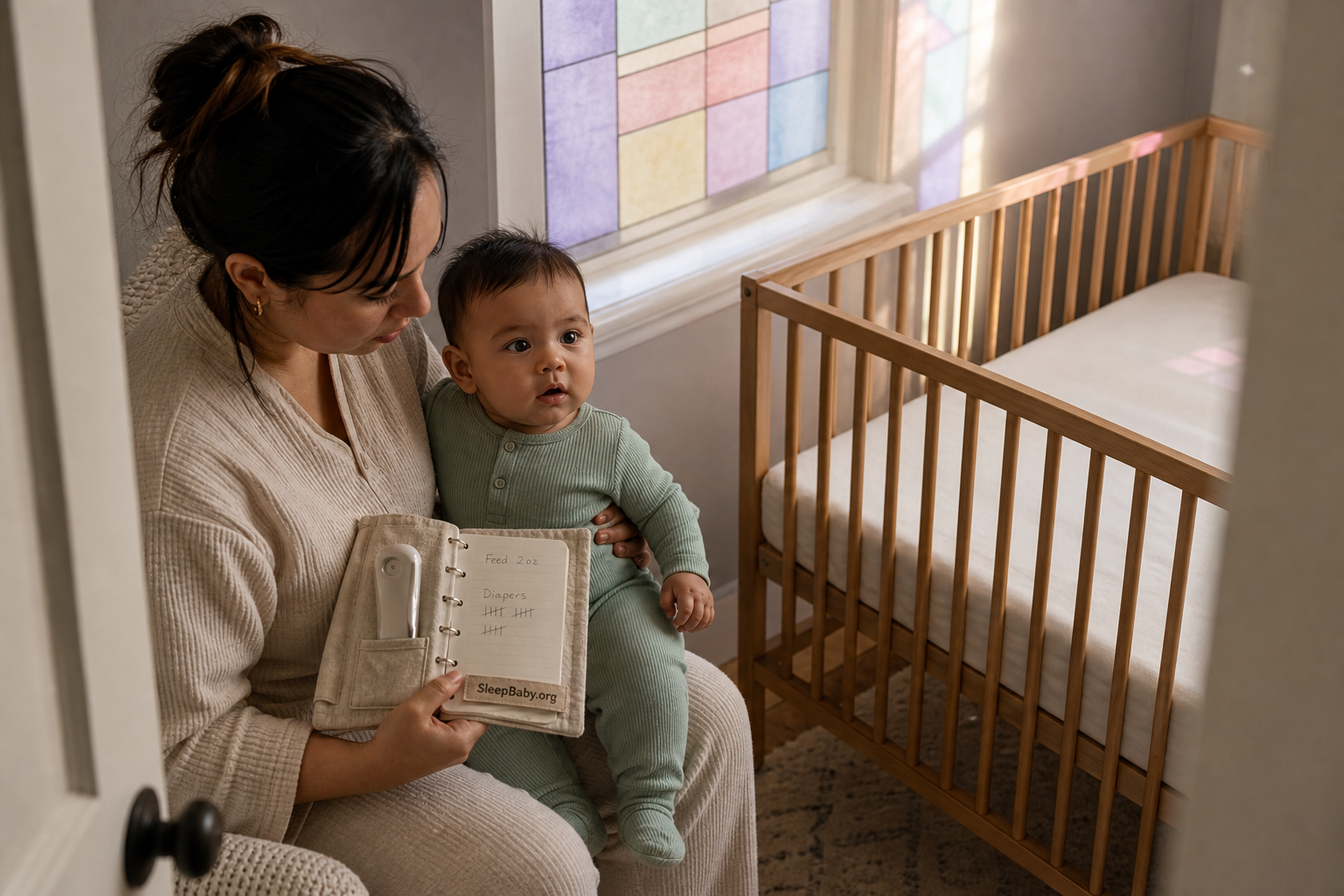
I know the particular arithmetic of a no-nap day: the mug has been reheated twice, the curtain has gone down and back up, and a baby who looked sleepy in the kitchen becomes startlingly interested in the ceiling the moment you reach the crib. By the third attempt, the clock starts feeling less like a tool and more like a tiny accusation.
The clock can report wakefulness. It cannot tell you whether the missing piece is milk transfer, ordinary newborn irregularity, a busy transition, discomfort, illness, or simply a nap opportunity that did not land. My first move is therefore not “make the baby sleep.” It is “find the detail that changes what we do next.”

For a newborn who is not sleeping during the day, check feeding before timing
Newborn naps do not arrive as a tidy row of appointments. The American Academy of Pediatrics notes that regular sleep cycles are not expected until around 4 months, and newborn sleep may arrive in short one- or two-hour bouts across day and night. That wide variation is real. It does not make a nearly sleepless day meaningless, especially when feeding or illness also looks different. HealthyChildren’s newborn sleep guidance is an orientation, not a command to make a newborn follow the clock.
In the first days and weeks, feeding often explains why a newborn appears awake for much of the day. Cluster feeding can be normal. So can frequent feeds. The useful question is not merely whether milk was offered; it is whether the baby fed effectively and whether the full intake pattern is reassuring.
The CDC says newborns may breastfeed every 1-3 hours in the earliest days and commonly feed about 8-12 times in 24 hours. Formula-fed newborns also commonly feed 8-12 times in 24 hours, with amounts and intervals changing by age and individual need. Those are broad patterns, not a reason to override your baby’s cues, weight plan, lactation guidance, or pediatric instructions. CDC breastfeeding guidance and CDC formula-feeding guidance both support frequent, responsive newborn feeding.
THE NEWBORN DAYTIME CHECK
Four observations before you call this a sleep problem
- Feed quality
-
Note the last several feeds, active sucking and swallowing or measured formula intake, whether the baby stays engaged, and whether the baby seems satisfied afterward. Repeated offers do not prove effective milk transfer.
- Diapers by age
-
Use the expectations your care team gave for your baby’s exact day of life. By days 5-7, six or more pale wet diapers per day can be a useful breastfeeding intake clue, but that benchmark must not be imposed on day 1. Stool transition and recent weight guidance matter too. AAP guidance describes the age-specific pattern.
- Illness and hydration
-
Look for fever, dry or sticky mouth, fewer tears, a sunken soft spot, noticeably fewer wet diapers, vomiting, worsening jaundice, breathing change, or unusual sleepiness. Infants under 6 months should not receive extra water as a home sleep fix; breast milk or formula remains the usual hydration source unless a clinician directs otherwise. HealthyChildren explains infant hydration signs and the no-extra-water boundary.
- The whole baby
-
Notice color, breathing, responsiveness, cry, muscle tone, pain, and whether this behavior is recognizably your baby. A newborn who is awake but weak, feeding poorly, or acting markedly unlike normal needs clinical guidance, not a darker room.
Sleep connection: when feeding and the whole-baby pattern are uncertain, the next useful step is a clinician or feeding professional, not a stricter nap plan.

If you are worried about intake, call the baby’s pediatrician, nurse, midwife, or lactation professional with the feed-and-diaper pattern. Do not dilute formula, add cereal to a bottle, offer water to a young infant, delay medically directed feeds, or use sleep as a reason to override an individualized plan.
Once a newborn finally sleeps, follow the feeding plan you already have. Some newborns need waking for feeds because of age, weight, prematurity, jaundice, or another clinical reason. If your own clinician has asked you to wake the baby, use a gentle, supported approach rather than loud noise or vigorous stimulation; SleepBaby’s guide to waking a sleeping baby safely covers those mechanics. A baby who repeatedly cannot wake enough to feed needs medical help.

What near-total daytime nap refusal is – and what it is not
There is no validated minute at which “a rough nap day” becomes a medical category. For this page, near-total nap refusal means several reasonable daytime sleep opportunities ended without meaningful sleep, or daytime sleep is strikingly below this baby’s recent pattern. A five-minute doze in arms or the car may be easy to miss, but hunting for hidden microsleeps is not the point. The useful comparison is the whole day, the baby’s baseline, and the feeding-health picture.
Short naps are different. A baby who sleeps four times for 25 minutes has a nap-length problem, not the same problem as a baby who has made repeated attempts and barely slept. The two patterns can share causes, but they deserve different next steps and should not be merged into one giant schedule article.
For infants 4-12 months, the American Academy of Sleep Medicine recommends 12-16 hours of sleep across 24 hours, including naps. It intentionally does not give a recommendation for babies younger than 4 months because normal patterns vary widely and evidence linking duration to health outcomes is insufficient. Use the older-infant range as context across the whole day, never as a diagnostic test for one baby or a quota for one afternoon. The AASM consensus explains both the range and the under-4-month evidence gap.
Why your baby may not nap, without pretending the symptom names the cause
A baby who will not nap may be hungry, uncomfortable, overstimulated, not quite ready for sleep, already very tired, reacting to a transfer, or moving through ordinary developmental change. The same outward result – open eyes at nap time – can come from very different beginnings. That is why I prefer observable clues to a dramatic label.
READ WHAT HAPPENED BEFORE THE CRIB
Six clues that can change the next attempt
-
Age and pattern. A newborn’s sleep is scattered. An older infant may be shifting nap timing or reacting to a different morning. Compare with this baby, not an internet baby’s perfect grid.
-
Feeding. Was the feed effective, rushed, distracted, painful, repeatedly interrupted, or due again? For a newborn, this clue moves to the front of the line.
-
Input. Bright light, screens, visitors, active play, fast transitions, or a caregiver cycling through many tricks can keep the final minutes busy. Ordinary daytime light is useful; the goal is a gentle slope, not a cave at noon.
-
Comfort and illness. A soiled diaper, congestion, fever, pain, vomiting, feeding difficulty, or a sudden behavioral change deserves a direct response. Nap refusal alone cannot diagnose reflux, allergy, teething, colic, or illness.
-
The sleep setup. Temperature, abrupt sound, sudden loss of motion, or a difficult transfer may matter. Safety still outranks convenience.
-
Timing and cues. For an older infant, repeated cheerful resistance may mean the opportunity arrived before sleep was likely; frantic, disorganized settling may mean the transition came late. Move one attempt modestly and observe. Do not impose a universal maximum wake window on a newborn.
Why this matters tonight: one visible clue gives you one modest experiment. Six guesses at once give you a nursery full of activity and no idea what helped.
This is also where I would resist the internet’s favorite one-word explanations. Daytime wakefulness by itself does not prove reflux disease, cow’s-milk protein allergy, a sleep regression, sensory sensitivity, “hyperactivity,” or a cortisol problem. Ordinary infant regurgitation is common, and reflux does not justify inclined, side, or stomach sleep. Marked distress, feeding difficulty, or poor growth changes the medical picture and belongs with a clinician. NICE reflux guidance keeps symptoms and safe sleep separate.
The research on infant behavioral sleep strategies does not establish one proven same-day nap reset. A 2026 systematic review found that daytime sleep was measured infrequently even though 59 studies were included, and an earlier systematic review found only modest short-term support with notable gaps in young infants. That is why the plan below is conservative: it combines feeding, safe-sleep, routine, and illness guidance rather than claiming a branded protocol has been clinically proven. The 2026 review and the 2020 review define that evidence limit.

A no-nap day can turn the room into a tiny sleep laboratory: curtain down, sound machine up, three kinds of shushing, one adult walking in a perfect rectangle, and a baby staring back as if the crib requires security clearance. I would undo the pileup before adding another trick. The memorable move is not more effort. It is less input and a clearer stop point.

ONE CALM SAME-DAY RESCUE
Seven steps, including permission to stop battling the nap
-
Pause and screen. Check age, the last several feeds, effective intake, diapers, breathing, color, responsiveness, vomiting, pain, temperature when illness is possible, and any instructions from your baby’s clinician.
-
Meet the need in front of you. Feed when due or when hunger cues are present, change a soiled diaper, address ordinary comfort, and call rather than experimenting when a red flag appears.
-
Lower the final minutes. Use a brief repeatable transition: quieter voice, less visual activity, dimmer light, one familiar phrase, perhaps a short book or song. Do not stretch the wind-down until it becomes the day’s main event.
-
Offer one safe sleep opportunity. Holding, rocking, patting, or another responsive settling cue may help. For babies 4 months and older, “drowsy but awake” can be an option, not an exam. Place the baby on the safe sleep surface for sleep.
-
Reset instead of wrestling. If the attempt becomes a prolonged, escalating struggle and the health check remains reassuring, pick the baby up, return to calm low-key awake time, and try again when a believable cue or quieter opening returns. Do not force a newborn to stay awake in order to manufacture sleep pressure.
-
Protect the remaining day. Keep later opportunities recognizable and calm. For a medically well older infant after a truly missed-nap day, a modestly earlier bedtime may be reasonable when behavior supports it. This does not replace feeds and is not a fixed newborn rule.
-
Write the pattern once. Record sleep bouts, failed attempts, feeds, diapers, symptoms or temperature, and the one change you tried. If near-total refusal persists or the whole baby changes, call with the record.
Sleep connection: a bounded attempt protects the next opportunity and the caregiver’s judgment. It does not promise that today’s clock will become tidy.

Safe sleep does not loosen on a rescue day
Place your baby on the back for every sleep on a firm, flat, level, noninclined infant sleep surface with only a fitted sheet. Keep pillows, blankets, bumpers, toys, nests, wedges, loungers, and weighted sleep products out. These rules apply to naps and nights. The AAP safe-sleep policy and NICHD Safe to Sleep guidance are explicit about every sleep.
A swing, bouncer, car seat outside travel, stroller, carrier, nursing pillow, couch, armchair, adult bed, or inclined product is not the regular nap solution. If a baby falls asleep in a sitting or carrying device, move the baby to the usual firm, flat sleep surface as soon as practical after travel or use. SleepBaby’s guide to what belongs in a baby’s sleep space gives the fuller setup.
A contact nap can be awake-adult comfort, but it is not a safety exemption. If you may doze, place the baby in the separate safe sleep space or hand off to an alert adult. Avoid feeding on a couch or armchair when you might fall asleep. The AAP’s guidance for sleep-deprived parents supports planning the handoff before fatigue makes the decision for you. Read the parent-facing fatigue precautions.
Swaddling is optional, never weighted, never a SIDS-prevention method, and always back-only; stop at signs of attempted rolling. White noise is optional too. If you use a sound machine, place it as far from the baby as practical, keep the volume at the lowest useful level, and limit duration. The AAP noise policy explains why “more soothing” should not mean louder or closer.
Age changes the next move
Newborn and early weeks
Expect irregular sleep, frequent feeding, and wide variation. Do not impose a rigid clock schedule or universal wake window. Check feeding effectiveness, diapers by day of life, temperature and illness signs, jaundice, responsiveness, and the care plan before working on routine.
About 4-12 months
Use the 12-16-hour 24-hour range only as context. Compare several ordinary days, how the baby wakes and feeds, and what missed naps do to the remaining day. Adjust one timing or transition clue modestly rather than rebuilding the entire schedule after one hard afternoon.
Why this matters tonight: development changes the question. A newborn needs a feeding-and-health lens; an older infant may also offer a readable schedule pattern.
If the first rescue nap finally happens
Let relief arrive before a new calculation. Check the safe sleep setup, note when sleep began, and follow any clinician-directed feeding plan. You do not need to wake an otherwise well older baby merely because the nap finally became longer than today’s failed attempts. If the nap becomes unusually long, repeatedly erases a needed feed, pushes bedtime far off course, or comes with a baby who is hard to wake or unwell, the next decision changes. SleepBaby’s guide to a longer-than-usual baby nap separates ordinary variation, feeding plans, and medical warning signs.
If no nap arrives, keep the rest of the day humane. Offer ordinary feeds and care. Use low-key awake time rather than an endless dark-room standoff. Try again at the next believable cue. For an older infant, bedtime may move modestly earlier if the baby’s behavior supports it. For a newborn, feeds and the individualized care plan remain the anchors.
FOUR LINES WORTH WRITING DOWN
Give tomorrow’s decision a paper trail
-
Sleep. Actual sleep bouts, where they occurred, and failed opportunities without inflating every closed-eye minute.
-
Feeds. Times, method, effective sucking or measured intake, and any clear difficulty or change.
-
Diapers and symptoms. Wet and stool pattern appropriate to age, temperature when relevant, vomiting, breathing, pain, jaundice, or unusual crying.
-
The one change. What you altered at the calm attempt and whether settling, waking, or the rest of the day became easier, unchanged, or harder.
Sleep connection: the log should reduce guessing. It should not turn one hard day into continuous surveillance.

When to call after a baby stays awake most of the day
Call promptly if near-total daytime nap refusal persists, total sleep remains strikingly below your baby’s usual pattern, feeding weakens, diapers become fewer or drier, fever or vomiting appears, breathing or color changes, the baby seems painful or unusually listless, or you cannot get a normal response. A newborn deserves a lower threshold for calling because feeding, jaundice, hydration, infection, and age-specific fever concerns can change quickly.
For a medically well older infant, a single chaotic day can be observed without diagnosing a disorder. If the pattern repeats across ordinary days, bring the concise log to the pediatric clinician. Ask about growth, feeding, breathing, pain, medicines, reflux symptoms when present, total 24-hour sleep, and the timing pattern you actually observed. The useful sentence is not only “my baby was awake all day.” It is “here is how my baby fed, breathed, responded, urinated, behaved, and slept across that day.”
That is the line I want you to carry out of this page: the nap is a clue, but the whole baby gets the final vote. Once feeding and illness concerns are cleared, you are allowed to make the room quieter, offer one safe attempt, stop a spiraling battle, and begin again from the day that really happened.
An AAP reminder: safe sleep counts for every nap
The American Academy of Pediatrics video below shows the safe-sleep foundation that stays fixed even on a difficult nap day. The written guidance above is complete, so watching is optional. The practical takeaway is simple: back, firm, flat, level, separate, and empty for every nap and every night.
Watch “Safe Sleep for Your Baby: Every Nap & Every Night” on YouTube. Published by the American Academy of Pediatrics. No autoplay.
Sources 16 references
- American Academy of Pediatrics: 2022 safe infant sleep policy
- NICHD Safe to Sleep: ways to reduce sleep-related risk
- HealthyChildren: AAP safe sleep policy explained
- HealthyChildren: getting your baby to sleep
- American Academy of Sleep Medicine: pediatric sleep-duration consensus
- HealthyChildren: newborn first-week feeding, sleep, and warning signs
- CDC: how much and how often to breastfeed
- CDC: how much and how often to feed formula
- HealthyChildren: signs a breastfed baby is getting enough milk
- HealthyChildren: infant hydration and water guidance
- HealthyChildren: fever and young infants
- HealthyChildren: safe sleep for sleep-deprived caregivers
- American Academy of Pediatrics: preventing excessive noise exposure
- NICE: infant reflux diagnosis and management
- Petrin et al.: 2026 systematic review of behavioral sleep interventions
- Reuter et al.: systematic review of infant behavioral sleep interventions
WHEN THE CLOCK HAS TURNED INTO A TINY ACCUSATION
Bring the whole sleep day back into one picture
A no-nap day can make every feed, cue, and bedtime decision feel separate. Once illness, feeding, and safety concerns are in the right professional hands, SleepBaby can help you look at timing, settling, feeds, and the night’s next step as one responsive pattern instead of another contest with the clock.
SleepBaby is not a substitute for pediatric, feeding, or emergency care.






What viewers said10 comments · 4 replies+
Archived comments from the original Baby Sleep Miracle presentation. Not independently verified by SleepBaby.org; individual experiences vary.
Thank you so much for this video! I had no idea about the dangers of baby swings :O
Hi Mary-Ann. I have a question: Is method in any way similar to the ones recommended by Dr Bucknam, Dr. Weissbluth or Dr. Karp? We tried those but none of them help.
Hi Regina, thank you for your question. The short answer is no. The techniques I share in my guide are based on newest scientific research and this is why I have never seen any approach similar to the one I recommend.
This method really works! I tried it on my son Jesus and after just one week he went from waking up more than 5 times a night to waking up just once or twice. You are a lifesaver, Mary-Ann!
I'm truly impressed with how much information you share in your video. And all for free! I can feel that you truly care about mothers like myself, and that's hard to find these days. I have recommended your site to several of my friends already.
Mary-Ann, our child suffers from autism. Is your approach still suited?
Chloe, I made sure my method can be used with any child, even babies who are special like yours. Please note that I'm not a doctor and that I always advice to consult with your physician because nothing is more important than the safety and well-being of your love.
Hallo Mary-Ann, I'm from Germany. Do you have your guide in German?
Hello Heide, we do! Normally you should already see our video in German. If not, please contact our support so they can guide you
Thenk you for your answer, Mary-Ann!
I just completed your approach and I have to say, it worked almost too well. Yes, it took a bit of getting used to with your bedtime routine but the difference is huge. My son George used to take 1 hours to go down and now he's firmly asleep in no more than 10 minutes! You're the best!
It seems I'm the only man watching this video, lol! What you shared about the 'emotional backpack' made immediate sense to me and I can't wait to help my little girl Mila to unpack it!
Hey there, just discovered your site and this really sounds different. Just wanted to say thanks for sharing :)
For everyone who's still thinking about getting Mary-Ann's guide I want to advise you to go ahead. I wasn't sure myself but now I'm so thankful I invested in this program. It made a huge difference in our life as a family and yes, my baby girl does sleep through the night now.