The pacifier touches your baby’s lips. Their face folds into the expression of someone who has just been offered a tiny silicone insult. Out it comes—sometimes with a gag, sometimes with a furious head turn, sometimes with enough force to send it under the feeding chair.
It is normal for some babies to hate a pacifier, and you do not need to make your baby accept one. First make sure your baby is not hungry and is feeding normally. Then, if you want to try, offer a clean, correctly sized pacifier once during a calm moment and let your baby draw it in—never hold it in place or keep pushing after refusal. A pacifier can be offered at naps and bedtime as one safe-sleep measure, but official guidance is equally clear that refusal is okay. Your baby can sleep safely without one.
The private question under “my baby hates the pacifier” is often much bigger: Have I lost the only soothing tool that was supposed to make bedtime easier—or safer? I would make that question smaller. A pacifier is optional. Feeding, responsive care, back sleeping, and a firm, flat, empty sleep space are not.
Decode the refusal before trying another pacifier
A baby who spits out silicone is not giving you a product review. They are showing you a moment. The useful work is figuring out which moment it is.
Is your baby asking to eat?
Rooting, searching, hand-to-mouth movements, an increasingly urgent cry, or turning toward your chest or bottle belong on the feeding branch. A pacifier must not replace or delay a meal. Feed first, then reconsider the pacifier only after hunger is settled.
Is the timing simply bad?
An overtired, already-crying baby may reject anything introduced near the mouth. A baby who has just finished a large feed may also have no interest in more sucking. Try only when calm enough to notice the offer.
Does the shape or size seem awkward?
Pacifiers differ in nipple shape, shield shape, material, and age sizing. One different shape can be a reasonable experiment. It is not proof that you need a kitchen drawer full of them.
Is something else uncomfortable?
Sudden refusal together with poor feeding, mouth sores, fever, ear drainage, repeated vomiting, breathing trouble, fewer wet diapers, unusual sleepiness, or marked pain deserves pediatric guidance. Refusal alone cannot diagnose teething, thrush, reflux, or an ear infection.
Or is the answer simply no?
Some babies prefer fingers, movement, contact, voice, or no extra sucking at all. When feeding and health look normal, preference is a complete explanation.
SleepBaby.org field guide: interpret the moment before changing the object.
The difference between offering and insisting
The safest pacifier technique is not really a technique. It is a boundary. You offer; your baby decides whether to take it.
- Check hunger first. Do not use a pacifier to stretch a feeding interval or quiet feeding cues.
- Choose a calm window. Try after a feed or during a quiet wind-down, not in the middle of escalating distress.
- Use the correct age size. Follow the manufacturer’s age range and use a clean, intact pacifier.
- Touch the lips gently. Let your baby open and draw the nipple in. Do not pry the mouth open.
- Release your hand. If the pacifier only stays in because you are holding it there, your baby has not accepted it.
- Read the stop cue. Turning away, gagging, crying harder, arching, or repeatedly pushing it out ends the trial.
I would not run this sequence ten times in one bedtime. Repeated insertion can turn a neutral object into the thing that appears whenever your baby is already upset. One calm try tells you more than a determined campaign.
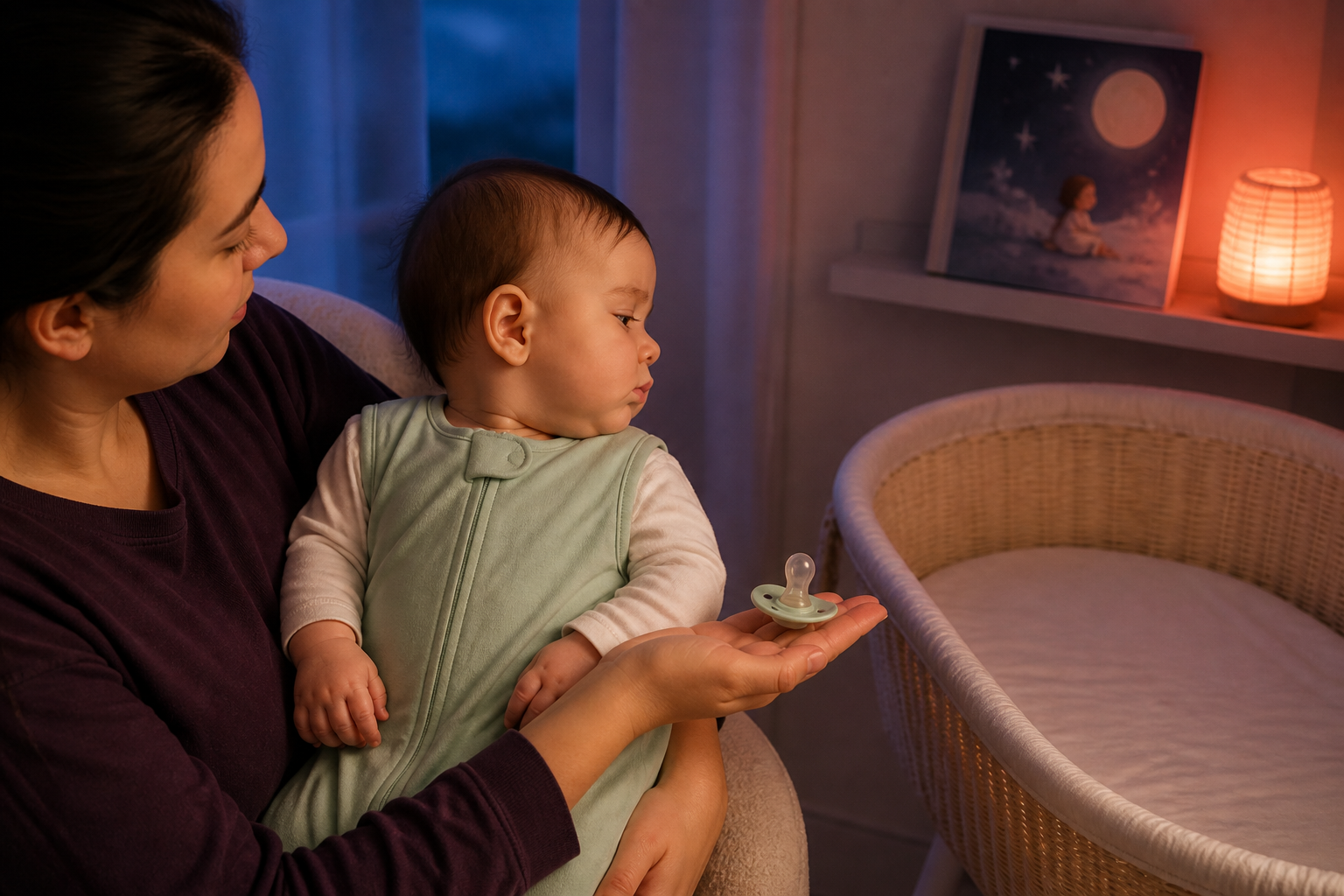
A clearly labeled composite Kacey-and-Benjamin moment: Imagine me in the feeding chair with Benjamin settled against my shoulder, the bassinet waiting, and a pacifier balanced between two fingers like the final answer to civilization. I touched it to his lips. He pushed it out. I tried again. He turned his head with the solemn certainty of a tiny restaurant critic sending back soup.
The useful part of that composite scene is not whether Benjamin eventually took it. It is the moment I would stop making his refusal into a puzzle I had to win. The pacifier was supposed to reduce distress. Once the attempt became the distress, the job had changed.
When the pacifier is standing where a feed should be
Non-nutritive sucking can be soothing, but a pacifier contains no milk. This sounds absurdly obvious in daylight. At 1:38 a.m., when a baby fed recently and is rooting again, it is surprisingly easy to wonder whether one more pacifier attempt might buy everyone twenty minutes.
I would not use it to negotiate with hunger. The American Academy of Pediatrics advises offering a pacifier only when you know the baby is not hungry. If your baby roots, searches, sucks their hands urgently, or settles briefly and then resumes a hungry cry, return to the feeding question.
Feed first
- Strong rooting or searching
- Hand-to-mouth movements with escalating urgency
- Turning toward breast or bottle
- It is time to feed under your baby’s individual plan
- Baby has not fed effectively or output is concerning
A calm offer may fit
- Baby has fed effectively
- Breathing and color look normal
- Baby is calm enough to explore the nipple
- You are beginning a nap or bedtime wind-down
- You can stop immediately if baby refuses
If your baby refuses not only the pacifier but also the breast or bottle, cannot latch or sustain sucking, coughs or chokes during feeds, seems unusually sleepy, or has fewer wet diapers, move out of the pacifier aisle and into feeding support. Call your pediatric clinician; a lactation consultant or feeding specialist may also be appropriate depending on the problem.
If breastfeeding is still being established
Official guidance generally recommends waiting until breastfeeding is well established before introducing a pacifier. That is not a magic date that arrives on the calendar. It means feeding is comfortable and consistent, milk supply is sufficient, latch is working, and the baby is gaining as expected. Your pediatrician or lactation professional can help interpret that for your specific baby.
The point is not to make parents frightened of pacifiers. It is to protect the learning and milk-transfer work happening at the breast. If feeding already feels uncertain, I would put my attention on latch, swallowing, output, comfort, and weight—not on finding a nipple shape marketed as “breast-like.” No silicone shape can certify that feeding is going well.
For a baby who is not directly breastfeeding, a pacifier may be offered earlier if the caregiver wants to. The same rules still apply: hunger comes first, the pacifier is optional, and refusal is allowed.
Should you try another shape?
Yes—once, calmly, if you want to. Pacifiers differ enough that a baby may reject one and accept another. The useful experiment changes one thing: shape, size, or material. The unhelpful experiment changes brands every six minutes while the baby gets angrier and the parent begins treating acceptance like an entrance exam.
| Check | What to do | What not to assume |
|---|---|---|
| Age label | Use a pacifier sized for your baby’s current age. | Bigger or longer is not automatically easier to hold. |
| One-piece construction | Choose an intact product and follow cleaning instructions. | A bottle nipple can be substituted as a pacifier. |
| Nipple shape | Try one genuinely different shape during a calm offer. | “Orthodontic” or “breast-like” guarantees acceptance. |
| Shield and airflow | Make sure the shield sits outside the mouth and is not damaged. | Holding the shield in place teaches the baby to suck. |
| Condition | Discard pacifiers that are torn, cracked, sticky, discolored, or deteriorating. | Cutting the nipple is a safe way to change or wean it. |
Never trim, puncture, or cut a pacifier. Damage is not a gentle training method; it is a reason to throw the pacifier away.
A safe-sleep reset when the pacifier is not the answer
Watch the foundation that stays the same
The American Academy of Pediatrics walks through the sleep-space choices that matter whether your baby accepts a pacifier, spits it out, or never uses one.
Pacifier-specific takeaway: keep the offer optional, but keep back sleeping and a firm, flat, clear sleep space nonnegotiable. If the pacifier falls out after sleep begins, it does not need to go back in.
Safe sleep still works when your baby refuses
A pacifier offered at naps and bedtime is associated with lower SIDS risk, which is why parents can feel alarmed when a baby spits it out. The next sentence matters just as much: NIH and AAP guidance says it is okay if the baby does not want it. Do not force acceptance, and do not put it back after it falls out during sleep.
Optional layer
Offer a clean pacifier at naps and bedtime once feeding is established when applicable. If baby refuses or it falls out, leave it out.
Non-optional foundation
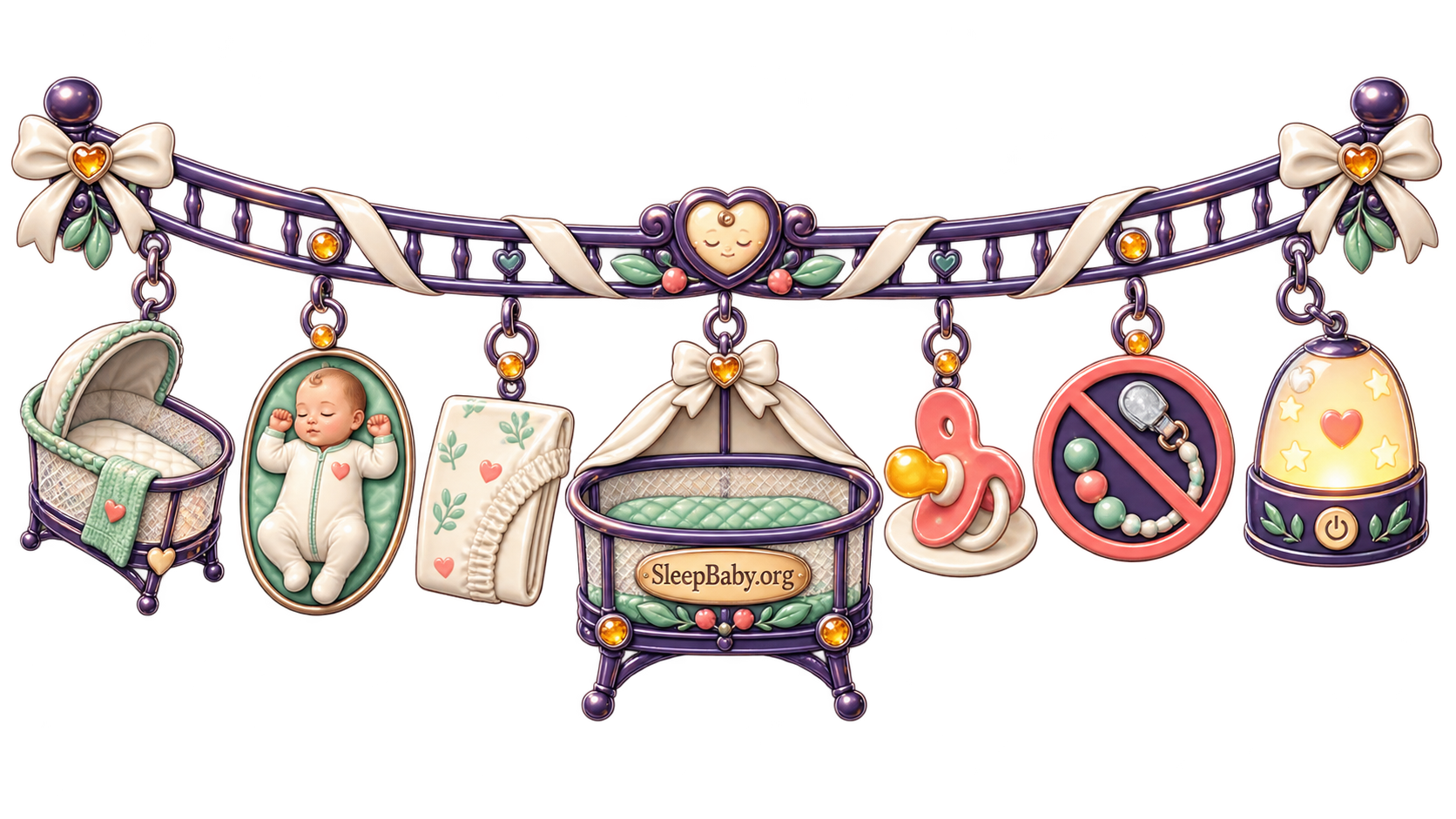
- Place baby on their back for every sleep.
- Use a firm, flat, level, safety-approved infant sleep surface.
- Keep the sleep space empty except for the fitted sheet.
- Use a separate infant sleep space rather than an adult bed, couch, or chair.
- Follow all other current safe-sleep guidance.
Do not “improve” the rejected pacifier with a clip, cord, stuffed-animal holder, blanket, lovey, or sweet coating during sleep. Attachments add choking, suffocation, or strangulation hazards. Honey is unsafe for infants under 12 months, and no sweet coating belongs on a sleep pacifier.

What can replace the pacifier’s job—not the pacifier itself?
The job is usually a transition: from feeding to resting, from arms to bassinet, from bright room to dark room, from alert to drowsy. You can support that transition without putting another object in the sleep space.
- Use a repeatable order. Feed as needed, change, dim the room, use a short phrase or song, and move toward the safe sleep surface.
- Keep stimulation low. A quiet voice, slow movement, and a predictable sound cue can be more useful than adding another gadget.
- Hold or rock while you are awake. Then transfer baby to the separate firm, flat sleep surface on their back.
- Respond to the actual need. Hunger needs feeding. Gas may need an upright cuddle while awake. Temperature discomfort needs clothing or room adjustment—not a pacifier.
- Let repetition do the teaching. A routine can become familiar even when no single object becomes essential.
Swaddling is not a pacifier substitute to improvise with. If used, it must follow current safe-swaddling guidance and stop as soon as the baby shows signs of trying to roll. Weighted swaddles and weighted sleep products are not safe.
When a baby suddenly refuses a pacifier they used to love
A sudden change can be ordinary. Babies develop preferences; the sucking need changes; the pacifier may be worn, the size may no longer fit, or your baby may simply be done. But sudden refusal is more useful when read alongside the rest of the day.
Call your pediatric clinician when refusal comes with:
- Refusal or difficulty with usual breast or bottle feeds
- Fewer wet diapers or other dehydration concerns
- White patches, ulcers, bleeding, swelling, or injury in the mouth
- Fever, ear drainage, significant congestion, or breathing difficulty
- Repeated vomiting, unusual sleepiness, weakness, or marked irritability
- Clear pain with sucking or a major change from your baby’s normal behavior
Seek urgent help for breathing trouble, blue color, inability to wake, severe weakness, or another emergency sign. A pacifier response is not a diagnostic test.
If the only change is that the pacifier now lands on the floor with impressive consistency, wash your hands, retire the experiment, and look at the whole baby. Feeding normally, breathing comfortably, producing expected diapers, and behaving normally matter more than loyalty to one soothing object.
The answer changes a little with your baby’s age
A newborn who turns away from a pacifier is not failing a sleep skill. In the early weeks, feeding, temperature, skin-to-skin contact, and the steady work of adjusting to life outside the womb are usually more important clues than whether a silicone nipple stays in place. A newborn may also have a small mouth, a strong gag response, or simply no interest in non-nutritive sucking. I would keep the offer brief and put my attention back on feeding cues, diaper output, weight follow-up, and safe sleep.
By three or four months, a baby may become more opinionated about texture and shape. That can make one calm comparison reasonable, but it still does not turn pacifier acceptance into a developmental requirement. At this age I also look at timing: a baby who is overtired may reject almost every settling tool, while the same baby may explore a pacifier peacefully after a feed and before the crying has escalated.
An older infant who previously used a pacifier may start removing it, chewing it, or preferring fingers. That change can reflect new motor skills rather than a problem. If refusal arrives alongside fever, unusual sleepiness, breathing trouble, fewer wet diapers, poor feeding, mouth sores, or signs of pain, the symptoms—not the pacifier—deserve attention. A sudden preference change without illness can be observed without a campaign to restore the old habit.
What gagging, spitting, and turning away are telling you
- Turning the head: “I do not want this right now.” Pause instead of following the mouth.
- Repeated tongue-thrusting: the shape, timing, or entire idea may not fit. One observation is enough; you do not need ten trials.
- Gagging: remove the pacifier and let your baby recover. Do not push it farther back or hold it in place.
- Crying harder when it appears: return to the underlying need—food, closeness, a burp, a clean diaper, less stimulation, or sleep.
- Calm mouthing without sustained sucking: your baby may be exploring rather than accepting. Let the baby control whether the interaction continues.
These signals are useful information, not objections to overcome. The goal is not to train the mouth to tolerate a product. The goal is to notice whether a voluntary sucking tool helps this particular baby settle.
If you keep one available, make the pacifier itself boringly safe
Follow the manufacturer’s age range and cleaning instructions, and inspect the pacifier before each use. Replace it if the nipple is torn, sticky, swollen, cracked, or otherwise damaged. Never cut or enlarge it to change the flow or feel. Do not dip it in honey, sugar, medicine, or another sweet substance, and do not use a bottle nipple as a substitute pacifier.
For sleep, keep cords, clips, ribbons, stuffed attachments, and other accessories out of the sleep space. A one-piece pacifier offered on its own is different from an object tethered to clothing or the crib. If it falls out after your baby is asleep, you do not have to keep putting it back. If your baby refuses it, remove it and continue the same safe-sleep setup: alone, on the back, in a clear crib or bassinet with a firm, flat sleep surface.
How to tell whether the pacifier is really the bedtime problem
For two or three evenings, observe the sequence rather than the outcome alone. Note when the last feed ended, how long your baby had been awake, what happened in the five minutes before the offer, and whether crying rose or fell when you stopped offering. You are not building a permanent tracking project; you are looking for a repeatable cause.
If your baby settles when you shorten the final wake period, protect a full feed, dim the room sooner, or reduce bouncing and talking, the pacifier was probably never the central issue. If one shape is accepted during calm practice but rejected during intense crying, timing matters more than brand. If every version causes gagging or distress, the useful conclusion may simply be that this baby does not want a pacifier.
That conclusion can feel strangely disappointing when you expected the pacifier to be the missing switch. But it is also clarifying. You can stop spending bedtime asking the same question and build a short, repeatable sequence around the cues your baby actually responds to. A predictable feed, fresh diaper, darkened room, brief cuddle, and calm crib transfer can be a complete routine even when no pacifier appears in it.
Also separate the first minute in the crib from the whole night. A baby can protest a transfer and then settle with your nearby voice or hand, while another may need to be picked up and calmed before you try again. Judge the routine by whether it is responsive, repeatable, and safe—not by whether silence arrives instantly. If the pattern keeps worsening or feeding and growth are part of the concern, bring the full picture to your baby’s clinician instead of treating pacifier refusal as the diagnosis.
One bounded shape test—not a pacifier campaign
Philips Avent Soothie Baby Pacifiers, 0–3 Months
If your newborn immediately rejects a flatter or multi-piece pacifier and you want to test one meaningfully different option, the one-piece silicone Philips Avent Soothie gives you a simple, age-labeled shape to try during a calm, fed moment. I prefer this fit to buying a mixed pile or adding a plush holder: it keeps the experiment to one variable and adds nothing to the empty sleep space. Use only for the labeled 0–3 month range, inspect it before every use, and stop when your baby refuses. It does not replace feeding, guarantee acceptance, prevent SIDS, or make any sleep setup safe.
See the Philips Avent Soothie on Amazon
As an Amazon Associate, SleepBaby may earn from qualifying purchases.
What I would do tonight
- Start with feeding. If your baby may be hungry, feed according to the individual plan before trying to soothe with a pacifier.
- Check the pacifier. Correct age size, clean, intact, and unattached.
- Offer once while calm. Let your baby draw it in. Do not hold it there.
- Accept the answer. A head turn, gag, harder cry, or repeated spit ends the attempt.
- Use the safe-sleep foundation. Back, firm flat level surface, fitted sheet only, empty sleep space.
- Watch the whole pattern. If feeding, output, breathing, mouth comfort, alertness, or behavior has changed, contact the pediatric clinician.
The goal tonight is not to graduate your baby into pacifier use. It is to identify the need, make one respectful offer if appropriate, and move toward sleep without turning a small silicone object into a family referendum.
Questions parents ask after the pacifier hits the floor
Can a baby learn to self-soothe without a pacifier?
Yes. Babies settle in many ways, and the ability to move between sleep cycles changes with development. A pacifier may be one cue, but it is not a required developmental skill. Responsive settling and a consistent routine can support sleep without placing objects in the crib.
Should I keep replacing it after my baby falls asleep?
No. If the pacifier falls out during sleep, official safe-sleep guidance says you do not need to put it back in.
Does gagging mean the pacifier is dangerous?
Gagging during an offer can mean the nipple shape, length, timing, or oral sensitivity is not working for that baby. Stop the attempt. Use only an intact, correctly sized pacifier and ask the clinician about persistent gagging, coughing, choking, pain, or feeding difficulty.
Should I hold the pacifier in until my baby starts sucking?
No. Gentle lip contact is an offer. Holding it in place overrides the refusal cue and can increase distress.
Is thumb sucking the same for SIDS risk?
No. NIH guidance notes that finger or thumb sucking has not been shown to provide the same SIDS-risk association as offering a pacifier. That still does not mean a pacifier should be forced.
Sources
When the pacifier is optional, the plan gets quieter
Build bedtime around the baby you have—not the prop you expected
The little silicone pacifier from the opening may still be under the feeding chair. It does not have to become the hero of tonight. Feed the need in front of you, keep the sleep space safe, offer comfort without pressure, and let a simple routine carry more of the transition.