
Look at the baby before you look for a cause
A baby who suddenly goes pale in sleep needs an immediate breathing, color, and responsiveness check.
Call 911 now if your baby looks blue, gray, ashen, or unusually pale and is struggling to breathe, has pauses in breathing, is limp or difficult to wake, has changed muscle tone, or is not responding normally. Call even if you are unsure whether the room light is fooling you. Emergency professionals would rather evaluate a concerning change than have you wait for a perfect description.
If your baby is breathing comfortably, wakes and responds normally, has normal color in the lips and tongue under neutral white light, and the apparent paleness disappears when you move out of warm or colored nursery light, that is more reassuring—but it is not a diagnosis. Recurrent episodes, persistent pallor, poor feeding, fewer wet diapers, unusual tiredness, fever or low temperature, or a clear change from your baby’s baseline deserve prompt pediatric advice.
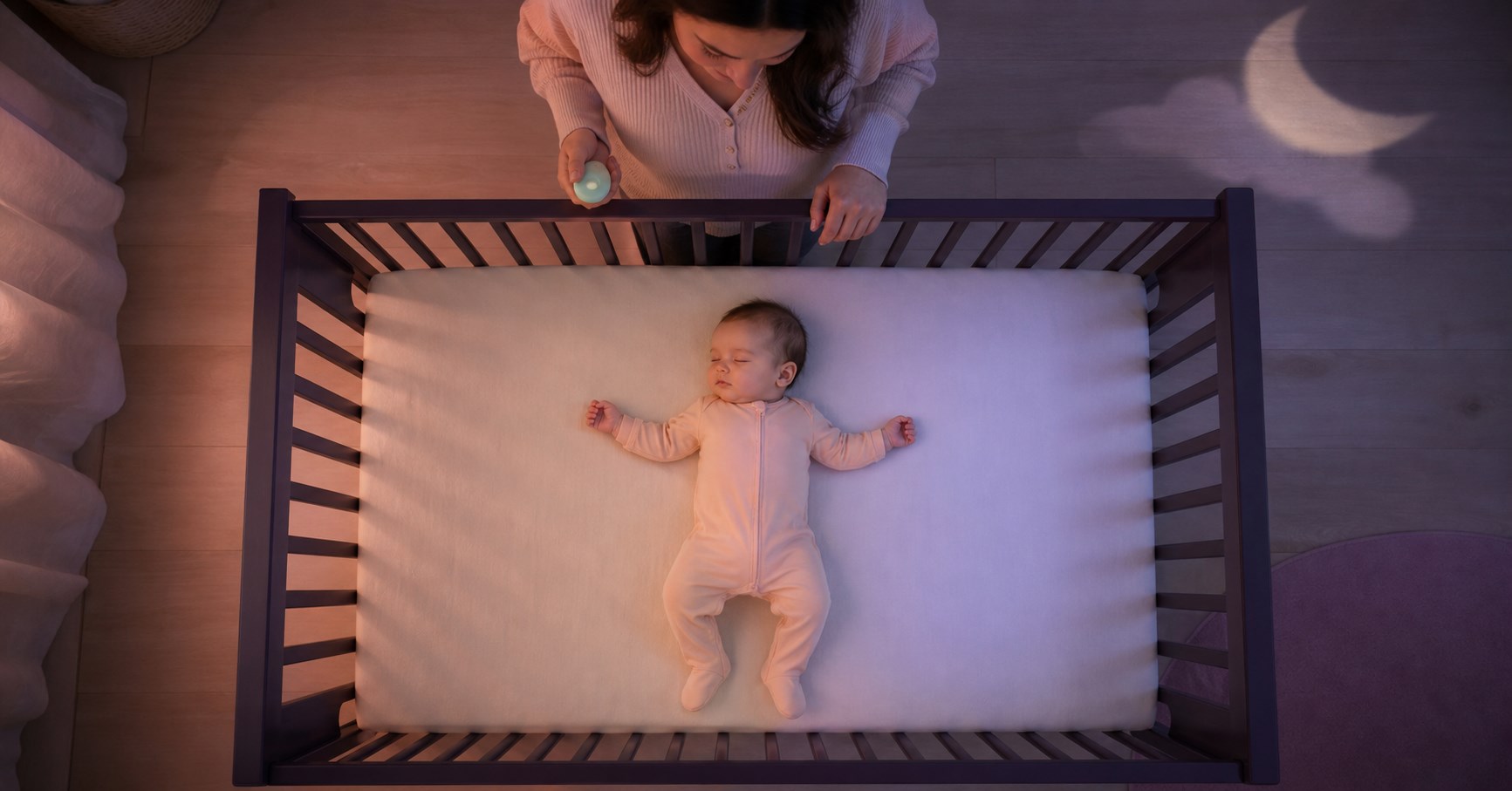
I know the private question underneath this search: Am I looking at a sleeping face, or am I looking at danger? At night, lavender bulbs make skin look gray, warm lamps erase pink tones, and a quiet baby can seem almost too still. I do not want to soothe you past something important. I also do not want one strange shadow to turn every nap into a bedside vigil. The way through is not guessing the cause. It is checking the few signals that change the decision.

A clearly labeled hypothetical Kacey-and-Benjamin scene
The night Benjamin looked like the color had left his face
Imagine me standing beside a sleeping hypothetical baby Benjamin under a purple night-light, convinced that his cheeks have gone pale. My brain immediately opens twenty-seven tabs without touching a browser: anemia, breathing, circulation, cold room, something I once read at 3:14 a.m. and should never have retained. I lean closer. The light changes as my shoulder blocks the bulb. His skin changes with it.
In this hypothetical scene, I do not decide that the bulb explains everything. I turn on neutral white light, look at Benjamin’s lips and tongue, watch several breaths, and gently rouse him. He stirs, objects to my management style, and looks like himself. That sequence gives me better information than staring harder under purple light. If he had been blue or gray around the lips, breathing abnormally, limp, or difficult to wake, the story would not continue into interpretation. It would become a 911 call.
This scene is not family history and it is not medical evidence. I am using it because the emotional mistake is real: we try to answer why before we have answered how is the baby right now? The order matters. First establish whether there is an emergency. Then collect the details a clinician can use. Only after that do ordinary explanations such as lighting or cool hands earn a place in the conversation.

The five-part check: Light ? Lips ? Lungs ? Lift ? Call
I built this as a decision tool, not a home exam. You are not being asked to diagnose oxygen levels, anemia, infection, or heart disease by eye. You are answering one narrower question: does my baby need emergency help now, prompt medical advice, or a careful recheck under better conditions?
1. Light
Use neutral white room light. Warm amber, red, blue, purple, projector, television, and phone-screen light can distort skin color. Move your viewpoint rather than moving an unwell baby around the house.
2. Lips
Check the lips, tongue, gums or inside the mouth. On darker skin, palms, soles, nail beds, and the inside of the lower eyelid may make a change easier to see. Blue, gray, or ashen central color is not a wait-and-see sign.
3. Lungs
Watch the chest and belly. Look for ribs pulling in, nostrils flaring, grunting, gasping, very fast breathing, repeated pauses, or a pattern that is clearly different from normal sleep breathing.
4. Lift
Gently try to rouse your baby. A normal sleepy protest, stretch, eye opening, or purposeful movement is different from limpness, abnormal stiffness, altered tone, or unusual unresponsiveness.
5. Call
Call 911 for emergency signs. Call your pediatrician promptly for persistent or recurrent pallor or associated feeding, temperature, hydration, or energy changes. A resolved scary episode still deserves a clinician’s history and exam.
SleepBaby.org teaching tool: this sequence organizes observation; it does not replace pulse oximetry, examination, laboratory testing, or emergency assessment.
What “pale” can mean—and why one cheek is not enough
Pallor is a reduced pink or healthy color related to blood flow or hemoglobin appearance; it is not the same as pigment loss. But parents use “pale” for several different sights: a washed-out face under cool light, gray lips, white-looking hands, mottled legs, a face that changes during a breathing pause, or a baby whose usual undertone seems absent. Those descriptions do not carry the same urgency.
I would compare the baby with the baby—not with a color chart built around someone else’s skin. What is normal around the lips and gums when your child is awake? What do the palms and soles usually look like? Does the color change involve the center of the body or only cool hands and feet? Did it appear suddenly? Did breathing, feeding, tone, or alertness change at the same time? Baseline plus associated signs gives the clinician more useful information than the word “pale” by itself.
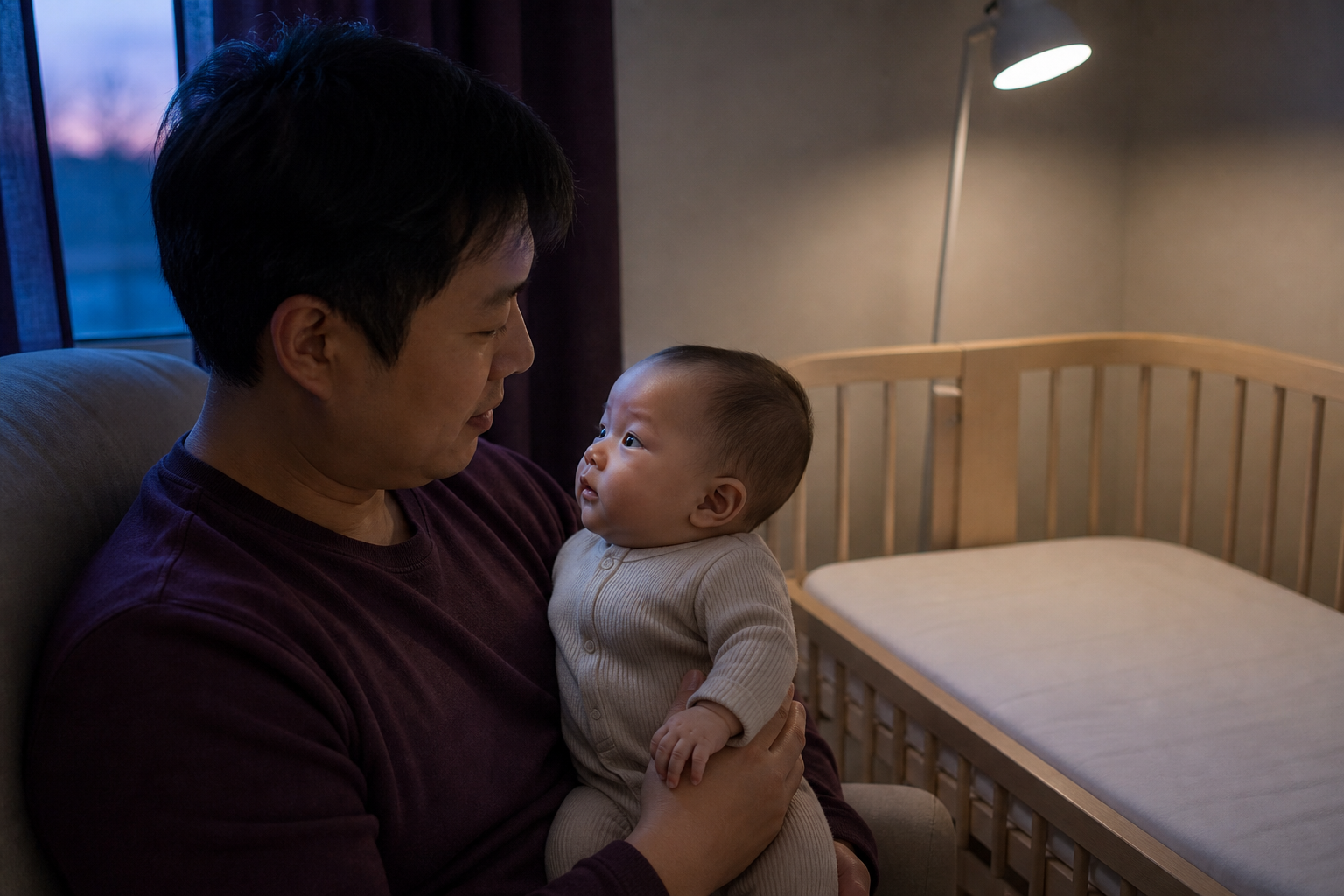
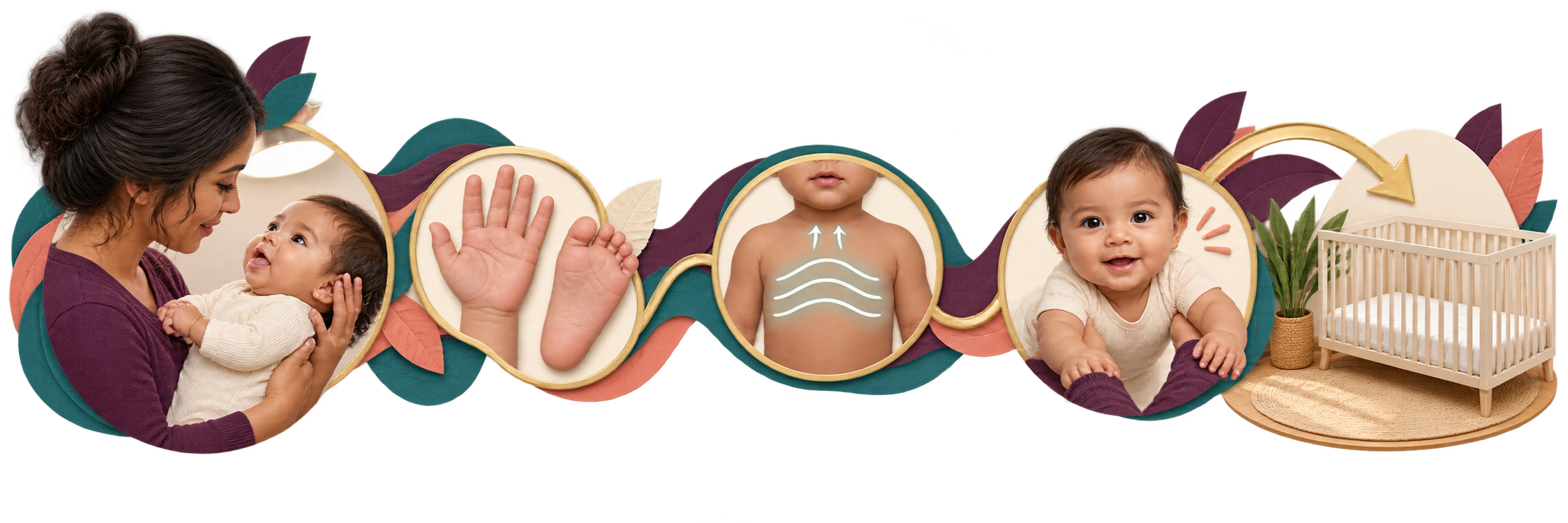
Sleep breathing can look irregular. Distress has company.
Babies do not breathe like quiet metronomes. Especially in early infancy, breathing can vary in depth and rhythm. A brief pause may be followed by several quicker breaths. That fact is not permission to normalize a color change. The important question is whether the pattern comes with central pallor or blue/gray color, visible work, abnormal tone, or reduced responsiveness.
Watch without pressing on the chest. Retractions look like skin pulling in between or below the ribs or near the collarbone. Nostrils may flare. Grunting can sound like a small repeated effort at the end of a breath. Gasping, choking, persistent noisy effort, head bobbing, or a breathing pause that feels long enough to make you reach for the baby belongs in the urgent decision, not in a sleep-tracking spreadsheet.
If breathing stops for more than 20 seconds or color changes to pale, blue, or gray, HealthyChildren advises calling emergency services. I would not make a parent run a stopwatch while frightened. If you see concerning color plus a meaningful pause, difficulty breathing, changed tone, or poor response, call 911 and follow the dispatcher. If your baby is not breathing normally, begin CPR if instructed or if you are trained, and use emergency guidance rather than this article.
More ordinary explanations belong after the safety check
Once breathing, central color, tone, and responsiveness are reassuring, there are less alarming reasons a baby may look different in sleep. They can explain an appearance; they cannot be used to dismiss a concerning event.
Colored or directional light
Amber light can hide pink tones; purple or blue light can make skin look gray; a phone screen can create a cold patch across one side of the face. If the apparent pallor vanishes immediately under neutral room light and everything else is normal, record the lighting condition rather than treating the shadow as a symptom.
Cool hands and feet
Peripheral color may change with temperature, especially in young babies. Check the chest or back for warmth rather than judging room comfort by hands alone. Do not add loose blankets, heating pads, hot-water bottles, or positioning products to the sleep space.
Normal baseline and contrast
Closed eyes, relaxed facial muscles, lighter surrounding fabric, or a recently flushed awake face can make sleep color seem dramatically different. Baseline comparison is useful only when the baby’s central color, breathing, tone, and response are normal.
Notice what is not on this list: “sleep makes blood leave the skin,” “fatigue redirects blood to essential organs,” or “a stuffy room reduces oxygen enough to cause harmless pallor.” Those explanations sound tidy and can delay care. When oxygenation or circulation is genuinely affected, the job is medical assessment—not creating a more comfortable story around it.
What a clinician may consider
Pallor is a sign, not a diagnosis. Depending on the age, history, examination, and associated symptoms, a clinician may consider anemia, infection, dehydration, blood loss, low blood sugar, circulation or heart problems, respiratory illness, shock, medication effects, or other causes. Some are uncommon; some are urgent. Listing them is not a way to choose one at home.
Anemia
Anemia can cause pale skin, but a sleeping face cannot confirm it. Clinicians consider feeding history, growth, prematurity, diet, blood loss, family history, energy, breathing, heart rate, and examination, and may order blood tests. Do not start iron supplements because of an online color comparison. Too much iron can be dangerous, and the correct dose—when iron is needed—depends on the child and the diagnosis.
Infection or sepsis
A baby who is pale or mottled and also unusually cold or hot, difficult to wake, feeding poorly, breathing fast or hard, producing fewer wet diapers, or acting markedly unlike normal needs urgent evaluation. Babies can become seriously ill quickly. A temperature of 38°C (100.4°F) or higher in a baby younger than 3 months requires immediate medical guidance; it is a fever threshold, not a normal target. A low temperature can also matter, especially with poor feeding or lethargy.
Heart, lung, or circulation problems
Central blue/gray color, sweating or tiring with feeds, poor growth, rapid breathing, weak response, or pale cool clammy skin can point toward cardiopulmonary or circulatory trouble. These are not sleep-position problems to fix with an incline. They require medical assessment, with emergency action for acute color, breathing, or responsiveness changes.
A resolved event
Clinicians sometimes use the term brief resolved unexplained event, or BRUE, for a sudden, brief, now-resolved event in a baby younger than 1 year involving color, breathing, tone, or responsiveness when no cause is found after a history and examination. Parents cannot diagnose a BRUE from a checklist. If choking, reflux, infection, seizure, injury, breathing disease, or another explanation is found, it is not unexplained. BRUE is not SIDS and should not be called a “near-miss SIDS.”
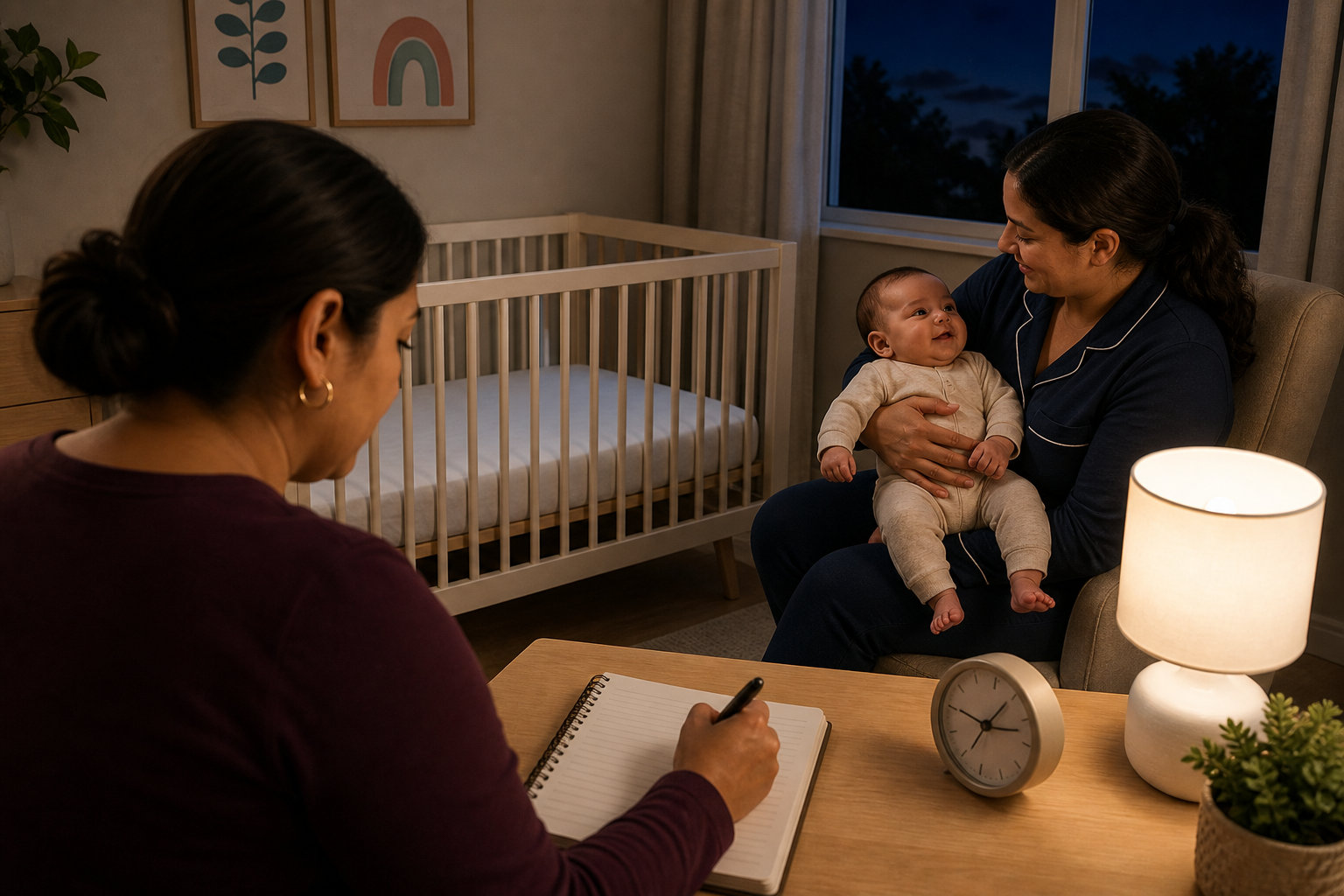
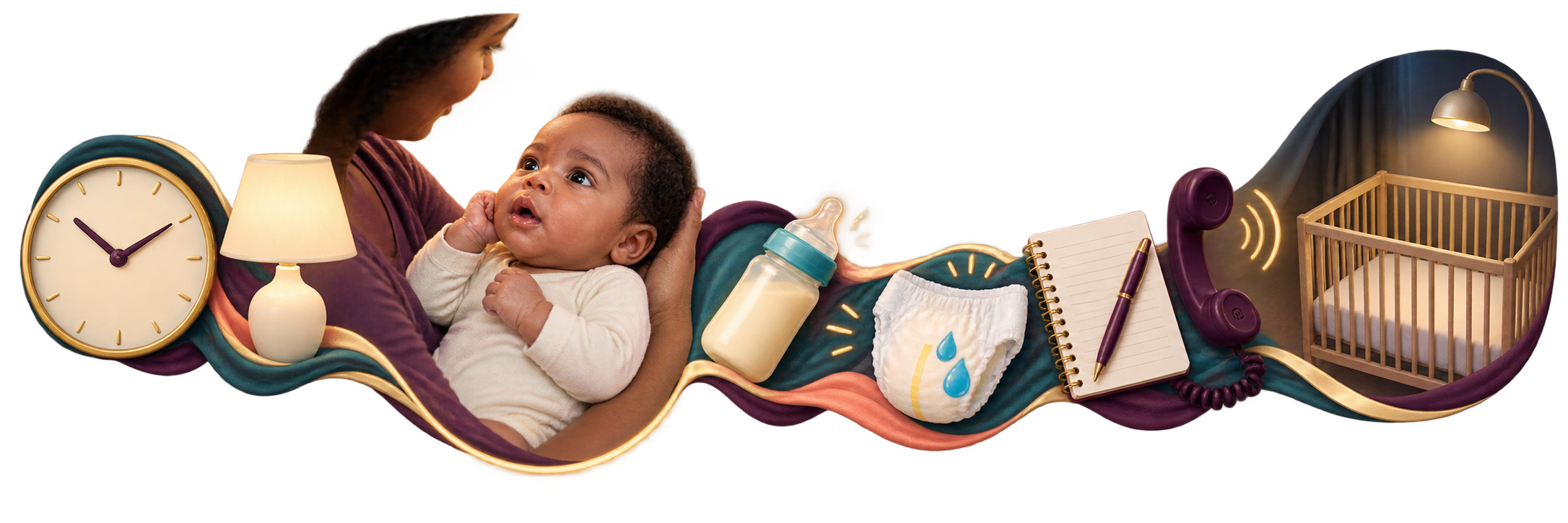
The note that helps a pediatrician more than “looked weird”
After immediate danger has been ruled out, write down what you saw while it is fresh. I would rather give a clinician six concrete observations than a polished theory.
- Baby’s age, gestational history, and current illnesses or recent vaccines.
- Exact time, sleep position, sleep surface, room light, and room temperature context.
- Where the color changed: face only, lips/tongue, gums, palms/soles, whole body, or mottled patches.
- Whether breathing paused, sped up, became noisy, or showed retractions, flaring, grunting, or gasping.
- Whether the baby was limp, stiff, difficult to wake, unusually sleepy, or normally responsive.
- How long the event lasted and what happened before color returned.
- Feeding, vomiting, fever or low temperature, wet diapers, stool changes, rash, and energy that day.
- Medicines, possible exposures, injury, or anything else that changed.
A photo or short video can sometimes help a clinician see lighting, breathing effort, or distribution—but only if making it does not delay calling 911, checking responsiveness, or following emergency instructions. Do not stage a repeat. Do not wait for the next episode to become “better evidence.”
Do not change the sleep surface to watch more closely
Fear can make an adult want to prop the baby up, move them into the adult bed, tuck blankets around them, or keep them asleep in a carrier where the face is closer. Those changes can introduce new risk. Unless a medical team has given you a specific supervised plan, continue to place your baby on the back on a firm, flat, level, safety-approved crib, bassinet, or portable-crib mattress with only a fitted sheet.
Keep pillows, blankets, bumpers, positioners, wedges, toys, cords, and loose objects out. Room share without bed sharing when appropriate for your baby’s age. If your baby falls asleep in a car seat, swing, bouncer, carrier, or other inclined device outside travel, move them to the safe flat sleep space as soon as practical. Monitoring does not make an unsafe surface safe.
If the concern is a cool room, dress the baby in an appropriate layer or wearable blanket rather than adding loose bedding. Check the chest or back for overheating; cold hands alone do not tell you the baby’s core temperature. If the baby is pale, mottled, abnormally cold, poorly responsive, or feeding badly, seek medical help rather than solving the observation with more clothing.
Watch the safe return after the check
A health concern does not make an unsafe sleep surface safer.
This CDC safe-sleep video belongs after the emergency decision, not inside it. Once a baby is breathing normally, responding normally, and following the clinician’s plan, the sleep destination remains a separate, firm, flat, bare crib, bassinet, or portable crib.
Takeaway: evaluate the color or breathing concern first; after danger is ruled out, return to back, bare, firm, and flat.
Five shortcuts I would not trust
- “The monitor number is normal, so the color is fine.” A consumer number does not overrule blue/gray lips, labored breathing, altered tone, or poor response.
- “Babies are pale when deeply asleep.” Lighting and relaxation can alter appearance, but sudden generalized or central color change still requires assessment.
- “It is probably anemia, so I should start iron.” Pallor alone does not diagnose anemia, and supplementation belongs with clinician guidance.
- “I should prop the mattress so breathing is easier.” Inclining an infant sleep surface is not a safe home response to breathing concern.
- “If the baby looks normal now, the event does not matter.” A resolved episode involving color plus breathing, tone, or responsiveness can still need urgent evaluation.
Age changes the threshold for calling
I would use a lower threshold for a newborn than for an older baby because newborn illness can be subtle and progress quickly. “But she is sleeping” is not reassuring when the baby is unusually difficult to wake, feeds weakly, has an abnormal temperature, or looks pale and unlike herself. Sleep should not erase a baby’s normal response to touch and handling.
Prematurity, heart or lung disease, anemia, a prior BRUE evaluation, feeding difficulty, recent hospitalization, or a clinician-provided monitoring plan can change these thresholds. Follow the individualized plan, but use 911 for acute breathing, central color, tone, or responsiveness danger even when you already own medical equipment.
Checking color across skin tones without pretending there is one “normal pink”
Medical descriptions often default to “pink,” which is not a useful baseline for every child. On brown or black skin, pallor or cyanosis may be easier to notice in the lips, tongue, gums, palms, soles, nail beds, or inside the lower eyelid. Ashen or gray may describe the change more accurately than pale. Mottling may look like an unusual patchwork or dullness rather than obvious purple lace.
I would avoid comparing your baby with online photographs. Camera processing, flash, screen settings, skin undertone, and illness stage make that unreliable. Compare several sites on your own baby under the same neutral light. Ask: Is the tongue its usual color? Are the lips clearly different? Do palms and soles match the child’s awake baseline? Is the whole face changed, or is one side in shadow? Does the baby respond normally while you check?
Do not press repeatedly on the skin trying to perform a capillary-refill test you found online. Clinicians interpret circulation in context, and technique matters. Likewise, do not pull hard on the eyelid, shine a bright beam into the eyes, or keep waking the baby for serial photographs. One clear comparison plus the baby’s breathing and behavior is enough to decide whether you need emergency help or a clinician call.
Three worked episodes: same word, different decision
The word pale can lead to three completely different next steps. These examples are hypothetical teaching cases, not diagnostic templates. If your baby has an emergency sign, do not keep reading to find the closest example.
1. The lavender-light illusion
A four-month-old is asleep in a bare bassinet. Under a purple projector, one cheek and the bridge of the nose look gray. The caregiver turns on the ceiling’s neutral white setting. The lips and tongue look normal, breathing is easy, the chest is not pulling in, and the baby wakes with an indignant squawk and purposeful movement. The gray cast disappears when the projector goes off.
I would document the lighting and stop using colored light for health checks. I would not call that proof that every future color change is lighting. If the appearance recurs under neutral light, becomes generalized, or arrives with poor feeding, fever, reduced diapers, breathing change, or unusual sleepiness, the decision changes to a clinician call or emergency action.
2. Pale, clammy, and hard to wake
A six-week-old looks washed out over the whole face and chest, feels cool and clammy, barely reacts when picked up, and is breathing quickly. This is not a “warm the room and recheck later” scene. Pale or mottled color plus abnormal temperature, rapid breathing, and poor responsiveness can signal serious illness or circulation trouble. The action is 911, with CPR readiness and dispatcher instructions—not a drive made by a lone adult who is also trying to watch the baby.
Notice how little cause-hunting appears in that answer. It does not matter whether the eventual diagnosis is infection, dehydration, a heart problem, low blood sugar, or something else. The combination has already answered the action question.
3. A brief event that is over
An eight-month-old coughs during sleep, seems pale around the mouth, stiffens briefly, then cries and returns to normal color and behavior within a minute. The event is over, but color plus altered tone is not erased by recovery. The caregiver seeks urgent medical assessment and reports the exact sequence. A clinician may find choking, reflux, infection, seizure, or another explanation; only after evaluation could an unexplained-event label even be considered.
I would not try to recreate the cough, offer food to “test swallowing,” or assume the event was a nightmare. Recovery is important information. It is not permission to delete the event.
What to say when you call
Fear makes language slippery. A short script can keep the first minute useful:
“My baby is [age]. At [time], while sleeping on [surface/position], I saw [exact color and location]. Breathing was [normal/paused/fast/working hard]. Tone and response were [normal/limp/stiff/difficult to wake]. The episode lasted about [duration] and [has/has not] fully resolved. Today feeding, diapers, temperature, illness signs, and behavior are [details].”
For 911, lead with what is happening now: “My baby’s lips are gray and breathing is difficult,” or “My baby is pale and will not wake normally.” Give the address and follow instructions. For the pediatrician, include recurrence and baseline. If someone else witnessed the episode, have them write their observations separately before memory blends the accounts.
If emergency professionals recommend evaluation, go. Do not stay home because the baby looks better, a monitor stopped alarming, or the appointment schedule is inconvenient. If a clinician gives home-observation instructions, repeat them back: what signs mean 911, what signs mean an urgent return, how to handle another episode, and when follow-up occurs.
Do not run experiments on a baby who looked pale
Do not delay feeding to see whether color changes
Feed according to normal cues and the clinician’s plan. Poor feeding is information to report, not a variable to provoke.
Do not cool or overheat the room
Use a comfortable environment and appropriate clothing. Deliberately changing temperature to reproduce pallor can obscure illness and create risk.
Do not change sleep position as a breathing test
Back sleep on a firm, flat surface remains the default. A baby who seems to breathe better only when held upright needs medical discussion, not a wedge.
Do not borrow oxygen or medication
Oxygen, iron, inhalers, fever medicine, and other treatments require the correct indication and plan. Another child’s equipment is not a diagnostic trial.
If the pediatrician says to observe at home
Observation should have edges. Ask which signs require 911, which require same-day reassessment, and how long to watch before follow-up. Keep feeding and diaper notes simple. Record sleep only around episodes; do not turn the whole night into surveillance unless the medical plan requires it.
Across the next day, notice whether pallor appears awake as well as asleep, during feeds, after crying, in cold conditions, or with activity. Note sweating with feeds, tiring before finishing, rapid breathing, vomiting, diarrhea, fever, rash, unusual bruising, blood in stool or vomit, or reduced urine. These details can change what the clinician evaluates. They are not a score you should total yourself.
If there is another episode, begin again with Light ? Lips ? Lungs ? Lift ? Call. Do not let yesterday’s reassuring conversation overrule today’s emergency signs. A plan is useful only if it remains responsive to the baby in front of you.
Questions parents ask after the first frightening look
Can deep sleep itself make a baby pale?
Sleep changes facial expression, muscle tone, breathing rhythm, and the way light falls across still skin. Those changes can alter appearance. But “deep sleep” is not a safe explanation for sudden generalized pallor, blue or gray central color, or pallor paired with breathing, tone, temperature, feeding, or responsiveness changes. If the only change disappears under neutral light and the baby wakes, breathes, and behaves normally, document it. If the color is real or you remain unsure, contact a clinician.
Why does my baby look pale only on the monitor?
Night-vision cameras commonly use infrared illumination and process color differently from the human eye. Exposure, white balance, compression, and the angle of a sheet or sleepwear can make a face look ghostly. Use the monitor to notice that something deserves an in-person check, not to decide that the baby’s circulation or oxygen is normal or abnormal. Go to the baby, use neutral light, and run the five checks. Never rely on a screenshot when the live baby looks concerning.
What if only the area around the mouth looks pale?
Lighting, saliva, pressure, temperature, and natural contrast can make the skin around the mouth look lighter. The lips and tongue matter more than the surrounding patch. If the lips or tongue are blue, gray, ashen, or clearly changed, or breathing and response are abnormal, call 911. If central color is normal but the area repeatedly changes, mention the pattern to the pediatrician and include what happens during feeding, crying, sleep, and cold exposure.
Could teething cause pallor?
Teething does not provide a reliable explanation for sudden pallor. A teething-age baby can still have infection, anemia, dehydration, breathing trouble, or another condition. Do not let drooling or sore gums close the assessment. Look at temperature, feeding, wet diapers, energy, breathing, central color, and response.
Should I wake my baby every hour to check?
Not unless your clinician gives that exact plan. Repeated waking can exhaust the household without answering the medical question. After an episode, obtain the recommended evaluation. If home observation is advised, clarify what to check, how often, and what ends home observation. Keep normal safe-sleep practices and use an in-person check whenever the monitor or your instincts identify a new concern.
What medical evaluation may involve
Knowing what the clinician may ask can make the visit feel less like walking into fog. Evaluation begins with the story: age, pregnancy and birth history, prematurity, feeding, growth, illness, medicines, family history, event duration, sleep surface, breathing, tone, response, and recovery. The clinician examines color under appropriate light, breathing effort, heart and lung sounds, pulses, hydration, temperature, neurologic response, and growth.
Testing is not automatic or identical for every baby. Depending on findings, clinicians may measure oxygen with medical equipment, check blood counts for anemia or infection, assess glucose, obtain viral or other infection tests, perform an electrocardiogram, order imaging, or arrange specialist or sleep evaluation. A lower-risk resolved event may need fewer tests than an ongoing or high-risk episode. More testing is not always better; the right testing follows the history and exam.
I would ask four questions before leaving: What is the most likely explanation? What dangerous possibilities have been considered? Which exact signs mean 911 or an urgent return? When and with whom is follow-up? If no cause is found, ask whether the clinician considers this a BRUE, whether the event is low or high risk, and whether caregiver infant-CPR training is recommended. Do not let an unexplained label become a vague promise that it cannot happen again.

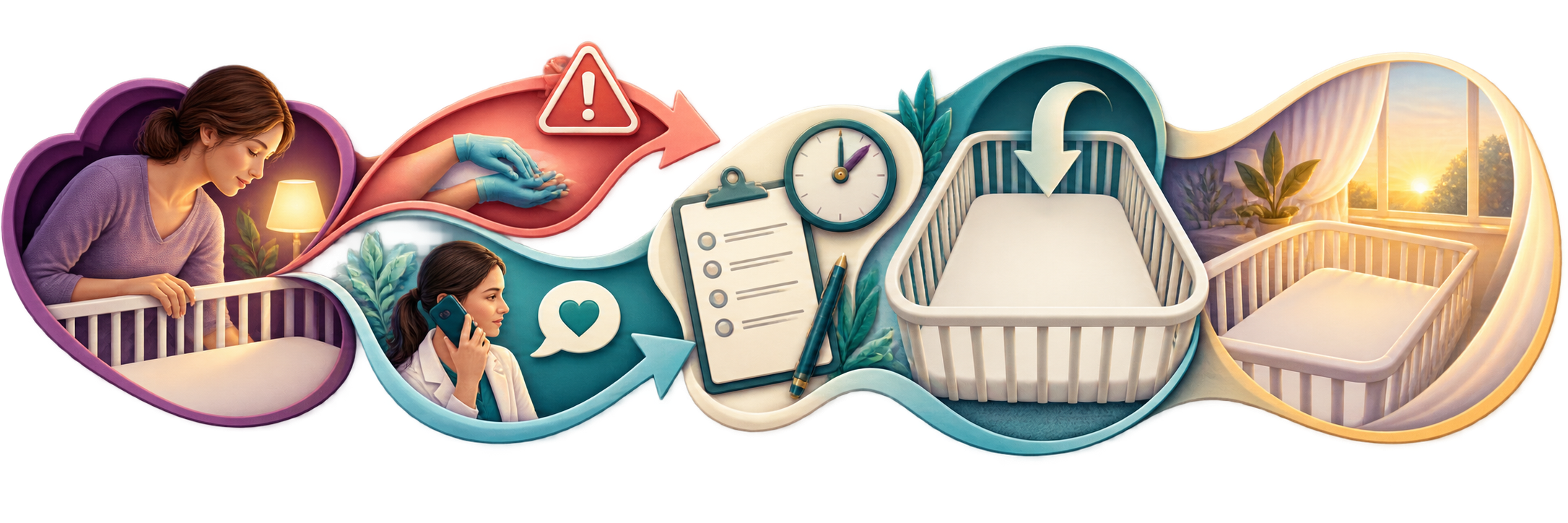
A calm plan for tonight—after danger is ruled out
Set one neutral white light within the caregiver’s reach but outside the crib. Know where your phone is. Make sure every caregiver knows the five checks and the 911 signs. Keep the sleep space bare. If you have already spoken with the pediatrician, write their specific instructions where the night caregiver can see them.
Then let the baby sleep. I do not mean “ignore your instincts.” I mean that responsible observation does not require watching every breath until sunrise. Check when something looks different, use the same sequence, and act on the result. If you cannot stop checking because the episode frightened you, tell the pediatrician that too. The emotional aftermath is part of the care plan, not evidence that you are overreacting.
If persistent mouth-open breathing is the next non-emergency question after your baby has been assessed, our guide to a baby sleeping with their mouth open can help you organize what to observe for the pediatrician. Do not use that article instead of emergency care for color change or breathing distress.
A visibility tool—not a medical monitor
Glocusent 16 LED rechargeable clip-on reading light
For this exact situation, I would choose a clip light with a neutral or cool white mode over a warm-only nursery lamp. The practical advantage is modest but real: it gives you hands-free, adjustable white light for a brief color check without asking you to hold a phone flashlight while trying to watch breathing and rouse your baby. The clip also makes it easier to keep the entire light outside the crib.
This fits better than a tracking journal or consumer vital-sign monitor because it supports one observable job without creating a stream of numbers that can falsely reassure or frighten you. It cannot diagnose pallor, measure oxygen, detect illness, prevent SIDS, or replace 911 or a pediatrician. Never delay emergency action to retrieve it, and keep the light, clip, charging cable, and charger beyond the baby’s reach.
See the Glocusent rechargeable clip-on light on Amazon
As an Amazon Associate, SleepBaby may earn from qualifying purchases.
Sources
- HealthyChildren: Sleep Apnea in Children—Detection & Treatment
- HealthyChildren: When to Call Emergency Medical Services for Your Child
- MedlinePlus: Brief Resolved Unexplained Event
- MedlinePlus: Paleness
- NICE: Fever in Under 5s—Recommendations
- Royal Free London: Signs and Symptoms of an Unwell Baby
- CDC: Helping Babies Sleep Safely
- HealthyChildren: Common Conditions in Newborns
- NHLBI: Heart Valve Diseases—Symptoms
- NHLBI: Iron-Deficiency Anemia
When the room goes quiet again
You do not have to choose between panic and pretending.
First check the signals that change the decision. Call when they tell you to call. Then bring the night back to its safest shape: clear light when you need it, a bare sleep space, and a written plan instead of a hundred imagined causes. SleepBaby can help with the sleep pattern after the medical question has been answered by the right person.
This sleep guidance supports—not replaces—your baby’s clinician or emergency care.