
The answer you need first
If your baby fell asleep on the floor, move them to an intended infant sleep space
If your infant simply dozed off during supervised floor play, move them as soon as practical to a safety-compliant crib, bassinet, play yard, or bedside sleeper. Use the product exactly as directed, with a firm, flat, level surface and only its fitted sheet. Put your baby down on their back. A carpet, foam play mat, loose crib mattress, adult mattress, or improvised floor bed does not become an approved infant sleep space because it feels firm or because an adult is watching.
One phrase changes the answer: if “fell asleep” means your baby fell, hit their head, became unusually sleepy, or is hard to wake, do not treat this as an ordinary nap question. Use the urgent head-injury guidance below now.

“Fell asleep” and “fell, then slept” are two different sentences
A baby can be reaching for a fabric book one minute and asleep beside it the next. The room may be bright. You may be sitting close enough to touch their sock. Nothing dramatic happened; the baby simply ran out of awake. That situation asks for a calm transfer to the usual safe sleep space.
A physical fall is different. Perhaps the baby rolled from an adult bed, slipped from a piece of furniture, tumbled down steps, or struck their head before becoming drowsy. Sleepiness after an injury can overlap with an ordinary nap time, which is precisely why the surrounding details matter. I would not let the clock make that decision for me. A familiar nap hour does not cancel a head impact, and a baby who is hard to wake needs emergency assessment rather than a quieter room.
The private question beneath the search is often, Am I overreacting by moving or waking a baby who finally looks comfortable? A kinder question is: Which event actually happened, and what is the safest next place for my attention? If the baby merely dozed, prepare and use the infant sleep space. If the baby fell or seems unusually difficult to wake, use the injury branch. You are not required to solve both possibilities with one answer.
Path one: dozed
No fall, no head impact, normal responsiveness
- Clear and prepare the intended infant sleep space.
- Lift the baby with the head and body supported.
- Place the baby on their back on the bare fitted surface.
- Review the day’s timing later if floor dozing repeats.
Path two: fell
A fall, head impact, or abnormal sleepiness occurred
- Check responsiveness, breathing, color, movement, and behavior.
- Use 911 for emergency signs; use urgent medical guidance for concerning injury signs.
- Do not rely on a peaceful appearance to rule out injury.
- Keep commerce and schedule experiments out of this decision.
This fork is not a diagnosis. It is a way to keep a safety question from being buried inside a sleep question. The American Academy of Pediatrics notes that difficulty waking, increasing sleepiness, repeated vomiting, seizures, unequal pupils, weakness, confusion, and abnormal behavior can signal a more serious head injury. [6]

A clearly labeled hypothetical Kacey-and-Benjamin scene
The nap you do not want to disturb
Imagine I look down and hypothetical Benjamin has gone from patting a crinkly page to sleeping with one hand still resting on it. I am beside him. Nothing fell. Nothing struck his head. The empty crib is across the room, and my first thought is the deeply parental one: If I move him, I am going to ruin this.
I would still move him. Not because the floor looks frightening, and not because a supervised minute is a moral emergency, but because sleep has changed the job of the surface. The mat was chosen for awake play. The crib was built and prepared for infant sleep. My inconvenience does not turn one into the other.
The hypothetical scene matters because this is where otherwise careful parents get stuck. You can see the baby. The floor feels solid. The nap seems fragile enough to have legal representation. But supervision is not the same feature as a fitted sleep surface, safe containment, an intact frame, or compliance with infant sleep-product rules.
This passage is hypothetical, not a claim about Kacey’s or Benjamin’s real history, product use, age, medical experience, or result. It is not evidence. Its practical job is to make one boundary memorable: when awake floor time becomes sleep, the sleep space takes over.
What to do now when your baby simply dozed on the floor
I would make the destination ready before lifting the baby. That means an age-appropriate crib, bassinet, play yard, portable crib, or bedside sleeper that meets current requirements and is still within every manufacturer limit. Use its intended mattress or pad and fitted sheet. Remove pillows, blankets, toys, positioners, added mattresses, folded towels, and the small comfort object that somehow appears exactly when the space needs to be bare.
The U.S. Consumer Product Safety Commission says to move a baby to a crib, bassinet, play yard, or bedside sleeper if the baby falls asleep elsewhere. It also uses the plain phrase “Bare is Best”: nothing but a fitted sheet in the infant sleep space. [1] NICHD’s Safe to Sleep guidance adds the other words worth remembering: firm, flat, level, separate, and designed for a baby. [2]
The whole sleep-surface test
“It feels firm” is only one answer
1. Intended
The product is meant for infant sleep and meets the applicable safety standard. A play mat or adult mattress does not pass by feel.
2. Firm, flat, level
The surface returns to shape, does not hammock around the baby, and is not inclined.
3. Fitted and bare
Use only the intended mattress or pad and a snug fitted sheet. No padding, loose bedding, toys, or positioning products.
4. Intact and in range
All parts are present and locked, no recall or damage applies, and the baby remains within the product’s age, weight, mobility, and climb-out limits.
My shortcut: if I have to explain how the floor arrangement imitates a crib, I have already answered the question. I would use the actual infant sleep space.
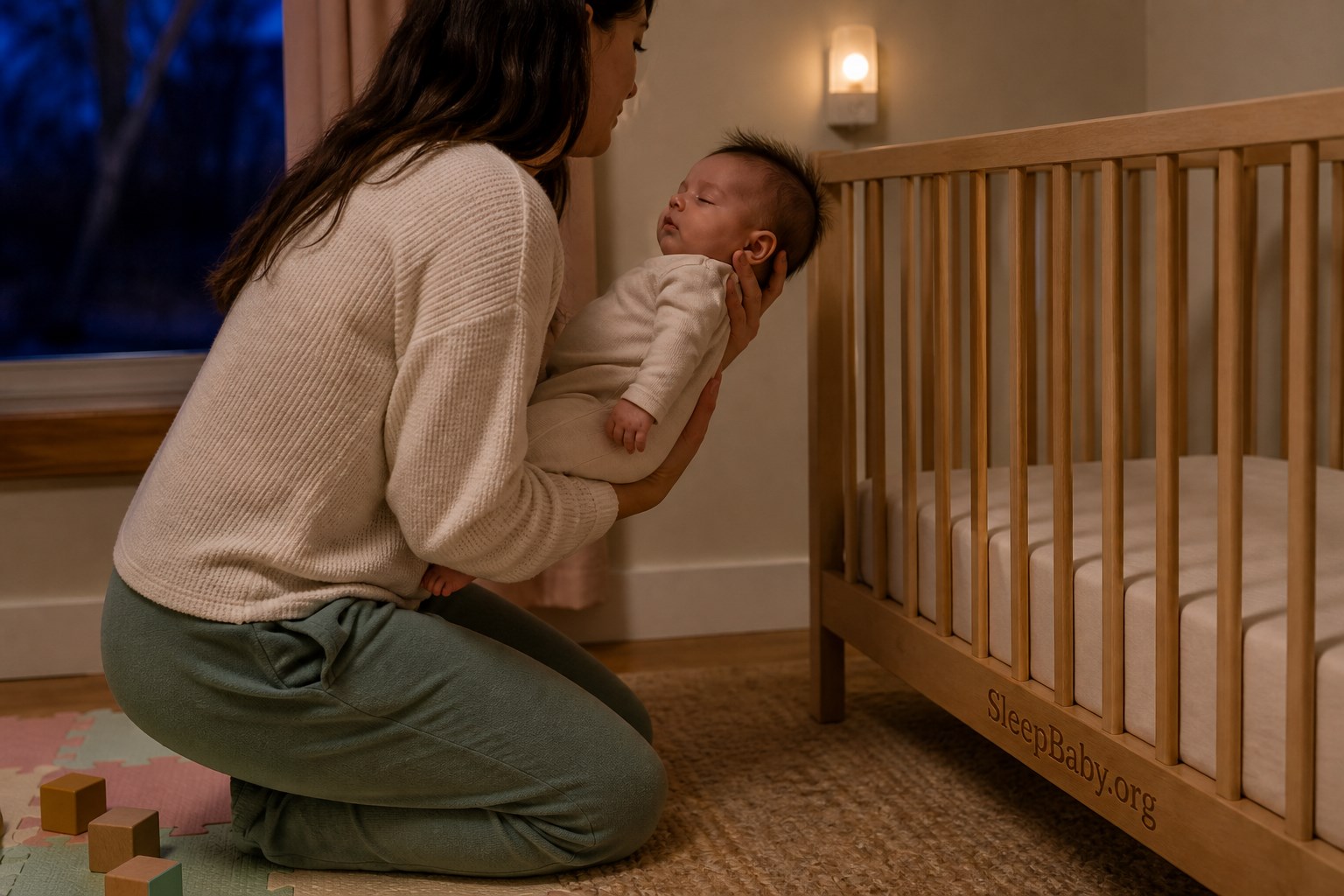
Once the destination is ready, slide one hand beneath the baby’s head and upper body and the other beneath the hips and lower body. Lift smoothly, keep the baby close to your body, and place them on their back. A transfer may wake them. That is frustrating, but waking is a sleep-management problem; leaving an infant on an improvised surface is a sleep-safety problem. I would not solve the first by pretending the second disappeared.
If the baby wakes, keep the response ordinary: low light, a calm voice, the familiar pre-sleep cue, and soothing that fits your family. You do not need to recreate the whole bedtime routine at 2:17 in the afternoon. You also do not need to surround the baby with objects to make the new surface resemble the mat. The bare space should remain bare.
A two-minute visual check from NICHD
Compare the floor nap with a complete infant sleep space
The Safe to Sleep campaign’s short demonstration for caregivers is useful here because it shows the whole setup at once: back placement, a separate intended surface, and a bare sleep area. Watch for the combination, not one comforting feature such as firmness.
Article-specific takeaway: the question is not whether the floor looks hard enough. It is whether the baby is in a separate, intended infant sleep space that is firm, flat, level, fitted, bare, intact, and used within its limits.
Video by NICHD’s Safe to Sleep campaign. If the player does not load, watch the video on YouTube. The written guidance in this article remains complete without playback.

Floor time is still good for babies—while they are awake and supervised
I do not want the safety answer to make the floor sound like an enemy. Babies need room to move. Supervised, awake tummy time supports development, and floor play can give a baby the freedom to reach, roll, pivot, crawl, and study one dust-free corner of a board book with astonishing commitment. The American Academy of Pediatrics is explicit about the boundary: tummy time is supervised and awake. [5]
The mistake is not putting a baby on a play mat. The mistake is allowing the label “play mat” to quietly expand into “nap surface” once the baby’s eyes close. Products are designed around jobs. A mat may cushion awake movement from a hard floor. It does not necessarily provide the fitted dimensions, containment, structural testing, or empty sleep environment expected of an infant sleep product.
Supervision also has limits as a safety feature. Watching a sleeping baby does not change the softness of carpet, the seams of a foam mat, the gap beside a wall, the dog’s access to the room, the cord under the side table, or the fact that someone can step into the space. A monitor can show a problem. It cannot redesign the surface beneath the baby.
This distinction helps beyond the floor. A bouncer, swing, stroller, lounger, or carrier may have a useful awake or transport job, yet that does not make it an intended sleep space. If this is the pattern you are seeing, the same logic is explained in our guide to the transfer-first rule when a baby dozes in a bouncer. The natural internal link belongs here because the reader’s next question is about the product’s job—not because every safety paragraph needs another link.
What about carpet, foam tiles, a play mat, or a crib mattress on the floor?
The floor can look reassuring because it has no drop beneath it. But fall height is only one hazard. Infant sleep guidance considers suffocation, entrapment, strangulation, rebreathing around soft material, access by people or pets, and whether the product is actually designed and tested for sleep. I would not trade one visible worry—the height of a bed—for several quieter ones the room was never designed to control.
The surface may solve an awake-time job without solving the infant-sleep job
Carpet or rug
Awake role: A comfortable place for supervised play.
Why sleep changes it: Unknown softness, fibers, nearby objects, room traffic, edges, cords, pets, and no infant-sleep containment or fitted surface.
Next move: Transfer to the prepared crib, bassinet, or play yard.
Foam tiles or padded mat
Awake role: Cushions knees and hands during awake movement.
Why sleep changes it: Padding and seams are not proof of a firm, fitted, approved infant sleep surface; pieces may separate or collect small objects.
Next move: End the floor-play session when the baby dozes.
Loose crib mattress
Awake role: None that requires separating it from its tested crib frame.
Why sleep changes it: On the floor it can create wall, furniture, edge, moisture, access, and room-containment hazards.
Next move: Return it to the compatible assembled crib and follow both manuals.
Adult mattress or “floor bed”
Possible later role: Part of an older child’s separately planned bed transition.
Why it does not fit infancy: Softness, bedding, edges, gaps, and room access still matter; low height does not meet first-year infant sleep guidance.
Next move: For an infant, use the separate safety-approved sleep space. Discuss an older child’s transition independently.
There is no evidence-based birthday at eight or nine months when a loose mattress on the floor automatically becomes safe for an infant. Mobility may change which bassinet or crib setting remains usable, but it does not erase first-year safe-sleep guidance. NICHD notes that safe-sleep recommendations to reduce SIDS risk continue until the first birthday. [2]
If a product has been damaged, handed down without all its parts, assembled from mixed models, or used beyond a stop-use limit, I would pause and check the manual and current recall information rather than improvise. “It held the baby yesterday” is not the same as “it is correctly assembled and appropriate today.”
When the missing piece is a sleep space near the play area
Some floor naps keep happening for a very practical reason: the baby gets sleepy in the living room, basement, or relative’s house while the usual crib is elsewhere. Moving a full crib is not realistic. Watching the mat more carefully does not fix the distance. A portable sleep space can be useful when it is the exact reason the transfer keeps getting postponed.
I would buy for that job, not for a promise of better sleep. The useful product creates a ready destination; it does not make the baby drowsy on schedule, prevent SIDS, or replace the manual. If the ordinary crib is already nearby and available, this purchase may add clutter rather than solve anything.
How to make the transfer calmer without turning it into a myth
There are entire corners of the internet devoted to the perfect sleeping-baby transfer: wait for one kind of breathing, lower one body part first, warm the sheet, keep a hand on the chest for an exact count. Some techniques may feel gentler in an individual family. None changes the safety destination, and none deserves a guarantee.
The prepared-destination sequence
- Set the sleep space first. Confirm the frame or product is correctly assembled, bare, flat, and within its limits before touching the sleeping baby.
- Clear the path. Move toys, cups, pets, cords, and anything that would make you twist or step awkwardly while carrying the baby.
- Support head and body. Place one hand beneath the head and upper body and the other beneath the hips and lower body. Lift smoothly and keep the baby close.
- Place the baby on the back. Lower into the center of the intended surface. Once a baby can roll both ways independently, follow current safe-sleep guidance; do not use positioners to hold a pose.
- Leave the space bare. Do not add a rolled blanket, pillow, toy, lounger, or extra pad because the floor looked cozier.
- Respond normally if the baby wakes. Use calm light, familiar words, feeding when appropriate, and your ordinary soothing approach. A failed transfer is not permission to change the surface rules.
I would keep my attention on safe handling, not on performing a piece of sleep choreography perfectly. If the baby is heavy, you are recovering from birth or surgery, you feel unsteady, or lifting from the floor hurts, get another adult to help when available. Put the baby in a safe place while you reset rather than attempting an awkward carry.
And if the transfer fails? The baby may open both eyes the instant their back touches the mattress, as if the room has issued a formal objection. That is ordinary frustration, not evidence that the floor was the better bed. Pause, soothe, and try the sleep space again. The goal is not to preserve every minute of this nap at any cost. The goal is to make the next safe sleep opportunity possible.

If floor dozing keeps happening, look for the repeatable handoff
A single surprise nap can be just that. The baby played hard, the morning began early, a car ride changed the day, or the room became quiet at exactly the wrong—or right—moment. I would not redesign the schedule from one photo-worthy collapse beside the stacking cups.
Repeated floor dozing does contain information. It may mean the play session regularly crosses into a sleep period, the nap routine starts after the baby’s strongest cue, the intended sleep space is too far from the caregiving area, or the baby is getting less sleep than the household realizes. It can also accompany illness or unusual sleepiness. The pattern matters, and so does the baby’s behavior when awake.
Timing clue
Notice: floor sleep begins at roughly the same time on ordinary days.
Try: begin the nap handoff earlier, before the baby’s eyes are closing on the mat.
Access clue
Notice: the safe sleep space is on another floor or unavailable during the usual play period.
Try: prepare the destination before play or use an appropriate portable option within its limits.
Sleep-pressure clue
Notice: short nights, skipped naps, unusually early mornings, or several travel days precede the dozing.
Try: restore the ordinary sleep opportunity before adding a complicated new routine.
Health clue
Notice: sudden unusual sleepiness, poor feeding, fever, breathing changes, reduced responsiveness, pain, or behavior unlike the baby’s normal pattern.
Act: contact the child’s clinician or emergency services according to severity. Do not test a schedule first.
Use two or three ordinary days, not a permanent tracking project. Write the time the baby began to look sleepy, where the doze happened, when the prior sleep ended, and whether alertness, feeding, breathing, and behavior were normal. I want the shortest record that answers the next decision. If you need a spreadsheet to interpret one yawn, the tool has become the hobby.
If the day’s difficulty began because the baby slept somewhere else—such as a car seat shortly before bedtime—the next question may be how to put the safe transfer before the bedtime schedule. That article helps with timing after a location change; it does not replace the floor-surface answer here.
Age changes the available product, not the first-year sleep rule
“Baby” can mean a six-week-old who still fits a bassinet, a crawling nine-month-old who can pull to stand, or a child close to the first birthday. The details matter. The shortcut does not: there is no general month when mobility turns a loose mattress on the floor into a recommended infant sleep space.
Newborn or young infant
Use a compliant crib, bassinet, play yard, or bedside sleeper within its limits, on the back, with the intended fitted surface bare. Feeding and responsiveness concerns outrank the nap plan.
Rolling or crawling infant
Mobility may end bassinet use or require lowering a crib mattress according to the manual. It does not create a floor-bed exception. Start each sleep on the back and do not use positioners.
Infant nearing one year
Continue first-year safe-sleep guidance. Review climb-out, height, weight, and mobility limits for the exact product rather than assuming age alone decides readiness.
Older toddler considering a bed transition
That is a separate decision involving the child’s development, the bed design, the entire room, stairs, windows, doors, furniture, cords, pets, and the family’s ability to supervise access. It does not retroactively make infant floor sleep appropriate.
Read the manual for the exact model. A bassinet may have a weight limit, but sitting, pushing up, rolling, or other mobility can end use earlier. A play yard may allow sleep in its main level after a bassinet insert is outgrown, but only in the approved configuration. A crib mattress position may need to move lower before the baby reaches the rail. Product names are not instructions.
I am deliberately not giving one universal transition age because that would replace several real variables with a tidy number. The child’s abilities, the product manual, current guidance, and room hazards all matter. When the answer is unclear, ask the pediatrician about the child and the manufacturer about the product rather than asking the floor to settle the disagreement.
What about a Montessori-style floor bed?
A Montessori-inspired room can emphasize independence and child-level access. That philosophy does not create a separate set of infant sleep-safety evidence. A mattress placed directly on the floor still has to be evaluated as a real sleep setup, including the child’s age, mattress firmness and fit, nearby gaps, wall contact, moisture and mold risk, furniture anchoring, windows, cords, outlets, doors, stairs, pets, siblings, and unsupervised access to the whole room.
For an infant in the first year, I would use the safety-approved crib, bassinet, portable crib, or play yard rather than treating a loose floor mattress as an equivalent. If an older child is approaching a genuine bed transition, make that decision on its own merits. Do not use an article’s old “eight or nine months” line as a permission slip; that threshold was unsupported and has been removed from this rewrite.
A low bed can reduce the distance of a future tumble, but height is not the entire safety problem. Gaps can trap. Soft bedding can obstruct breathing. Furniture and cords can become reachable. An open door can turn a bedroom into a whole-house sleep space. The room itself becomes part of the bed, which means childproofing must be more than moving a lamp.
If your baby actually fell before sleeping
Come back to this branch if “fell asleep on the floor” means the baby arrived on the floor by falling. The distance, landing surface, body part struck, loss of consciousness, crying, feeding, vomiting, movement, behavior, and responsiveness all help a clinician judge what should happen next. An article cannot examine your baby or see the event.
Call 911 if the baby is unconscious, cannot wake normally, has a seizure, has abnormal or stopped breathing, turns blue or gray, develops marked weakness, or shows another life-threatening change. Protect the neck from unnecessary movement when a serious neck injury is possible. Do not drive while trying to monitor an unstable baby.
Seek urgent medical guidance for repeated vomiting, increasing drowsiness, confusion or behavior unlike normal, unequal pupils, difficulty moving, standing, or walking as developmentally appropriate, fluid or blood from the nose or ears, a large or concerning wound or swelling, a dangerous-height fall, or any concern that the injury is serious. The AAP advises calling a doctor or seeking care promptly for head injury in a child younger than one year. [6]
It can be appropriate for a child to sleep after a clinician has evaluated a head injury and given instructions; the CDC advises letting a child sleep as usual during concussion recovery when emergency danger signs are absent and the child has been appropriately assessed. [7] That is different from deciding at home that sleep proves everything is fine. Follow the evaluating clinician’s instructions about waking checks, observation, activity, and return precautions.
I am keeping this section plain on purpose. No monitor, crib, sleep log, nap adjustment, or transfer technique can rule out a head injury. When responsiveness or injury is the question, the schedule leaves the room.

A practical plan for the next floor-to-sleep handoff
Once an injury or illness concern is excluded, the household problem becomes smaller. You do not need to ban floor play, purchase every sleep product, or turn one accidental nap into a new schedule. You need a prepared destination and a handoff that begins before the baby is fully asleep.
- Prepare the intended sleep space before floor play begins. Confirm the fitted sheet, correct mattress or pad, assembly, and product limits. Keep it bare.
- Notice the earliest repeatable cue. Slower movement, staring, fussing, face rubbing, or losing interest may tell you the handoff should begin before the baby’s body becomes heavy with sleep.
- Use one short transition cue. A phrase, dimmer light, sleep sack when age-appropriate and used correctly, or the same short song can mark that awake play is ending. The cue supports the change; it does not override safe-sleep rules.
- Transfer to the back on the bare fitted surface. If the baby wakes, soothe in the ordinary way and try again. Do not add padding to preserve the nap.
- Record only what changes the next decision. Note timing, prior sleep, location, and whether alertness and behavior were normal. Stop after two or three ordinary days unless a clinician requests more.
- Move health concerns out of the schedule lane. Sudden unusual sleepiness, poor feeding, fever, breathing change, pain, reduced responsiveness, or injury deserves medical guidance according to severity.
I would also tell every regular caregiver the same sentence: “If the baby falls asleep during floor play, move them to the crib or play yard.” A grandparent, babysitter, or older sibling should not have to reconstruct an entire safe-sleep lecture in the moment. Clear household language is part of the environment.
Then make the destination easy to use. Keep laundry out of the crib. Keep the portable crib assembled correctly rather than half-folded behind a chair. Store the fitted sheet where a caregiver can find it. A safe plan that requires moving six baskets and locating a missing frame piece is a plan the household will postpone.
What if the transfer wakes the baby?
This is the part that can make a parent bargain with the surface. Your baby finally stopped fighting sleep, you lift them, and their eyes open before you reach the crib. It is tempting to decide the transfer “did not work” and put them back exactly where they were. I would define success differently. The purpose of the move is not to preserve every second of the accidental nap. It is to put sleep back in the place prepared for sleep.
If your baby wakes but remains drowsy, finish the handoff gently. Keep the room quiet, lower them into the empty sleep space, place them on their back, and give them a moment to settle. You do not need to add a blanket, pillow, positioner, toy, or improvised barrier to persuade the nap to continue. A brief protest or a pair of newly open eyes does not change what belongs in the sleep space.
If they wake fully, call the moment what it is: a short doze interrupted by a necessary transfer. You can offer a calm feed if one is due, hold them while awake, read a quiet book, or return to low-key play while watching for the next sleepy cue. Then try the usual sleep routine again. I would not spend the next hour trying to force the lost minutes back into the day. One untidy nap does not require an untidy sleep setup.
The useful question comes later: Why was sleep arriving on the floor before I was ready for it? Perhaps the awake period stretched longer than expected. Perhaps a feed, an outing, or an exciting visit shifted the rhythm. Perhaps the play mat has become the final dim, quiet stop in a routine that starts elsewhere. None of those possibilities makes the mat a sleep product. They tell you where to move the transition.
Try changing one practical thing at a time. Start the wind-down a little earlier on the days when floor dozes usually appear. Move the last book or song beside the crib instead of leaving it on the mat. Prepare the sleep space before play begins. If another caregiver handles that hour, agree on the same transfer sentence and the same destination. The goal is not a perfectly timed baby. It is a household that recognizes the handoff before everyone is improvising around a sleeping infant.
And if the baby wakes during every transfer for several days, keep the safety boundary while you study the pattern. Look at the timing, the strength of the sleepy cues, and whether the chosen nap window still fits the day. Bring unusual sleepiness, feeding changes, breathing concerns, pain, fever, poor responsiveness, or a recent injury to a clinician instead of treating them as schedule puzzles. The answer to a difficult transfer is better timing and clearer support—not turning the floor into the permanent backup bed.

The floor was not the verdict
At the beginning, your baby was asleep beside a crinkly book and moving them felt like the one action most likely to ruin the afternoon. Now the scene has a clearer shape. The floor did not prove you missed something terrible. It told you awake play crossed into sleep, and the baby needed a handoff to the surface built for that next job.
If there was no fall, no injury, and no unusual change in responsiveness, prepare the sleep space, transfer the baby, and look at timing later. If there was a fall or your baby is hard to wake, forget the nap math and get medical help. Those two sentences are allowed to stay separate.
What I want you to carry into the next sleepy moment is not fear of the floor. It is confidence in the boundary. Floor time can remain lively, useful, and full of tiny discoveries. Sleep gets the crib, bassinet, play yard, or bedside sleeper. The handoff may wake the baby. It may be inconvenient. It is still the part of the plan that makes sense.
Sources
- U.S. Consumer Product Safety Commission: Safe Sleep—Cribs and Infant Products
- NICHD Safe to Sleep: Frequently Asked Questions about safe infant sleep
- American Academy of Pediatrics / HealthyChildren.org: How to Keep Your Sleeping Baby Safe
- Centers for Disease Control and Prevention: Helping Babies Sleep Safely
- American Academy of Pediatrics / HealthyChildren.org: 3 Tummy Time Activities to Try With Your Baby
- American Academy of Pediatrics / HealthyChildren.org: Head Injury in Children—How to Know If It’s Minor or Serious
- Centers for Disease Control and Prevention HEADS UP: What to Do After a Concussion






What viewers said10 comments · 4 replies+
Archived comments from the original Baby Sleep Miracle presentation. Not independently verified by SleepBaby.org; individual experiences vary.
Thank you so much for this video! I had no idea about the dangers of baby swings :O
Hi Mary-Ann. I have a question: Is method in any way similar to the ones recommended by Dr Bucknam, Dr. Weissbluth or Dr. Karp? We tried those but none of them help.
Hi Regina, thank you for your question. The short answer is no. The techniques I share in my guide are based on newest scientific research and this is why I have never seen any approach similar to the one I recommend.
This method really works! I tried it on my son Jesus and after just one week he went from waking up more than 5 times a night to waking up just once or twice. You are a lifesaver, Mary-Ann!
I'm truly impressed with how much information you share in your video. And all for free! I can feel that you truly care about mothers like myself, and that's hard to find these days. I have recommended your site to several of my friends already.
Mary-Ann, our child suffers from autism. Is your approach still suited?
Chloe, I made sure my method can be used with any child, even babies who are special like yours. Please note that I'm not a doctor and that I always advice to consult with your physician because nothing is more important than the safety and well-being of your love.
Hallo Mary-Ann, I'm from Germany. Do you have your guide in German?
Hello Heide, we do! Normally you should already see our video in German. If not, please contact our support so they can guide you
Thenk you for your answer, Mary-Ann!
I just completed your approach and I have to say, it worked almost too well. Yes, it took a bit of getting used to with your bedtime routine but the difference is huge. My son George used to take 1 hours to go down and now he's firmly asleep in no more than 10 minutes! You're the best!
It seems I'm the only man watching this video, lol! What you shared about the 'emotional backpack' made immediate sense to me and I can't wait to help my little girl Mila to unpack it!
Hey there, just discovered your site and this really sounds different. Just wanted to say thanks for sharing :)
For everyone who's still thinking about getting Mary-Ann's guide I want to advise you to go ahead. I wasn't sure myself but now I'm so thankful I invested in this program. It made a huge difference in our life as a family and yes, my baby girl does sleep through the night now.