
The quiet answer first
If your baby fell asleep and did not burp, you usually do not need to wake them
If your baby is breathing normally, looks comfortable, and has simply drifted off after feeding, it is usually reasonable to stop chasing a burp. You can hold them upright briefly if that is already part of the feed, then place them on their back on a firm, flat, noninclined sleep surface. Do not use a wedge, positioner, inclined sleeper, or raised mattress to manage gas or spit-up.
What changes the answer is not the missing burp by itself. It is what happens alongside it: breathing difficulty, blue or gray color, repeated or forceful vomiting, green or bloody vomit, a swollen belly, poor feeding, dehydration, unusual difficulty waking, severe irritability, or a baby who simply looks acutely unwell. Those signs deserve prompt medical help rather than another round of patting.
The bottle may still be warm. The burp cloth is already sliding off your shoulder. Your baby has gone deliciously heavy against your chest, and now your brain has produced the least restful question possible: What if I put them down without getting the burp?
I understand why this feels like an unfinished task. Feeding advice often turns “burp your baby” into a box that must be checked, as though the night cannot continue until a tiny bubble has submitted the correct paperwork. But babies do not burp after every feed, and a burp is not a receipt proving the feed was completed safely.
The question I want to make smaller is not “How do I force a burp out of a sleeping baby?” It is “Does my baby look comfortable and well enough for a safe sleep transfer?” That is something you can actually observe.
Why some feeds end without a burp
A burp releases swallowed air from the stomach. How much air a baby swallows varies with feeding method, latch, nipple flow, position, pace, crying, and the individual feed. Some babies swallow enough air to feel uncomfortable. Others finish quietly and have very little to bring up. The same baby can produce a magnificent shoulder-rattling burp at noon and absolutely nothing at 1:00 a.m., because consistency has never been a requirement for infant employment.
The NHS does not set one compulsory burping schedule. Its guidance is to watch the baby, support the head and neck, avoid pressure on the throat, and spend only a couple of minutes trying. The American Academy of Pediatrics’ parent guidance also notes that babies do not burp every time. I would treat those points as permission to respond to the baby in front of you rather than to an invisible quota.
Burping also is not a proven colic-prevention switch. In a small randomized trial involving 71 mother-infant pairs, routine burping did not reduce colic episodes and was associated with more reported regurgitation. One modest trial cannot answer every feeding question, but it is enough to stop us from promising that a determined burping session will prevent crying or spit-up.

A qualitative decision path, not a diagnosis
The Sleepy-Feed Check: choose the lane your baby is actually in
1. Comfortably asleep
Normal color and breathing, relaxed body, no repeated gagging, no arching or distressed crying.
Do: stop trying to manufacture a burp. Complete a safe back-sleep transfer.
2. Uncomfortable but stable
Squirming, drawing up legs, grimacing, repeatedly pulling away, or waking and fussing after the feed.
Do: try one brief supported upright position. Reassess comfort instead of watching the clock.
3. Medically concerning
Breathing or color change, forceful/repeated or green/bloody vomit, marked lethargy, dehydration, poor feeding, or a swollen abdomen.
Do: seek urgent medical guidance. Do not let burping distract from the actual symptom.
This is the hierarchy I would use at night: look, choose, transfer, escalate if needed. It keeps an ordinary absent burp from occupying the same mental shelf as symptoms that truly matter. It also gives you permission to stop when your baby is peaceful.

How long should you try to burp a sleeping baby?
Think in terms of a brief attempt, not a mandatory waiting period. If your baby has just finished feeding, it is reasonable to keep them upright against your chest or shoulder for a couple of minutes while you support the head and neck. Gentle rubbing or patting may bring up air. If it does not—and the baby remains comfortable—you have learned enough.
I would not turn this into a 20- or 30-minute endurance event merely because the internet offered a precise number. Time can matter for other reasons, including a clinician’s plan for a baby with a medical condition, but “no burp yet” is not a reason by itself to keep a peacefully sleeping baby upright indefinitely.
A gentle attempt that protects the sleepy part
- Set the support first. Hold your baby upright against your chest or shoulder. Keep one hand supporting the head and neck. Keep the face visible and the airway open.
- Use a light rub or pat. A cupped hand and slow movement are enough; harder patting does not make the attempt more legitimate.
- Watch the baby, not just the clock. Relaxed breathing and body language matter more than whether a burp arrives on schedule.
- Stop when the baby is comfortable. Move to the safe transfer rather than cycling through positions until everyone is fully awake.
Do not press on the throat. If you use a seated position, support the chin and jaw—not the soft tissues of the neck—and keep the baby upright and supervised.


If your baby wakes during the attempt, that does not mean you made the wrong choice. It means you can reassess. A newly fussy baby may need another brief upright hold, a diaper check, more feeding if hunger cues continue, or simply resettling. What I would avoid is assuming every wake-up after a feed proves trapped air. Babies wake for an impressive number of reasons, several of which seem to be “the room got one molecule quieter.”
Does the answer change for breastfeeding, bottle-feeding, or paced feeds?
The same comfort-first principle applies, but feeding mechanics can change how much air is swallowed. A baby with a deep, effective latch at the breast may swallow little air. Another baby may take in more during a fast letdown, repeated unlatching, or a feed that starts with hard crying. With a bottle, nipple flow, angle, pace, and the amount of air kept in the nipple can all affect the feed.
Breast or chest feeding
If the feed was calm, the latch stayed secure, and your baby fell asleep relaxed, a burp may not be necessary. If there was repeated unlatching, gulping, coughing, or fussing, pause and assess the feed rather than focusing only on the burp afterward.
Bottle feeding
Keep milk in the nipple, choose an appropriate flow, and pause when your baby shows stress or needs a break. Paced feeding can create natural pauses; a brief mid-feed burp may help some babies, but it is not a performance requirement.
Mixed or changing feeds
Notice patterns without making one night a verdict. If discomfort consistently appears with a particular bottle, flow, latch issue, or feeding position, bring that pattern to your pediatrician or feeding professional.
I would especially ask for feeding support if your baby regularly coughs, chokes, struggles to coordinate sucking and breathing, takes very long feeds, refuses feeds, seems in pain, has fewer wet diapers, or is not growing as expected. Those are feeding questions, not burping failures.
What about reflux, spit-up, and choking in sleep?
This is where the private fear often becomes louder: If milk comes back up, won’t my baby choke while lying flat? For healthy infants, the safe-sleep recommendation remains back sleeping on a firm, flat, noninclined surface—even for babies with reflux. The AAP and NICHD explain that infant airway anatomy and protective reflexes make back sleeping the safer position; back sleep does not increase fatal choking risk.
Spit-up can look dramatic because it spreads. An ordinary wet patch can somehow appear to contain the entire contents of the refrigerator. But frequent effortless spit-up in an otherwise comfortable, feeding, growing baby is different from forceful vomiting, green or bloody vomit, pain, dehydration, or a baby who looks ill. I want the article to keep those categories separate, because “messy” and “dangerous” are not synonyms.
The transfer endpoint
Back. Flat. Firm. Noninclined. Empty.
- Place your baby on their back for every sleep.
- Use a firm, flat, level, noninclined mattress designed for the sleep space.
- Keep the crib or bassinet empty apart from a fitted sheet.
- Do not raise the mattress or add a wedge, positioner, pillow, rolled towel, or loose cloth.
- If your baby falls asleep in a sitting device, move them to an appropriate sleep surface as soon as practical.
A burp cloth belongs on your shoulder while you are awake and holding the baby—not under or beside the baby in the sleep space.

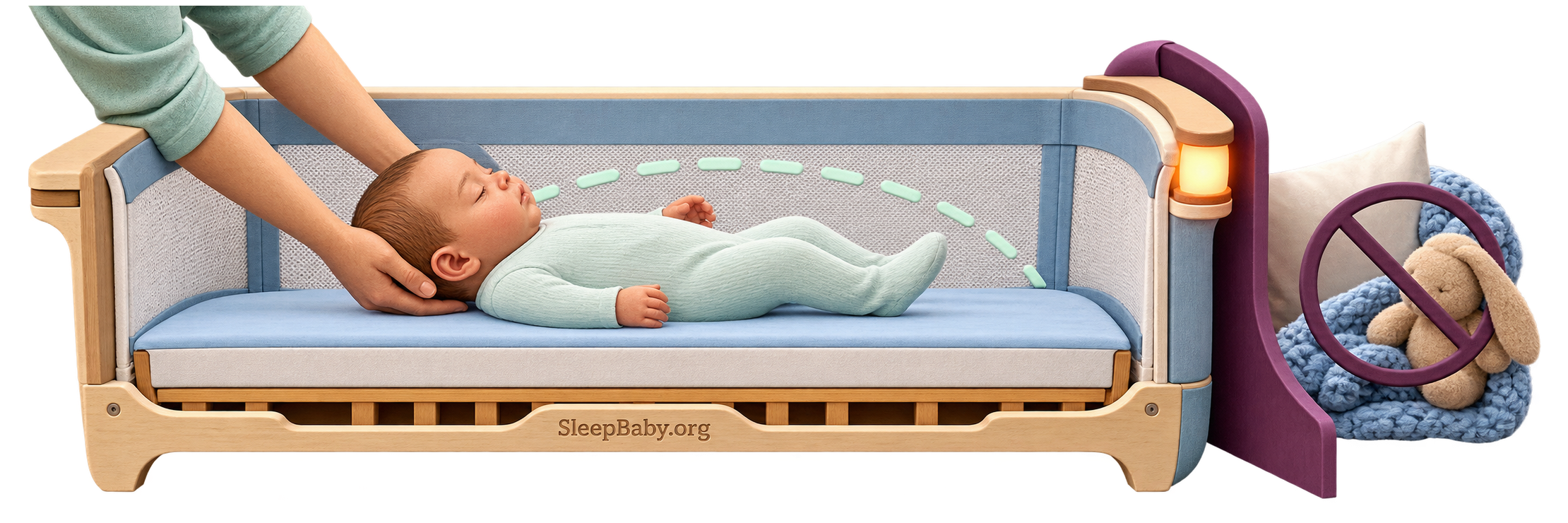
If your clinician has given your baby an individualized feeding or medical plan, follow that plan and ask how it fits with safe sleep. But do not improvise an inclined sleep setup because a product page, social post, or exhausted midnight thought makes it sound soothing. I would rather tolerate an extra load of laundry than trade away the safer sleep surface.
When the missing burp is not the real problem
Burping is ordinary caregiving. The signs below are medical decision points. If your baby has severe breathing difficulty, becomes blue or gray around the lips or face, is unresponsive, or has another immediate emergency, call emergency services. For other concerning symptoms, contact your pediatric clinician promptly or use the urgent-care guidance available where you live.
This is one place I will not make a joke or soften the language. A parent who is worried about breathing, color, responsiveness, dehydration, or abnormal vomiting needs a clear door, not a charming paragraph. Missing a burp is not the diagnosis, and getting a burp is not a treatment for those signs.
Five burping beliefs I would stop carrying into the nursery
| Belief | What the evidence and guidance support | What I would do |
|---|---|---|
| Every feed must end with a burp. | Babies vary, and some feeds produce no burp. | Use comfort and feeding cues rather than a quota. |
| A sleeping baby must be woken to burp. | A comfortable sleeping baby generally does not need to be awakened solely to force a burp. | Brief upright hold if desired, then safe transfer. |
| Burping prevents colic. | The small randomized trial did not find fewer colic episodes with routine burping. | Do not turn crying into proof that you burped incorrectly. |
| Inclining the sleep surface prevents choking. | Safe-sleep guidance calls for back sleep on a firm, flat, noninclined surface, including for reflux. | Keep the sleep space level and empty. |
| No burp means trapped gas will ruin the night. | An absent burp alone does not predict pain, spit-up, colic, or waking. | Watch what your baby does next; change course if discomfort appears. |

The distinction worth keeping is simple: a burp is one possible outcome of a feed, not a grade. I would much rather have you recognize easy breathing, normal color, relaxed hands, and a safe sleep surface than spend another half hour trying to earn a noise.
If your baby wakes after the transfer, was it the missing burp?
Maybe—but one wake-up cannot tell you that. A baby can wake because the mattress feels different from your chest, because the transfer triggered a startle, because hunger returned, because a diaper became uncomfortable, because milk came back up, or because infant sleep is full of brief arousals. The timing makes “trapped burp” feel obvious, but timing alone is not proof.
I would look at the first thirty seconds after the wake. Is your baby rooting, bringing hands toward the mouth, or trying to latch again? Those cues point back toward feeding. Are they grimacing, squirming, pulling up their legs, or settling when held upright? A brief upright reassessment may be reasonable. Did they startle the moment their back touched the mattress and calm as soon as they were held? That sounds more like a transfer or settling problem than an invisible air bubble.
A pattern decoder, not a diagnosis
Read what happens next instead of blaming the silent feed
| What you notice | What it may suggest | A reasonable next move |
|---|---|---|
| Rooting, sucking hands, turning toward touch | The feed may not be finished | Offer the breast/chest or bottle based on your feeding plan and cues |
| Squirming or discomfort that improves upright | Swallowed air or spit-up may be bothering the baby | Try one brief supported upright hold; review flow, latch, and pacing if it repeats |
| Immediate startle at mattress contact | The transfer itself may have woken the baby | Resettle calmly and keep the safe sleep surface unchanged |
| Small effortless spit-up, then relaxed behavior | Ordinary regurgitation may be messy without being distressing | Clean up, reassess comfort, and return to the safe sleep setup |
| Repeated pain, feeding struggle, forceful vomiting, poor intake, or illness signs | This is bigger than one missed burp | Contact the pediatric clinician or seek urgent help according to the symptom |
One wake is a moment. A repeated pattern is information. If the same discomfort follows many feeds, I would note the bottle and nipple flow if used, how the latch looked, whether there was gulping or coughing, how long the feed lasted, what the spit-up or vomiting looked like, wet diapers, and whether upright holding reliably changed anything. That short record is far more useful to a clinician or feeding professional than “the baby would not burp.”
I also would not change five things in one evening. If you switch nipple flow, feeding position, formula, burping technique, and sleep routine together, tomorrow’s result will tell you almost nothing. Start with the most plausible, lowest-disruption feeding adjustment recommended for your baby’s situation, then observe. If pain, feeding trouble, poor growth, or illness signs are present, skip the home experiment and ask for professional guidance.
When an individualized feeding plan outranks this general answer
Some babies need more specific instructions because they were born prematurely, have growth concerns, have difficulty coordinating sucking and swallowing, have a diagnosed medical condition, or are being followed by a pediatrician, lactation professional, speech-language pathologist, dietitian, or feeding team. If you have been told to wake your baby to feed, use a particular position, limit or extend feeds, thicken feeds, monitor intake, or follow another clinical plan, do not discard that plan because the baby fell asleep.
The general “do not wake solely to force a burp” answer is not permission to skip needed feeding or monitoring. I would ask the clinician a very plain question: When my baby falls asleep during or immediately after a feed, what signs tell me the feed is complete, and how should I handle burping before safe sleep? That turns a vague worry into instructions designed for your baby.
And if you have no special plan, you do not need to invent one at 2:00 a.m. Use the baby’s feeding cues, comfort, breathing, color, and safe-sleep endpoint. The internet is excellent at making every ordinary fork in the road look like it requires a committee. Most peaceful post-feed moments need careful observation, not a committee.
Watch a pediatrician demonstrate practical burping positions
A calm visual reset
See the support before you try the pat
Cook Children’s pediatrician Dr. Devona Martin demonstrates practical burping positions. Watch for the head-and-neck support and the ordinary scale of the movement; this is not a procedure that needs force.
The takeaway for a baby who has already fallen asleep: choose one supported position, keep the attempt brief, and stop when your baby remains comfortable. The written safe-sleep guidance in this article still applies if the video cannot play.
What I would do tonight, in order
One feed, one brief check, one safe transfer
- Finish the feed based on feeding cues. Do not stop needed feeding merely to protect sleep, especially when your baby has an individualized newborn or growth plan.
- Look at breathing, color, tone, and comfort. If something concerns you, follow the medical lane rather than continuing to burp.
- Try one brief upright hold if it fits the feed. Support the head and neck; use gentle rubbing or patting.
- Let no burp be an acceptable result. A calm baby has given you useful information.
- Transfer to the back on a firm, flat, noninclined surface. Remove the burp cloth from the sleep space.
- If the pattern repeats with discomfort, record the pattern—not every bubble. Note feeding method, flow, coughing/gulping, spit-up or vomiting, wet diapers, and how your baby behaves. Share persistent concerns with the pediatric clinician.
If the next question is timing rather than burping, our guide to how long to hold your baby after a feeding before the sleep transfer can help you sort the practical handoff without inventing a magic minute.
I would also give tonight permission to be ordinary. Your baby may burp during the upright hold. They may burp when you shift them. They may produce nothing and remain perfectly content. The useful skill is not extracting the same outcome from every feed; it is noticing when the outcome changes what your baby needs.
A useful shoulder-side tool
KeaBabies Organic Burp Cloths, 5-Pack, Prairie
I like this recommendation for the exact few minutes after a sleepy feed: keep a clean cloth over your shoulder while you hold your baby upright, so you can support the head and neck steadily without worrying about the shirt underneath. A five-pack makes it practical to leave one near the feeding chair and rotate a fresh cloth after spit-up.
Why this fits better than the obvious alternatives: a burp cloth helps with supervised holding and cleanup without changing the sleep surface. A wedge or positioner conflicts with safe-sleep guidance; a gas-treatment product would imply a diagnosis or benefit this article cannot support; and a sound machine does not solve this feed-specific job. The cloth remains useful even when no burp happens.
View the KeaBabies burp-cloth 5-pack on Amazon
Disclosure: As an Amazon Associate, SleepBaby may earn from qualifying purchases.
Existing SleepBaby Amazon paths preserved
Sources
- American Academy of Pediatrics: Evidence Base for 2022 Updated Recommendations for a Safe Infant Sleeping Environment
- HealthyChildren.org: Baby Burping, Hiccups & Spit-Up
- NHS: How to burp your baby after bottle feeding
- NHS: Burping your baby after breastfeeding
- Kaur et al.: A randomized controlled trial of burping for the prevention of colic and regurgitation in healthy infants
- NICHD Safe to Sleep: Back Sleeping
- Pregnancy, Birth and Baby: Burping and wind in babies
- HealthyChildren.org: Infant Vomiting
When the burp cloth comes off your shoulder
Let the night continue without one more test
The bottle can go to the sink. The clean cloth can stay by the chair. Your baby can settle on a safe sleep surface, and you do not have to turn one silent feed into a referendum on the whole night. SleepBaby can help you make the next bedtime decisions feel this clear, one manageable step at a time.






What viewers said10 comments · 4 replies+
Archived comments from the original Baby Sleep Miracle presentation. Not independently verified by SleepBaby.org; individual experiences vary.
Thank you so much for this video! I had no idea about the dangers of baby swings :O
Hi Mary-Ann. I have a question: Is method in any way similar to the ones recommended by Dr Bucknam, Dr. Weissbluth or Dr. Karp? We tried those but none of them help.
Hi Regina, thank you for your question. The short answer is no. The techniques I share in my guide are based on newest scientific research and this is why I have never seen any approach similar to the one I recommend.
This method really works! I tried it on my son Jesus and after just one week he went from waking up more than 5 times a night to waking up just once or twice. You are a lifesaver, Mary-Ann!
I'm truly impressed with how much information you share in your video. And all for free! I can feel that you truly care about mothers like myself, and that's hard to find these days. I have recommended your site to several of my friends already.
Mary-Ann, our child suffers from autism. Is your approach still suited?
Chloe, I made sure my method can be used with any child, even babies who are special like yours. Please note that I'm not a doctor and that I always advice to consult with your physician because nothing is more important than the safety and well-being of your love.
Hallo Mary-Ann, I'm from Germany. Do you have your guide in German?
Hello Heide, we do! Normally you should already see our video in German. If not, please contact our support so they can guide you
Thenk you for your answer, Mary-Ann!
I just completed your approach and I have to say, it worked almost too well. Yes, it took a bit of getting used to with your bedtime routine but the difference is huge. My son George used to take 1 hours to go down and now he's firmly asleep in no more than 10 minutes! You're the best!
It seems I'm the only man watching this video, lol! What you shared about the 'emotional backpack' made immediate sense to me and I can't wait to help my little girl Mila to unpack it!
Hey there, just discovered your site and this really sounds different. Just wanted to say thanks for sharing :)
For everyone who's still thinking about getting Mary-Ann's guide I want to advise you to go ahead. I wasn't sure myself but now I'm so thankful I invested in this program. It made a huge difference in our life as a family and yes, my baby girl does sleep through the night now.