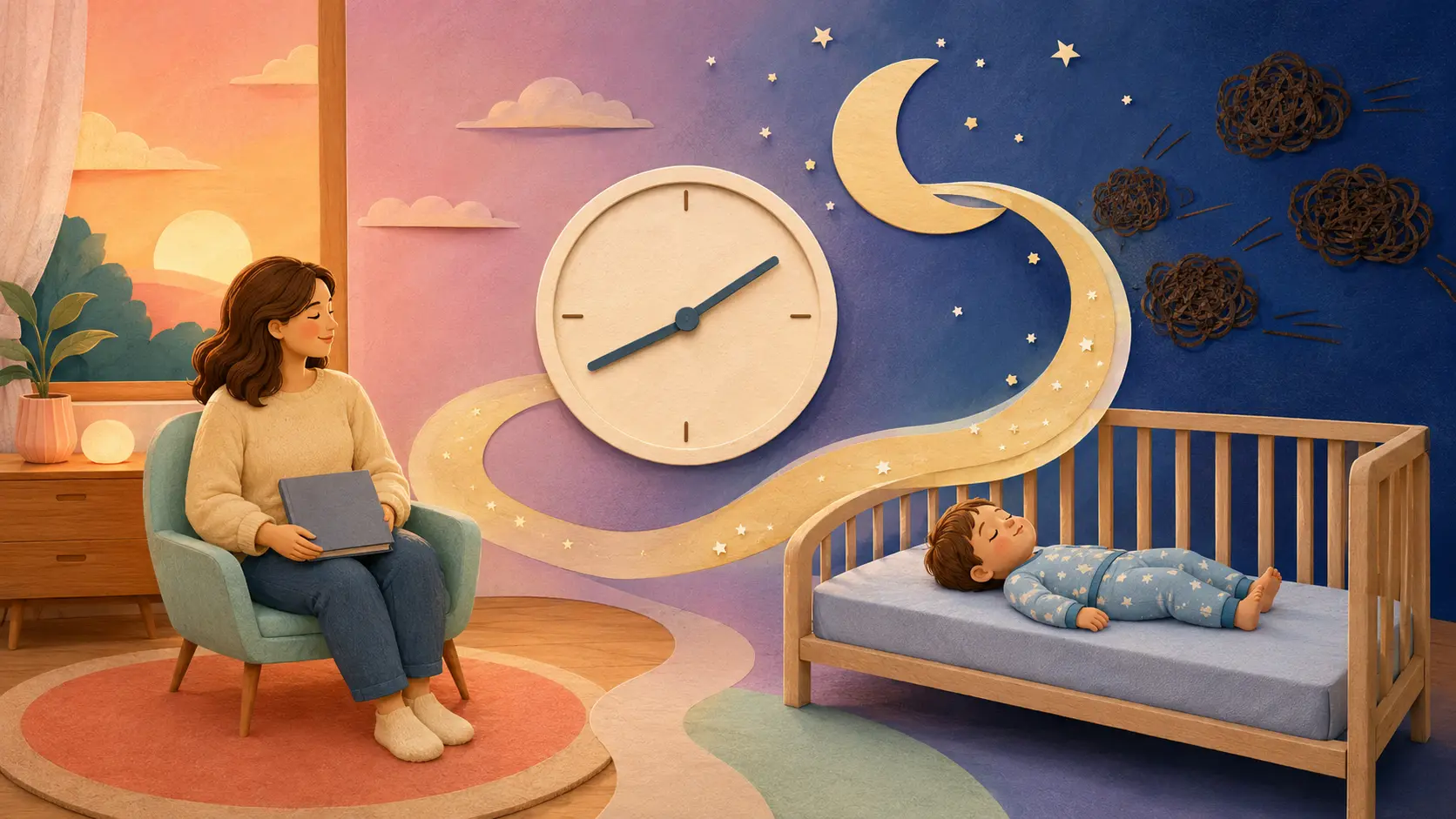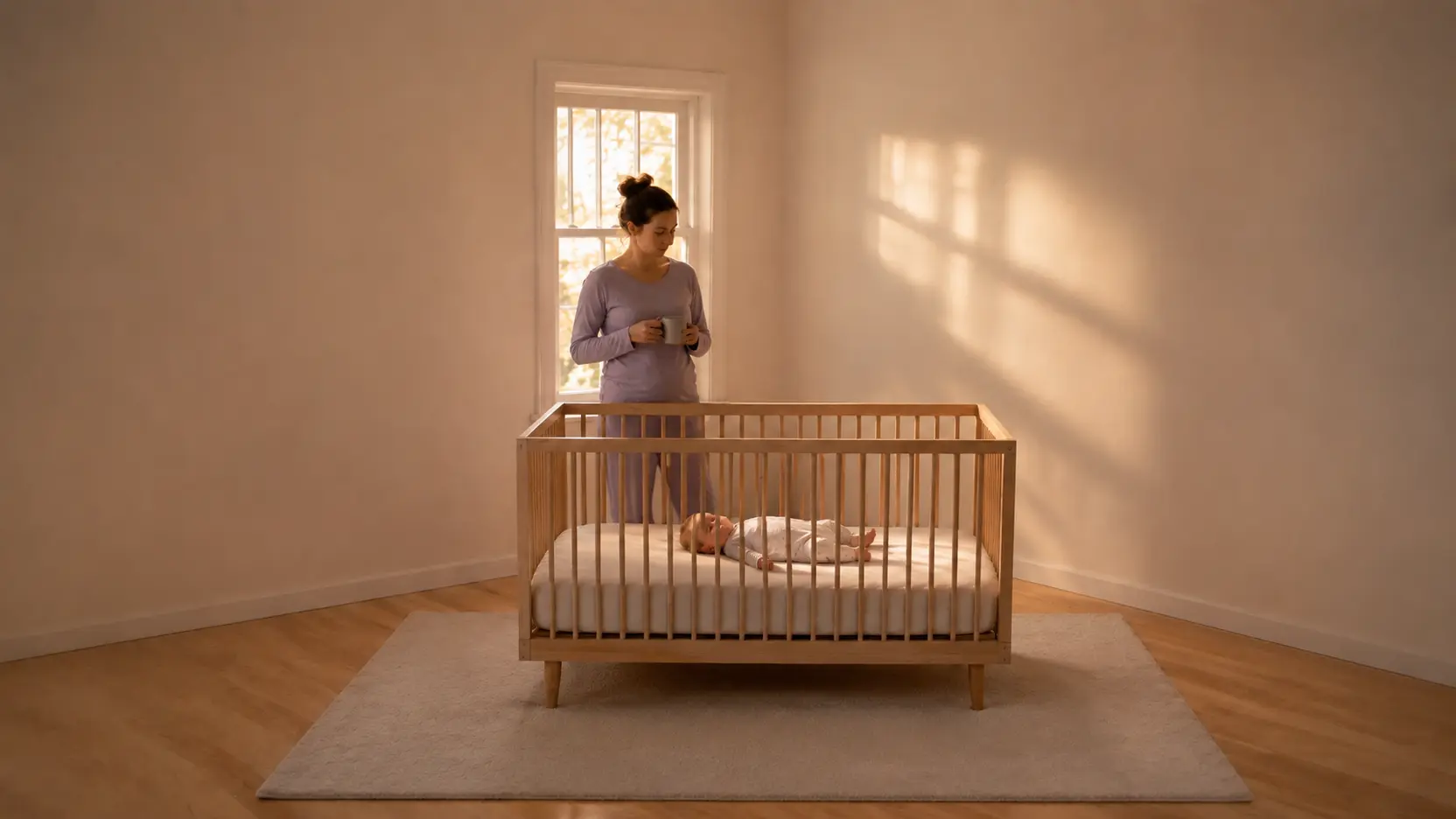
A composite Kacey-and-Benjamin moment: The vacuum clicked off, the room went suddenly thin and quiet, and Benjamin opened his eyes as if silence itself had entered carrying paperwork. I remember the thought that arrives in this kind of moment: Have I somehow created a baby who requires a full-size appliance to sleep?
Usually, a baby who falls asleep to the vacuum is responding to a steady mechanical sound that masks sharper household noises and has become familiar. That response alone is not a sign that something is wrong, and you do not need to train your baby to sleep in perfect silence. The useful questions are how loud the sound is where your baby lies, how close it is, how long it runs, and whether your baby is on a safe sleep surface.
I would keep the part that helps—the predictable sound—and replace the awkward part: running a corded cleaning appliance as nursery equipment. If your baby falls asleep in a carrier, stroller, swing, or other sitting device while you clean, move them to a firm, flat, noninclined sleep surface on their back as soon as practical. The vacuum may be a cue. It does not change the safe-sleep rules.

What the vacuum is probably doing
It creates continuity. The low mechanical whoosh can cover the door latch, a pan in the sink, footsteps, or the strange betrayal of one crinkly snack bag after bedtime.
What it does not prove: that your baby needs a vacuum, that the sound is harmless at every volume, or that the noise recreates the womb in a scientifically exact way.
Why can vacuum noise make a baby sleepy?
A vacuum is not a textbook white-noise generator. White noise has a technical definition tied to how energy is distributed across frequencies; a household vacuum produces its own uneven blend of motor, airflow, floor, room, and distance. To a sleeping baby, though, the practical effect can be similar to other steady background sounds: it reduces the contrast between quiet and the next abrupt noise.
That contrast matters. A closing cabinet is much more noticeable in a nearly silent room than it is inside a stable wash of sound. If sudden household noises are the real problem, our guide to what to do when your baby wakes to every little noise can help you separate ordinary sound sensitivity from a room that simply changes too sharply.
Familiarity may matter too. When the same sound appears beside the same short routine, your baby can begin to recognize the whole pattern as a settling cue. That is conditioning in the ordinary sense—not evidence that your baby has a mysterious vacuum preference encoded at birth. A small randomized trial published in 1990 found that more newborns exposed to white noise fell asleep within five minutes than babies in the control group.[5] It supports a possible short-term settling effect. It does not tell us that a vacuum should run all night, that every baby benefits, or that years of continuous exposure are harmless.
I would also be cautious with the popular “it sounds exactly like the womb” explanation. The prenatal sound environment is complex, and a baby relaxing to one household drone does not prove why it works. “The sound is steady, familiar, and masks sharper changes” is a less magical sentence, but it gives you something useful to do next.
It also explains why a baby can sleep through the vacuum and then wake when it stops. The motor may not be the disturbance; the sudden change may be. Babies are sometimes exquisitely offended by the absence of the noise they were happily ignoring.

Is the vacuum too loud for my baby?
It can be. “My baby slept through it” is not a hearing-safety measurement. Neither is the word white noise on a product box. The American Academy of Pediatrics recommends placing infant sleep machines as far from the baby as practical, using the lowest useful volume, and limiting how long they run.[1] Its technical report emphasizes that volume, distance, and duration work together, while long-term developmental evidence remains incomplete.[2]
The 2014 study that tested 14 infant sleep machines measured them at 30, 100, and 200 centimeters. Output changed with distance, and maximum settings on some machines reached concerning levels.[3] That is why I would not turn one decibel number into a magical household certificate. A setting that seems moderate at the device can be different at the crib, and exposure for a few minutes is not the same as exposure through every nap and night.
The National Institute on Deafness and Other Communication Disorders explains the same general relationship: risk depends on how loud a sound is, how long it lasts, and how close you are to it. It notes that sounds at or below 70 dBA are generally unlikely to cause hearing loss even after long exposure, while long or repeated exposure at or above 85 dBA can cause damage.[4] Those public-health reference points are not a prescription to aim a nursery device at 70 dBA. For infant sleep, the conservative parent-facing rule remains simpler: low, far, and limited.
The three sound knobs that actually change the answer
- 1. Level at the baby
- Use the lowest setting that does the job. A phone meter can flag an obviously loud setup, but it is a rough household tool, not a calibrated pediatric instrument.
- 2. Distance
- Keep the sound source well away from the crib or bassinet. Do not put it beside your baby’s head or on the crib rail.
- 3. Duration
- Use sound for the settling job you need. More hours are not automatically more helpful, and current evidence does not prove a long-term developmental benefit from continuous exposure.
This is a practical safety framework, not a diagnostic or calibrated acoustic test.
If I were checking a setup tonight, I would stand where the baby’s head actually rests rather than judge the sound from the doorway. Can two adults speak normally there? Does the noise feel intrusive rather than background? Is the device close because the room is loud, or is the room loud because the device is close? Those observations do not replace a meter or professional advice, but they help expose the setups that deserve an immediate turn-down and move-away.
For a real vacuum, I would be even less interested in finding the perfect nursery setting. It is a cleaning appliance with a motor, cord, attachments, and output that varies by model and surface. Use it for attended cleaning, not as the thing that stays parked next to a crib.
Does sleeping through the vacuum mean my baby cannot hear?
No—not by itself. A sleeping baby’s response to one steady sound is not a hearing test. The vacuum may have been running before sleep began, its sound may be more continuous than the sudden noises that usually wake your baby, and its level at the sleep space may be much lower than it sounds beside the machine. None of those details tells you how your baby responds to voices and ordinary sounds while awake.
I would not test this concern by clapping close to the baby’s ear, turning the vacuum up, or creating a louder surprise. That only adds exposure without giving you a reliable answer. Instead, notice the ordinary pattern: Does your baby startle or blink at a sudden nearby sound? Quiet or turn toward a familiar voice as developmentally appropriate? React differently when a sound comes from one side? The exact expected response changes with age, wakefulness, and development, so one missed reaction is not a diagnosis.
What would make me ask the pediatrician is a broader pattern—little or no response to voices and everyday sounds while awake, a loss of responses you used to see, concern after a very loud close exposure, or any doubt raised by newborn hearing screening or later development. A pediatric clinician can decide whether a formal hearing assessment is warranted. The calm distinction is important: sleeping through the vacuum can be ordinary; consistently not responding to meaningful sound deserves a real evaluation instead of a louder home experiment.
The reverse is also true. Waking when the vacuum stops does not prove exceptional hearing. The baby may simply notice the change from steady sound to silence. I care more about the awake pattern and the exposure setup than whether one nap survived a cleaning session.
How long should the replacement sound run?
There is no evidence-based runtime that fits every baby and every room. The AAP’s practical advice is to limit duration, and the 2024 scoping review found that evidence about continuous white-noise exposure and childhood development is still incomplete.[6] That means I would not translate “we do not have proof of harm at this exact setup” into “all-night use is proven beneficial.” Those are different statements.
Start with the job you actually need. If the sound mainly helps with the handoff into sleep, use a timer or lower it after settling. If abrupt household noise repeatedly breaks naps, you may choose to keep a low, distant sound through that vulnerable period. If the whole house is already quiet, the machine does not earn extra hours simply by existing. Reassess as routines, rooms, and sleep mature.
I would change only one runtime variable at a time. Shorten it a little while leaving volume and routine alone, then watch several ordinary sleeps rather than declaring victory or disaster after one nap. The goal is not a perfectly silent child. It is a sound setup that is useful, conservative, and flexible enough that bedtime does not depend on somebody vacuuming the hallway forever.

What if my baby falls asleep while I am vacuuming?
Keep the sound question and the sleep-surface question separate. If your baby is already on their back in an empty crib or bassinet with a firm, flat, noninclined surface, the fact that the vacuum helped them drift off does not require a rescue mission. Keep the machine and cord far from the sleep space, avoid vacuuming right beside the baby, and finish the attended cleaning job.
If your baby falls asleep in a carrier, stroller, swing, car seat outside travel, or another sitting device, move them to a safe sleep surface as soon as practical. The AAP recommends back sleeping on a firm, flat, noninclined surface, with the sleep space empty except for a fitted sheet.[7] A successful nap cue does not make a sitting device a routine sleep destination.

Did I create a bad sleep association?
Not automatically. Every baby goes to sleep with context: darkness, a routine, a feeding pattern, a caregiver’s voice, a familiar room, or a steady sound. A cue becomes a practical problem when it is unsafe, impossible to reproduce, or so rigid that normal life keeps collapsing around it.
A running vacuum fails the convenience test rather spectacularly. It uses energy, ties up a cleaning appliance, adds cord and equipment friction, and is not something most people want humming beside every nap. But your baby’s preference is still useful information. It says a continuous mechanical sound may help more than silence or a tinkly lullaby.
I would resist the urge to remove the cue and the comfort at the same time. That turns one small transition into a referendum on independent sleep. Instead, keep the familiar sound quality while changing the source. Once the replacement is predictable, you can decide whether you even want to reduce it.
Keep the cue. Change the machinery.
Keep
- a low, steady mechanical tone;
- the same short wind-down sequence;
- a predictable start to sleep;
- enough masking for abrupt household noise.
Change
- the full-size vacuum as the sound source;
- close placement;
- high volume;
- automatic all-night runtime.
If your baby wakes to every small change in the room, masking may still be valuable. If the family wants to understand why different steady sounds feel different, this guide to how brown, pink, and green noise differ for baby sleep explains the categories without pretending that color names make a setup safe.
How do I replace the vacuum sound?
Choose a controllable source with a continuous, low mechanical character. A real-fan machine may feel closer to the vacuum’s airflow than a short recorded loop. A phone recording can work for a test, but it adds notifications, battery management, device dependence, and the possibility that the loop itself becomes noticeable. A multi-sound machine is flexible, though dozens of chimes and forest frogs are not an advantage when the reader job is simply “make this one familiar whoosh reproducible.”
Then make the transition deliberately boring. Do not change the sound, the routine, the room, and the settling response all on the same night. My first move would be to place the replacement well away from the crib, start at the lowest useful level, and use it beside the same two or three bedtime actions the baby already knows.
A two-night bridge from vacuum to repeatable sound
This is a household trial, not a clinical sleep protocol or guaranteed timetable.
- Before the first nap or bedtime: put the replacement source well away from the crib and listen from the baby’s sleep position. Set it lower than your instinct to “make sure it works.”
- During the same short routine: use the replacement for the whole settling period. If you need the familiar vacuum briefly while cleaning, let the replacement continue when the vacuum stops so silence is not the sudden event.
- On the next stable sleep: repeat the same sequence without increasing volume. Consistency teaches more than intensity.
- After several steady nights: if you want less sound, reduce either level or runtime a little—not both together. If sleep becomes harder, return to the last workable setup rather than adding five new variables.
Some babies accept the substitute immediately. Others notice that the acoustic wallpaper has been redecorated and file a complaint. That does not mean the transition failed. It means the cue was familiar enough to be noticed. Give the new setup a fair, calm repeat before deciding it needs to be louder.
If your baby settles only while the vacuum is physically moving around the room, the sound may not be the whole cue. Motion, proximity, your own activity, or a contact nap may be part of the pattern. In that case, observe which ingredient disappears when the machine stops. I would solve the actual missing piece instead of turning up the replacement.


Vacuum, recording, or real-fan machine?
| Option | What it preserves | Main friction | My practical take |
|---|---|---|---|
| Household vacuum | The exact familiar motor and airflow | Cord, equipment, energy, variable output, impractical runtime | Use for attended cleaning, not as nursery equipment. |
| Phone recording | A close sound match for a short trial | Loop seams, notifications, battery, device dependence | Useful for testing the idea; less graceful as the permanent plan. |
| Real-fan sound machine | Continuous, non-looping mechanical airflow | Still needs conservative volume, distance, and duration | The strongest fit when the vacuum-like whoosh is the useful ingredient. |
Keep the sound cue below the safety foundation
American Academy of Pediatrics video
Safe Sleep for Your Baby: Every Nap & Every Night
The sound may explain why sleep begins. This video keeps the more important question visible: where and how the baby sleeps once those eyelids close.
SleepBaby takeaway: The vacuum may be a cue; the crib setup is still the safety foundation.
Watch the video directly on YouTube if the embedded player is unavailable.
What if the replacement does not work?
Do not answer that question by raising the volume first. Work out which part of the original situation changed.
- Your baby wakes the instant the vacuum stops: start the replacement before the vacuum ends so there is no hard drop into silence.
- Your baby dislikes a hissy “white noise” track: try a lower mechanical or fan-like tone. The sound category may matter more than the label on the app.
- The replacement works at bedtime but not for naps: daytime household noise may be more abrupt, or the nap routine may have fewer familiar cues. Keep the sound low; strengthen the non-audio routine rather than overpowering the room.
- Your baby sleeps only while being carried during cleaning: motion, contact, or your presence may be doing part of the settling. Transfer to a safe surface and observe before deciding the sound failed.
- You need portability: test the travel setup at home first. A new room plus a new machine plus a new tone is an impressive number of variables for one small person.
- You want to stop using sound entirely: wait for a relatively stable stretch, then lower level or shorten duration in small steps. There is no evidence-based prize for making the room silent by Tuesday.
I would watch the baby’s whole response rather than one nap. Settling time, repeated startles, the need for contact, feeding timing, illness, and an unusually noisy day can all change what happens. A failed transition is data. It is not proof that your baby is “addicted” to white noise.
What would change my answer
- Your baby does not respond to voices or everyday sounds in ways you would expect.
- Your child seems distressed by ordinary sound, reports ringing or muffled hearing when old enough to describe it, or has a sudden change in hearing behavior.
- There was a very loud, close, or prolonged exposure that worries you.
- Sleep difficulty appears alongside breathing trouble, illness, pain, feeding problems, poor growth, or another concerning symptom.
Those are reasons to stop guessing and contact your child’s pediatric clinician or a qualified hearing professional. Trouble breathing, blue or gray color, unusual unresponsiveness, or another emergency sign needs immediate emergency care.
Article-specific Amazon recommendation
SNOOZ Original White Noise Machine
This is the product I would shortlist for this exact situation—not because it promises better sleep, but because its internal fan makes continuous, non-looping mechanical sound and its adjustable tone is a closer match for a vacuum’s low whoosh than a phone loop or a machine built mainly around dozens of unrelated sounds. It gives the family a repeatable cue without running the cleaning appliance.
Use it conservatively: the manufacturer reports that output can reach 87 dBA at the device, so it is not automatically safe because it is sold for sleep. Start at the lowest useful setting, keep it well away from the crib, and limit duration. This is a convenience replacement for the vacuum, not a hearing-safety guarantee or treatment.
See the SNOOZ Original on Amazon
As an Amazon Associate, SleepBaby may earn from qualifying purchases.

What I would do tonight
- Keep your baby on a firm, flat, empty sleep surface on their back.
- Use the vacuum only for attended cleaning, away from the sleep space.
- Choose a controllable, fan-like replacement and place it well away from the crib.
- Set it at the lowest level that gently masks abrupt noise.
- Start it before the vacuum stops, then keep the rest of the routine unchanged.
- If you later want less sound, reduce one variable at a time.
That is the whole job. You are not trying to teach your baby to tolerate a soundproof recording studio. You are turning an improvised household cue into something quieter, safer, and easier to repeat.
Back in that composite room, the vacuum still clicks off. This time the air does not disappear with it. The gentler fan sound keeps going from across the room, Benjamin’s eyelids stay closed, and I no longer have to treat the vacuum like an exhausted member of the bedtime team. The changed understanding is small but useful: the baby did not need the appliance. He needed continuity.
Sources
- American Academy of Pediatrics: Preventing Excessive Noise Exposure in Infants, Children, and Adolescents (2023).
- American Academy of Pediatrics technical report on excessive noise exposure (2023).
- Hugh et al.: Infant Sleep Machines and Hazardous Sound Pressure Levels (2014).
- National Institute on Deafness and Other Communication Disorders: Noise-Induced Hearing Loss.
- Spencer et al.: White noise and sleep induction (1990).
- Continuous white noise exposure during sleep and childhood development: A scoping review (2024).
- HealthyChildren.org / AAP: How to Keep Your Sleeping Baby Safe.
- HealthyChildren.org / AAP: How Noise Affects Children.
- SNOOZ Original product specifications, used only for product-description details and manufacturer-reported output.
When the house finally exhales
You should not need a cleaning schedule to protect bedtime
If the vacuum has become the most reliable member of the evening routine, keep the clue it gave you: your baby settles better with continuity. SleepBaby can help you turn that clue into a calmer plan for the whole night—without promising perfection or asking the appliance to work overtime.