Quick answer
If your baby falls asleep on the playmat, move the nap
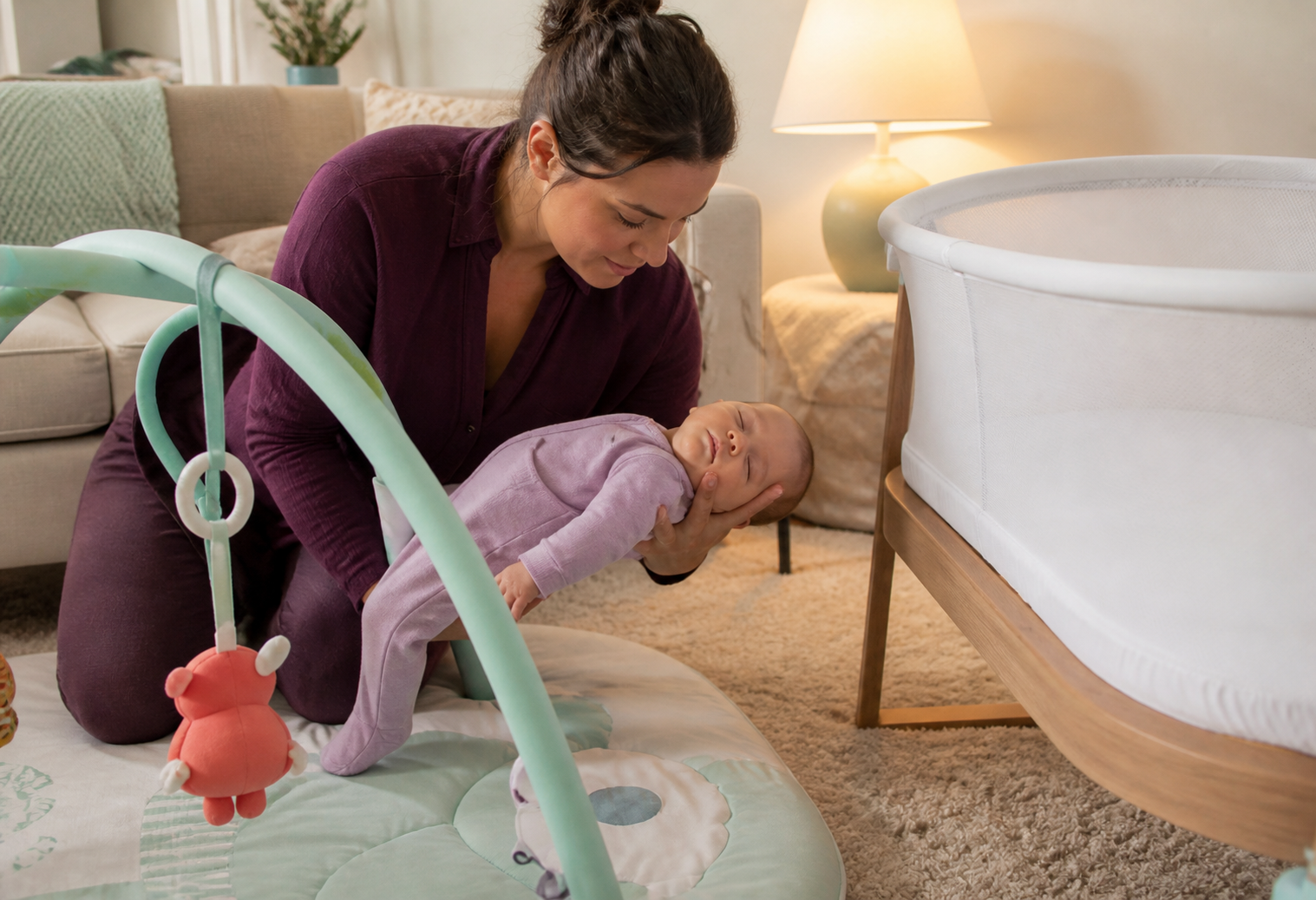
You look down expecting one more determined kick at the crinkle fox, and the room has gone suspiciously quiet. Your baby is asleep on the playmat. Do not leave them there to nap, even if you are sitting beside them. End the play session, check that breathing, color, and responsiveness look usual, then transfer your baby onto their back in a separate safety-approved crib, bassinet, portable crib, or play yard with a firm, flat, level surface and only a fitted sheet.
A brief accidental doze does not need a guilt spiral. It needs a calm handoff. A playmat can be useful for awake floor play, but supervision does not turn it into an infant sleep surface. If this keeps happening, the useful question is usually not “How do I make the mat safe for naps?” It is “Why is floor play landing so close to sleep, and how can I make the next transfer easier?”
Before the transfer, notice whether this looks like ordinary sleep
Most babies who drift off during floor play are simply sleepy. But safety comes before storytelling. Call emergency services if your baby has trouble breathing, looks blue or gray, is unresponsive, has seizure-like movements, or may have a serious injury. Seek prompt pediatric guidance for unusual limpness or lethargy, repeated difficulty waking, poor feeding, dehydration, fever in a young infant, illness, medication exposure, possible ingestion, or a concerning head impact.
If breathing, color, muscle tone, and response look usual, stay beside your baby and make the ordinary transfer. You are not expected to diagnose a sleep stage from the rug. You are checking that this is your baby’s familiar kind of sleepiness before you lift.
Why watching closely does not make a playmat a sleep space
This is the part the old advice often blurs. A caregiver can watch an awake baby on a clear floor mat and respond immediately. That is appropriate supervision for play. Infant sleep guidance asks a different question: Is the surface itself designed and safety-approved for infant sleep?
The American Academy of Pediatrics and CDC recommend placing babies on their backs for every sleep on a firm, flat, noninclined surface in a safety-approved crib, bassinet, portable crib, or play yard. The space stays empty except for a fitted sheet. A foam mat, quilted activity gym, blanket, puzzle mat, padded nest, or carpet is not added to that list because an adult remains nearby.
I would not try to calculate whether the mat feels “firm enough.” Firmness is only one part of the standard. Seams can separate. Puzzle edges can lift. Toys and arches can sit near the face. A blanket can bunch. The baby can roll toward furniture, cords, a pet, a sibling, or the edge of an elevated setup. The product was built for movement and play, not for unattended or supervised sleep.
Supervision matters enormously during tummy time because the baby is awake, moving, and practicing. During sleep, the correct safeguard is the sleep environment itself. That distinction is wonderfully unglamorous. It is also the one that ends the argument.
The quiet handoff
What to do, in order
Stay beside the baby and clear the next move
End the play session. Move hanging toys or loose objects out of your lifting path. If another child or pet is nearby, create space before you pick the baby up. Do not slide a pillow beneath the head or cover the baby “just for a minute.”
Look before you lift
Notice ordinary breathing, usual color, familiar muscle tone, and some response to your voice or touch. If something looks wrong, use the urgent guidance above. If everything looks familiar, continue without turning the moment into a home neurological exam.
Support the whole sleepy package
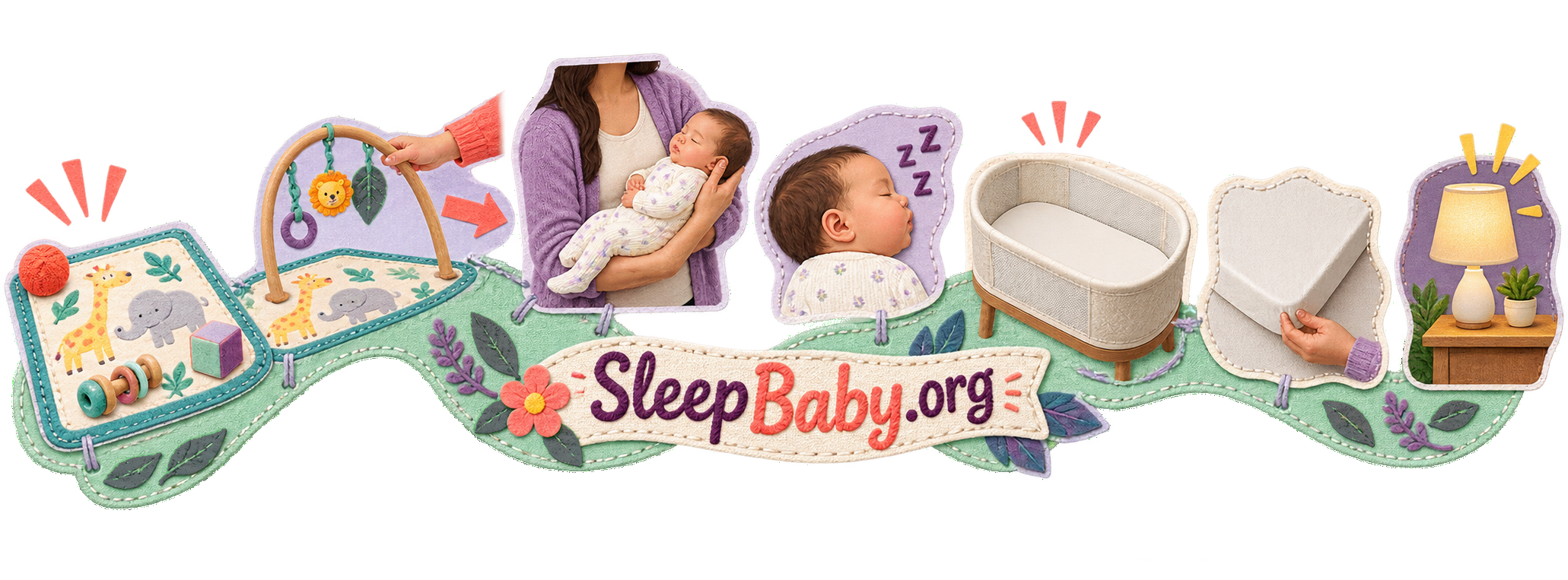
Slide one hand beneath the head and neck and the other beneath the body. Lift smoothly toward your chest. The goal is control, not preserving sleep at any cost. A baby who wakes during a safe transfer has not ruined anything; they have merely filed an immediate complaint with management.
Place the baby on the back in the prepared sleep space
Use a crib, bassinet, portable crib, or play yard that meets current safety standards and is appropriate for your baby’s age, size, and development. Use the manufacturer’s intended mattress or pad with a fitted sheet only. No playmat, extra mattress, folded blanket, positioning roll, pillow, toy, or improvised padding goes inside.
Settle there if the eyes reopen
Keep the lights and your voice low if it is nap time. Use the soothing steps that fit your family, but keep the sleep itself in the approved space. Returning to the playmat because the baby protested the transfer teaches the room the wrong job and leaves you facing the same safety decision five minutes later.
Does the doze count as tummy time?
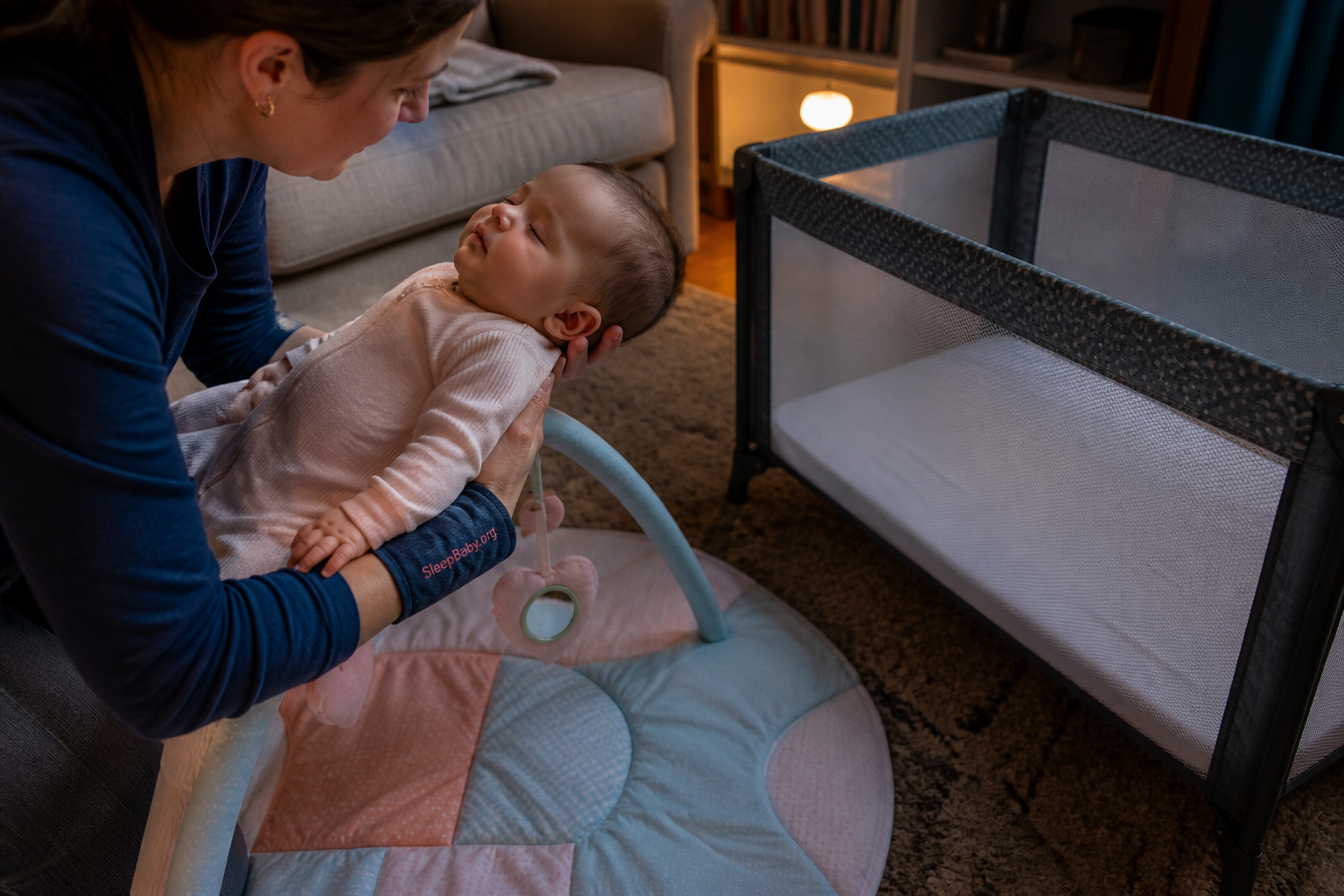
No. NICHD defines tummy time as placing a baby on the stomach while the baby is awake and someone is watching. Once sleep begins, the awake practice has ended. Move the baby to the safe sleep space and place them on the back.
That does not mean the few awake minutes before sleep were wasted. Short, frequent tummy-time sessions help babies practice lifting and turning the head, bearing weight through the arms, and building motor control. Very young babies may manage only a few minutes at a time. The point is not to keep a drooping baby on the mat until a daily timer is satisfied.
If your baby dislikes floor tummy time, the related SleepBaby guide on safer tummy-time surfaces and supervision explains how to keep the setup stable, clear, and easy to watch without moving prone play into a stroller or other improvised equipment. Short awake attempts on the floor, your chest, or your lap can be more useful than one long exhausted session.
I would count tolerance, effort, and repeated chances—not minutes survived with the emotional atmosphere of a tiny corporate retreat gone wrong. Sleepiness is a perfectly good stopping cue.
Pattern decoder
If this keeps happening, look one step earlier
Repeated playmat dozing does not automatically prove overtiredness, a sleep disorder, or a schedule failure. It tells you that the current play session and sleep pressure are overlapping. The surrounding pattern decides what to change.
Ordinary timing clues
- Floor play starts near the end of the baby’s usual comfortable awake stretch.
- The session follows a feed, car ride, busy outing, short nap, or missed nap.
- Movement slows, gaze turns away, hands relax, fussiness rises, or yawning appears before sleep.
- The baby transfers, wakes normally later, feeds normally, and behaves like themselves.
Clues that change the question
- The baby is repeatedly difficult to wake or unusually limp.
- Feeding, wet diapers, breathing, color, temperature, or movement has changed.
- Sleepiness appears suddenly after illness, medicine, a fall, or possible ingestion.
- A newborn regularly cannot stay awake long enough to feed effectively.
For the ordinary pattern, move floor play earlier rather than trying to stretch the baby through it. Prepare the sleep space first. Then begin a shorter play session while your baby is alert enough to engage. If the baby repeatedly arrives on the mat already fading, the mat is not the problem; the handoff has simply been scheduled too late.
If the pattern is hard to read, use a tiny observation note for two or three days: last sleep ended, feed time, floor play began, first sleepy signal, and what happened after transfer. This is not a surveillance project. It is enough information to see whether the doze reliably follows one part of the day. The flexible guide to building a baby sleep rhythm without a rigid clock can help if the whole day feels like a row of accidental naps.
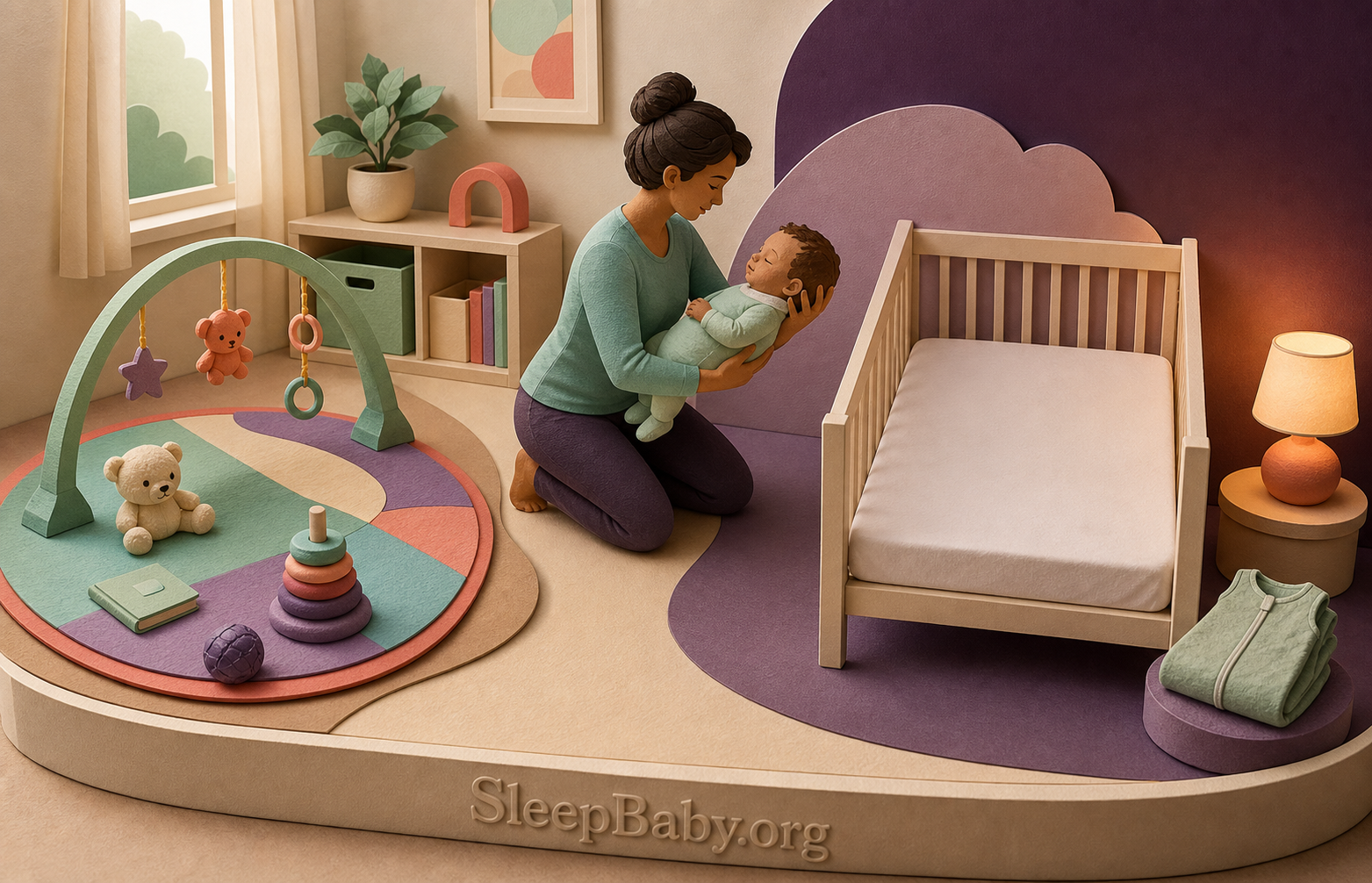
A clearly labeled composite Kacey-and-Benjamin scene
The nap that arrived between the crinkle page and the sock
Imagine Kacey on the living-room floor with Benjamin during an ordinary late-morning play session. One minute he is offended by the existence of his left sock; the next, his cheek is resting on the mat and the crinkle book has been abandoned mid-argument. The quiet feels sweet for about two seconds, followed by the thought that sends a parent to Google: Can I just let him sleep there if I stay?
In this composite scene, I would not treat Benjamin’s peaceful face as evidence that the surface is appropriate. Babies can look deeply comfortable in places that were never designed for sleep. I would check him, lift him, and put him on his back in the prepared bassinet. If his eyes opened, I would accept the injustice of having disturbed a person who had selected the floor without consulting anyone.
The useful clue comes afterward. Floor play began when he was already slowing down. The solution is not a softer mat or closer supervision. The next day, I would bring the play session forward and keep it short. That is the Kacey answer I want a parent to carry: do not redesign the accidental sleep place; redesign the handoff into the real one.
This scene is composite storytelling, not evidence about a documented event in Kacey or Benjamin’s life. The safety guidance comes from AAP, CDC, NICHD, and CPSC sources.
What if the baby fell asleep on the belly?
Tummy time belongs to awake, supervised play. If a baby falls asleep prone on the mat, transfer them and place them on their back in the approved sleep space. Do not leave the baby prone because changing position might wake them.
For babies who can roll both ways independently, safe-sleep guidance still starts every sleep with back placement. If the baby later rolls independently in an empty approved sleep space, you do not need to keep flipping them back all night. You do need to stop swaddling when the baby begins trying to roll, keep the sleep space empty, and avoid positioning products that promise to hold one posture.
A baby who rolled on the mat while awake may have an arm trapped beneath the body or a face near a toy, fabric edge, or activity-gym post. That is another reason the immediate response is a full transfer, not simply rotating the baby onto the back on the same mat.
Are some playmats safer than others?
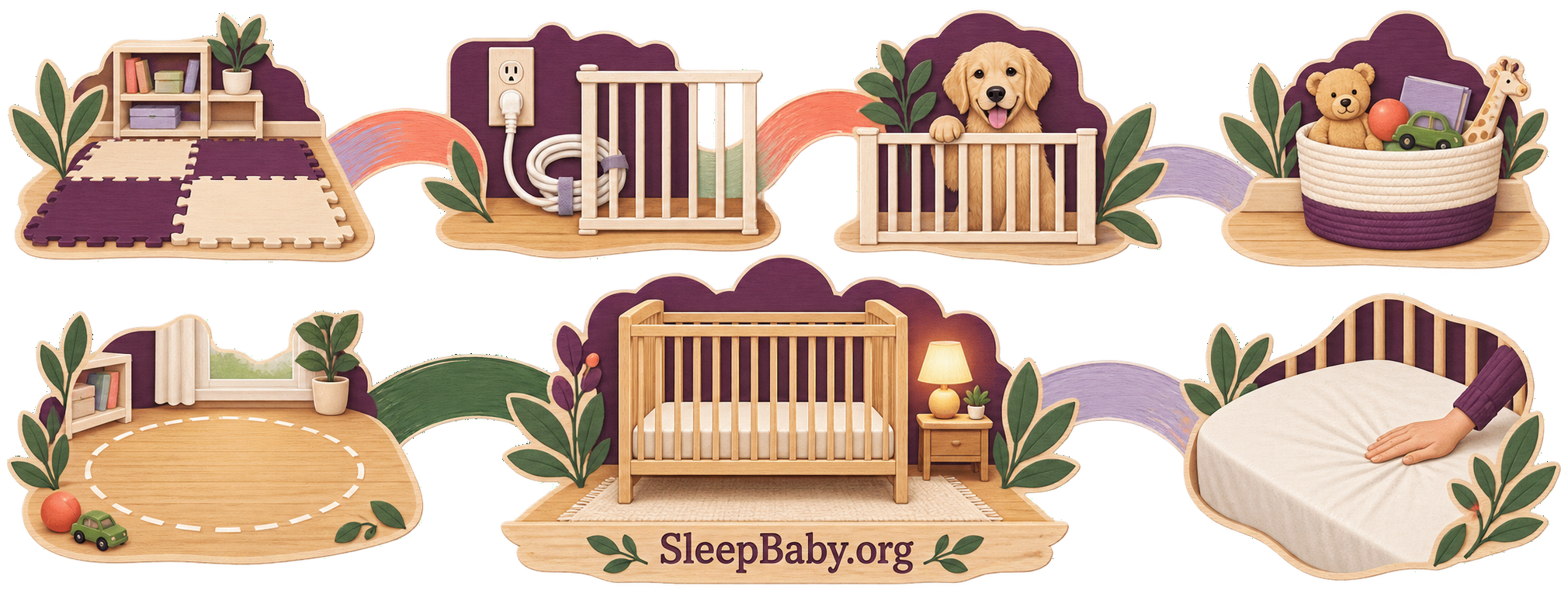
For awake floor play, yes: the setup matters. Choose a stable, level floor area. Keep the baby’s face visible. Check that puzzle pieces or seams stay flat and intact. Remove loose blankets, pillows, stuffed animals, strings, plastic bags, cords, small pieces, and anything a mobile baby can pull over. Keep the mat away from stairs, fireplaces, heaters, furniture gaps, direct sun, pets, and older children’s fast-moving play.
But no material—foam, cotton, quilted fabric, cork, carpet, or padded activity gym—earns approval for infant sleep merely by feeling firm to an adult hand. Product labels and safety standards matter. A “non-toxic” marketing claim answers a different question from “intended and safety-approved for infant sleep.”
Do not move the playmat into the crib, bassinet, or play yard. Do not add a third-party mattress or padding to make a portable sleep surface feel softer. Use the sleep product exactly as its current instructions specify, including stage, weight, height, assembly, and accessory limits.
I know the bare sleep surface can look almost comically austere beside an activity mat covered in smiling animals, mirrors, loops, textures, and what appears to be a tiny fabric tax department. The empty space is intentional. Play gets the interesting objects. Sleep gets the clear surface.
What if every transfer wakes the baby?
Then the transfer is frustrating, not optional. Keep the safety boundary and work on the mechanics around it.
- Prepare first. Make sure the bassinet, crib, portable crib, or play yard is assembled, empty, and ready before play begins.
- Shorten the distance. If the approved sleep space is far away, consider arranging an appropriate portable sleep space nearer the daytime play area rather than carrying a sleeping baby through doors and stairs.
- Move before deep sleep becomes the mission. When you see disengagement, slower movement, yawning, or relaxed hands, end play and begin the nap routine before the baby is fully asleep on the mat.
- Keep one cue steady. A familiar phrase, dimmer room, or ordinary sound-machine setting can bridge the transition. It does not make sleep happen; it tells the baby what is happening next.
- Accept a reset. If the baby wakes fully, feed or settle as needed and try the nap again in the safe space. Protecting an accidental nap is not more important than protecting the sleep environment.
If waking the baby feels especially daunting, the guide to checking and lifting a sleeping baby gently gives a calm observation sequence. It does not promise a tear-free transfer. Some babies regard being moved three feet as a major breach of contract.
A practical option for a long-distance transfer
A portable play yard can put the approved sleep space closer
If floor play happens downstairs while the main crib is upstairs, a Graco Pack ’n Play On the Go Playard can solve the specific household-friction problem: it gives you a manufacturer-designated portable sleep space near the play area, so the correct handoff does not require a parade through the whole house.
I prefer this fit over another playmat, lounger, blanket, monitor, or soothing gadget because it changes the destination, not the safety rule. Use it only as the current manufacturer instructions allow for your baby’s age, size, and development. Use the supplied sleep surface and an approved fitted sheet; never add the playmat, extra mattress, pillow, toy, or padding. This product does not prevent SIDS, guarantee sleep, or make an unsafe setup safe.
See the Graco Pack ’n Play On the Go Playard on Amazon
As an Amazon Associate, SleepBaby may earn from qualifying purchases.
Watch the safe destination take shape
The playmat can be busy; the sleep space stays bare
This American Academy of Pediatrics video is useful here because it shows the simple environment you are transferring toward: a firm, flat sleep surface without loose objects. The written steps above remain the decision guide if playback is unavailable.
Takeaway: Keep awake play interesting and supervised; when sleep begins, transfer to the separate bare, safety-approved space.
Age changes the context, not the sleep-surface answer
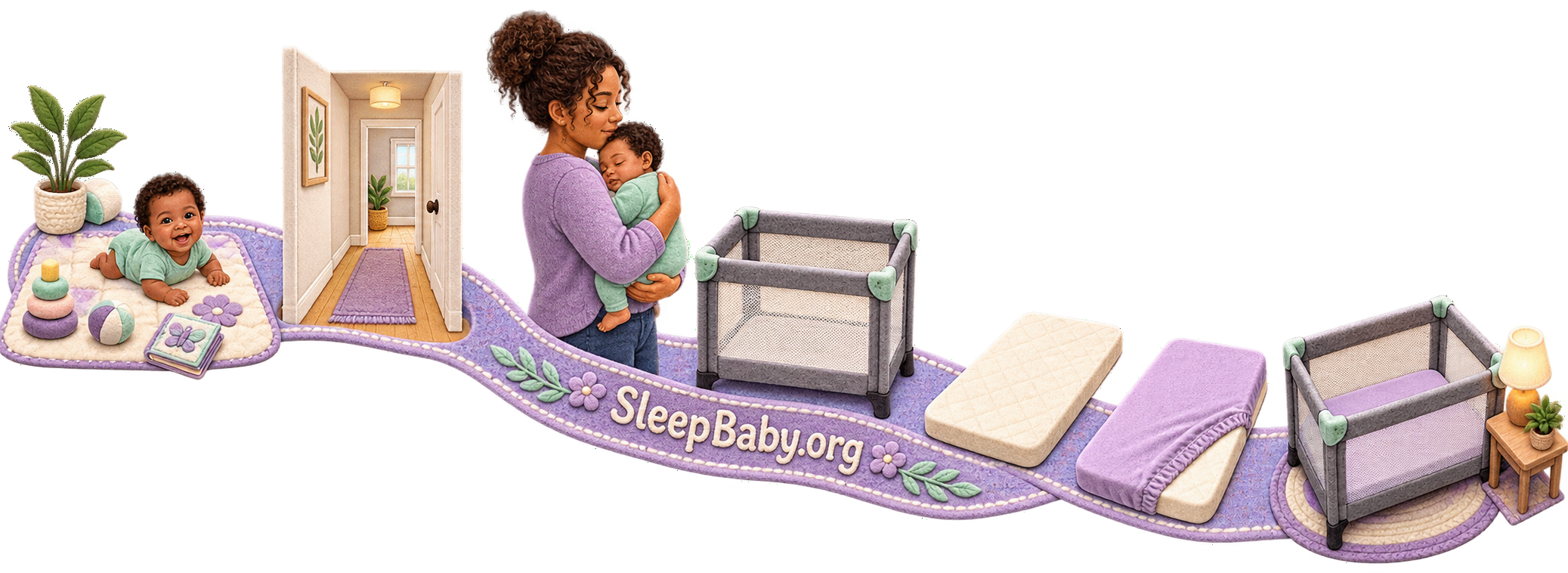
A newborn may drift off after only a few minutes of looking at a face or attempting one heroic head lift. That can be ordinary. Newborn sleep is scattered across day and night, and awake periods may be brief. The safe response is still to end floor play and move the baby onto the back in the appropriate sleep space. What deserves closer attention is not the short wake period by itself, but whether the baby can wake and feed effectively, has expected wet diapers, maintains usual color and breathing, and returns to an alert state at other times.
For a baby who is beginning to roll, the playmat may suddenly become the place where every new skill gets rehearsed. Keep watching closely, because mobility adds access to seams, toy arches, furniture edges, cords, and whatever mysterious crumb the floor acquired thirty seconds after you cleaned it. If sleep begins, transfer and start on the back. Stop swaddling when the baby shows signs of trying to roll, and do not use a positioning device to hold the baby still.
An older mobile baby may crawl to the edge of the mat, lower the head, and appear to choose a nap with impressive confidence. Confidence is not a product certification. For infants under one year, use the same approved sleep destination. After the first birthday, development and individual circumstances change the discussion, so follow the child’s clinician and the product instructions rather than extending infant rules or abandoning them on a calendar date.
Plan for the moment when you are sleepy too
The harder version of this question is not the baby dozing at 11:20 in the morning while you are wide awake. It is the late-afternoon feed on the floor when you can feel your own eyes closing. If you are becoming drowsy, stop floor play before both of you drift. Put the baby in the separate safe sleep space, then rest somewhere appropriate for you.
Do not move to a sofa or armchair with the baby because it feels easier to supervise from there. Those surfaces create serious sleep hazards if the adult falls asleep. If feeding is needed, make the plan before you sit down: clear the baby’s sleep space, ask another alert adult to help when available, and return the baby to that separate space before you sleep.
I would rather interrupt a lovely drowsy minute than build a safety plan around my ability to remain perfectly alert. Exhaustion is not a moral weakness; it is a condition worth designing around. A prepared bassinet or play yard nearby turns the right choice from a trek into one practiced movement.
The questions parents usually ask next
Can I let the baby finish a ten-minute nap if I sit right there?
No. Duration does not change the surface standard, and direct supervision does not make a playmat an approved infant sleep product. Transfer the baby when sleep begins.
Should I wake the baby before moving them?
You do not need to deliberately wake a baby who appears normally asleep. Check breathing, color, tone, and usual responsiveness, support the head and body, then transfer. If the baby wakes during the move, settle in the safe sleep space.
What if the playmat is thin and lies directly on hardwood?
It may be appropriate for awake play if it is stable, intact, clear, and used as directed. It is still not a safety-approved infant sleep surface. “Firm” is not the only requirement.
What if the baby is older than one year?
Safe-sleep recommendations and development change with age. This article’s firm, flat, back-to-sleep guidance is written for infants up to age one. For an older child who independently lies down on the floor, consider the child’s mobility, environment, product instructions, and individual health needs rather than applying infant advice mechanically.
Does repeated dozing mean the baby needs more naps?
Possibly, but not from that clue alone. Look at when the last sleep ended, feeding, illness, stimulation, age, and the baby’s usual signals. Move play earlier for a few days and see whether the pattern changes. New or extreme sleepiness deserves clinician input.
What if the baby hit their head just before falling asleep?
Do not assume the sleep is an ordinary nap. Seek urgent medical guidance based on the injury and symptoms, especially for loss of consciousness, repeated vomiting, seizure-like activity, unusual behavior, unequal pupils, worsening sleepiness, breathing changes, or difficulty waking. Call emergency services for severe symptoms.
The plan I would use for the next play session
- Prepare the crib, bassinet, portable crib, or play yard before the baby goes on the floor.
- Start floor play earlier than yesterday, when the baby is awake enough to look, kick, reach, or lift.
- Keep the mat clear and stay close enough to see the face, breathing, color, and movement.
- End at the first reliable sleepy pattern instead of waiting for the cheek to land on the mat.
- Use one quiet transition into the safe sleep space, then respond to whatever the baby actually needs.
That is enough. You do not need a new mat, a perfect wake-window spreadsheet, or a strategy for preserving every accidental doze. The playmat’s job is awake movement. The crib or other approved space has the sleep shift.
Sources
- American Academy of Pediatrics: Safe Sleep—9 Ways to Reduce a Baby’s Risk of SIDS & Suffocation
- American Academy of Pediatrics: How to Keep Your Sleeping Baby Safe
- CDC: Providing Care for Babies to Sleep Safely
- NICHD Safe to Sleep: Tummy Time for a Healthy Baby
- NICHD Safe to Sleep: Frequently Asked Questions
- U.S. Consumer Product Safety Commission: Safe Sleep
The image at the beginning has changed now. The sleeping baby on the mat is not proof that you failed, and it is not a puzzle about how long you can safely wait. It is simply the moment awake play ended. Check, lift, place on the back in the prepared sleep space. The handoff is the answer.
When the crinkle fox suddenly loses
Make the next safe handoff feel less improvised
A baby falling asleep halfway through floor play can make the whole day feel mistimed. SleepBaby helps you turn moments like this into a workable rhythm—without pretending every yawn is a diagnosis or every nap follows a clock.






What viewers said10 comments · 4 replies+
Archived comments from the original Baby Sleep Miracle presentation. Not independently verified by SleepBaby.org; individual experiences vary.
Thank you so much for this video! I had no idea about the dangers of baby swings :O
Hi Mary-Ann. I have a question: Is method in any way similar to the ones recommended by Dr Bucknam, Dr. Weissbluth or Dr. Karp? We tried those but none of them help.
Hi Regina, thank you for your question. The short answer is no. The techniques I share in my guide are based on newest scientific research and this is why I have never seen any approach similar to the one I recommend.
This method really works! I tried it on my son Jesus and after just one week he went from waking up more than 5 times a night to waking up just once or twice. You are a lifesaver, Mary-Ann!
I'm truly impressed with how much information you share in your video. And all for free! I can feel that you truly care about mothers like myself, and that's hard to find these days. I have recommended your site to several of my friends already.
Mary-Ann, our child suffers from autism. Is your approach still suited?
Chloe, I made sure my method can be used with any child, even babies who are special like yours. Please note that I'm not a doctor and that I always advice to consult with your physician because nothing is more important than the safety and well-being of your love.
Hallo Mary-Ann, I'm from Germany. Do you have your guide in German?
Hello Heide, we do! Normally you should already see our video in German. If not, please contact our support so they can guide you
Thenk you for your answer, Mary-Ann!
I just completed your approach and I have to say, it worked almost too well. Yes, it took a bit of getting used to with your bedtime routine but the difference is huge. My son George used to take 1 hours to go down and now he's firmly asleep in no more than 10 minutes! You're the best!
It seems I'm the only man watching this video, lol! What you shared about the 'emotional backpack' made immediate sense to me and I can't wait to help my little girl Mila to unpack it!
Hey there, just discovered your site and this really sounds different. Just wanted to say thanks for sharing :)
For everyone who's still thinking about getting Mary-Ann's guide I want to advise you to go ahead. I wasn't sure myself but now I'm so thankful I invested in this program. It made a huge difference in our life as a family and yes, my baby girl does sleep through the night now.