
If your baby swallowed tin foil, call their pediatrician or urgent medical advice service now, even if they seem comfortable. Babies need advice based on the piece and their age. If your baby cannot breathe, cough or cry normally, is turning blue, or is unresponsive, call your local emergency number immediately. Don’t make them vomit or try to push the foil down with food.
I would keep the remaining wrapper and make the call before trying to work out whether a missing corner counts as “tiny.” The piece’s shape, what it came from, and your baby’s symptoms matter more than that word.
Breathing first. Swallowing next. Then the wrapper.
Emergency: Trouble breathing, a weak or absent cough, inability to cry, blue or very pale skin, collapse, or inability to wake needs emergency help. Follow the dispatcher’s instructions and provide age-appropriate first aid according to your training.
Urgent assessment: Drooling, trouble swallowing, repeated vomiting, pain in the neck, chest or belly, blood in vomit or stool, or ongoing coughing after the event needs urgent medical assessment. Don’t wait for a diaper to answer the question.
No symptoms: Still call now for your baby. Tell the clinician that foil may have been swallowed, even if you did not see the swallow. Seattle Children’s advises prompt care advice for swallowed objects in children under two.
In the United States, call 911 for an emergency. If the foil came from medicine packaging, held an unknown substance, or raises a possible poison exposure, also call Poison Control at 1-800-222-1222. Outside the U.S., use your local emergency and poison-information services.

What I would do while getting advice
Move the remaining foil and anything it wrapped out of reach. Stay with your baby. If another adult is there, one person can make the call while the other watches the baby. Looking for the rest of the wrapper is useful only if it doesn’t delay help.
If your baby is coughing strongly or crying, keep watching closely. Don’t perform choking maneuvers just because foil is missing. If the cough becomes weak or your baby cannot breathe or cry, treat that as an emergency. Never sweep a finger blindly around the mouth; you can push an object farther in.
I would skip the home fixes: no forced vomiting, no bread to “wrap around” the metal, and no extra food to push it along. If your baby is drooling, struggling to swallow or distressed, do not give anything by mouth while seeking medical help. Ask the clinician what to do about the next breastfeed, bottle or meal.
Keep the foil roll, food wrapper or packaging, or take a photo of it. If you have an identical piece, that can help explain the material. Don’t put a sample into your baby’s mouth to recreate what happened.
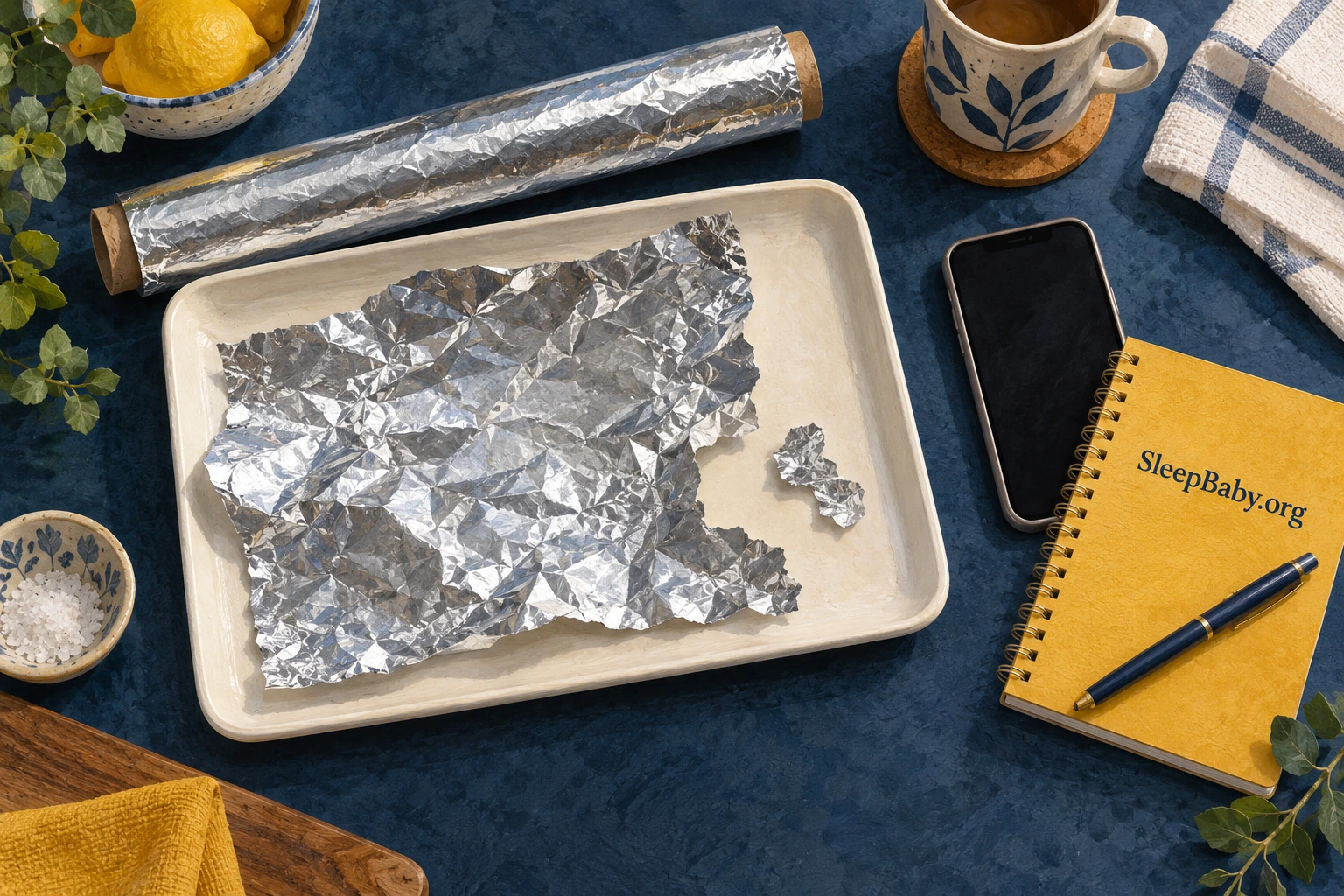
A soft kitchen-foil scrap is different from a sharp package
“Tin foil” can describe several things on a kitchen floor. The information I would want to give the clinician is more specific:
- Ordinary kitchen foil: Was a thin corner torn off a sheet, or could a larger folded or crumpled piece be missing?
- A foil food lid or wrapper: Was it only a flexible layer, or did it include a stiff rim, plastic backing or another part?
- Medicine packaging: Could a tablet or capsule be missing too? Keep the product name and packaging for Poison Control.
- A can tab or other rigid metal: Say that explicitly. Don’t describe a pull tab as a little foil scrap.
These are details to report, not a sorting exercise that lets you declare an object safe. Sharp or pointed objects need urgent medical advice, and a baby who seems well can still need assessment. If you cannot identify the object, say so. The Royal Children’s Hospital advises hospital assessment when the swallowed object is uncertain.
Does a tiny piece always pass?
Many small, smooth swallowed objects pass through the digestive tract without a procedure. That general reassurance does not tell us where your baby’s piece is, whether it has a sharp folded edge, or whether anything else went down with it. There isn’t a universal “safe foil size” I can give you from a description.
I would describe the largest amount that could reasonably be missing, then let the clinician decide what that means. “A corner is gone, but I can’t tell whether it tore off before today” is useful information. It is better than turning a guess into a measurement.
Is the concern aluminum poisoning?
For the immediate decision, I would focus the conversation on the swallowed object and anything on or inside the wrapper. A discussion about aluminum in cookware cannot assess an individual baby who may have swallowed foil. Nor does food-safe packaging mean the packaging is safe to eat.
If the wrapper contained a medicine, cleaner or something you cannot identify, give Poison Control that detail. Don’t assume the silver material is the whole exposure.

KEEP THIS BESIDE THE PHONE
Foil facts for the call
- Baby
- Age, approximate weight if known, and any swallowing or digestive problems the clinician should know about.
- Wrapper
- Kitchen roll, food lid, candy wrapper, medicine blister pack, or unknown. Keep the original label.
- Missing piece
- What you actually saw, the possible amount, and whether it was flat, folded, crumpled or rigid.
- Clock
- When it happened, or the time window if you did not see it.
- Baby now
- Breathing, coughing, swallowing, drooling, vomiting, pain or behavior that is different from usual.
Ask before ending the call: Where should we go, if anywhere? What about the next feed and nap? Which changes mean emergency care? Is follow-up needed, and when?
You do not need every answer before calling. “I don’t know” is an answer the clinician can work with.
AFTER YOU HAVE A CARE PLAN
Put the medical instructions on one page. Keep bedtime simple.

Once your clinician has explained what to watch for, you can leave the wider sleep questions for the free planning preview at SleepBaby.org. It offers a starting step without a sign-up or card.
The optional SleepBaby.org Workshop has short lessons you can revisit and a seven-night tracker. That can give ordinary bedtime observations a place to go, separate from the foil incident and its care instructions.
Neither the preview nor the Workshop assesses swallowed objects, clears your baby for sleep, or replaces follow-up. If the medical plan still feels unclear, make that call first.
If the clinician recommends watching at home
Home observation should be the plan you were given, not the plan you inferred because your baby stopped fussing. Write down the instructions in the same place as the time of the incident. If you were told to arrange a review or go in if a particular symptom appears, make that part easy to find.
A useful note can be very short: when the foil was found, what might be missing, who you spoke with, what they advised, and the follow-up they requested. Keep any photo of the wrapper with that note. The point is a reliable handoff, not a minute-by-minute diary.
If your baby’s symptoms change after the call, the original advice may need to change too. Breathing trouble is an emergency. New trouble swallowing, persistent cough, repeated vomiting, pain, blood, or a baby who looks unwell needs renewed urgent medical advice. Do not wait until the suggested follow-up time if there is a concerning change.
Do I have to search every diaper?
Ask the clinician who assessed your baby. Public guidance differs on stool checking for different objects; some children need follow-up, while routine searching is not always useful. I would not set a three-day deadline from an article or take a clean diaper as proof that nothing was swallowed.
Use the plan specific to your baby. If you are instructed to look for the object, ask what to do if you don’t find it and how long to continue. A reassuring answer should include what happens next, not leave you guessing over each diaper.
What if an X-ray doesn’t show foil?
Tell the medical team what you think was swallowed even if an image looks clear. The Royal Children’s Hospital notes that aluminum may not show on an X-ray. The clinician decides whether imaging or another assessment is needed; an at-home interpretation of a scan cannot settle it.
I would bring the packaging rather than trying to predict the test. A sample can make “a bit of shiny wrapper” much easier to understand.

What about the next nap or bedtime?
Ask this during the medical call: “Can my baby follow their usual sleep routine, and is any specific observation needed?” A normal nap time does not answer that question. A sleep guide, including this one, cannot give clearance after a swallowed object.
Once the clinician has said home care and usual sleep are appropriate, keep ordinary safe-sleep practices: place your baby on their back on a firm, flat sleep surface with a fitted sheet, without pillows, loose blankets or toys. Don’t prop the mattress or use a pillow to “help the foil move.”
I would keep the medical note outside the sleep space and make sure the next caregiver has read it. If you were given a monitoring instruction you cannot realistically follow, tell the clinician. Don’t replace it with a baby monitor or invent your own schedule of waking the baby.
Hard-to-wake or unresponsive is different from simply being due for a nap. Get emergency help if your baby cannot be awakened. If you are unsure whether their behavior is normal after the event, call for advice instead of treating it as a settling problem.
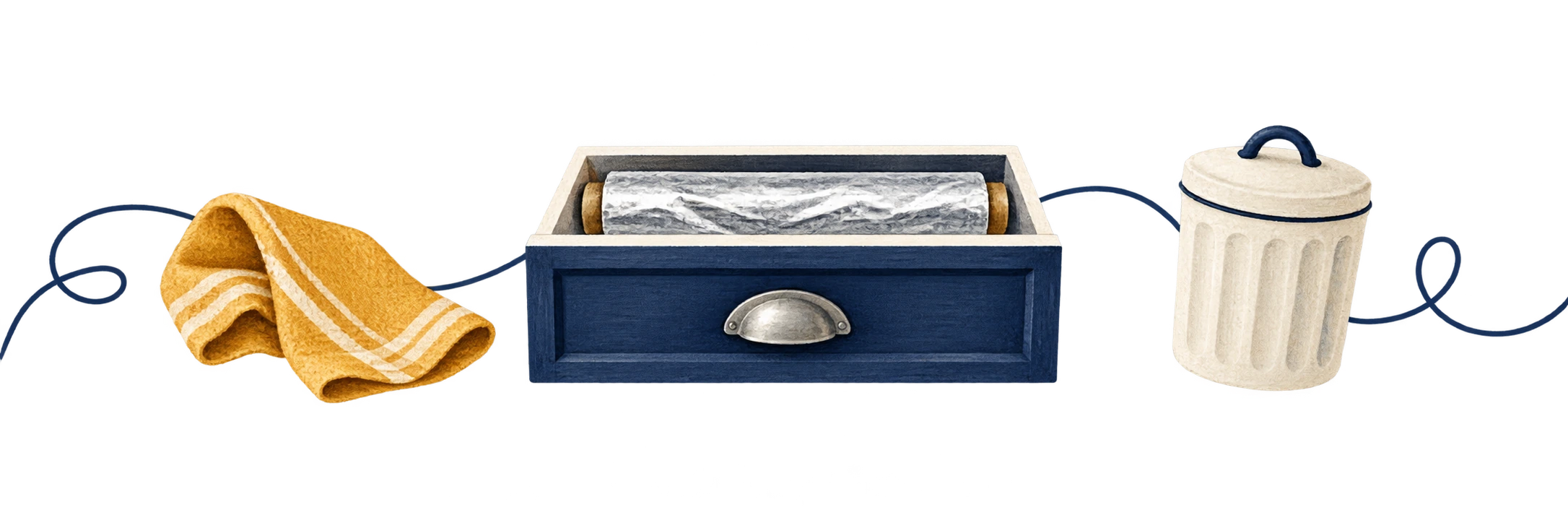
Find how the foil got within reach
After the immediate care decision, I would fix the route the wrapper took. A roll in a drawer, a yogurt lid on a high-chair tray and a scrap dropped beside the bin need different changes. Buying a storage product before finding that route can leave the same problem in place.
- During food preparation: Remove wrapping before bringing food to the baby. Put the scrap straight into inaccessible waste rather than leaving it beside the plate.
- After a snack: Check the high-chair tray, the seat, and the floor underneath. A small piece can separate from the larger wrapper you already threw away.
- At the bin: Check whether the lid and its location actually keep the contents out of reach. A lid alone is not a guarantee.
- With medicine: Return the whole package to secure storage immediately. Don’t leave a partly emptied blister pack on a bedside table.
Include the adults and older children who share the room. A simple instruction such as putting wrappers directly into the secured bin is more useful than asking everyone to “be careful.” Keep foil out of sensory play and offer an age-appropriate toy instead.
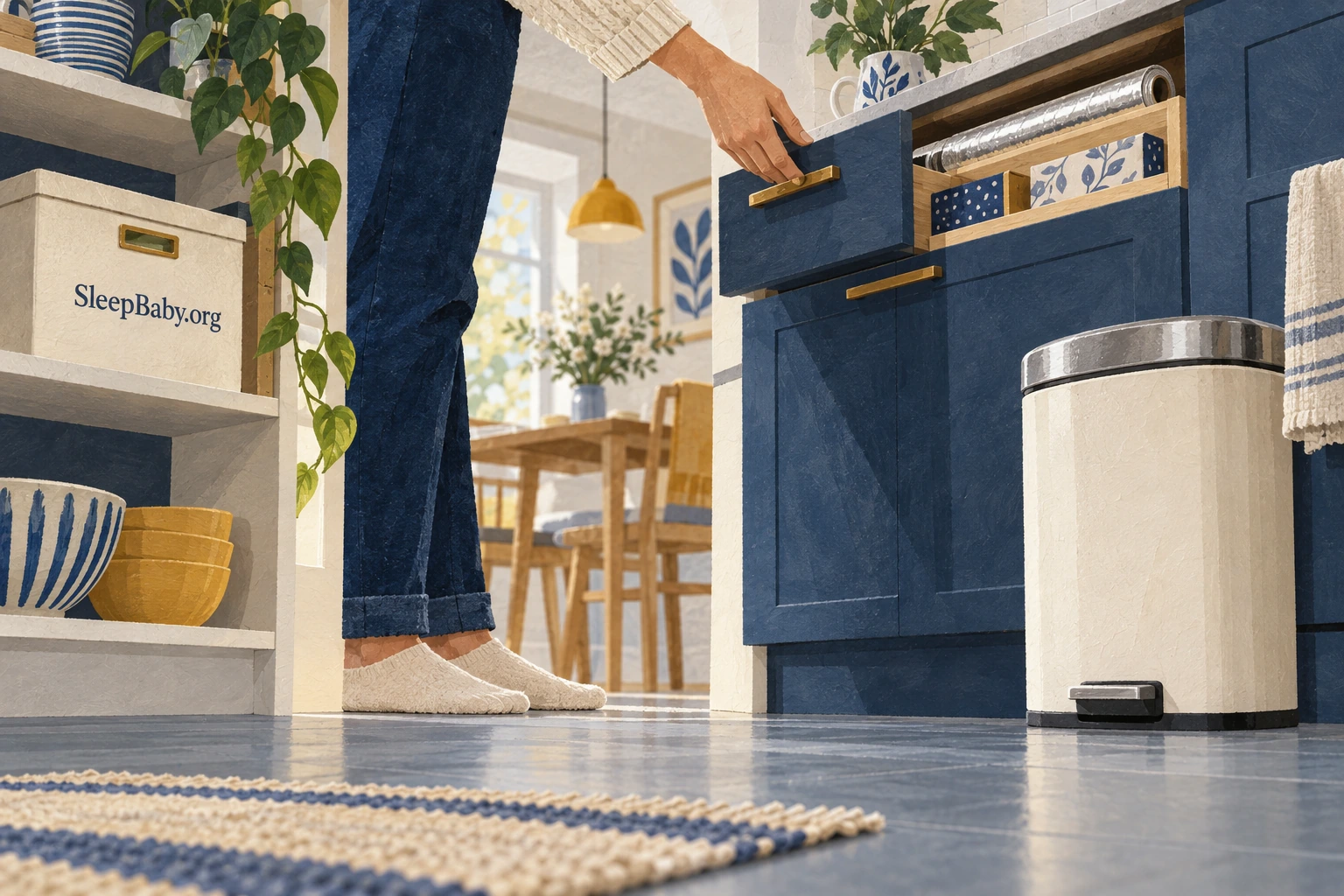
Optional: a barrier for the wrapping cupboard
If the foil came from a reachable cupboard with compatible handles or knobs, the Safety 1st OutSmart Flex Lock, white, 2-pack is one practical option to consider. I would check the fit and installation instructions before choosing it. It will not solve wrappers being left on the floor or a high-chair tray.
The manufacturer describes it as a deterrent. Some children can defeat it; it is not a substitute for adult supervision. An adult should install it, check that it holds securely, and replace a damaged or malfunctioning device.
Already-owned alternative: Move the foil and wrappers to existing secure storage your baby cannot reach or open, and clear scraps straight away. You do not need a purchase to take that step.
As an Amazon Associate I earn from qualifying purchases.
Learn the infant-choking response before you need it
This American Red Cross demonstration shows care for a responsive choking infant. It is for learning and reviewing first aid, not deciding whether swallowed foil has passed. In an emergency, call for help immediately rather than waiting to finish a video.
Written takeaway: A baby who cannot cough or cry effectively needs immediate help. Infant choking care uses back blows and chest thrusts, not abdominal thrusts. If the baby becomes unresponsive, follow emergency instructions for CPR. The Red Cross written guide explains the steps; an age-appropriate first-aid course gives you a chance to practice.
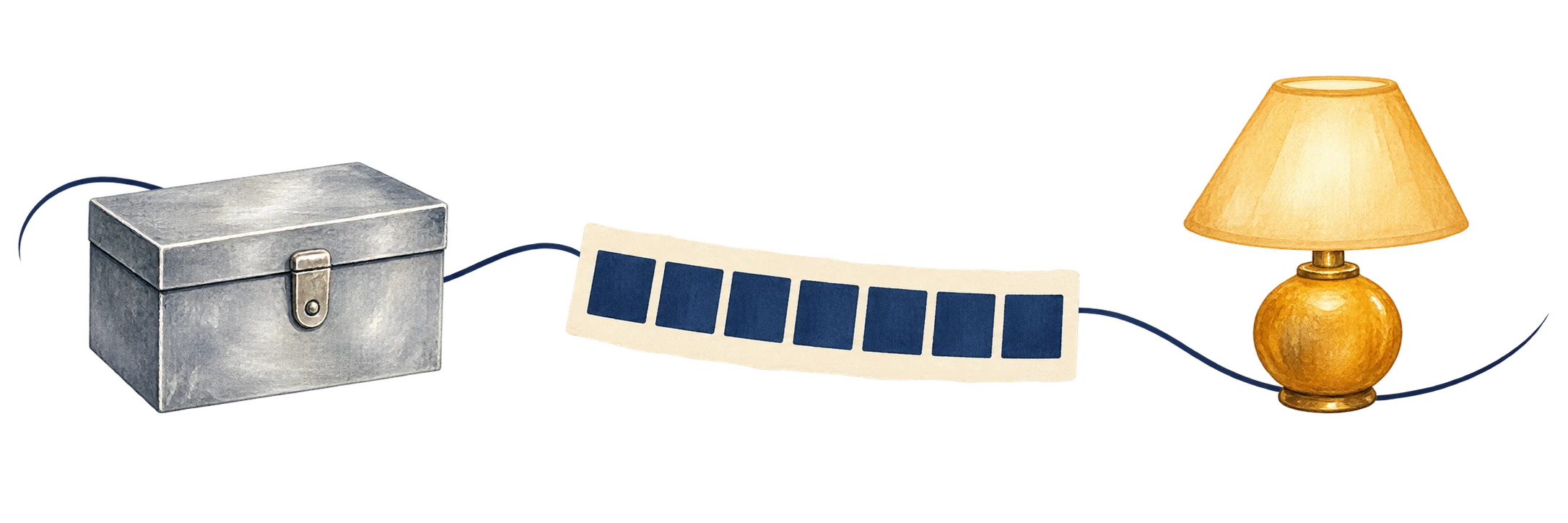
The detail I would not leave unresolved
Before moving on, make sure you know what the clinician wants you to do next. “Watch your baby” is easier to follow when you have the symptoms, feeding advice, sleep advice and follow-up written down.
The missing foil corner may turn out to need very little intervention. You still deserve a plan based on your baby and the actual object. Keep that plan, put the wrapper away, and let ordinary bedtime take its place after the safety question has been answered.
Sources
- Seattle Children's: Swallowed Foreign Object
- Royal Children’s Hospital: Swallowed objects
- American Red Cross: Infant choking
- Poison Control: First aid for poisonings
- Poison Control: How to get help
- NICHD Safe to Sleep: Ways to reduce sleep-related risk
- Safety 1st: Home Safety Help Center and OutSmart Flex Lock manual
THE ROUTINE CAN WAIT ITS TURN
One clear care plan. One manageable evening.
Keep the clinician’s instructions where the next caregiver can find them. When it’s appropriate to return to ordinary sleep planning, the homepage preview can help you choose a starting step.






What viewers said10 comments · 4 replies+
Archived comments from the original Baby Sleep Miracle presentation. Not independently verified by SleepBaby.org; individual experiences vary.
Thank you so much for this video! I had no idea about the dangers of baby swings :O
Hi Mary-Ann. I have a question: Is method in any way similar to the ones recommended by Dr Bucknam, Dr. Weissbluth or Dr. Karp? We tried those but none of them help.
Hi Regina, thank you for your question. The short answer is no. The techniques I share in my guide are based on newest scientific research and this is why I have never seen any approach similar to the one I recommend.
This method really works! I tried it on my son Jesus and after just one week he went from waking up more than 5 times a night to waking up just once or twice. You are a lifesaver, Mary-Ann!
I'm truly impressed with how much information you share in your video. And all for free! I can feel that you truly care about mothers like myself, and that's hard to find these days. I have recommended your site to several of my friends already.
Mary-Ann, our child suffers from autism. Is your approach still suited?
Chloe, I made sure my method can be used with any child, even babies who are special like yours. Please note that I'm not a doctor and that I always advice to consult with your physician because nothing is more important than the safety and well-being of your love.
Hallo Mary-Ann, I'm from Germany. Do you have your guide in German?
Hello Heide, we do! Normally you should already see our video in German. If not, please contact our support so they can guide you
Thenk you for your answer, Mary-Ann!
I just completed your approach and I have to say, it worked almost too well. Yes, it took a bit of getting used to with your bedtime routine but the difference is huge. My son George used to take 1 hours to go down and now he's firmly asleep in no more than 10 minutes! You're the best!
It seems I'm the only man watching this video, lol! What you shared about the 'emotional backpack' made immediate sense to me and I can't wait to help my little girl Mila to unpack it!
Hey there, just discovered your site and this really sounds different. Just wanted to say thanks for sharing :)
For everyone who's still thinking about getting Mary-Ann's guide I want to advise you to go ahead. I wasn't sure myself but now I'm so thankful I invested in this program. It made a huge difference in our life as a family and yes, my baby girl does sleep through the night now.