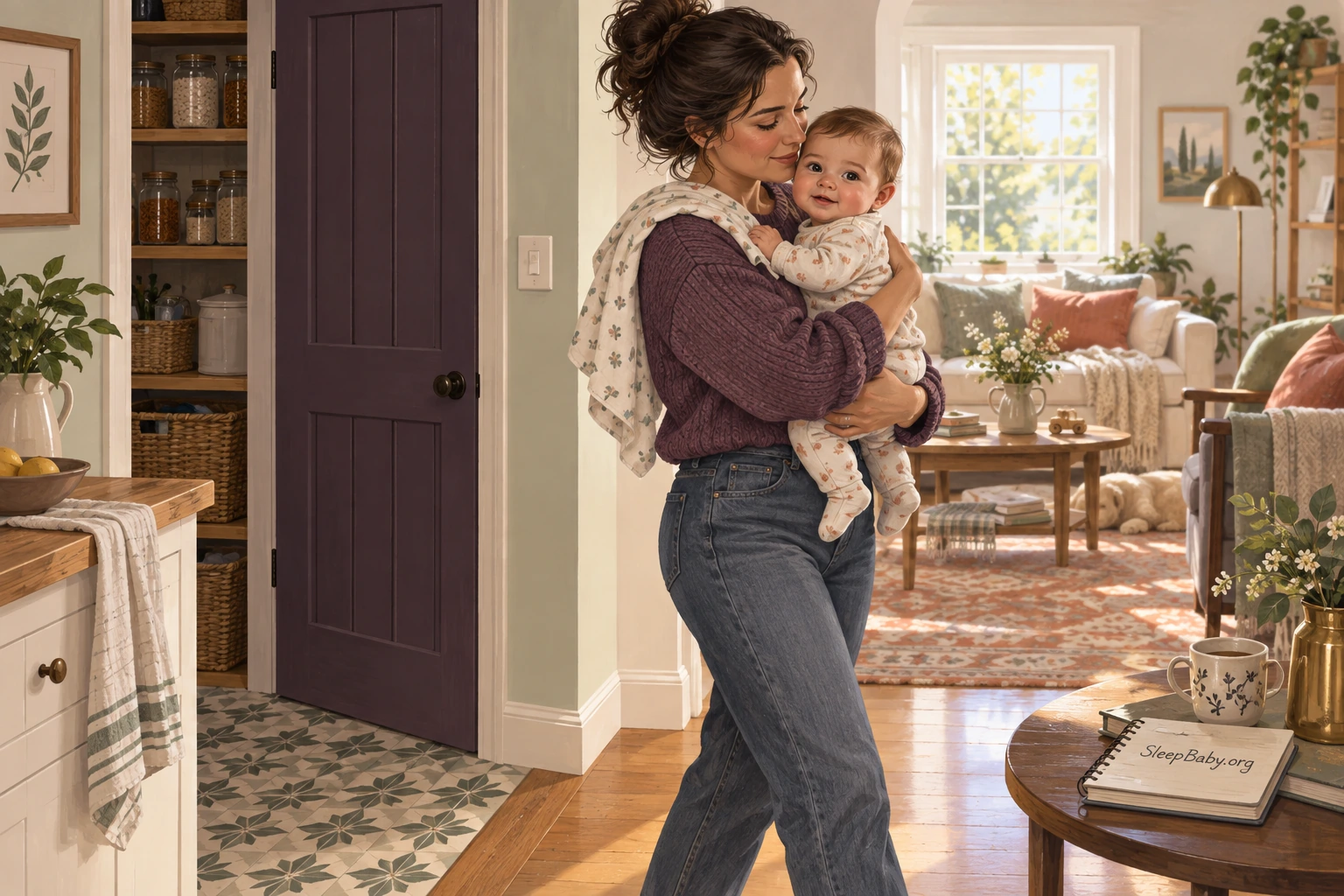
If your baby ate rat poop, move them away from the area, gently wipe visible material from their mouth with a damp cloth, and wash their hands. Call your pediatrician or, in the U.S., Poison Control at 1-800-222-1222 for advice about this exposure. Do not make your baby vomit. If they have trouble breathing, collapse, have a seizure, or cannot be awakened, call 911 immediately.
I would make that call before cleaning the room. Animal droppings can carry germs, and the person advising you needs to know whether your baby swallowed something, touched it, or might have reached rodent bait instead. You do not need a perfect identification before asking for help.
SleepBaby.org · The original video
A little help
for the night ahead.
Take a moment to watch the original Baby Sleep Miracle presentation. Your article will be right here when you’re ready to keep reading.
What viewers said10 comments · 4 replies
Archived comments from the original Baby Sleep Miracle presentation. Not independently verified by SleepBaby.org; individual experiences vary.
Hi Mary-Ann. I have a question: Is method in any way similar to the ones recommended by Dr Bucknam, Dr. Weissbluth or Dr. Karp? We tried those but none of them help.
Hi Regina, thank you for your question. The short answer is no. The techniques I share in my guide are based on newest scientific research and this is why I have never seen any approach similar to the one I recommend.
This method really works! I tried it on my son Jesus and after just one week he went from waking up more than 5 times a night to waking up just once or twice. You are a lifesaver, Mary-Ann!
I'm truly impressed with how much information you share in your video. And all for free! I can feel that you truly care about mothers like myself, and that's hard to find these days. I have recommended your site to several of my friends already.
Mary-Ann, our child suffers from autism. Is your approach still suited?
Chloe, I made sure my method can be used with any child, even babies who are special like yours. Please note that I'm not a doctor and that I always advice to consult with your physician because nothing is more important than the safety and well-being of your love.
Hallo Mary-Ann, I'm from Germany. Do you have your guide in German?
Hello Heide, we do! Normally you should already see our video in German. If not, please contact our support so they can guide you
Thenk you for your answer, Mary-Ann!
I just completed your approach and I have to say, it worked almost too well. Yes, it took a bit of getting used to with your bedtime routine but the difference is huge. My son George used to take 1 hours to go down and now he's firmly asleep in no more than 10 minutes! You're the best!
It seems I'm the only man watching this video, lol! What you shared about the 'emotional backpack' made immediate sense to me and I can't wait to help my little girl Mila to unpack it!
Hey there, just discovered your site and this really sounds different. Just wanted to say thanks for sharing :)
For everyone who's still thinking about getting Mary-Ann's guide I want to advise you to go ahead. I wasn't sure myself but now I'm so thankful I invested in this program. It made a huge difference in our life as a family and yes, my baby girl does sleep through the night now.
Ready to get started?Take the next step with SleepBaby.
Pick your priceTWO JOBS, IN THIS ORDER
Baby first. Room second.
First: care for your baby
Get them away from the droppings, check how they are acting and breathing, clean visible contamination, and get case-specific advice. Tell the professional about any possible bait, cleaner, bite, or scratch too.
Then: keep the area closed off
Have another adult handle the room if possible. Keep children and pets out. Leave dry droppings undisturbed until you can follow proper wet-cleaning instructions. Do not sweep or vacuum them.
If you are alone, the room can wait while you arrange your baby’s care. A cleaned floor cannot answer the medical question.
What to do in the first few minutes
Check your baby before trying to count droppings or identify the animal. If they are alert and breathing normally, remove visible residue gently with a damp cloth. Do not probe deep into the mouth or try to scrape it clean. Use soap and water for hands, including yours. Keep household disinfectants away from your baby’s mouth and skin.
Do not give a home remedy to “kill the germs,” force a drink, or induce vomiting. Ask the professional what, if anything, your baby should eat or drink and whether they need an examination. Poison Control’s first-aid guidance specifically warns against making someone vomit after a poisoning concern.
In the U.S., the Poison Control number is free and confidential. Outside the U.S., contact your local poison service or urgent medical advice line; use your local emergency number for emergency symptoms. A phone call is especially useful when the material is uncertain and your baby cannot describe what happened.
If it might have been rat poison
Tell Poison Control immediately if there is any chance the object was bait or your baby could have accessed a bait station. A dark pellet on the floor is not enough to establish what it was. If a product package is available, have its label ready without delaying the call. Do not wait for symptoms or guess at a remedy from the pellet’s color.
I would describe the uncertainty plainly: possible droppings, possible bait, and what you actually saw. The clinician or poison specialist can work with an honest “I don’t know.” You do not need to handle more material to prove your theory.

What information should you give the pediatrician?
A short, accurate account is more useful than a long list of possible diseases. Start with your baby’s age, approximate weight, when this happened, and how they look now. Then separate what you witnessed from what you suspect.
- Contact: Did you see swallowing, find something in the mouth, or only see a hand touch the area? Was there a bite or scratch?
- Amount: One visible piece, several pieces, or unknown? Do not invent a number because you feel you should know.
- Location: A pantry, outdoor space, pet enclosure, garage, or another setting? Mention your country or region and whether you know which animal was involved.
- Other exposures: Nearby rodent bait, cleaning products, contaminated food, or dust stirred up during cleaning.
- Changes: Vomiting, diarrhea, fever, breathing changes, feeding difficulty, or unusual sleepiness, including when each began.
Ask for specific next steps: whether your baby needs to be seen, what to watch for, how long the recommended follow-up lasts, and whom to call if something changes overnight. Write down the instructions and the time of the call. If the advice is unclear, repeat it back before hanging up.

Can rat droppings make a baby sick?
They can, but an exposure does not establish that an infection occurred. Poison Control explains that feces may contain bacteria, viruses, or parasites; illness can include vomiting, diarrhea, and fever. Advice written about a small taste of ordinary stool should not be treated as blanket reassurance about unknown rodent droppings.
The setting and type of contact matter. For example, CDC explains that rat-bite fever can spread through contact with infected rodents or contaminated materials, food, or drink. Despite its name, a bite is not required. Fever, vomiting, rash, or joint pain after rodent contact deserve prompt medical attention, and the clinician needs to hear about the exposure.
Hantaviruses are also associated with infected rodents, but you cannot diagnose a virus from a dropping’s shape or decide your baby’s risk from an internet photograph. Different rodents and locations are involved in different infections. Tell the clinician about the actual setting rather than assuming every rat-dropping encounter has the same outcome.
I would keep the exposure note even after the immediate call. Some rodent-associated illnesses begin days or weeks later. There is no single symptom-free afternoon that rules out every possible infection. That does not mean inventing your own round-the-clock monitoring schedule; it means following the plan you were given and mentioning the exposure if your baby becomes unwell.
Symptoms that need medical help
Emergency help now: trouble breathing, collapse, a seizure, or a baby who cannot be awakened. Use 911 in the U.S. or your local emergency number.
Call the pediatrician immediately for a young infant’s fever: the American Academy of Pediatrics says a baby 3 months old or younger with a rectal temperature of 100.4°F (38°C) or higher needs an immediate call, even if they otherwise seem well.
Get prompt advice about new illness after this exposure: fever, repeated vomiting, diarrhea, a rash, or signs your baby is unusually unwell. Fewer wet diapers, few or no tears, a sunken soft spot, or unusual drowsiness can indicate dehydration and need urgent medical advice. Do not wait for all of these signs to appear.
Follow any more specific instructions from the professional who assessed your baby. Sources: AAP infant fever guidance and NHS dehydration guidance.
ONCE YOU HAVE THE CARE INSTRUCTIONS
Give the care plan its own page

After an exposure scare, there may be two adults, a closed-off room, and a bedtime still ahead. I would keep the professional’s instructions in one place and ordinary evening plans in another. The free planning preview on SleepBaby.org offers three choices and one suggested starting step, with no sign-up or card.
For ordinary sleep planning, the optional paid SleepBaby.org Workshop is an online sleep guide with short lessons you can revisit and a seven-night tracker. You might use that planning time to decide who handles the household follow-up and who keeps the familiar evening routine going, while preserving every care instruction.
A plain notebook can help you make that separation too. Neither the preview nor the Workshop assesses rodent exposure, treats illness, provides medical clearance, or tells you when observation can stop. Keep those decisions with your baby’s clinician.
Clean up rodent droppings without stirring them into the air
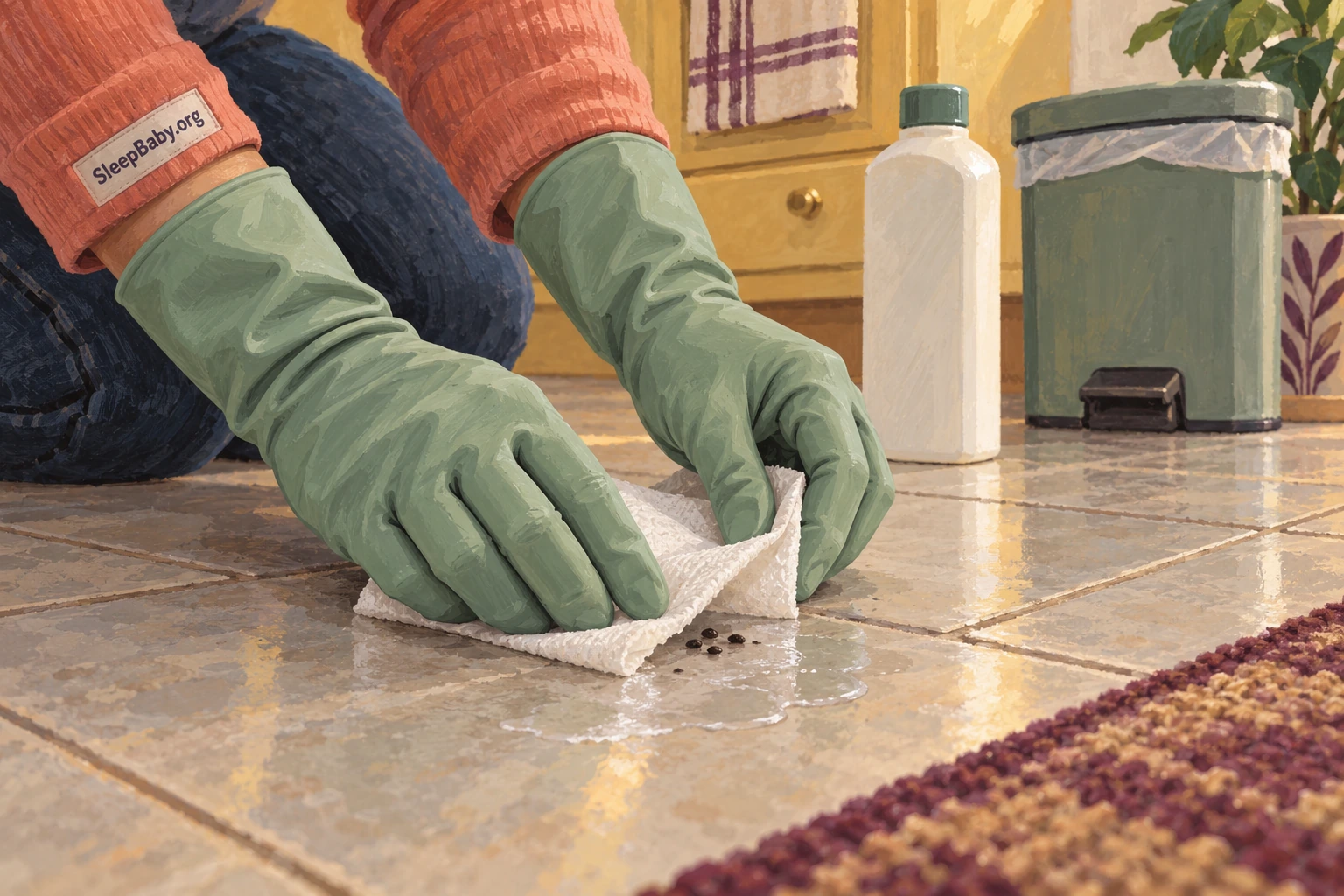
Once your baby’s immediate needs are addressed, keep the contaminated area out of bounds. This is an adult job. A quick pass with the vacuum is not the right shortcut: CDC says not to vacuum or sweep rodent urine, droppings, or nesting material, because that can put contaminated particles into the air.
- Put on rubber or plastic gloves.
- Wet the droppings and surrounding area thoroughly with an appropriate disinfectant. CDC advises soaking for five minutes or the time stated on the product label.
- Wipe up with paper towels and place the waste in a covered garbage container that is emptied regularly.
- Disinfect the hard surface. Follow the product’s directions for that surface, including any required rinse.
- Wash gloved hands before removing the gloves, then wash bare hands with soap and water.
Follow the label rather than improvising a stronger mixture. Heavy infestations and difficult-to-clean areas need additional precautions; contact the local health department or a qualified pest-control professional for guidance.
Keep the cleanup supplies from becoming a second exposure
Before beginning, decide where your baby will be and who is watching them. Keep the disinfectant, used towels, gloves, and waste inaccessible. An open doorway can become an invitation to crawl back in while an adult is looking for another towel.
I would finish one contained cleanup job before reopening the space. Follow the disinfectant label for ventilation, contact time, rinsing where required, and safe use around children. Put the product away when you finish. The goal is to remove contamination without leaving a new accessible hazard behind.
What about a blanket, toy, or pacifier?
Set a potentially contaminated item aside where your baby cannot reach it while you find the right cleaning instructions. CDC recommends hot water and detergent for contaminated washable bedding, clothing, and stuffed animals, followed by high-heat drying or drying in sunlight.
For an item that goes into your baby’s mouth, check its manufacturer’s cleaning guidance and ask your pediatrician or local health department if you are unsure it can be cleaned appropriately. Do not apply a floor-disinfectant method to a pacifier by guesswork. While you sort it out, an already-clean spare avoids rushing the decision.
Watch the CDC handwashing steps
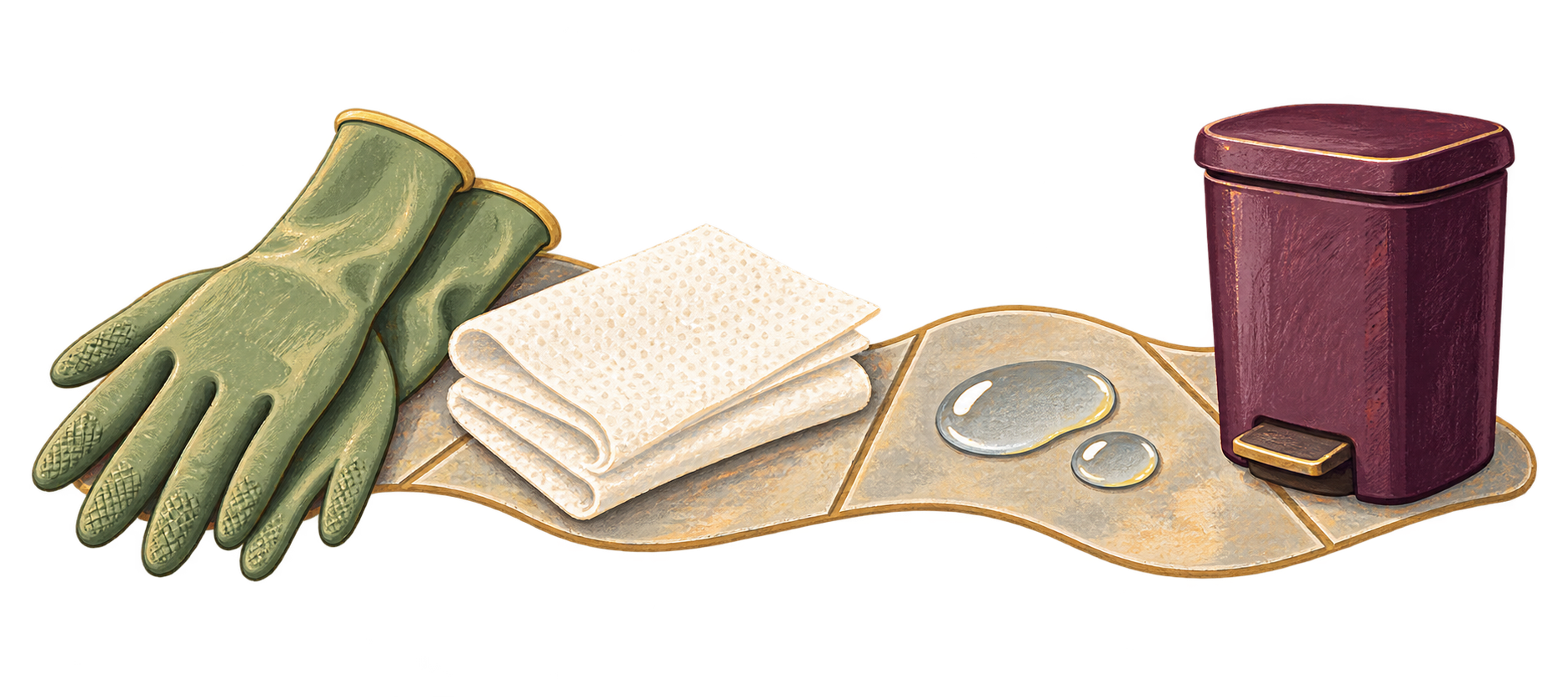
The CDC’s Fight Germs. Wash Your Hands! video is a useful demonstration for the adults handling care and cleanup. It covers handwashing, not an assessment of your baby’s exposure.
Written steps: Wet hands under clean running water and apply soap. Lather the backs of hands, between fingers, and under nails. Scrub for at least 20 seconds, rinse well, then dry with a clean towel or air dryer. Help your baby clean their hands safely. Wash your own after animal-waste contact, cleanup, and glove removal, and before preparing food.
If the player does not load, the CDC handwashing instructions provide the same basic steps in writing.
Find out how the droppings reached your baby’s space
Cleaning the spot is only part of the household work. Look at how rodents could reach food, water, or shelter and which part of the room your baby can access. A pantry corner, the gap around a pipe, and pet food left out overnight call for different changes.
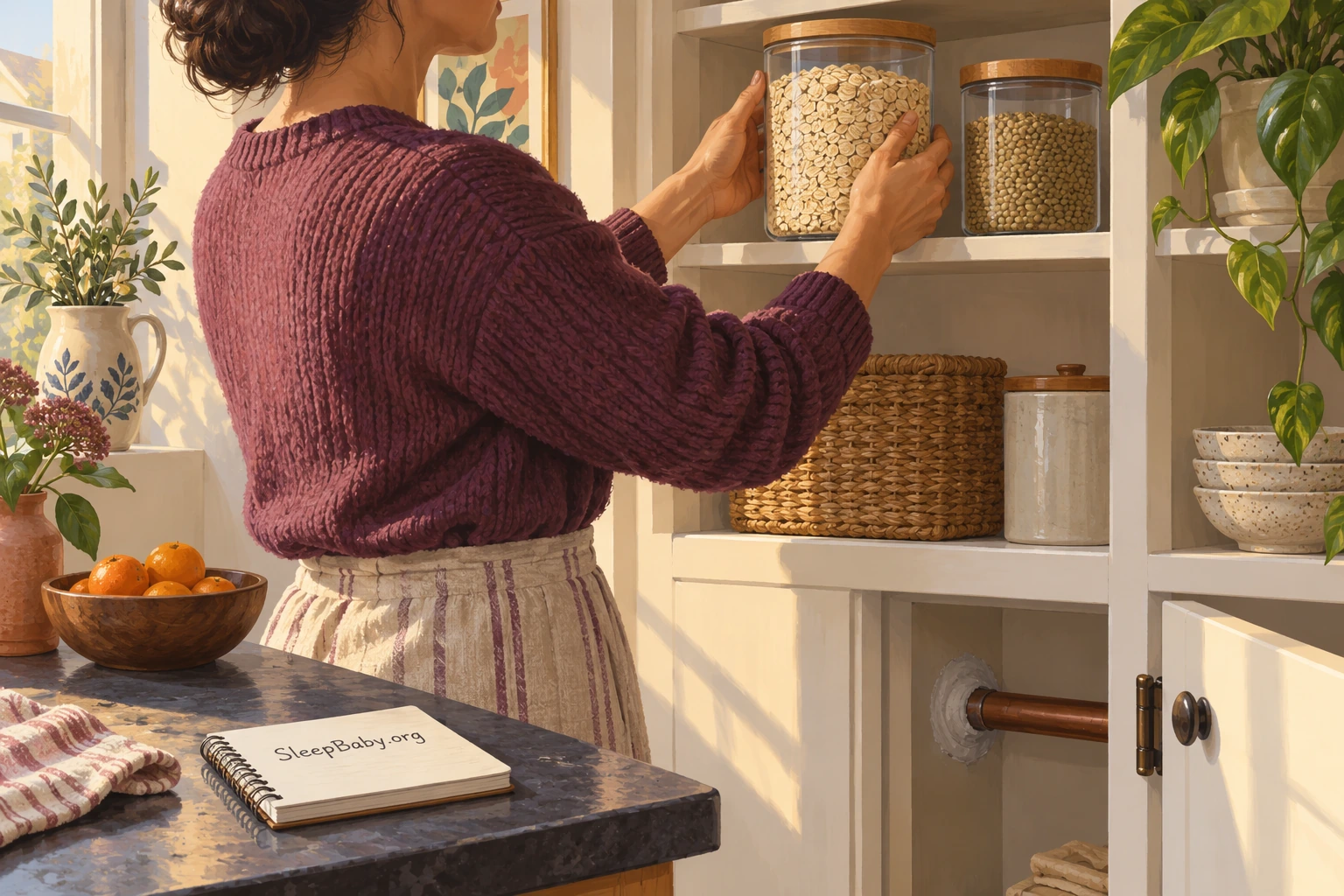
CDC recommends sealing entry gaps and keeping food in tightly lidded thick plastic, metal, or glass containers. Check around pipes, cabinets, doors, and other entry points. Put pet food away after use, clean up spills, and keep garbage contained. Ask a professional for help with inaccessible areas or an ongoing infestation.
Give each household action an owner: who will contact the landlord or pest professional, who will address the pantry, and who will check that the baby cannot return to the affected spot. “Someone should deal with this” is easy to lose during an unsettled evening.
If more droppings appear after cleanup, treat that as information about an unresolved rodent problem. CDC’s rodent-control guidance explains that new droppings can indicate active rodent presence. Keep the area restricted while the cause is addressed.
An optional container for the pantry reset
As an Amazon Associate, I earn from qualifying purchases.
If open bags of dry food are part of the household problem, one optional storage choice is the OXO Good Grips POP Big Square Medium container, 4.4-quart/4.2-liter size. OXO describes a push-button lid seal for dry foods such as rice, sugar, pasta, and flour.
The useful job here is putting clean, uncontaminated pantry food into a closed container. This is not a rodent-proofing guarantee, a way to rescue contaminated food, or something your baby needs before you call for medical advice. A container does not replace closing entry gaps or addressing an infestation.
Already-owned alternative: use an intact thick plastic, metal, or glass food container with a tight-fitting lid that you already have. Choose a size that fits your shelf and food supply; you do not need a matching set to start.
Leave the next caregiver a clear handoff
A second adult should not have to reconstruct the event from a worried text message. Share the original exposure note and the actual advice you received, including any overnight instructions. Then tell them which area or belongings are still off limits.
A two-part note to copy
For the baby: What happened and when; what was seen versus uncertain; current symptoms; who advised us and when; exact care instructions; what changes mean we should call again.
For the room: Which area stays closed; what has been cleaned; items still set aside; where cleanup supplies are secured; who is handling the remaining rodent-control work.
Before changing shifts: Make sure both adults know where the note and contact number are. Update the note when the advice changes.

What about the next nap or bedtime?
Ask the professional who assessed the exposure what sleep and observation should look like for your baby. An article cannot tell you that sleep means your baby is fine, or that a particular number of symptom-free hours gives clearance. Unusual drowsiness and difficulty waking are different from an ordinary scheduled nap.
Keep any medical instructions separate from the usual bedtime routine so they do not get lost in a checklist about pajamas or lights. If a familiar sleep space is contaminated, keep your baby out of it and arrange an appropriate clean sleep space while the problem is addressed.
For ordinary infant sleep, NICHD recommends placing babies on their backs on a firm, flat, level sleep surface in a safety-approved crib, bassinet, or play yard, with only a fitted sheet. Keep pillows, blankets, and toys out. A scare is not a reason to improvise a soft sleep spot on the sofa.
I would keep the evening’s decisions small: follow the care plan, keep the affected room unavailable, and make sure the next adult knows both. You can return to ordinary sleep planning when it fits the guidance you have been given.
CARE FIRST. HOUSEHOLD FOLLOW-UP NEXT.
Keep the next step clear for everyone
Call about the exposure, write down the advice, and keep your baby away from the affected area while an adult addresses it. A shared care note and a clear room plan can keep those two jobs from getting mixed up.
When ordinary sleep planning is appropriate, the free SleepBaby.org preview offers a starting step. The optional Workshop can support that separate planning work, without changing the medical instructions.
Sources
- Poison Control: Feces
- Poison Control: First aid
- Poison Control: What to have ready for a call
- CDC: Cleaning up after rodents
- CDC: Rat-bite fever
- CDC: Hantavirus
- American Academy of Pediatrics: Fever and your baby
- NHS: Dehydration
- CDC: Handwashing
- CDC: Sealing entry points and food storage
- CDC: Rodent control
- OXO: POP Big Square Medium specifications
- NICHD: Safe infant sleep
SleepBaby.org · The original video
A next step for
the next bedtime.
Still thinking about sleep? Watch the presentation here, then explore the SleepBaby program whenever you’re ready.
What viewers said10 comments · 4 replies
Archived comments from the original Baby Sleep Miracle presentation. Not independently verified by SleepBaby.org; individual experiences vary.
Thank you so much for this video! I had no idea about the dangers of baby swings :O
Hi Mary-Ann. I have a question: Is method in any way similar to the ones recommended by Dr Bucknam, Dr. Weissbluth or Dr. Karp? We tried those but none of them help.
Hi Regina, thank you for your question. The short answer is no. The techniques I share in my guide are based on newest scientific research and this is why I have never seen any approach similar to the one I recommend.
This method really works! I tried it on my son Jesus and after just one week he went from waking up more than 5 times a night to waking up just once or twice. You are a lifesaver, Mary-Ann!
I'm truly impressed with how much information you share in your video. And all for free! I can feel that you truly care about mothers like myself, and that's hard to find these days. I have recommended your site to several of my friends already.
Mary-Ann, our child suffers from autism. Is your approach still suited?
Chloe, I made sure my method can be used with any child, even babies who are special like yours. Please note that I'm not a doctor and that I always advice to consult with your physician because nothing is more important than the safety and well-being of your love.
Hallo Mary-Ann, I'm from Germany. Do you have your guide in German?
Hello Heide, we do! Normally you should already see our video in German. If not, please contact our support so they can guide you
Thenk you for your answer, Mary-Ann!
I just completed your approach and I have to say, it worked almost too well. Yes, it took a bit of getting used to with your bedtime routine but the difference is huge. My son George used to take 1 hours to go down and now he's firmly asleep in no more than 10 minutes! You're the best!
It seems I'm the only man watching this video, lol! What you shared about the 'emotional backpack' made immediate sense to me and I can't wait to help my little girl Mila to unpack it!
Hey there, just discovered your site and this really sounds different. Just wanted to say thanks for sharing :)
For everyone who's still thinking about getting Mary-Ann's guide I want to advise you to go ahead. I wasn't sure myself but now I'm so thankful I invested in this program. It made a huge difference in our life as a family and yes, my baby girl does sleep through the night now.
Ready to get started?Take the next step with SleepBaby.
Pick your price



Thank you so much for this video! I had no idea about the dangers of baby swings :O