
If your baby ate nystatin cream, remove the tube, gently wipe visible cream from their mouth, and call U.S. Poison Control at 1-800-222-1222 now. Have the actual tube or pharmacy label with you. Do not make your baby vomit. If they have trouble breathing, collapse, have a seizure, or cannot be awakened, call 911 first. A small taste of an antifungal cream often causes little harm, but the full formula, amount, baby’s age, and symptoms determine the advice. Nystatin skin cream is not the same product as nystatin oral medicine.
Outside the United States, contact your local poison information service or emergency number. You do not need to know the exact amount before calling. MedlinePlus specifically directs people to Poison Control when topical nystatin is swallowed.
Start with your baby, then read the tube
- Look at breathing and responsiveness. Emergency symptoms take priority over finding a label.
- Stop further contact. Move the cream out of reach. Wipe away easily reached cream; do not put a finger deep into the mouth.
- Keep the tube and cap. Check whether the cap or a piece of packaging is missing, as well as whether cream may have been swallowed.
- Call with the full name. Read every active ingredient, not just the first word on the tube.
I would keep the product in my hand for that call, rather than search for a picture of a similar tube. Two creams can share the word “nystatin” and still need different advice.
Is nystatin cream poisonous if swallowed?
Poison Control explains that small amounts of creams containing antifungal medicines probably will not cause harm, while emphasizing that they are still medicines. Larger amounts of some diaper creams can cause stomach upset. That provides useful reassurance about many small exposures; it does not clear an unknown amount or a combination prescription for your baby.
Try to keep those two ideas together: a taste does not automatically mean a dangerous poisoning, and a cream prescribed for the skin is not automatically safe to eat. Call promptly rather than waiting to see whether symptoms develop.
The label for one Padagis nystatin cream listed on DailyMed specifies topical use and says it is not intended for oral use. Its information about absorption through intact skin describes the intended route. I would not use that statement to dismiss an accidental swallowing incident.

The full name matters: plain, combination, or compounded
Nystatin treats fungal infections. A nystatin-only cream contains that active medicine in a cream base. A combination product adds another active medicine, and a pharmacy-compounded preparation may have a formula that is not obvious from the container’s front.
For example, nystatin and triamcinolone acetonide cream includes a corticosteroid. Other formulations can include different medicines; the NHS nystatin overview describes creams mixed with steroids, antiseptics, or antibacterials. Those examples are a reason to read the whole label, not a prediction that every combination will cause serious harm.
Read these three parts of the label
- Product and form: cream, ointment, powder, or oral suspension. Keep the pharmacy sticker and original box if you have them.
- Every active ingredient and strength: include words after “and,” plus numbers and units exactly as printed.
- Who supplied it: the manufacturer or dispensing pharmacy. For a compounded cream, the pharmacy may need to confirm the complete formula.
A strength on the tube is not the amount your child swallowed. Read it to the specialist; do not try to turn it into a home dose calculation.
For instance, a label may express nystatin in units per gram while another ingredient is expressed as a percentage. Neither the tube’s total weight nor a smear’s apparent size reliably tells you an ingested dose. If the label is damaged, photograph what remains and contact the dispensing pharmacy while following Poison Control’s advice.
Tell the specialist what actually happened
A baby licking a finger after touching treated skin is a different description from a toddler squeezing an open tube into their mouth. Report the event you saw. If you found cream on clothing and cannot tell whether any was swallowed, say that.
Have your baby’s age, approximate weight, the earliest and latest possible exposure times, and any symptoms ready. Mention other accessible products if the baby could have reached more than one medicine. Poison Control uses the product, amount, route, timing, and child’s details to decide what care is needed.
You can say: “The tube says nystatin cream. It also lists another ingredient. I found cream around her lips about ten minutes ago, but I did not see her swallow it.” An honest unknown is more useful than a confident guess.
For a baby under 6 months, use the phone. The webPOISONCONTROL online tool’s stated age range begins at 6 months. Calling also lets you explain an unreadable label, several possible products, or a confusing sequence directly.
CARE INSTRUCTIONS COME FIRST
Give the care plan room. The routine can wait.

The SleepBaby.org homepage describes the SleepBaby.org Method and its information about bedtime routines and baby sleep schedules.
After a cream exposure, the next step comes from Poison Control or your clinician. The Method does not assess medicines, replace observation instructions, or decide whether a sleepy baby is well.
If your later question is about arranging an ordinary evening, you can read about the current Method on the homepage. Follow any individual instructions about feeding, waking, checking symptoms, or seeking care before changing a routine.
What should I do while waiting for advice?
Keep your baby with you and stop further exposure. Gently remove visible cream from the lips and easily reached mouth area with a soft, damp cloth. Do not force a baby to rinse, pour water into their mouth, or sweep a finger where you cannot see. The American Academy of Pediatrics’ poison guidance advises removing remaining material and seeking poison advice.
Do not induce vomiting or give a home remedy to “neutralize” the medicine. Activated charcoal should not be used as a home poisoning treatment. Ask the specialist whether your baby can continue their normal milk feed and whether any other step is needed. Milk is not an antidote, and forcing a large feed is not a treatment.
If cream got into an eye, rinse promptly with room-temperature running water for 15–20 minutes and get advice. Wash unwanted cream off hands or skin so it cannot be transferred back to the mouth. Poison Control’s first-aid instructions distinguish swallowed, eye, and skin exposures. Do not delay emergency help to finish cleaning up.
Symptoms that change the next step
Call emergency services for breathing difficulty, collapse, a seizure, or inability to wake your baby. Sudden swelling of the mouth, lips, or tongue, or a baby becoming limp and unresponsive, can also indicate a serious allergic reaction. The NHS nystatin side-effect guidance identifies these as emergency signs.
Tell Poison Control promptly about vomiting, diarrhea, a new rash, persistent coughing, trouble swallowing, or behavior that is unusual for your baby. Repeated vomiting, inability to keep feeds down, or fewer wet diapers deserves prompt medical advice. Do not decide that vomiting is either harmless or inevitable just because the tube contains an antifungal.
If you already called and symptoms change, call back with the new information. The plan made for a well baby may need to change if the baby starts coughing or becomes unwell.
What if the tube cap is missing?
Tell the specialist. The medicine and its packaging create separate questions. A cap in the airway can cause choking, while a swallowed object can cause trouble farther along the swallowing passage.
For a responsive baby under 1 year who cannot breathe, cry, or cough effectively, summon emergency help and give cycles of up to five back blows followed by up to five chest thrusts. Do not give abdominal thrusts to an infant. If the baby becomes unresponsive, begin CPR following the dispatcher’s instructions. Encourage an effective cough and stay with the child; never do a blind finger sweep. The American Red Cross infant choking guide provides the written steps.
Normal breathing does not prove a cap has passed safely. Drooling, difficulty swallowing, chest or belly pain, or ongoing vomiting after a suspected swallowed object requires urgent assessment. See the Royal Children’s Hospital’s swallowed-object guidance. Do not try to push a cap down with food or drink.

Can my baby sleep after this?
Ask Poison Control or the clinician how to follow the care plan during nap or bedtime. There is no universal number of symptom-free minutes that makes every nystatin-containing cream exposure safe. Ask whether any checks are needed, how long to observe, and which changes require another call.
Make the handover specific
Write down who you spoke with, when you called, the full product name, and the instructions you received. Share that note with the next caregiver.
Include what would make you call back or seek urgent care. If an instruction about sleep or feeding is unclear, ask before guessing. A baby being unusually hard to wake is not reassurance that they are resting.
I would use the written care plan as the evening’s anchor. A missed nap can be dealt with later; the immediate task is making sure each adult knows what to do.
If the cream was on a breastfeeding parent’s skin
Explain exactly where the cream was applied and whether the baby licked it directly. Keep the tube available, including any added ingredients. Do not assume that guidance for medicine in breast milk also answers direct swallowing of a skin preparation.
The NHS advises keeping babies from touching skin treated with nystatin cream or ointment, washing hands after application, and washing it off breasts or nipples before a feed when it is being used there. Confirm the directions for your exact prescription. An accidental lick is a reason for product-specific advice, not a reason to make a permanent feeding change on your own.
Keep treatment and accidental exposure separate
If a clinician prescribed nystatin oral suspension for thrush, use that exact oral product as directed. Do not put skin cream inside your baby’s mouth, mix it into milk, or substitute it because the names look alike. If you used the wrong formulation or gave too much oral medicine, call with the product, amount, and timing; do not compensate with another dose.
After the exposure has been assessed, ask the prescriber or pharmacist about the next scheduled skin application, a damaged tube, or any concern about the rash itself. The exposure plan and the treatment plan answer different questions. I would not add extra cream to replace what was spilled, change the medicine, or continue a product that seems to be causing a reaction without checking.
A safer place for the tube between changes
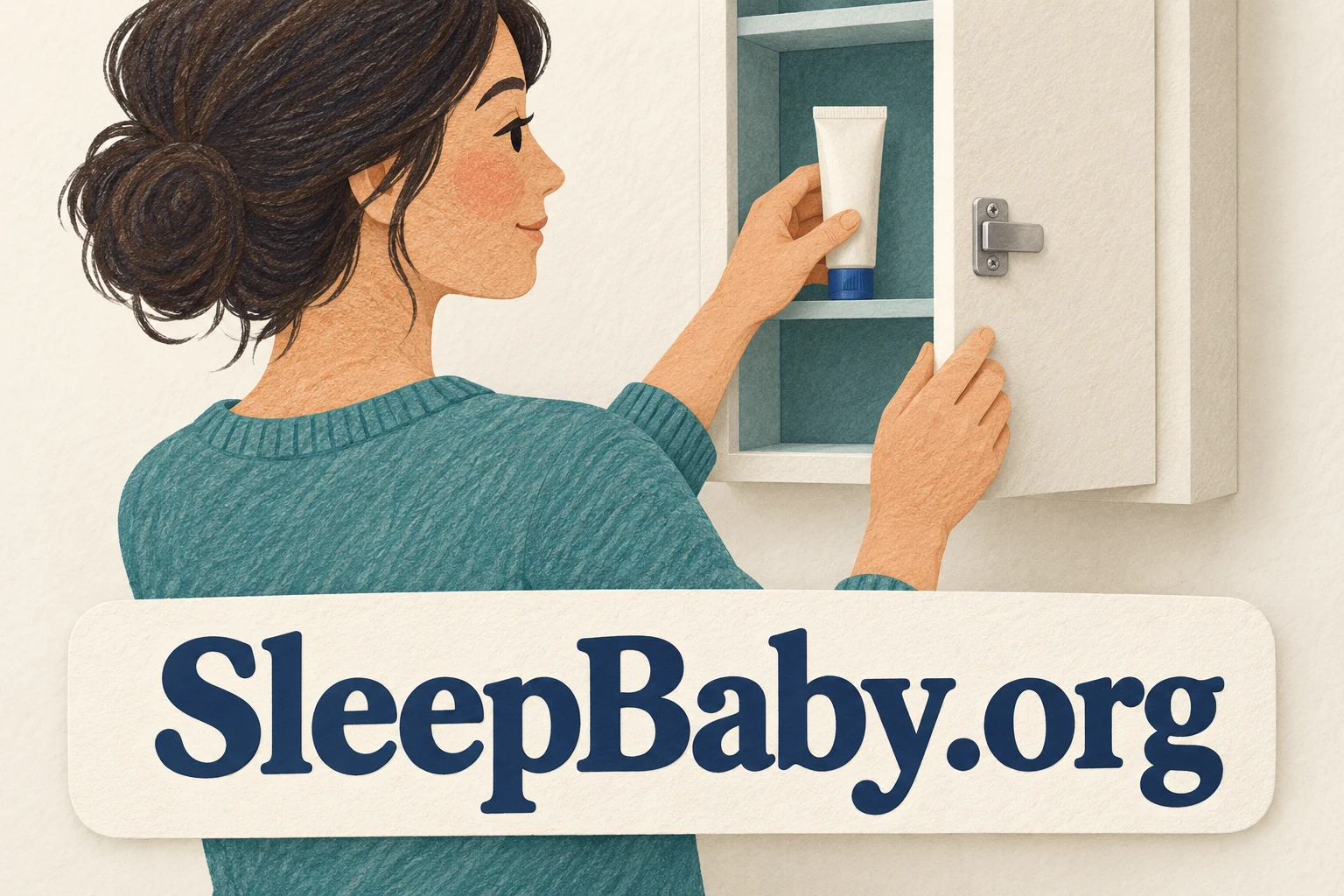
Store the cream in its original labelled container, tightly closed and out of sight and reach. Put it away after each application, even when another diaper change is not far off. The CDC’s Up and Away resources make this an every-use habit.
A changing basket can hold clean diapers and cloths without also being the medicine’s permanent home. Set up adult access to the supplies without leaving the baby alone on a raised surface. The AAP’s changing-table advice is clear: never leave a child unattended there, even with a strap.
Give other caregivers the same storage location and prescription directions. Ask visitors to keep medicine-containing bags inaccessible too. If leaving the tube out was your reminder to use it, a phone reminder can do that job while the medicine stays stored safely.
Optional storage help for a cupboard you already use
Safety 1st Secure to Explore Adhesive Magnetic Locks, 20 Locks & 2 Keys (HS402), may be useful if you need to secure several compatible cupboards or drawers. The manufacturer describes adhesive locks fitted inside most cabinets and drawers, opened with a magnetic key.
Check the exact fit and installation directions, keep the key inaccessible, and check the lock regularly. These locks do not make every cupboard suitable for medicine storage. Keep the cream in its original container and follow its storage instructions. I have not personally tested this product, and no lock replaces safe placement or adult care.
Try the no-purchase fix first: use an existing secure, inaccessible storage space and put the tube back after every application. A large lock set may be unnecessary for one cream. Deal with the ingestion and care plan before considering a purchase.
For later: Simple Steps to Safe Medicine Storage
Safe Kids Worldwide’s video covers medicine storage around children. It supports the prevention step after this incident; it does not assess a nystatin dose or tell you whether your baby needs care.
Written fallback: keep medicine out of reach and sight, secure child-resistant closures, and use a reminder instead of leaving medicine on a counter. Save Poison Help’s number for every caregiver. The official Safe Kids page supplies these written tips and identifies the video. Call for exposure advice first; the video can wait.
One clear next step beats another search
Keep your baby close, the tube out of reach, and the full label ready for Poison Control. You do not have to identify every ingredient or prove the swallowed amount yourself. Once you have individual advice, write it down and make the next handover easy.
Sources
- MedlinePlus: topical nystatin
- DailyMed: Padagis nystatin cream label
- DailyMed: nystatin and triamcinolone acetonide cream
- Poison Control: diaper rash products
- Poison Control: immediate assistance and online-tool limits
- NHS: about nystatin
- NHS: nystatin side effects
- NHS: nystatin and breastfeeding
- AAP: changing-table safety
- CDC: Up and Away medication-safety resources
- Safe Kids Worldwide: medicine storage and prevention videos
- Poison Control: first aid
- Poison Control: getting help
- Poison Control: activated charcoal
- American Red Cross: infant choking
- Royal Children's Hospital: swallowed objects
- AAP: poison prevention and treatment
- Safety 1st: adhesive magnetic cabinet locks
KEEP THE FULL LABEL CLOSE
Make the call with the actual tube.
Get advice for your baby and that exact formula, then keep the instructions together. For a separate, later question about everyday bedtime routines and baby sleep schedules, visit the SleepBaby.org homepage to read about the current Method.






What viewers said10 comments · 4 replies+
Archived comments from the original Baby Sleep Miracle presentation. Not independently verified by SleepBaby.org; individual experiences vary.
Thank you so much for this video! I had no idea about the dangers of baby swings :O
Hi Mary-Ann. I have a question: Is method in any way similar to the ones recommended by Dr Bucknam, Dr. Weissbluth or Dr. Karp? We tried those but none of them help.
Hi Regina, thank you for your question. The short answer is no. The techniques I share in my guide are based on newest scientific research and this is why I have never seen any approach similar to the one I recommend.
This method really works! I tried it on my son Jesus and after just one week he went from waking up more than 5 times a night to waking up just once or twice. You are a lifesaver, Mary-Ann!
I'm truly impressed with how much information you share in your video. And all for free! I can feel that you truly care about mothers like myself, and that's hard to find these days. I have recommended your site to several of my friends already.
Mary-Ann, our child suffers from autism. Is your approach still suited?
Chloe, I made sure my method can be used with any child, even babies who are special like yours. Please note that I'm not a doctor and that I always advice to consult with your physician because nothing is more important than the safety and well-being of your love.
Hallo Mary-Ann, I'm from Germany. Do you have your guide in German?
Hello Heide, we do! Normally you should already see our video in German. If not, please contact our support so they can guide you
Thenk you for your answer, Mary-Ann!
I just completed your approach and I have to say, it worked almost too well. Yes, it took a bit of getting used to with your bedtime routine but the difference is huge. My son George used to take 1 hours to go down and now he's firmly asleep in no more than 10 minutes! You're the best!
It seems I'm the only man watching this video, lol! What you shared about the 'emotional backpack' made immediate sense to me and I can't wait to help my little girl Mila to unpack it!
Hey there, just discovered your site and this really sounds different. Just wanted to say thanks for sharing :)
For everyone who's still thinking about getting Mary-Ann's guide I want to advise you to go ahead. I wasn't sure myself but now I'm so thankful I invested in this program. It made a huge difference in our life as a family and yes, my baby girl does sleep through the night now.