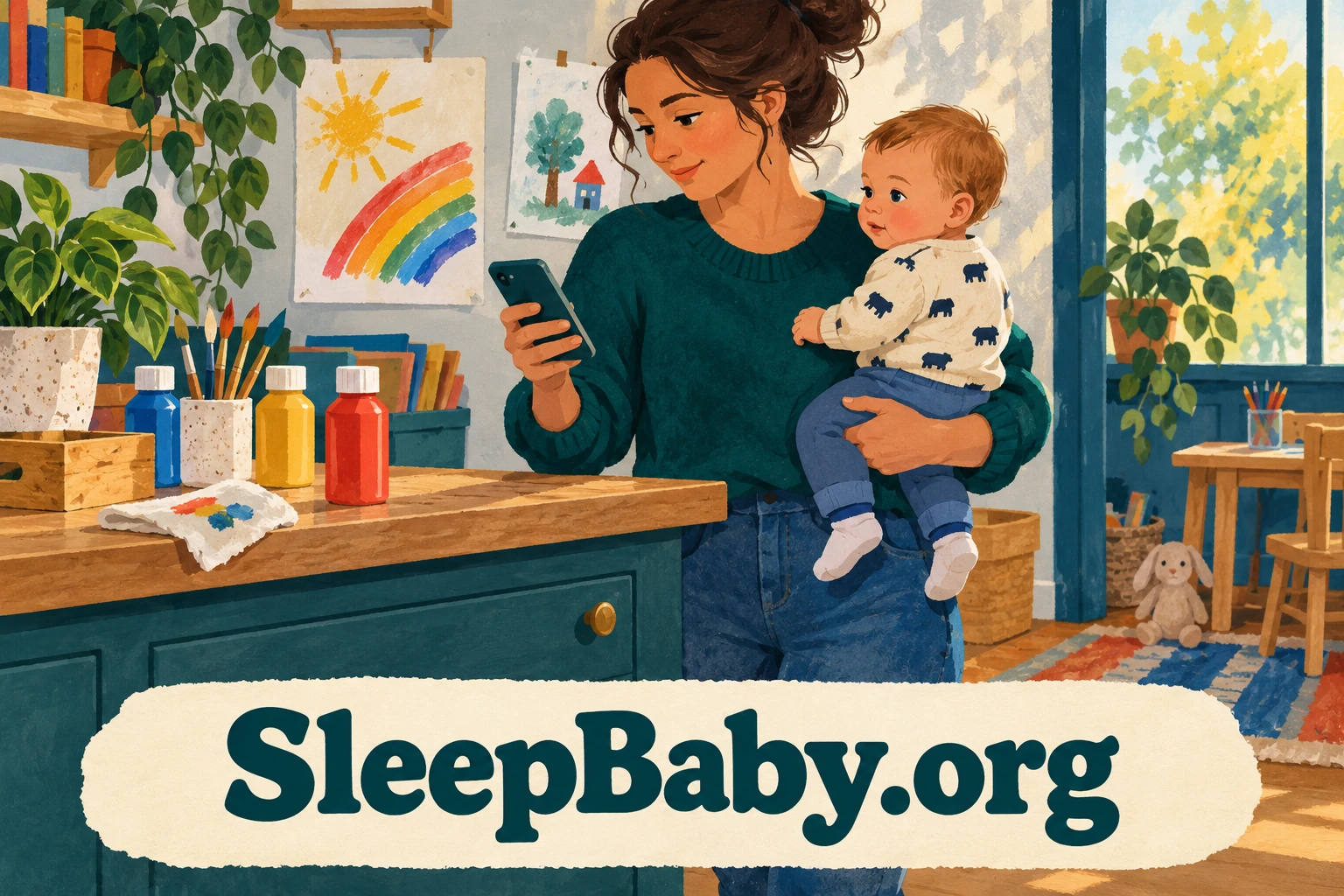
If your baby tasted a small amount of known, water-based children’s paint, serious poisoning is unlikely, but the label alone isn’t an all-clear. Move the paint away, gently wipe visible paint from the mouth, and call U.S. Poison Control at 1-800-222-1222 with the container beside you. Don’t make your baby vomit. If your baby has trouble breathing, collapses, has a seizure, or can’t be awakened, call 911 immediately.
I would check the actual bottle before assuming that “washable,” “acrylic” or “non-toxic” tells the whole story. A brush lick, a mouthful of brush water and a chip from an old windowsill are different exposures. The guidance below helps you describe what happened and follow the right advice. Outside the U.S., contact your local poison service or emergency number.
Start with your baby, then the bottle
- Look at breathing and responsiveness. Emergency symptoms come before label research or cleanup.
- Stop further contact. Put the paint and brush beyond reach. For visible paint around the lips or mouth, use a damp cloth gently; don’t push fingers deep into the mouth.
- Get product-specific help. Call with the container, your baby’s age, what you saw and when it happened. Ask before giving anything if swallowing seems difficult or your baby isn’t fully alert.
A paint cap or dry chunk can also cause choking. If your baby cannot breathe, cry or cough effectively, call emergency services and follow the dispatcher’s infant-choking instructions. Don’t wait for a video or sweep blindly inside the mouth.
Poison Control first aid · Missouri Poison Center paint guidance · NHS choking guidance
What “non-toxic” does and doesn’t tell you
Many water-based art paints cause little or no illness after a small accidental taste. Some can irritate the mouth or upset the stomach, particularly when more is swallowed. That is different from saying that paint is food or that every product with the same color is interchangeable. Poison Control’s art-material guidance makes the distinction between common water-based products and paints containing solvents.
Look for the complete product name, intended age and directions. An ACMI AP seal identifies art materials evaluated for toxicological safety; the CL seal indicates cautionary labeling and is not for young children’s supplies. Neither means that you should offer the paint to eat. ACMI describes its certifications in the context of appropriate use. Read ACMI’s explanation of the seals.
“Washable” is a cleanup feature. “White” is a color. Neither settles an ingestion question. And I wouldn’t use a photo of a similar bottle online to fill in a missing label. The product actually involved is the one the specialist needs.
THE LABEL LADDER
Three details before a guess
- 1. The container
- Brand, exact paint type, label directions and any warning. Keep the bottle or photograph all sides if someone else has it.
- 2. The contact
- A lick of wet paint? A swallowed dry flake? Brush water? Paint in an eye? Say which happened, including anything mixed into it.
- 3. The child
- Age, approximate weight if known, time of contact and current symptoms. Say what you don’t know instead of inventing an amount.
This is a way to organize a call, not a home toxicity test. Poison Control’s assessment uses these exposure details.
Which kind of paint was involved?
A labeled children’s water-based paint
A small taste of tempera, poster paint or another identified children’s water-based product is often a low-risk event. Follow the advice for the exact product and amount. An otherwise normal-looking baby and a reassuring label are useful information for the call; neither gives you a reason to conceal a symptom or estimate more confidently than you can.
Acrylic or latex paint
These names cover different uses. Water-based acrylic craft paint and water-based household latex paint may cause irritation or stomach upset if swallowed. Ingredients vary, and some products contain additional ingredients such as mold inhibitors. Read the full label rather than treating “acrylic” as a recipe. Dry latex pieces can present a choking risk even when the paint itself has low toxicity. Poison Control explains indoor paint exposures.
Oil-based paint, varnish, thinner or an unidentified mixture
Call Poison Control promptly. Products containing solvents need a different assessment; some can injure the lungs if they enter the airway during swallowing or vomiting. Coughing after this kind of exposure matters even if only a little seems missing. Don’t induce vomiting or try to neutralize the product with a kitchen remedy. Breathing difficulty is an emergency. Read the paint, varnish and lacquer guidance.
A chip from a wall, windowsill, crib or older painted object
Don’t apply a children’s-paint label to an unknown old coating. In the U.S., homes built before 1978 can present a lead-paint exposure risk. Lead exposure can occur without obvious symptoms; ask your baby’s clinician about whether blood testing is needed. Looking well today does not answer that question. Keep your baby away from the damaged surface while you arrange advice. CDC explains lead testing.
What to say when you don’t know how much
You don’t need a perfect reconstruction to call. “I saw a wet brush at her lips, but I didn’t see her swallow” is more useful than an unsupported teaspoon estimate. Mention whether paint is missing from the pot, on clothing or spread over the floor, while making clear that a spill isn’t the same as an amount swallowed.
For brush water, tell the specialist everything that may have been in the cup: the paint, water, any brush cleaner or another product. A cloudy cup doesn’t tell you its ingredients. Save the container safely out of reach and follow the specialist’s directions about what to keep.
For a baby under six months, phone Poison Control rather than using its online assessment tool. The tool also has limits for exposures involving multiple substances and other circumstances. Calling is reasonable at any age when the label or situation is unclear. Poison Control lists when to use the phone service.
AFTER YOU HAVE AN EXPOSURE PLAN
Put the paint away. Keep the advice close.
The SleepBaby.org homepage describes the SleepBaby.org Method and its information about bedtime routines and baby sleep schedules.
A paint scare can leave you studying every yawn. Before you think about an evening routine, get the product-specific advice, ask what observation is needed, and write down what would mean calling back. I would keep that note where the next caregiver can find it, even after the art supplies are packed away.
When the exposure questions have been addressed, you may still have ordinary questions about how your evenings work: when to begin the routine, how to share it, or what you want to understand about a sleep schedule. Explore the current Method with those questions in mind, and decide whether its information fits your family.
Sleep information does not treat a paint exposure, establish that a baby is safe, or replace instructions about monitoring. Your poison specialist or clinician's plan stays in charge of this incident. The bedtime conversation can wait until then.
Should I give water, milk or a snack?
Advice for a known water-based paint may include a small drink to clear the taste. Missouri Poison Center includes water in its paint guidance. But that isn’t an instruction to force a bottle, give a large volume, or offer a snack to a baby who isn’t eating solids. Tell the specialist your baby’s age and usual feeding, and ask what, if anything, to give.
Don’t give anything by mouth to a child who is unconscious, having seizures or unable to swallow safely. For irritating swallowed substances, Poison Control limits its small-water-or-milk advice to someone conscious and able to swallow. Don’t use salt water, induced vomiting or a homemade “detox.” The goal is a safe response to a known exposure, not washing an unknown substance through.
Paint-specific first steps · General first-aid restrictions
Paint on skin or in an eye needs its own response
For ordinary water-based paint on skin, use soap and lukewarm water. Skip paint thinner and other harsh chemicals, even if a stubborn spot remains. Tell the poison specialist if irritation persists. Missouri Poison Center specifically warns against harsh skin-cleanup chemicals.
For paint splashed in an eye, start gentle irrigation with room-temperature running water immediately and get poison-center guidance. Poison Control advises rinsing for 15–20 minutes. Have another adult call if available; don’t delay rinsing to search for the bottle. Follow further advice about persistent pain, redness or trouble seeing. Eye exposure first aid
Turn “keep an eye on them” into a clear plan
Before ending the call, I would write down these answers:
- What effects, if any, are expected from this product?
- Which change means another call, and which means emergency help?
- How long should we observe, and what should we do if nap time arrives?
- Can usual feeding continue? Is any follow-up needed?
Keep the advice with the product name and time of exposure. Add the time of any symptom or callback. This note helps the next adult follow the same instructions; it does not create a monitoring schedule of its own.
What symptoms should change the plan?
Some water-based paint exposures cause an upset stomach, nausea or vomiting. Contact Poison Control if symptoms start or you have questions about whether the current plan still fits. Don’t assume a new cough belongs to a cold, or that vomiting proves all the paint has come back up. Describe the change and let the specialist reassess it.
The emergency signs at the top of this page still apply. If a solid piece is involved, a loud effective cough is different from an infant who cannot cough or cry. The NHS advises encouraging an effective cough while watching closely; an ineffective cough or inability to breathe requires immediate choking first aid. Techniques differ for babies under one year and older children. Use age-appropriate choking guidance.
I wouldn’t choose an arbitrary “two hours and we’re done” rule. The amount, ingredients and route of exposure are exactly why the advice needs to be specific. If you later find a different bottle or remember that cleaner was mixed in, call back with that correction.

Can my baby sleep afterward?
Ask this during the poison-control call, especially if a nap is already due. Tell the specialist whether your baby is behaving normally and ask what observation is needed through the next sleep. Don’t use sleep as a test of whether the exposure was harmless, and don’t interpret unusual difficulty waking as simply a long nap.
When your care plan permits ordinary sleep, keep the usual safe setup: baby on their back on a firm, flat infant sleep surface, with a fitted sheet and no pillows, loose blankets or soft objects. Don’t prop the mattress or put your baby in a swing to manage a paint exposure. NIH Safe to Sleep describes the recommended sleep environment.
If another adult takes over, pass on the note rather than just saying, “It was non-toxic.” The difference is practical: the next person knows which paint it was, what advice you received and what change would matter.

Reset the art area before the next activity
Keep paints and related chemicals in their original containers, locked away from children. Put the supplies away when you’re interrupted as well as when you’re finished. A high shelf helps separate the activity from a crawling baby, but it isn’t a substitute for secure storage. Texas Poison Center Network recommends locked storage and original packaging.
My cleanup check would include the brush-water cup, the cloth that still has wet paint on it, and any loose caps under the table. Those are easy to overlook when the obvious mess is on paper. Have older siblings paint in a separate supervised space, then finish the reset before the baby returns to it.
Read age guidance on art supplies and wash hands and the work area after use. Don’t assume ordinary craft paint is suitable for face painting or decorating food. Choose a product specifically labeled for that purpose. Poison Control’s art-safety advice covers these distinctions.

A paint-label example for an older sibling
If you need paint for an age-appropriate older child’s supervised project, Crayola Washable Project Paint, 6 Count, item 541204 is an example with a manufacturer’s label you can check. Crayola describes it as water-based, non-toxic and washable, and recommends it for ages three and up. That is not a recommendation to give it to a baby or let a child taste it.
I’ve used the manufacturer’s product information for this comparison, not a personal product test. Check the current package for the exact product you have. Read Crayola’s product and age information.
No purchase is needed to respond to today’s exposure. For now, pack away the paint and choose an already-owned age-appropriate toy or a book to share with your baby. Older children can use existing suitable supplies in their own supervised space.
Disclosure: This section contains no affiliate purchase link. As an Amazon Associate, SleepBaby.org earns from qualifying purchases through affiliate links elsewhere on the site.
For later learning: infant choking first aid
This American Red Cross video is relevant to a paint cap or solid piece that blocks an infant’s airway. It does not assess paint toxicity. In an emergency, call for help and follow the dispatcher; don’t stop to watch.
Written takeaway: An infant who cannot cough, cry or breathe needs immediate help. Infant first aid uses back blows and chest thrusts, with the head and neck supported; do not use abdominal thrusts on a baby under one year. Follow emergency-dispatch instructions and learn the full technique from an accredited course.
Read the Red Cross infant choking instructions. The written instructions remain available if the video won’t play.
Questions that often come up after the first call
Is there a safe amount of non-toxic paint for a baby to swallow?
There isn’t a useful universal number for all paints and babies. Give the product and your best description of the contact to Poison Control. “A lick” and “an unknown amount from an open pot” are worth distinguishing, even when you can’t measure either.
Does a paint-colored diaper mean everything has passed?
Paint pigment may color stool after some exposures, but a diaper cannot confirm that an exposure is resolved. Keep following the plan you were given. If you’re uncertain whether a color is pigment or something else, describe it to the clinician rather than using it as an all-clear.
What if the paint was homemade?
Give the actual ingredient list and any uncertain amounts when you call. “Homemade” doesn’t identify what went into the mixture. I would photograph the recipe and the ingredients used rather than treating the project name as a safety claim.
Do I need the emergency department if my baby looks fine?
The poison specialist can help decide the right level of care for the exposure. The phone call is useful precisely because you shouldn’t have to choose between automatic reassurance and an automatic hospital trip from a label alone. Any emergency symptom changes that decision immediately.
Sources
- Poison Control: Safe use of art products
- Missouri Poison Center: Paint
- Poison Control: First aid for poisonings
- Poison Control: Get help online or by phone
- Poison Control: Help and FAQs
- Poison Control: Paints for indoor use
- Poison Control: Paint, varnish and lacquers
- ACMI: Art material safety and certification seals
- CDC: Testing for lead poisoning in children
- NHS: How to stop a child from choking
- NIH Safe to Sleep: Reduce baby's risk
- Crayola: Washable Project Paint, 6 Count
- Texas Poison Center Network: Prevention
- American Red Cross: Infant choking first aid
A CLEAR NEXT STEP
Keep the label. Follow the plan.
For this incident, use the advice given for the exact paint and your baby. For separate questions about ordinary routines and baby sleep schedules, you can read about the SleepBaby.org Method on the homepage when you're ready.





What viewers said10 comments · 4 replies+
Archived comments from the original Baby Sleep Miracle presentation. Not independently verified by SleepBaby.org; individual experiences vary.
Thank you so much for this video! I had no idea about the dangers of baby swings :O
Hi Mary-Ann. I have a question: Is method in any way similar to the ones recommended by Dr Bucknam, Dr. Weissbluth or Dr. Karp? We tried those but none of them help.
Hi Regina, thank you for your question. The short answer is no. The techniques I share in my guide are based on newest scientific research and this is why I have never seen any approach similar to the one I recommend.
This method really works! I tried it on my son Jesus and after just one week he went from waking up more than 5 times a night to waking up just once or twice. You are a lifesaver, Mary-Ann!
I'm truly impressed with how much information you share in your video. And all for free! I can feel that you truly care about mothers like myself, and that's hard to find these days. I have recommended your site to several of my friends already.
Mary-Ann, our child suffers from autism. Is your approach still suited?
Chloe, I made sure my method can be used with any child, even babies who are special like yours. Please note that I'm not a doctor and that I always advice to consult with your physician because nothing is more important than the safety and well-being of your love.
Hallo Mary-Ann, I'm from Germany. Do you have your guide in German?
Hello Heide, we do! Normally you should already see our video in German. If not, please contact our support so they can guide you
Thenk you for your answer, Mary-Ann!
I just completed your approach and I have to say, it worked almost too well. Yes, it took a bit of getting used to with your bedtime routine but the difference is huge. My son George used to take 1 hours to go down and now he's firmly asleep in no more than 10 minutes! You're the best!
It seems I'm the only man watching this video, lol! What you shared about the 'emotional backpack' made immediate sense to me and I can't wait to help my little girl Mila to unpack it!
Hey there, just discovered your site and this really sounds different. Just wanted to say thanks for sharing :)
For everyone who's still thinking about getting Mary-Ann's guide I want to advise you to go ahead. I wasn't sure myself but now I'm so thankful I invested in this program. It made a huge difference in our life as a family and yes, my baby girl does sleep through the night now.