
If your baby may have swallowed melatonin, call Poison Control now at 1-800-222-1222 in the U.S., even if your baby seems fine. If your baby has trouble breathing, collapses, has a seizure or cannot be awakened, call 911 or your local emergency number immediately. Take the product away, keep the bottle or package for the call and do not make your baby vomit. Do not assume it is safe to let your baby “sleep it off.”
A bottle marked “sleep” can make this especially confusing. You may be trying to decide whether a sleepy baby is simply ready for a nap or reacting to something they swallowed. I would get a poison specialist involved before making that decision. You do not need to know the exact amount or prove that a swallow happened before calling.
The next step depends on your baby, not the bottle’s promise
- Call emergency services now for abnormal or difficult breathing, collapse, seizures or a baby you cannot wake. Follow the dispatcher’s instructions. Do not wait for a poison-center callback if these signs appear.
- Call Poison Control promptly for a suspected ingestion when your baby is awake and breathing normally. Report unusual drowsiness, vomiting, agitation or any other change right away.
- Keep the package. Read the exact product name, ingredients and strength to the specialist. “Melatonin” may be only one ingredient in a sleep product.
The American Academy of Pediatrics’ melatonin guidance and Poison Control first aid support these emergency priorities. Outside the U.S., use your local poison service and emergency number.

What to do while you get help
Move the bottle, loose pieces and any liquid out of reach. Stay with your baby. If another adult is present, ask them to collect the package while you make the call. The information matters, but searching for the missing lid should not delay help.
Do not force a baby to spit, reach blindly into the mouth or try to retrieve something from the throat. If there is severe choking, with an ineffective cough or inability to cry or breathe, call emergency services and begin age-appropriate choking first aid. For infants under 1, the Red Cross guide uses five back blows followed by five chest thrusts, not abdominal thrusts. If the baby becomes unresponsive, follow the dispatcher and your CPR training.
Gummies and tablets introduce a choking question as well as an ingestion question. A child who is breathing normally still needs the poison-center assessment; a child who is not breathing normally needs emergency help first.
If your baby is drowsy, choking or struggling to swallow, do not give food or drink. For other situations, ask Poison Control what is appropriate before offering something as a “remedy.” The AAP’s poisoning advice says to remove the substance and avoid inducing vomiting.
What Poison Control needs to know
The U.S. poison-center line is free, confidential and available 24 hours a day. It connects you with a specialist who can assess the product and situation. A call does not automatically mean an ambulance or hospital stay; it helps determine which response is appropriate.
Start with your baby’s age, how they are acting and what may have happened. Then have these details ready if you know them:
- The product: exact name, manufacturer and all listed active ingredients.
- The form: gummy, chewable tablet, capsule, liquid, dissolving tablet or another form. Mention “extended release” or similar wording if it appears.
- The strength and serving size: read the label as printed, including the units and how many gummies or tablets make one serving.
- The amount: what you actually saw swallowed or what you can establish is missing. If it is unknown, say “unknown.”
- The timing: when the product was last known to be out of reach, when you found it and when any symptoms started.
- Your baby: known weight, medical conditions, medicines, supplements and anything else they might have reached.
Do not guess the weight or turn a partly empty bottle into a confident swallowed amount. A specialist can work with uncertainty. Describe the evidence: “The lid was off, there were pieces on the floor, and I do not know how many were in the bottle earlier.”
Poison Control explains the questions it asks and why those details guide the recommendation. Bring the container if you are advised to seek in-person care.


Why the label needs a careful read
The largest number on the front may describe a serving rather than one piece. The back panel may define that serving as more than one gummy or tablet. For liquids, the amount of liquid and the amount of melatonin are different measurements. Read both to the specialist instead of doing hurried arithmetic while upset.
Keep different products separate in your description. An adult bottle, a children’s bottle and a product with a similar name can have different ingredients and concentrations. A familiar brand name does not identify the exact product.
Also read the full ingredient list of a “sleep blend.” Tell the specialist about other medicines, supplements or ingredients listed alongside melatonin. Do not use advice for a melatonin-only product to assess a mixed product or a possible second exposure.
The label is still valuable even though it is not a laboratory measurement. The National Center for Complementary and Integrative Health reports that studies have found differences between the stated and measured melatonin content of some supplements. That is another reason to avoid declaring a swallowed amount safe from the front label alone.
How much melatonin is too much for a baby?
There is no number in this article that can clear an accidental ingestion as safe. The National Capital Poison Center’s melatonin information explains that overdose is not well understood and a standard dose has not been established. A baby’s age, the exact product, symptoms and possible additional substances all affect the assessment.
A dose discussed for an older child’s clinician-directed sleep treatment is not an overdose threshold for an infant. Nor does “one gummy” mean the same amount across products. I would not use an online dose chart or another parent’s experience to decide whether to call.
If you are searching for “my baby ate 1 mg,” “5 mg” or “10 mg,” give that information to Poison Control together with the label and your baby’s details. Do not wait to find a matching story. The specialist needs the whole situation, including what you do not know.
The same applies when a caregiver accidentally gave an extra dose or used the wrong bottle. Explain what was intended, what was actually given and any earlier dose. An honest account is more useful than trying to make the numbers fit the original plan.
After the exposure has been assessed
Let the safety call come first. Give bedtime its own conversation.

For a separate look at bedtime routines and baby sleep schedules, the homepage introduces the SleepBaby.org Method.
A melatonin scare can leave you second-guessing every sleepy moment. I would follow the poison specialist’s instructions first and keep that plan separate from the ordinary question of how bedtime is going.
When the exposure has been addressed, you can visit the current SleepBaby.org homepage for information about routines and schedules. There is no need to make a sleep-program decision while you are working out what your baby swallowed.
The Method does not assess an ingestion, treat poisoning or decide whether your baby can sleep after an exposure. Those questions belong with Poison Control and your baby’s clinician.
Symptoms to report, and signs that cannot wait
Melatonin can cause drowsiness. The Missouri Poison Center also describes nausea, vomiting and, in some children, agitation or disorientation after excessive intake. Headache and dizziness are reported effects too, but a baby cannot describe those sensations to you.
Focus your report on what you can observe: your baby is less responsive than usual, unusually sleepy, vomiting, difficult to settle or behaving differently. Describe the change and when it began. Do not dismiss unusual sleepiness simply because melatonin is sold to promote sleep.
Abnormal breathing, collapse, a seizure or inability to wake your baby is an emergency. Call 911 or your local emergency number. The fact that many melatonin exposures have mild outcomes cannot rule out a serious situation in the baby in front of you.
If a new symptom develops while you are following a home-observation plan, follow the return-call instructions you were given. When you are unsure whether a change fits that plan, call again. You are reporting new information, not bothering the person who helped you.
Do not wait for symptoms before making the first call after a suspected ingestion. An open bottle and an uncertain amount are enough reason to ask for guidance.
Can I let my baby sleep after swallowing melatonin?
This needs an individual answer from Poison Control or your baby’s clinician. Ordinary nap advice does not apply until the exposure has been assessed. Do not put your baby down and assume a long sleep will solve the problem.
Ask directly: “Can my baby sleep now? How should I check them? What response do you expect when I try to wake them? How long do I follow these instructions?” Write down the answer, including whom to call if you are worried.
General melatonin pages may describe observation for people of many ages. I would not turn a general interval or an adult recovery story into an infant monitoring plan. Your baby may need different advice because of their age, symptoms or the product involved.
Stay available to observe your baby as instructed. A baby monitor does not replace the assessment or the checks a clinician requests. If your baby will not fully awaken or breathing is not normal, seek emergency help rather than waiting for the next planned check.
If the clinician says ordinary sleep is appropriate, continue the usual safe sleep setup: on the back, on a firm, flat, level infant sleep surface, with only a fitted sheet and no loose bedding or toys. NICHD’s safe sleep guidance explains the environment. Do not add pillows, an incline or a different sleep position to try to counteract melatonin.
How long will the effects last?
Poison Control notes that melatonin-related drowsiness can last for several hours. That is background information, not a countdown after which every baby is safe. The product’s formulation and the individual situation matter.
Tell the specialist if the package says extended release. Ask what time frame they expect for your baby and whether another call is planned. If the time of ingestion is uncertain, give the range you actually know instead of choosing a convenient starting point.
Do not use an internet “half-life” calculation to decide when observation can stop. A number about how the body processes a substance does not replace seeing how your baby is doing or following the poison specialist’s plan.
If your baby remains unusually sleepy, begins vomiting or develops another concerning change, get further advice even if a suggested time window has passed. Symptoms and professional instructions take priority over the clock.

Do not try to cancel out the melatonin at home
There is no specific antidote for melatonin overdose, according to Poison Control. That does not mean there is nothing a clinician can do; it means you should not try to invent an antidote in the kitchen.
- Do not make your baby vomit. Skip gagging, salt water and syrup of ipecac.
- Do not give caffeine or another medicine to try to make your baby more alert. Tell the specialist about anything already given.
- Do not force extra water, milk or food to “flush it out.” Ask what to do about the next feed, especially if your baby is sleepy or has been vomiting.
- Do not give more melatonin because your baby seems unsettled, vomited or did not fall asleep. Report what happened and get instructions.
I would keep the response simple: remove access, make the call, follow the plan. A remedy suggested in a comment thread can make the situation harder to assess and may introduce another exposure.
Bottle. Baby. Time. Plan.
When more than one adult is involved, use these four headings for a short handoff note. They help preserve the advice without turning you into the person responsible for calculating toxicity.
Bottle
Write the exact product name and where you put the package. Include any other possible product. Keep the original container available and securely out of reach.
Baby
Record what you observed and what the specialist asked you to watch for. Use descriptions such as “awake and responding as usual” instead of making your own diagnosis.
Time
Note the known or possible exposure time, the call time and any instructed follow-up time. Mark uncertain information as uncertain.
Plan
Write down the next action, feeding or sleep instructions, the signs requiring another call and the signs requiring emergency help. Say the plan aloud to the next caregiver before stepping away.
An existing piece of paper or a note on your phone is enough. The useful part is that both adults have the same instructions.

Prevent the next reach for the bottle
Once the immediate care is handled, look at how the product became accessible. A nightstand, an open bag or a bottle set out for the evening can become part of a baby’s expanding reach.
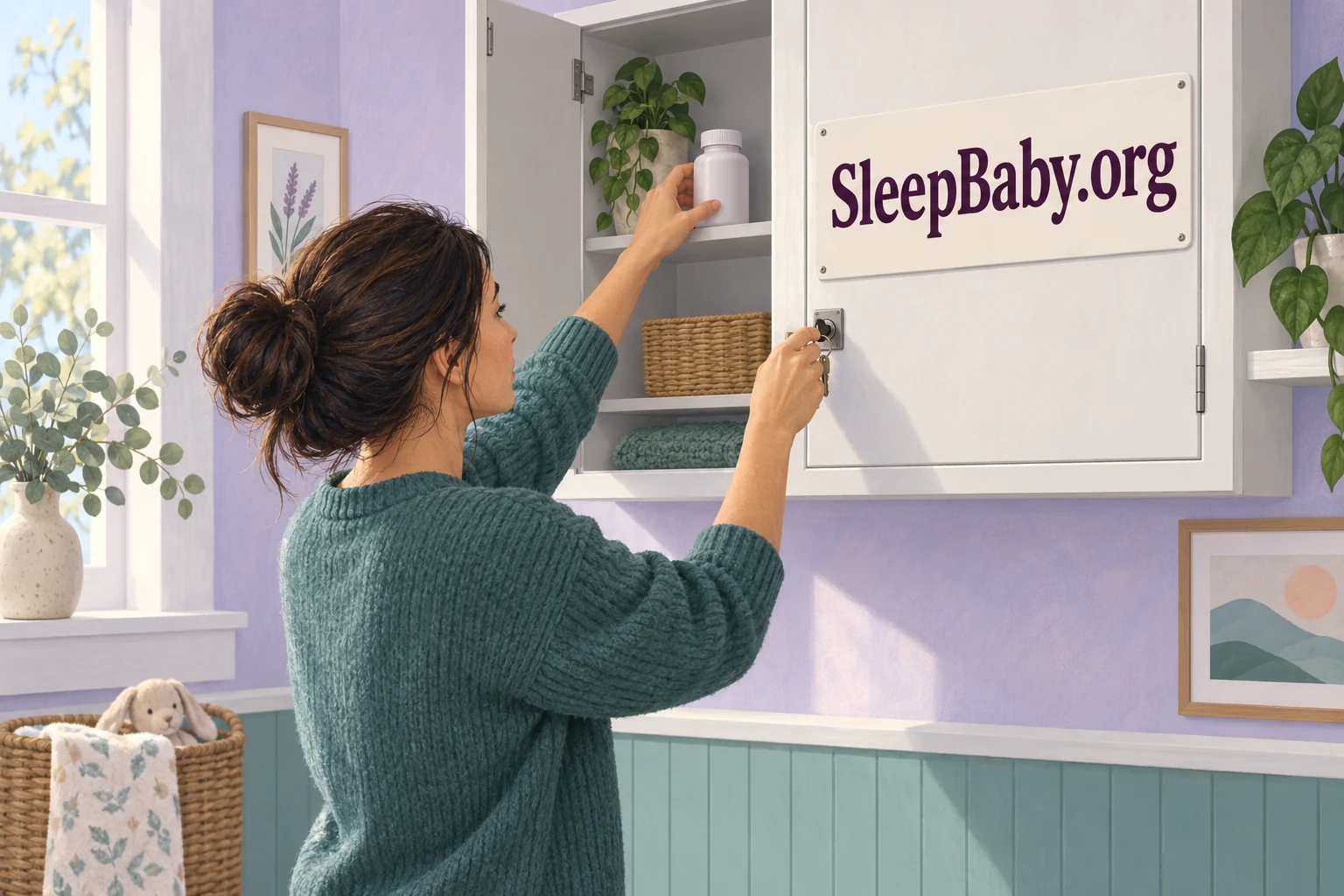
The AAP recommends keeping medicines and other potentially poisonous products out of children’s reach and sight, in locked storage. Safety caps are child-resistant, not childproof. The Missouri Poison Center’s medicine-safety guidance also emphasizes tightly closed bottles, high or locked storage and visitors’ medicines.
- Keep supplements in their original containers so the label stays with the product.
- Close the cap properly and return the container to secure storage after each use.
- Check handbags, travel bags and bedside areas as well as the main medicine cabinet.
- Ask guests and other caregivers to secure their products too.
- Keep medicines separate from snacks, and do not call gummies or medicine “candy.”
Use a suitable locked storage place you already have if it keeps products inaccessible and follows their storage instructions. A new organizer sitting within reach does not fix the access problem.
After a spill, collect the remaining pieces and check the nearby floor. Tell the poison specialist what you found if it changes the information you gave during the call.
Accidental ingestion and routine sleep use are different questions
If the incident makes you wonder whether melatonin is ever appropriate for your child, discuss that separately with your pediatrician. The AAP advises making decisions about pediatric melatonin use together with a clinician, cautiously, alongside established sleep habits.
Do not copy an older sibling’s plan, a friend’s dose or a product’s marketing onto your baby. A “children’s” label does not establish that the product is appropriate for every age. Trouble settling for a nap or an upcoming flight is not a reason to start giving an infant melatonin without medical guidance.
Research on long-term use in children is incomplete. That uncertainty does not prove that one accidental ingestion caused lasting hormonal damage. I would avoid both extremes: declaring every exposure harmless and telling a frightened parent that permanent harm has already happened.
For ongoing sleep concerns, describe the pattern to your clinician: what sleep looks like, what has changed, how feeding is going and what you have tried. That conversation can address your child’s needs without using this accidental exposure as a test of a sleep aid.

Common questions after a melatonin mix-up
My baby seems completely normal. Should I still call?
Yes. Call after a suspected ingestion, even without symptoms. The specialist can use the product, amount, timing and your baby’s details to advise you. Waiting for unusual sleepiness is not the way to confirm whether something was swallowed.
What if I cannot tell how many gummies are missing?
Say the amount is unknown. Describe the open container, pieces you found and what you actually saw. Do not delay while trying to reconstruct an exact count that you cannot establish.
Does “natural” mean the supplement is harmless?
No. Melatonin occurs naturally in the body, but a supplement is an additional exposure. In the U.S., supplements are regulated differently from prescription and over-the-counter drugs. “Natural” and “sold without a prescription” are not individual safety assessments.
What if my baby vomited after swallowing it?
Report the vomiting and its timing. Do not assume everything came back up, and do not give another dose. Ask about the next feed and any additional observation. Breathing trouble or inability to wake your baby requires emergency help.
Can the same advice cover a sleep gummy with other ingredients?
No. Read the entire label and mention every possible product. A mixed supplement or an additional medicine can change the assessment. Keep the packaging rather than relying on the color or shape of the gummy.
Do I need to buy a special monitor or remedy?
Start with professional advice. No shopping decision should delay the call or replace the observation instructions. For prevention, the practical task is secure storage and a shared caregiver plan.
Medicine storage: a short poison-center video
The Missouri Poison Center’s “Medicine safety tips for parents and sitters” covers closed containers, keeping products out of reach and remembering visitors’ medicines. It is prevention guidance, not a melatonin dose or emergency assessment.
The official page includes written tips and a transcript if the player is unavailable. If an ingestion has happened, make the call first; do not wait to watch a video.
Use the storage and notes you already have
An appropriate existing locked cabinet and a shared note on your phone can cover the immediate household tasks. A supplement, sleep product or monitoring purchase does not replace Poison Control’s assessment. No purchase is needed to make that call.
Sources View sources
- National Capital Poison Center: Melatonin exposures
- Missouri Poison Center: Melatonin and children
- American Academy of Pediatrics: Melatonin and children’s sleep
- NCCIH: Melatonin evidence, labels and uncertainties
- American Academy of Pediatrics: Poison prevention and first aid
- Missouri Poison Center: Medicine storage video and transcript
- Poison Control: Emergency signs and first aid
- Poison Control: Getting help and information for the call
- NICHD: A safe infant sleep environment
- American Red Cross: Infant choking recognition and care
- NHS: Urgent medical help for babies and young children
Your next step
Keep the bottle. Make the call. Follow your baby’s plan.
You do not need a perfect count or an online dose calculation before asking for help. Share what you know, say what is uncertain and keep the care instructions available to every caregiver.
When the immediate concern has been addressed, visit SleepBaby.org for a separate look at the SleepBaby.org Method, bedtime routines and baby sleep schedules.