If your baby ate a jade leaf, take the plant away, gently wipe visible material from the lips, and call Poison Control at 1-800-222-1222 in the U.S. Jade appears on non-poisonous plant lists, but that does not rule out choking, stomach upset, a mistaken identification or something else in the pot. Call 911 for breathing difficulty, collapse, a seizure or a baby who cannot be awakened. Do not make your baby vomit.
I would check the baby before trying to settle the plant’s name. Keep the plant and its nursery label available, safely out of reach, while you get advice about what actually happened.
SleepBaby.org · The original video
A little help
for the night ahead.
Take a moment to watch the original Baby Sleep Miracle presentation. Your article will be right here when you’re ready to keep reading.
Ready to get started?Take the next step with SleepBaby.
Help my baby sleepThe first few steps
- Stop access. Move the plant, loose leaves and pot contents away. Keep your baby in a clean supervised place while another adult handles the mess, if help is available.
- Clean what is visible gently. Wipe residue around the lips with a clean damp cloth and wash the hands. Do not sweep blindly inside the mouth or force liquid into it.
- Call with the plant beside you. Give your baby’s age and weight, the time, the part involved, the amount you actually saw and any symptoms. Say when the plant or amount is uncertain.
If your baby cannot breathe, cry or cough effectively, treat it as choking and call 911. Follow the dispatcher’s age-appropriate first-aid instructions. A plant’s toxicity rating does not decide whether a piece can block an airway.
In Australia, call the Poisons Information Centre on 13 11 26 and 000 for emergencies. Elsewhere, use your local poison service and emergency number. Do not wait for symptoms before asking about an unidentified plant exposure.
Why do some sources call jade non-poisonous and others mildly toxic?
The National Capital Poison Center lists jade under non-poisonous plants, using the name Crassula argentea. Children’s Hospital of Philadelphia also includes jade plant on its nonpoisonous list, while warning that plants in this category can still cause choking or stomach upset in young children.
UC Agriculture and Natural Resources describes Crassula ovata, the jade plant, as mildly poisonous if eaten, with possible vomiting or diarrhoea, and says its sap may irritate skin. These sources use different labels. None gives this article a safe number of leaves for your baby.
I would use that information for perspective, not an all-clear. It does not support treating an ordinary jade-leaf taste as inevitably severe poisoning. It also does not support dismissing symptoms or assuming that every succulent sold as “jade” has been correctly identified.
The poison specialist can put the name, the actual contact and your baby’s condition together. Keep the distinction clear during the call: a plant listing is general information; advice about your baby is individual.
Pet warnings do not answer a baby’s exposure question
A search can quickly lead to pages written about dogs or cats. Check whom a warning is meant for before applying it to your child. Give the human poison service the plant details and your baby’s symptoms rather than reading out a pet treatment plan.
If a pet also ate the plant, contact a veterinarian about the animal separately. Keep any veterinary treatment or medicine away from the baby. Two exposures in the same room still need advice for the individual involved.
Separate the plant, the mouthful and the pot
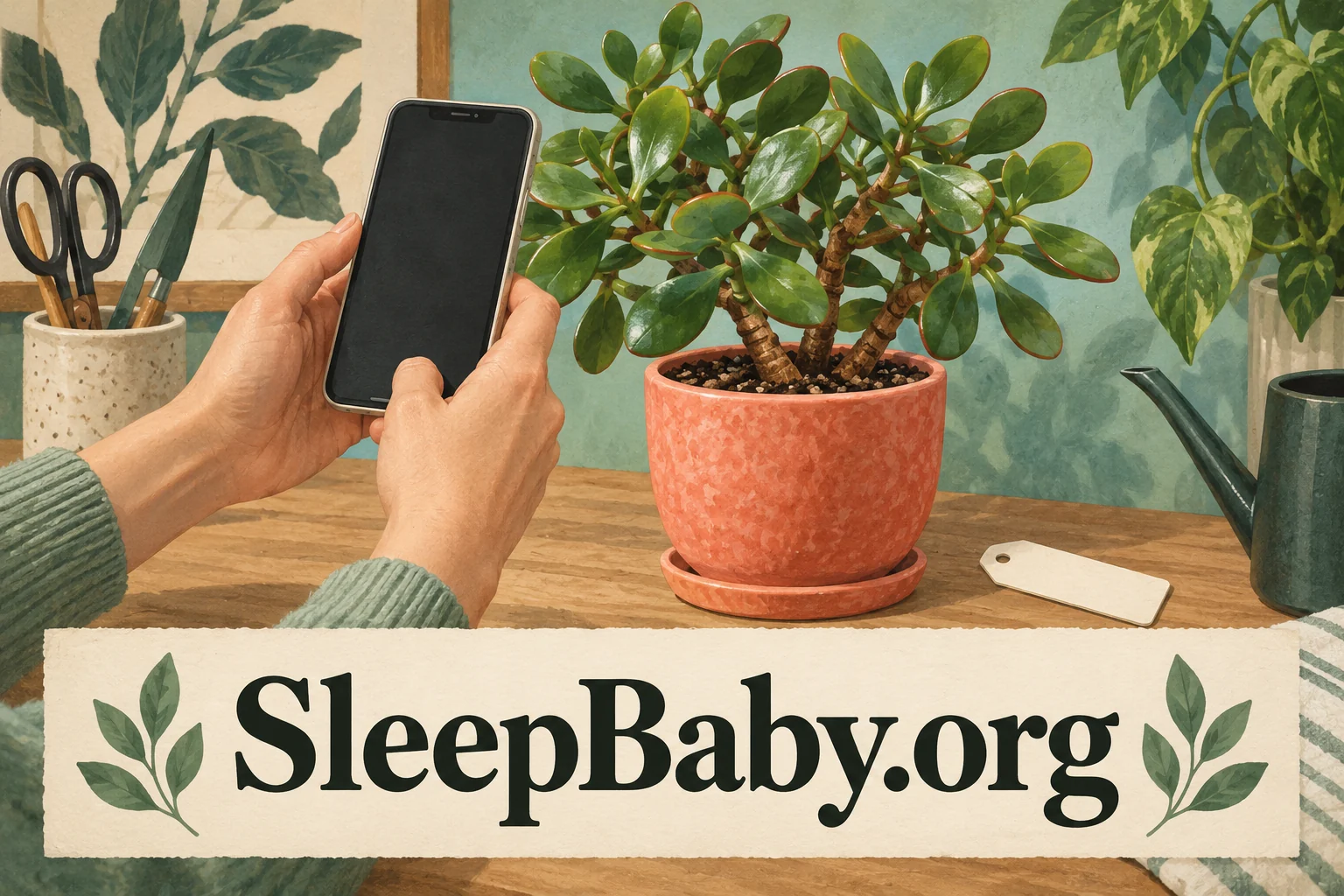
This is the check I would make before getting lost in leaf photographs. A jade plant is one part of the scene. The leaf in your baby’s hand, the decorative stones on the soil and a recently used plant product may raise different questions.
Three things to describe on the call
- The plant: the nursery label, any scientific name, where it came from and whether you are certain it is jade. A familiar nickname is useful history, not proof.
- The mouthful: a leaf, stem, sap, soil or an unknown piece; whether you saw licking, chewing or swallowing; and what is still visible or missing.
- The pot: decorative gravel, loose plant tags, fertiliser pellets, treatments or broken container pieces that may also have been accessible.
Then add the time and how your baby is acting. “I found a chewed leaf but did not see anything swallowed” is a useful observation. You do not have to turn it into an exact dose.
If another adult can help, ask them to photograph the whole plant and the nursery label while you call. Include a clear view of the leaves and stems. Keep the original label even if a phone app suggests a different name.
Do not delay help while waiting for an online plant group to answer. Do not taste a leaf yourself to identify it. The poison center’s plant guidance stresses accurate identification; a photo is information for the conversation, not a guarantee that an automated match is right.
AFTER THE PLANT EXPOSURE CALL
Put the plant away. Keep the care note close.
For ordinary bedtime routines and baby sleep schedules, you can explore the SleepBaby.org Method homepage and read the current offer.
A chewed leaf can leave you second-guessing the whole room: the windowsill, the fallen leaves and the little pot you thought was out of reach. I would start with one clear care plan from the poison specialist, then make one practical change to access.
Save the plant photo and the advice you received. Put the plant and its loose pieces in a suitable secure place, and tell the next caregiver what to watch for. Those steps keep the exposure question from getting lost when the household turns toward the evening routine.
The SleepBaby.org Method discusses everyday bedtime routines and baby sleep schedules. Its homepage explains the current offer if those ordinary questions are useful after the immediate care is settled. It cannot identify a plant, assess ingestion, treat symptoms or decide when observation can end. No purchase is needed to follow this article’s safety guidance.
What if it was soil, gravel or a treated leaf?
Tell the specialist about the whole reachable area. If you saw only a hand in the pot, say that rather than assuming the leaf was the only thing tasted. A close look at the scene can help describe access without proving which material entered the mouth.
The University of Connecticut’s jade-care guidance describes potting mixes that may include grit, rock chips, bark or perlite. That is one reason I would keep the mix separate from the plant-name question. Have the bag or its details available if you still have it.
For a recently treated plant, find the original product container. Report the product name, when it was used and whether your baby could reach the bottle, spray, granules or runoff. Do not assume a plant-care product is harmless because the leaf itself appears on a non-poisonous list.
Keep any loose stones, broken pot pieces or plant markers away from the baby. If an object may have been swallowed, say so explicitly. “Jade plant exposure” should not hide an uncertainty about a piece of gravel or a sharp fragment.
I would leave the pot in a safe place until the important details have been recorded, then clean the floor. If you need to move a heavy container, put the baby somewhere safe first. Carrying a baby while lifting a top-heavy plant makes a simple cleanup job harder to control.
Which symptoms should I report?
Describe vomiting, loose stools, redness, mouth discomfort, unusual drooling, trouble feeding or any change in alertness. These observations help the specialist decide the next step; they do not prove that jade caused a particular problem.
If breathing becomes difficult, your baby collapses, has a seizure or cannot be awakened, call emergency services immediately. Do not continue checking the plant label while an emergency is developing.
Ask the poison specialist what to watch for and how long the individual plan applies. I would also ask whom to contact if symptoms appear later. A normal-looking baby at one moment is useful information, but it is not a universal rule about when follow-up can stop.
If vomiting or diarrhoea develops, tell your baby’s clinician about feeding and wet nappies or diapers. The Royal Children’s Hospital notes that babies under six months are especially vulnerable to dehydration. Fewer wet nappies, dry mouth, poor intake or worsening condition deserve medical advice.
Go to hospital if your child has green vomit, or cannot keep fluids down and shows signs of dehydration. A baby who is very lethargic or hard to wake needs emergency help. Do not assume that unusual sleepiness is a welcome return to the normal nap schedule.
Should I give a feed, water or a home remedy?
Ask during the poison call, particularly if swallowing is uncomfortable, your baby is vomiting or the material is uncertain. Do not force a drink to wash down a leaf. Advice intended for an older child who can rinse and spit should not become an instruction to pour water into a baby’s mouth.
Do not induce vomiting, give salt water or use another plant as an antidote. Do not give activated charcoal or a medicine unless a poison specialist or clinician specifically directs it. Keep the next action tied to the advice for this exposure.
What if sap touched the skin or eyes?
If plant material touched the skin, gently wash it away with clear running water. Stop the hands from carrying residue to the eyes while you clean. Do not scrub irritated skin or add a household solvent.
NSW Poisons Information Centre advises flushing eyes exposed to a plant with clear running water for 20 minutes. Get help with positioning your baby safely and call for advice. Do not put eye drops or another chemical in the eye to neutralise sap.
Tell the service whether the eye was splashed, rubbed with a dirty hand or possibly scratched by a leaf or stem. Those are different observations. Persistent pain, redness or difficulty opening the eye needs medical advice; an apparent injury should not be treated as only a plant-toxicity question.
I would keep the plant details available even after the visible residue is gone. The name and the kind of contact can still matter when someone asks what happened during follow-up.
Change the reach, not just the plant label
Once the immediate advice is handled, revisit the exact access point. Was the pot on a low windowsill, a cutting left on the table, or a fallen leaf beside the play area? Moving the main plant will not solve a loose-leaf problem on the floor.
Choose a stable location your baby cannot reach or pull toward them. Consider the pot’s weight, the stand and nearby furniture that an older child might climb. A room or area that can be securely closed may be more practical than balancing a heavy plant on a high narrow shelf.
Put cuttings, pruned leaves and plant-care supplies away as soon as the job is finished. Check beneath the plant and around the container after watering or repotting. Ask visitors not to leave gifted plants beside a cot, play mat or changing area.
Keep the nursery label with the plant, or save a clear photo of it. If the plant was a cutting from a friend, ask for its original name before there is another urgent question. Labeling helps future identification; it does not make a reachable plant suitable for chewing.
You do not need to purchase a special storage system to take these steps. Use a suitable existing secure area and supervise your baby around plants. Even a replacement described as non-toxic still needs thought about loose pieces, soil and the container.

Two questions to settle before the next caregiver takes over
Can we return to the usual feed and sleep routine?
Ask the professional who assessed the exposure. Follow their instructions about observation, feeding and symptoms. Ordinary bedtime information cannot decide whether the plant was correctly identified or clear a baby who is behaving differently.
What details should I pass along?
Share the plant photo, approximate time, what you actually saw and the advice received. Include any uncertainty about the pot contents or a missing piece. Save the callback number with the note so the next adult does not have to reconstruct the story.

A general poisoning first-aid refresher
St John Ambulance’s “How To Treat Poisoning, Signs & Symptoms” reviews recognising a possible poisoning and getting help. It does not identify jade plants or give a baby-specific treatment plan. It uses UK emergency numbers; in the U.S., call 911 for emergencies and 1-800-222-1222 for Poison Control.
Written takeaway: stop access, gather the relevant details and follow professional advice. Do not induce vomiting or delay an urgent call to watch a video.
A useful next step beats a guessed diagnosis
A chewed leaf can leave you with several questions at once. Separate them: which plant, what contact, what else was reachable and how your baby is now. Let the poison specialist use those facts to guide the care plan.
Then secure the plant and keep the instructions close. You do not need a perfect estimate of the missing leaf to make a useful call.
Sources
- National Capital Poison Center: Poisonous and non-poisonous plants
- Children’s Hospital of Philadelphia: Nonpoisonous plants
- UC Agriculture and Natural Resources: Crassula ovata
- NSW Poisons Information Centre: Poisonous plants
- University of Connecticut: Jade plants
- Poison Control: First aid
- Poison Control: Getting help
- St John Ambulance: Poisoning first aid
- American Red Cross: Infant choking
- Royal Children’s Hospital: Gastroenteritis
- NHS: Eye injuries
AFTER THE IMMEDIATE QUESTION
A secure plant and a clear handoff
Keep the label or photo with the care instructions, and make the plant’s new location practical for your household. If your next question concerns everyday sleep routines, the SleepBaby.org Method homepage describes the current offer.
For symptoms, an uncertain plant name or an unanswered exposure question, return to Poison Control or your baby’s clinician. Their advice guides the care.
SleepBaby.org · The original video
A next step for
the next bedtime.
Still thinking about sleep? Watch the presentation here, then explore the SleepBaby program whenever you’re ready.
Ready to get started?Take the next step with SleepBaby.
Help my baby sleep