
If your baby ate or licked Icy Hot, call Poison Control now at 1-800-222-1222 in the United States. Keep the exact container beside you. Different Icy Hot products contain different medicines, and a baby who looks well still needs an exposure assessment. If your baby collapses, has a seizure, has trouble breathing, or cannot be awakened, call 911 immediately. Do not make your baby vomit. [1][2]
Take the product away and gently wipe visible cream from the mouth with a soft, wet cloth. Don’t push a finger or cloth deep into the mouth. I would make the call before trying to decide whether that smear was “enough to matter.” Outside the U.S., contact your local poison service or emergency number. [3]
What to do in the first few minutes
Put the tube, jar, roll-on, or patch somewhere your baby cannot reach, but keep its label available. If another adult is there, one person can stay with the baby while the other brings the packaging and makes the call. If you’re alone, using speakerphone can leave your hands free. You do not need to finish cleaning the room first.
Do not induce vomiting or use syrup of ipecac. Do not try a homemade neutralizer, give a medicine to counteract the rub, or make your baby eat a meal to “soak it up.” Treatment needs to match the actual product and exposure; get that direction from the specialist. The American Academy of Pediatrics also advises taking the substance away and avoiding induced vomiting. [4]
For muscle cream in the mouth, Missouri Poison Center describes wiping it out with a wet cloth and offering water. Poison Control’s general first-aid advice limits drinks to someone who is conscious and able to swallow. With an infant, an unknown formula, or a lidocaine product, ask immediately what, if anything, to give by mouth. Do not force a drink or try to feed a baby who is drowsy, coughing, choking, or having trouble swallowing. [1][3][7]
The useful result of the call is a specific next step: care at home with instructions, an assessment in person, or emergency help. Calling does not automatically mean an ambulance or hospital visit. It means someone qualified can make that decision using details an article cannot see. [2]

Read the Drug Facts panel, not just “Icy Hot”
The most useful thing you can do with the packaging is turn it around. Icy Hot is a brand name covering several products. “The blue tube” or “the one for back pain” may not identify the medicine inside. Read the full product name, the active ingredients, and the percentages exactly as printed.
For example, the current U.S. DailyMed listing for Icy Hot Original Cream lists menthol 10% and methyl salicylate 30%. Its balm is listed separately with menthol 7.6% and methyl salicylate 29%. Those are examples for identifying a container, not directions for estimating a baby’s risk. [5]
The Icy Hot with Lidocaine No-Mess label instead lists lidocaine HCl 4% and menthol 1%. A lidocaine patch label also lists a different product form. I would never assume that advice given for one of these products applies to the others. A similar-looking tube from another country or an older package may differ too; your actual label is what the specialist needs. [6][8]
Three places to read while you call
- The front: full name and form
- Cream, balm, roll-on, spray, or patch? Include words such as Original or Lidocaine. Don’t identify it by color alone.
- Drug Facts: medicine and strength
- Read each active ingredient and percentage. A cooling smell cannot tell you which ingredients are present.
- The package: size and what is missing
- Read the container size. Describe the open cap, squeezed cream, or damaged patch separately from anything you actually saw swallowed.
SleepBaby.org · Information to share with Poison Control before making a feeding or bedtime plan.
If the label has peeled off, say that. Don’t spend the next several minutes trying to match the container to an online photograph before calling. A photo of the front and back can be useful to keep on your phone, especially if another caregiver takes the container elsewhere, but it is not a reason to delay help.
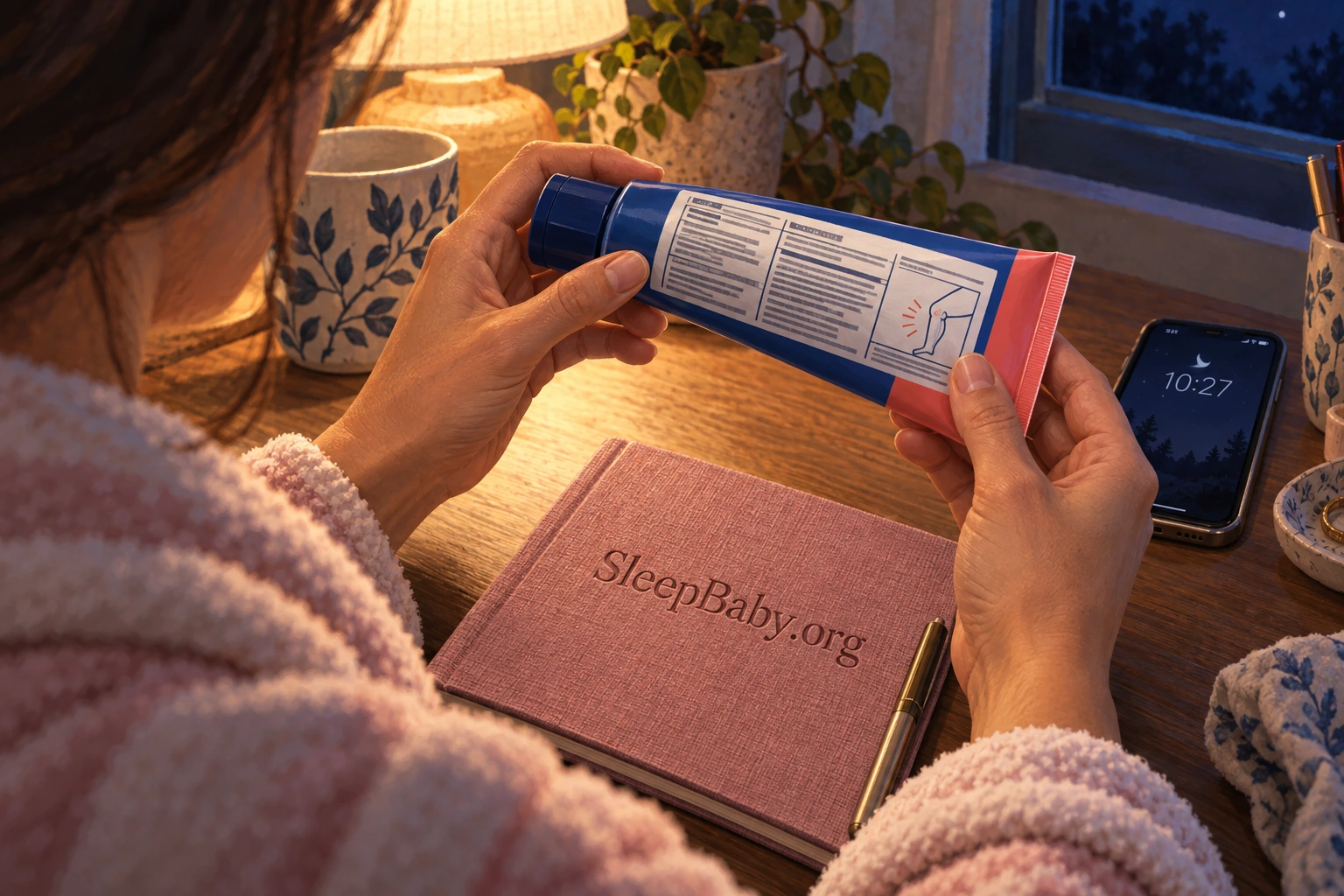
A lick, a smear, or an unknown amount needs its own assessment
“Only a lick” tells us something about what you saw. It does not establish a safe dose. A trace transferred from an adult’s hand is a different exposure from a baby chewing a tube, but neither description supplies the product concentration, the swallowed amount, and the baby’s weight by itself.
Methyl salicylate is related to aspirin, and swallowing a harmful amount can cause serious poisoning. Missouri Poison Center specifically identifies the amount swallowed and the child’s weight as important in muscle-cream exposures. I would leave that calculation to the specialist rather than convert a tube into spoonfuls or aspirin tablets at home. [3][9]
If you did not see the beginning, separate what you know from what you don’t. Cream on the shirt does not prove the same amount went into the mouth. An almost-empty tube does not tell you how full it was beforehand. Avoid squeezing out the remainder to recreate the incident. Keep the container in its current state and explain the uncertainty.
There is no responsible universal teaspoon cutoff here, and no countdown after which this page can declare every baby safe. The specialist may ask about age, weight, timing, symptoms, the exact medicine, and other health information. If you don’t know the weight, say so rather than offering a confident guess. [2]

Which symptoms matter, and can your baby go to sleep?
Possible effects depend on the product and exposure. Mouth or stomach irritation, nausea, and vomiting can follow swallowing muscle cream. More serious effects of methyl salicylate poisoning can include rapid or difficult breathing, unusual drowsiness, agitation, confusion, or seizures. These are reasons to seek guidance, not a checklist that must fill up before you act. [3][9]
Lidocaine creates an additional concern: it can numb the mouth and throat and make swallowing difficult. A substantial ingestion can affect the brain and heart. Do not assume that a quieter baby is simply more comfortable, or use feeding as a test of whether everything is okay. Tell Poison Control if lidocaine is on the label. [7]
Ask about the next sleep before ending the call. I would say, “A nap is due soon. Can my baby sleep, and what checks do you want me to make?” Ask how long any observation should continue and what should make you call again. The plan must come from the person assessing this exposure, not from your usual wake window.
Don’t decide to let your baby “sleep it off,” and don’t invent an overnight waking schedule from internet advice. If your baby becomes difficult or impossible to wake, has breathing trouble, collapses, or has a seizure, use emergency services. A planned nap never overrides those warning signs. [1]
Once you have specific care instructions, write them somewhere the next caregiver can find them. A baby monitor is not a poisoning assessment. Neither is the fact that your baby has reached their normal bedtime. It is reasonable to ask the specialist to repeat a direction while you write it down.
For ordinary nights after the care question is settled
Keep the medical instructions separate from the bedtime plan

If the remaining question is your family’s usual bedtime or waking pattern, you can explore the SleepBaby.org Workshop. Its browser-based free planning preview uses three answers to show a starting step and a tracking focus before you decide whether to buy.
The complete Workshop includes a seven-night tracker and short steps for tired parents to revisit. These are planning tools, not predicted results. The Workshop does not assess or treat an Icy Hot exposure, and its sleep suggestions cannot replace Poison Control’s instructions.
Ask specifically about the next feed
A familiar feeding routine can feel like the fastest way to comfort a baby. After an exposure, check that plan rather than automatically offering a bottle, nursing, or serving a snack. Tell the specialist when your baby last fed, when the next feed is due, and whether you have noticed coughing, drooling, vomiting, or trouble swallowing.
I would be especially clear about a lidocaine formula because numbing in the mouth or throat changes the swallowing question. Ask what is appropriate for your baby’s age and condition and when normal feeding can resume. Do not use a successful sip as proof that the exposure was harmless. [7]
If you already gave a drink, food, or medicine, simply report what it was and when. That detail belongs in the call; it is not something to leave out because you are worried it was the wrong choice. The next instruction needs to start from what has actually happened.
When ordinary sleep and feeding are cleared to resume, keep drinks out of the sleep space. Our guide to sleeping with a sippy cup addresses that separate bedtime question. A cup left beside a sleeping baby is not a way to manage a possible poisoning.
What if you only noticed the contact later?
Call when you discover it. Tell the specialist both the time you found the product and the last time you know it was safely put away. Those may be different times. If your baby has already napped or fed, include that in the account; don’t treat it as proof that no assessment is needed.
For example, you may know a tube was in a zipped bag before a visit and find it open after everyone leaves. That gives you a window of possible access, not an exact exposure time. I would describe the window honestly instead of choosing a convenient starting point for an observation period. Ask the specialist which timing they want you to use for any follow-up instructions.
If the label is partly unreadable, keep the original container and explain which information you can see. A receipt, carton, or product photo may help identify it later. Finding those things can be another adult’s job while you make the call; it does not need to become a research project before someone can help you.
If the rub also got on skin or into an eye
Tell Poison Control about every route of contact. A baby can have cream on their hands, rub an eye, and bring a hand back to the mouth during the same incident. Concentrating only on the swallowed amount can leave out a useful part of the picture.
For exposed skin, remove contaminated clothing and rinse with plenty of room-temperature running water for at least 15 minutes. Mild soap can help remove material that sticks. For an eye exposure, begin a gentle rinse immediately with room-temperature water for 15 to 20 minutes; avoid directing a forceful stream into the eye. Contact Poison Control for further instructions while another adult helps, if available. Severe or persistent symptoms need assessment. [1]
Keep the container nearby without putting it within the baby’s reach during cleanup. Don’t scrub the skin raw, cover the area with a heating pad, or apply another rub to cancel the sensation. Icy Hot labeling warns against external heat and use on damaged or irritated skin. [5]

If the contact came from your own treated skin rather than the container, describe that too. Say which product you used, where you applied it, when you applied it, and what touched your baby. You don’t have to turn the story into a guessed swallowed amount before asking for help.
A chewed patch adds another question
If your baby sucked or chewed an Icy Hot patch, identify the exact patch rather than calling it “a sticker.” Give the specialist the product name and tell them whether it was new or had already been worn. Mention any missing backing or torn material. A used medicated patch should not be treated as an empty piece of paper.
Poison Control advises getting help when someone swallows, chews, or sucks on a medicine patch. Patch products differ, so this does not mean an Icy Hot patch has the same risks as every prescription patch. It means the medicine and the physical material both need to be described accurately. [10]
Keep whatever remains and the wrapper for identification. Do not rummage deep inside the baby’s mouth for an unseen piece. If choking or breathing trouble is occurring, call emergency services and follow their instructions. An article about ordinary chewing gum cannot tell you what to do about a medicated patch, even if both incidents look like chewing.
Also mention damage to a tube, lid, or applicator. “The medicine may be in the mouth” and “a piece of the container may be missing” are separate details to report. You do not need to prove a piece was swallowed before mentioning it. If you find the missing piece afterward, update the specialist so the plan can use the new information.

If you are told to go for medical assessment
Follow the destination and transport instructions you are given. Take the container or patch packaging with you, along with the known timing and anything you have already done. If another adult made the first call, bring their notes rather than asking the next clinician to reconstruct the exposure from a shorter version.
Depending on the medicine and circumstances, clinicians may examine your baby and consider tests or observation. A salicylate blood test is one tool used when salicylate poisoning is suspected; it is not something every Icy Hot contact automatically requires. The team’s assessment determines what is useful. [11]
I would ask for the home plan in plain language before leaving: when feeding and sleep can resume, which symptoms need another call, and whether follow-up is arranged. If the written instructions and what you remember hearing seem different, ask the team to clarify. You shouldn’t have to resolve that difference alone at bedtime.
With several adults helping, choose one place for the notes. A text on one person’s phone, a remembered instruction from someone else, and an unlabeled tube in a bag make the handoff harder than it needs to be. Record the advice in the specialist’s terms rather than shortening it to a conclusion.
Ask the receiving caregiver to read the instructions before you leave or rest. Show them where the packaging is secured and which number to call if something changes. If a grandparent or babysitter was present when the contact happened, their direct observations may be more useful than your reconstruction of the event.
I would also keep the phone available for any arranged follow-up. If a direction is unclear, call back to clarify it. A question such as “Does that instruction include the next feed?” is more useful than silently making the plan fit an ordinary evening.
Change where the rub lives, including between uses
Once your baby’s immediate care is addressed, trace the route that made the product available. Was the tube left beside an adult’s bed? Did a roll-on stay in an open gym bag? Was a used patch sitting in an accessible wastebasket? That specific route is a better starting point than promising to be more careful everywhere.
The AAP recommends keeping medicines in their original packaging in locked storage, out of children’s sight and reach. Child-resistant packaging is not childproof. A closed cap, a high shelf, and a reminder to another adult are not interchangeable with a secure storage plan. [4]
I would choose a storage location you can use immediately after each application, without setting the tube down temporarily on the changing table. Put it away before the next task begins. That matters when an adult is using the rub repeatedly for back or joint pain and it starts to feel like an ordinary bedside item.
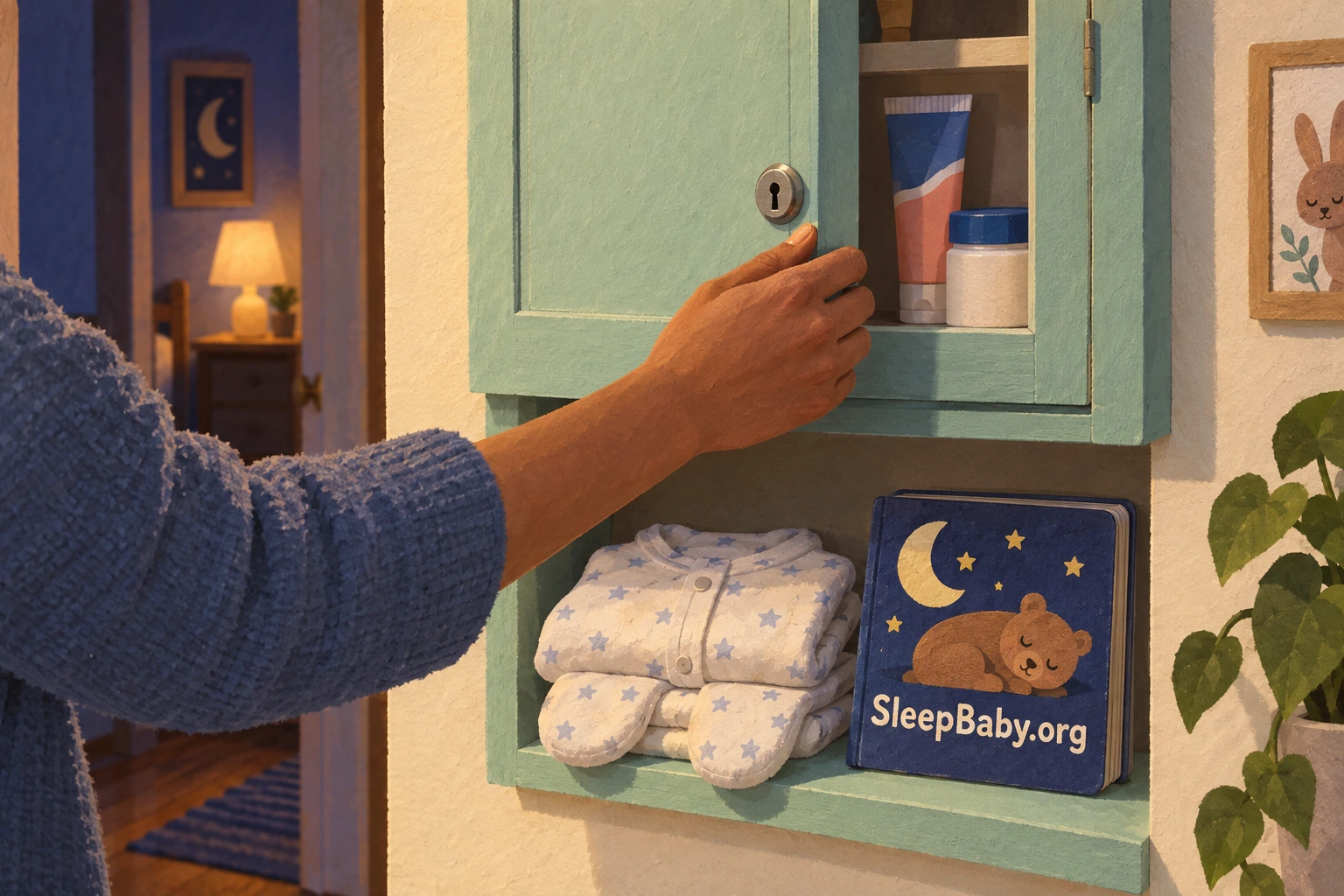
Wash your hands after applying a rub, following its directions, before handling a pacifier, bottle, or your baby’s hands. Keep your baby away from the treated area. Do not assume that a pleasant smell means a product belongs near a baby’s face or mouth. The adult product’s intended use does not make it an infant soothing product. [5]
If an adult in your home needs a topical pain reliever, consider the whole application sequence: take it out, use it as directed, close it, return it to secure storage, then wash hands. Keep that sequence apart from preparing feeds or changing a diaper. It should work on an ordinary tired evening, not only when everyone remembers to watch the counter.
Read the exact product’s instructions about clothing, heat, and contact rather than improvising a tight wrap to keep it away from the baby. If you are unsure how to use your own medicine while caring for your child, a pharmacist can help you understand its directions. Choosing a different baby-care arrangement is preferable to guessing how a topical medicine should be covered.
For patches, follow the disposal directions and keep used patches inaccessible. Poison Control recommends folding medicine patches adhesive sides together before disposing of them where children and pets cannot get them. An open bedroom bin may solve the adult’s tidying problem while leaving the child’s access problem untouched. [10]
Include visiting caregivers and bags in the same conversation. A grandparent may not think of a muscle rub as medicine worth mentioning. Ask where their creams, patches, and tablets will stay during the visit. If pills were also accessible, tell Poison Control about that possibility; our separate guide to a baby getting into iron pills explains why a tablet exposure needs its own assessment.
Keep one usable photo of the product label if the outer carton is likely to be discarded. The original container still belongs with the medicine. I would also save Poison Control’s number in the phones used for baby care, so the next adult isn’t searching through a long message thread to find it.

After care: an optional storage improvement
An Amazon hardware option if several cabinets need securing
Safety 1st Home Safeguarding Set, 80 pieces
The manufacturer lists cabinet and drawer latches, cabinet slide locks, door-knob covers, and outlet covers. It may be useful if this incident revealed several access points around your home. Choose hardware that fits the actual cabinet and follow its installation instructions. [12]
Check before buying: The set includes many items unrelated to storing one tube of rub. Confirm the current contents and compatibility. These devices are additional barriers, not a promise that a child cannot reach medicine.
When to skip it: An existing suitable locked cupboard or container may already solve the problem. If you only need one appropriate latch or lock, a large kit may be unnecessary. No purchase changes what to do about today’s exposure.
As an Amazon Associate I earn from qualifying purchases.
Meet the people behind the poison-help call
In this Missouri Poison Center video, staff explain their work and why an individual exposure needs individual advice. Watch after making any needed call, not before.
The written takeaway: keep the product label with you and ask for advice specific to your baby. If playback is unavailable, the official page includes a transcript. You can also watch on YouTube.
You don’t need a perfect account before you ask for help
An open cap and a little cream on a sleeve can leave you trying to reconstruct every second. I would make room for a less complete sentence: “I found this, I didn’t see the whole thing, and I need help deciding what to do.” That is enough to begin a conversation.
Your job is to share the product and what you observed, then follow the assessment and instructions you receive. You do not have to diagnose poisoning, prove that nothing happened, or get the bedtime schedule back on track at the same time. The next useful step is the call, even when the amount is uncertain.
Sources and references
- Poison Control: poisoning first aid.
- Poison Control: getting help and information to provide.
- Missouri Poison Center: muscle creams.
- AAP: poison prevention and treatment.
- DailyMed: Icy Hot Original cream, balm, and stick labels.
- DailyMed: Icy Hot with Lidocaine No-Mess label.
- Poison Control: lidocaine exposure risks.
- DailyMed: Icy Hot with Lidocaine patch label.
- MedlinePlus: methyl salicylate overdose.
- Poison Control: medicine-patch safety.
- MedlinePlus: salicylate blood tests.
- Safety 1st: Home Safeguarding Set contents.
- Missouri Poison Center: staff video and transcript.






What viewers said10 comments · 4 replies+
Archived comments from the original Baby Sleep Miracle presentation. Not independently verified by SleepBaby.org; individual experiences vary.
Thank you so much for this video! I had no idea about the dangers of baby swings :O
Hi Mary-Ann. I have a question: Is method in any way similar to the ones recommended by Dr Bucknam, Dr. Weissbluth or Dr. Karp? We tried those but none of them help.
Hi Regina, thank you for your question. The short answer is no. The techniques I share in my guide are based on newest scientific research and this is why I have never seen any approach similar to the one I recommend.
This method really works! I tried it on my son Jesus and after just one week he went from waking up more than 5 times a night to waking up just once or twice. You are a lifesaver, Mary-Ann!
I'm truly impressed with how much information you share in your video. And all for free! I can feel that you truly care about mothers like myself, and that's hard to find these days. I have recommended your site to several of my friends already.
Mary-Ann, our child suffers from autism. Is your approach still suited?
Chloe, I made sure my method can be used with any child, even babies who are special like yours. Please note that I'm not a doctor and that I always advice to consult with your physician because nothing is more important than the safety and well-being of your love.
Hallo Mary-Ann, I'm from Germany. Do you have your guide in German?
Hello Heide, we do! Normally you should already see our video in German. If not, please contact our support so they can guide you
Thenk you for your answer, Mary-Ann!
I just completed your approach and I have to say, it worked almost too well. Yes, it took a bit of getting used to with your bedtime routine but the difference is huge. My son George used to take 1 hours to go down and now he's firmly asleep in no more than 10 minutes! You're the best!
It seems I'm the only man watching this video, lol! What you shared about the 'emotional backpack' made immediate sense to me and I can't wait to help my little girl Mila to unpack it!
Hey there, just discovered your site and this really sounds different. Just wanted to say thanks for sharing :)
For everyone who's still thinking about getting Mary-Ann's guide I want to advise you to go ahead. I wasn't sure myself but now I'm so thankful I invested in this program. It made a huge difference in our life as a family and yes, my baby girl does sleep through the night now.