
If your baby may have swallowed sharp glass, get urgent medical assessment now, even if they seem comfortable. Call 911 or your local emergency number if your baby cannot breathe or cry normally, has a weak or absent cough, turns blue or gray, or becomes unresponsive. Do not wait for symptoms to prove that something happened. Until the medical team tells you otherwise, do not give food or drink, make your baby vomit, or sweep blindly inside their mouth.
A broken cup and a baby beside it leave plenty of unanswered questions. You do not have to solve all of them before getting help. Tell the clinician what you saw and what you cannot account for.
Start with your baby, then the broken object
- Breathing or responsiveness has changed: call emergency services. Put the phone on speaker and follow the dispatcher’s age-appropriate first-aid instructions.
- Breathing normally, but sharp glass may have been swallowed: seek an emergency department assessment promptly. A baby who looks well can still need evaluation.
- Unsure what the object was: say that. In the U.S., Poison Control at 1-800-222-1222 can advise about the object and any chemical contents. A call should not delay emergency care.
Move your baby away from the broken glass. If another adult is available, have them secure the area while you stay with your baby and arrange care.
What if you did not actually see your baby swallow it?
Maybe you heard a crash, turned around, and found your baby holding a piece. Maybe a drinking glass has a new chip around its rim after a feed. Maybe you found something shiny on your baby’s lip and cannot tell where it came from. Those are different observations, but none requires you to manufacture certainty before calling.
I would use the most literal description possible: “The rim is chipped, and I don’t know where the missing piece is.” That gives the person helping you more useful information than either “My baby definitely ate glass” or “I’m probably worrying over nothing” when neither is established.
Healthdirect’s swallowed-object guidance treats sharp objects as an emergency concern and notes that children may initially have no symptoms. With a baby, you also cannot rely on a verbal report of something feeling stuck. Normal-looking behavior is one observation to pass along, not a home clearance test.
Give the approximate time and the last time you know the object was intact. If the exposure happened at childcare, ask the adult who was there to describe it directly or write down the sequence. Avoid turning a secondhand guess into a fact as the story moves from one person to another.
You do not need to reassemble every fragment. Trying to prove that a tumbler is complete can delay care and create more chances for someone to get cut. A quick photograph of the damaged object, taken safely by another adult if possible, can preserve the useful detail without holding up departure.

Choking, a mouth cut, and swallowed glass are different concerns
Glass can injure the mouth, enter the swallowing passage, or be involved in an airway emergency. The first priority is whether your baby is breathing effectively and responding normally. Persistent coughing, noisy breathing, or a change after the incident deserves medical attention even when you cannot see anything in the mouth.
The 2025 American Heart Association and American Academy of Pediatrics guidance distinguishes an effective cough with sounds from severe choking, when a child cannot move air effectively. Severe choking needs immediate first aid and emergency help. Do not perform choking maneuvers simply because you suspect that an otherwise normally breathing baby swallowed glass. Follow the emergency dispatcher if breathing becomes impaired.
Do not reach toward the back of the mouth, make a blind finger sweep, or try to dig out a piece that appears embedded. Tell the clinician about visible blood or a visible fragment. A cut you can see does not tell you whether another fragment went farther down, and an apparently clear mouth does not answer that question either.
If coughing was already happening because of congestion, make that timeline clear: did it begin before the broken glass was discovered, or immediately afterward? Our guide to a baby waking with coughing or mucus addresses a different situation. Do not use a familiar congestion explanation to dismiss a new possible foreign-body exposure.
Bring the useful information, without delaying help
Once help is being arranged, a few concrete details can make the handoff easier. Start a note on your phone or use any scrap of paper. It does not need to be tidy, and it does not need an answer in every space. “Unknown” is a useful answer.

A note to read out loud
What I saw. What I don’t know. What changed.
What I saw
The object, the approximate time, and exactly what was in the baby’s hand or mouth. Include the baby’s age and any known swallowing or digestive condition.
What I don’t know
Whether anything was swallowed, how much is missing, and whether the material was definitely glass. Leave uncertainty visible.
What changed
Breathing, coughing, drooling, swallowing, vomiting, bleeding, pain behavior, or alertness. Note what has happened since the incident, including anything already given to eat or drink.
Start the call: “My baby may have swallowed a sharp piece from a broken glass at about ____. Right now their breathing is ____. I saw ____, and I’m not sure about ____.”
The Royal Children’s Hospital clinical guideline emphasizes the object, timing, symptoms, and relevant medical history. If your baby has had surgery involving the digestive tract or has a known swallowing problem, mention it early rather than assuming it will be obvious in a new hospital’s record.
If you can safely save a representative piece without delaying care, keep it in a rigid, securely closed container, away from your baby. Do not carry loose shards in a diaper bag, tissue, or pocket. A photograph may be simpler. Tell the team whether the sample is the piece found in the mouth or merely another piece from the same broken object.
Packaging can matter too. A broken drinking tumbler, an ornament containing liquid, and a light bulb are not interchangeable exposures. Poison Control describes additional hazards from some ornaments, including their contents. Report the original object and any liquid, coating, or other material involved. Do not identify an unknown shiny fragment by appearance alone.
Skip the home fixes that can complicate the situation
The urge to do something with food or drink is understandable, especially if your baby seems hungry. But the immediate job is to get an appropriate plan, not to try to push the object down. Poison Control finds no scientific evidence that bread or bran protects the digestive tract from swallowed glass. A familiar suggestion is not a tested treatment.
While you are getting medical advice
- Do not try to cushion or push down the glass.
- Skip bread, banana, extra milk, or a drink used as a swallowing test. Ask the medical team when feeding is appropriate.
- Do not induce vomiting.
- Do not use a finger, salt water, or a vomiting remedy. Tell the clinician if vomiting has already happened.
- Do not force a mouth inspection.
- No blind sweeps or attempts to pull an embedded shard. Describe what is visible and let the medical team assess it.
If someone already offered milk or food before realizing what happened, say what was given and when. This is information the team needs, not a reason to delay or avoid care. I would put it in the same note as the last normal feed so it does not get lost during a hurried conversation.
Keep following the advice of the clinician who is managing this event. General pages about coins or smooth objects can contain feeding and observation advice that does not apply to a potentially sharp fragment. The category “swallowed something” is too broad to decide your baby’s next step.

What the medical team may need to work out
The team will consider what may have been swallowed, where it may be, whether there are symptoms, and what examination or testing is appropriate. Children’s Health recommends emergency evaluation for swallowed sharp objects. Being sent for assessment does not mean that every baby will need an operation; it means the decision needs more information than a parent can gather at home.
An X-ray may be part of that assessment, but “nothing showed up” is not a universal answer for glass. The UC Davis pediatric foreign-body algorithm includes glass among sharp objects that may not be visible on ordinary X-rays. The history, symptoms, and suspected object still matter when clinicians decide whether more investigation is needed.
A useful question is: “Given the object we think was involved, what does this result rule out, and what are we doing next?” That is more helpful than asking a scan to answer every possible question. If you witnessed swallowing or have a photograph that was not available earlier, make sure the team knows before the plan is finalized.
Different recommendations for different children are not automatically contradictory. A known tiny fragment, an uncertain jagged piece, and an object causing symptoms can lead to different decisions. Ask what information is driving the recommendation for your baby and who to contact if the situation changes.
For later, after your baby’s medical plan is clear
Put the sleep questions on a separate page

A possible glass ingestion needs medical care. Baby Sleep Miracle does not assess swallowed objects, treat injury, or replace your clinician’s instructions.
Once that care is settled, you may want help returning to an ordinary bedtime routine. You can watch the Baby Sleep Miracle introduction at SleepBaby.org and decide whether its sleep guidance fits your family.
If the team discusses an endoscopy
An upper endoscopy uses a thin instrument with a camera to look inside the upper digestive tract. Depending on the situation, specialists can use instruments through it to retrieve an object and assess the area. The team decides whether this is needed and how urgently; it is not something every suspected ingestion automatically requires.

Ask the team to explain the immediate aim in plain words: are they trying to find a suspected fragment, remove a known object, check an injury, or answer another question? Then ask what the next step would be if they do not find what they are looking for. You do not have to memorize the name of every instrument to understand the plan.
The timing of feeding and drinking around a procedure must come from your baby’s team. Tell them about the last feed and anything given after the incident. Do not start preparation instructions found in a general video or move the appointment yourself because a routine-procedure page describes a different schedule.
Optional viewing: what an endoscopy visit can look like
Children’s Hospital of Philadelphia made this animation to introduce children to a planned endoscopy and colonoscopy visit. It can help you picture the setting if your baby’s clinician has mentioned endoscopy.
This is procedure context, not emergency glass-ingestion advice. Do not delay care to watch it or apply its scheduled-visit or bowel-preparation directions to your baby. Follow the urgent team’s instructions.
If the player is unavailable, open CHOP’s official video page or ask your clinician to explain the procedure.
If your baby is sent home, get a written plan
Home observation can be a medical decision after assessment. It should not be a decision you make from a search result saying that small objects often pass. Before leaving, ask the team to connect the instructions to this specific incident: what they think happened, what remains uncertain, and what would change the plan.
Do not leave with “watch closely” as the only instruction you understand. Watching needs an action attached to it. Which symptoms mean calling the team, which mean returning to the emergency department, and which mean calling emergency services? Where should you go overnight if the service that saw your baby is closed?
Before we leave, I need to know…
- Feeding: when to restart usual breast milk, formula, or age-appropriate food, and what to do if my baby will not take it.
- Warning signs: what changes require an immediate return, and the right number to call.
- Follow-up: whether another examination, image, or appointment is planned, and who arranges it.
- Observation: what to record, for how long, and whether the team wants any specific diaper or stool checks.
Read the plan back in your own words. Have the other caregiver hear it too, if possible.
Hull University Teaching Hospitals’ discharge guidance lists changes such as vomiting, abdominal pain, or rectal bleeding as reasons to seek help again. The CHOP Poison Control explanation of foreign bodies also makes clear why sharp objects deserve particular attention: they can lodge or injure tissue.
For a baby, describe what you can observe rather than trying to diagnose pain: repeated vomiting, a swollen-looking belly, new unusual crying, difficulty swallowing, more drooling, refusal of feeds, blood, or a change in alertness. New breathing trouble or unresponsiveness is an emergency. Do not wait for a scheduled follow-up when a concerning change happens.
Ask about stool checks instead of assuming you need to search every diaper for glass. Do not handle stool looking for a sharp fragment with bare hands, and do not start laxatives to speed things along unless the treating clinician tells you to. A generic estimate of how long an object takes to pass is not a personalized deadline or an all-clear.
Make sure the plan works in your actual home
If the instructions depend on something you cannot do, say so before leaving. Perhaps you live a long drive from the hospital, the other caregiver is working overnight, or the follow-up number goes to a service you have never used. Ask the team to help you understand the practical next step. Do not quietly substitute a plan from another child’s experience.
Request an interpreter if you need one, and ask for unfamiliar words to be explained. “Come back if symptoms worsen” may still leave you wondering which symptoms count. Point to the instructions and ask for examples that fit a baby who cannot describe a sore throat or stomach pain. You are checking that you can use the plan when you get home.
Separate an arranged appointment from a suggestion to arrange one. If follow-up is needed, find out whether someone will call you or whether you need to make the call. Save the number with the name of the service and keep any reference number from the visit. If the plan includes a result that is still pending, ask who will explain it and how you will be contacted.
These questions also help the next caregiver. A written contact number and a definite next action are much easier to hand over than “They’ll probably call tomorrow.”
Make the caregiver handoff specific
A second adult should not have to reconstruct the visit from scattered texts. Keep the discharge instructions, the contact number, and your short event note together. If there was a procedure, include its discharge instructions in the same place. Use the actual paperwork, not a remembered version of it.

I would hand over three things aloud: what the medical team concluded, what the next caregiver needs to do, and what change means getting help. Then point to the written plan. That makes it easier to notice when a statement is still vague, such as “They said feeding was okay,” without anyone remembering when or under what conditions.
Record what actually happened, not what was offered. “Took the usual feed comfortably at 8” is more useful than “Bottle ready.” If the plan calls for checking in with a service, write down who made the call and what they were told. A shared note can prevent two tired adults from assuming the other completed the next step.
If your clinician says ordinary sleep is appropriate, keep the usual safe sleep environment: back to sleep on a firm, flat, level infant sleep surface with a fitted sheet and no loose bedding or soft objects. NICHD’s Safe to Sleep guidance explains that setup. Do not add a pillow or incline because you are worried about the incident.
Ask the treating team whether any special observation is needed overnight. A camera or monitor cannot establish that a swallowed object is harmless. For dividing ordinary rest between adults after the care plan is settled, our sleep schedule guide for new parents can help with the practical handoff. The medical instructions still determine what your baby needs.
Clean up after another adult has your baby safely away
The cleanup can wait long enough for someone to take charge of your baby and arrange the necessary care. Keep children and pets out of the area. An adult dealing with fragments needs closed shoes and appropriate tools, not a baby on one hip while reaching across the floor.
Think beyond the spot directly under the broken glass. Check nearby objects that a child can reach: a dropped bib, the edge of a play mat, an open toy basket, or a low shelf. If you cannot confidently clear an item of fragments, keep it away from your baby while deciding how to deal with it. Do not test a surface with your bare palm.
Keep sharp waste contained so the next person taking out the trash does not meet it unexpectedly. Follow local disposal guidance, and keep the container out of children’s reach. Do not put a recovered sample back among the toys because it is inside a bag; a sample is still a sharp object.
Optional household tool, after medical care is arranged
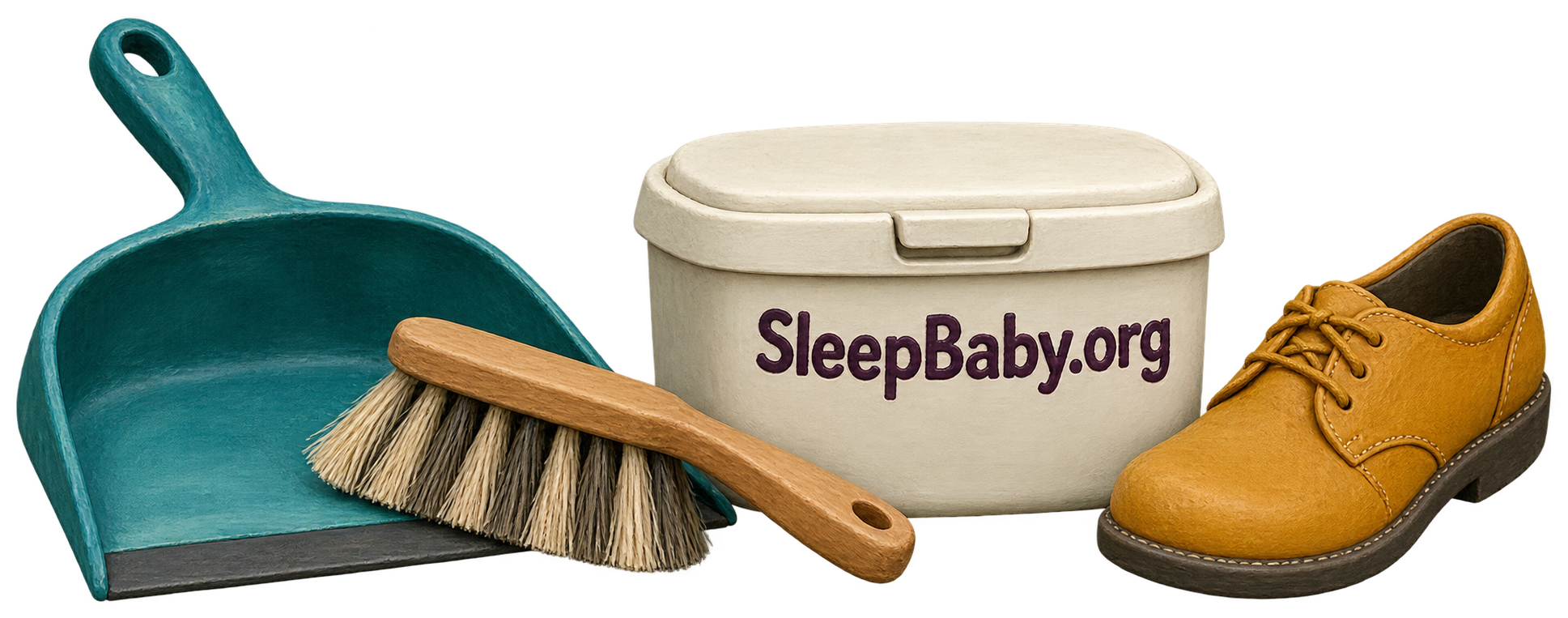
OXO Good Grips Dustpan & Brush Set
For an adult cleaning a hard floor, a separate brush and dustpan keeps the task organized. OXO’s model 1334480 has a rubber dustpan lip, and the brush snaps into it for storage. It does not treat an ingestion or prove that an area is free of every tiny fragment.
Use what you own: an existing suitable brush and dustpan may do this job. There is no reason to delay medical care or cleanup to buy a new set.
Before buying: check the model, whether it suits your floor, and where you can store it securely away from your child. For a large breakage or a surface you cannot clear confidently, keep the area inaccessible and arrange appropriate help.
View the OXO dustpan and brush on Amazon
As an Amazon Associate, SleepBaby may earn from qualifying purchases.
Once the immediate area is dealt with, look at what made the object reachable. A glass left at the edge of a low table needs a new home. A chipped feeding container needs to come out of use. A decorative object within crawling or cruising reach needs to move. A specific change is more useful than asking everyone to “be more careful.”
Get down to your child’s level after the cleanup, with the area safely accessible, and look for the next reachable breakable item. Include things adults move temporarily: a visitor’s drinking glass, a vase set down during cleaning, or an ornament box opened on the floor. Tell other caregivers about the change so the old habit does not quietly return.
Questions that come up after the first call
Can a tiny piece of glass pass without causing harm?
Yes, that can happen. Poison Control explains that small pieces may pass without symptoms. But that does not create a safe size cutoff for a parent assessing a baby at home. The size, shape, symptoms, and confidence about what happened matter. Suspected sharp glass still deserves prompt professional assessment.
Does every swallowed piece have to be removed?
No. Removal, further testing, and observation are decisions for the treating team. The important question is why the chosen approach fits this object and this baby, and what the follow-up plan is. Do not interpret “some objects pass” as permission to skip the initial assessment.
What if the shiny piece was a bead rather than glass?
Tell the clinician that the material is uncertain and show the packaging or a photograph if available. Different objects have different risks. Our article on a child swallowing Orbeez or other water beads explains why a small-looking bead can need a different response. Do not wait to see whether an unidentified bead changes size.
What if my baby seems completely normal now?
Report that improvement, along with what happened earlier. A baby who stopped coughing still needs the suspected glass exposure explained to a clinician. If your baby has already been assessed, follow that team’s plan and return for the warning signs they gave you. A comfortable moment is welcome; it does not replace the plan.

You do not need a perfect account of the accident to ask for help. Start with your baby’s breathing and responsiveness, explain the possible sharp object, and let the medical team guide the next step. The cleanup, the bedtime routine, and the unanswered “how did this happen?” questions can come afterward.
Sources and further reading
- National Capital Poison Center: swallowed glass and first-aid guidance.
- Healthdirect: swallowed objects; Children’s Health: children swallowing objects.
- Royal Children’s Hospital: foreign-body ingestion guideline; UC Davis: pediatric ingestion algorithm.
- CHOP Poison Control: foreign bodies; Hull University Teaching Hospitals: discharge advice.
- AHA/AAP: 2025 pediatric basic life support; NICHD: safe sleep environment.
- Poison Control: ornament hazards; CHOP: endoscopy visit video.
- OXO: dustpan and brush specifications.
When the medical questions are settled: if getting back to an ordinary sleep routine is your next concern, watch the Baby Sleep Miracle introduction at SleepBaby.org. Keep your baby’s care instructions first, and return to sleep planning when your family is ready.






What viewers said10 comments · 4 replies+
Archived comments from the original Baby Sleep Miracle presentation. Not independently verified by SleepBaby.org; individual experiences vary.
Thank you so much for this video! I had no idea about the dangers of baby swings :O
Hi Mary-Ann. I have a question: Is method in any way similar to the ones recommended by Dr Bucknam, Dr. Weissbluth or Dr. Karp? We tried those but none of them help.
Hi Regina, thank you for your question. The short answer is no. The techniques I share in my guide are based on newest scientific research and this is why I have never seen any approach similar to the one I recommend.
This method really works! I tried it on my son Jesus and after just one week he went from waking up more than 5 times a night to waking up just once or twice. You are a lifesaver, Mary-Ann!
I'm truly impressed with how much information you share in your video. And all for free! I can feel that you truly care about mothers like myself, and that's hard to find these days. I have recommended your site to several of my friends already.
Mary-Ann, our child suffers from autism. Is your approach still suited?
Chloe, I made sure my method can be used with any child, even babies who are special like yours. Please note that I'm not a doctor and that I always advice to consult with your physician because nothing is more important than the safety and well-being of your love.
Hallo Mary-Ann, I'm from Germany. Do you have your guide in German?
Hello Heide, we do! Normally you should already see our video in German. If not, please contact our support so they can guide you
Thenk you for your answer, Mary-Ann!
I just completed your approach and I have to say, it worked almost too well. Yes, it took a bit of getting used to with your bedtime routine but the difference is huge. My son George used to take 1 hours to go down and now he's firmly asleep in no more than 10 minutes! You're the best!
It seems I'm the only man watching this video, lol! What you shared about the 'emotional backpack' made immediate sense to me and I can't wait to help my little girl Mila to unpack it!
Hey there, just discovered your site and this really sounds different. Just wanted to say thanks for sharing :)
For everyone who's still thinking about getting Mary-Ann's guide I want to advise you to go ahead. I wasn't sure myself but now I'm so thankful I invested in this program. It made a huge difference in our life as a family and yes, my baby girl does sleep through the night now.