
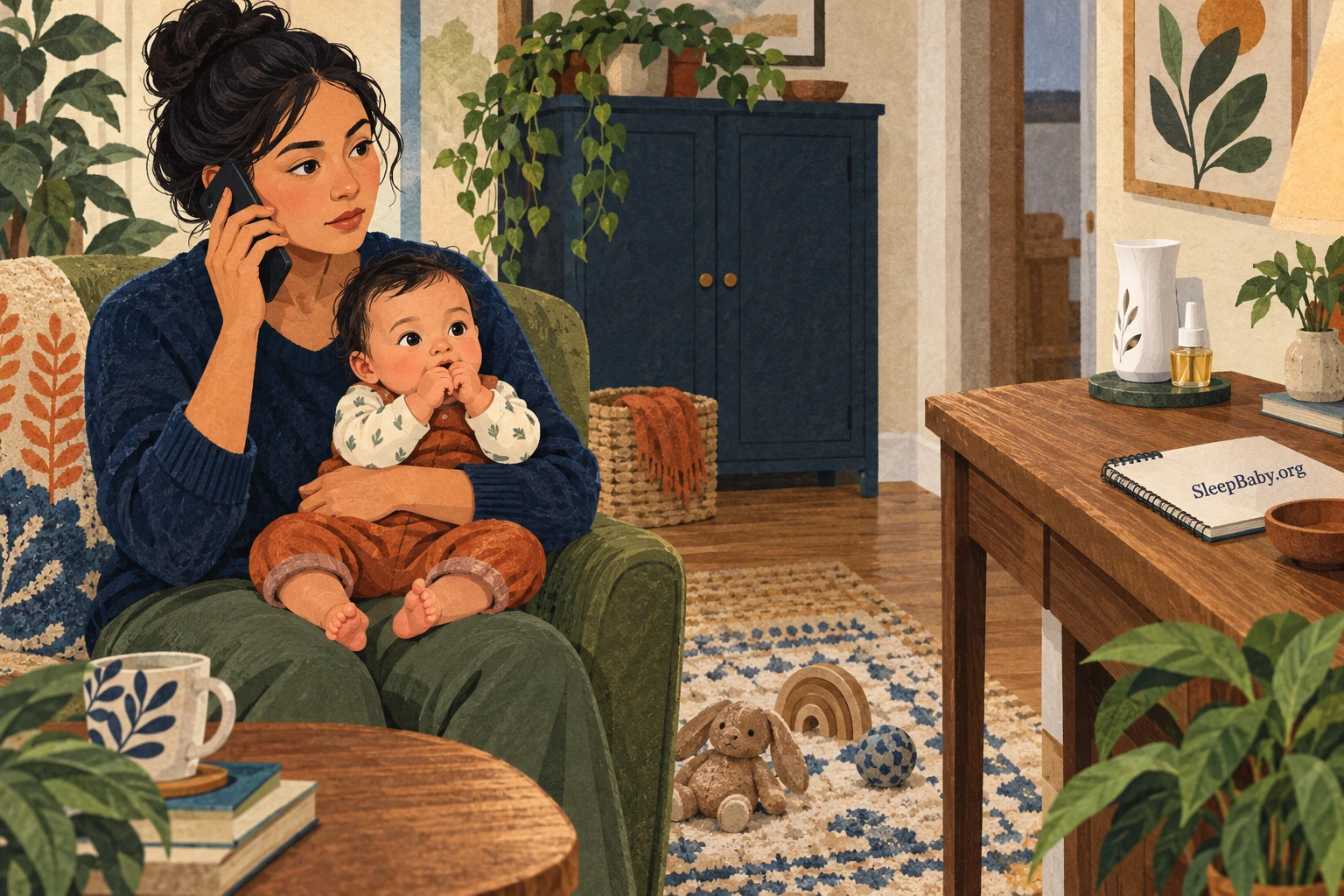
If your baby licked, sucked, or swallowed liquid from a Glade PlugIn, call U.S. Poison Control now at 1-800-222-1222, even if your baby looks well. Take the product away and do not make your baby vomit. If your baby has trouble breathing, collapses, has a seizure, or cannot be awakened, call 911 immediately. Outside the U.S., use your local poison center or emergency number.
I would make the call with the refill in hand. The exact product, what reached your baby’s mouth, and how your baby is acting matter more than the scent name or how full the bottle looks.
This article explains general precautions. A poison specialist needs to assess your child’s particular exposure. Poison Control says to get help without waiting for symptoms.
Start with your baby, then the bottle
- Check breathing and responsiveness. Emergency symptoms belong with 911, not a search for an ingredient list.
- Stop further contact. Move your baby away from the warmer, refill, spill, and any broken pieces. Keep the product for identification.
- Call Poison Control. Say whether you saw a lick, sucking on the wick, a swallow, a spill, or a missing piece. “I don’t know” is useful information.
Do not induce vomiting or try a home remedy. Follow the poison specialist’s instructions about anything by mouth. These priorities follow AAP poisoning guidance and Poison Control first aid.

What does “ate a Glade plug-in” mean here?
It can describe several different events. A baby may have mouthed the outside of the warmer, sucked the exposed wick, gotten oil on their hands and then in their mouth, or chewed a part of the refill. Tell the specialist what you actually saw before trying to put it into a category.
A liquid exposure and a missing piece are separate details. One does not rule out the other. If the refill broke or the wick, cap, or plastic housing looks incomplete, mention that early in the call. If your child is choking or cannot breathe, call emergency services and follow the dispatcher’s directions.

The bottle level cannot tell you how much was swallowed
A partly empty refill may already have been in use. Liquid can also end up on clothing, a rug, or the outside of the bottle. I would describe the level and any spill, but I would not subtract one guess from another and call the result a dose.
Useful wording is plain: “The bottle was already open. I found it beside my baby. The shirt smells of fragrance, and I don’t know whether any was swallowed.” That is a sample description, not a report from a particular family. You do not need a tidy explanation before asking for help.
“Fragrance oil” is not a complete safety answer
SC Johnson’s ingredient page for one current Glade PlugIns refill lists fragrance oil and identifies multiple ingredients within it. That page is an example of why the specific refill matters; it does not establish what is in every scent, country’s formula, or older bottle. Bring the label, packaging, or a clear photo into the conversation. SC Johnson’s product-specific ingredient disclosure is more useful than assuming the oil is simply scented water.
Likewise, “natural,” “essential oil,” and a familiar flower on the carton do not answer whether an exposure is safe for your baby. I would leave the ingredient interpretation to Poison Control and spend my attention on describing what happened.
What symptoms should you report?
Poison Control’s air-freshener guidance explains that effects depend on the formulation and amount. Liquid air freshener can irritate the mouth or cause nausea and vomiting; larger swallowed amounts can cause drowsiness or intoxication. This range is a reason to get individual advice, not a prediction about your child.
Tell the specialist about coughing or gagging during the event, vomiting, changes in swallowing, or behavior that is different from your baby’s usual pattern. Describe what you can observe: when it started, whether it stopped, and what is happening now. Do not wait for a complete symptom list.
Breathing difficulty, collapse, a seizure, or being unable to wake your baby means call 911. A normal-looking moment does not replace the initial Poison Control assessment. A smiling photo, a feed, or the absence of a rash cannot supply the missing product and exposure details.
If the oil also reached skin or eyes
Start rinsing promptly. For skin, remove contaminated clothing and rinse with room-temperature running water for at least 15 minutes; mild soap can help with material that sticks. For an eye exposure, gently rinse with room-temperature water for 15–20 minutes. Do not wait to finish reading this article. Get Poison Control’s guidance during or after first aid; another adult can make the call while you rinse. Their first-aid instructions include ways to rinse a young child’s eye and when symptoms need urgent examination.
Keep separate facts separate: oil on a sleeve, oil in an eye, and possible swallowing may all need to be discussed. A washed hand does not settle the question of what happened earlier.
Should I give water, milk, or a bottle?
Do not force a drink, a feed, or food as a remedy. Poison Control’s general advice about small amounts of liquid applies only under particular conditions, including being conscious and able to swallow. It is not a blanket feeding instruction for a baby who may have swallowed fragrance oil. Ask the specialist what is appropriate for your baby’s age and situation. If your baby is choking, unusually drowsy, or having difficulty swallowing, do not try to give something by mouth while seeking urgent help.

A CALL NOTE YOU CAN COPY
Label. Time. Change.
These three headings keep useful facts together. They are a communication aid, not a way to decide whether your baby is safe.
- LABEL: What was the actual product?
- Glade product type and scent; refill or warmer; readable package details; whether a part is missing. Keep the container available.
- TIME: What do I know about when it happened?
- Time found; last time you know the product was out of reach; whether you saw the contact. Say “unknown” where it belongs.
- CHANGE: What is different about my baby?
- Breathing, coughing, swallowing, vomiting, alertness, and any skin or eye contact. Give your baby’s age and weight if known; do not invent a weight.
Start the call before completing the note. The poison specialist will guide the questions and tell you which details they need.
FOR LATER, AFTER THE EXPOSURE PLAN
Let the safety plan lead. Give bedtime its own page.

Once Poison Control or your clinician has addressed the exposure and told you how to handle observation and sleep, you can use the SleepBaby.org Workshop planning preview to consider an ordinary bedtime starting point.
The preview asks three questions. The Workshop offers short steps you can revisit and a seven-night tracker, so routine sleep questions have a place of their own after the immediate care is handled.
This is sleep planning, not poisoning treatment, monitoring advice, or permission to stop watching for symptoms. Follow the medical plan first.
What to write down before the call ends
I would keep the advice in the same note as the product details. A stressful call can leave you remembering the conclusion and forgetting the conditions that came with it.
If home care is recommended, ask the specialist to make the plan specific. If they recommend an examination, follow that direction rather than using the questions below to delay leaving.
- What should I do now? Include any instructions about rinsing, feeding, or other immediate care.
- What exactly should I watch for? Ask which changes mean call back and which mean emergency care.
- How long does this plan apply? Write the time or follow-up instruction they give you. Do not borrow an observation period from another product’s story.
- What about the next nap or bedtime? Ask whether sleep changes anything about their monitoring instructions.
- Who do I contact if something changes? Keep the callback number or case details with the note.
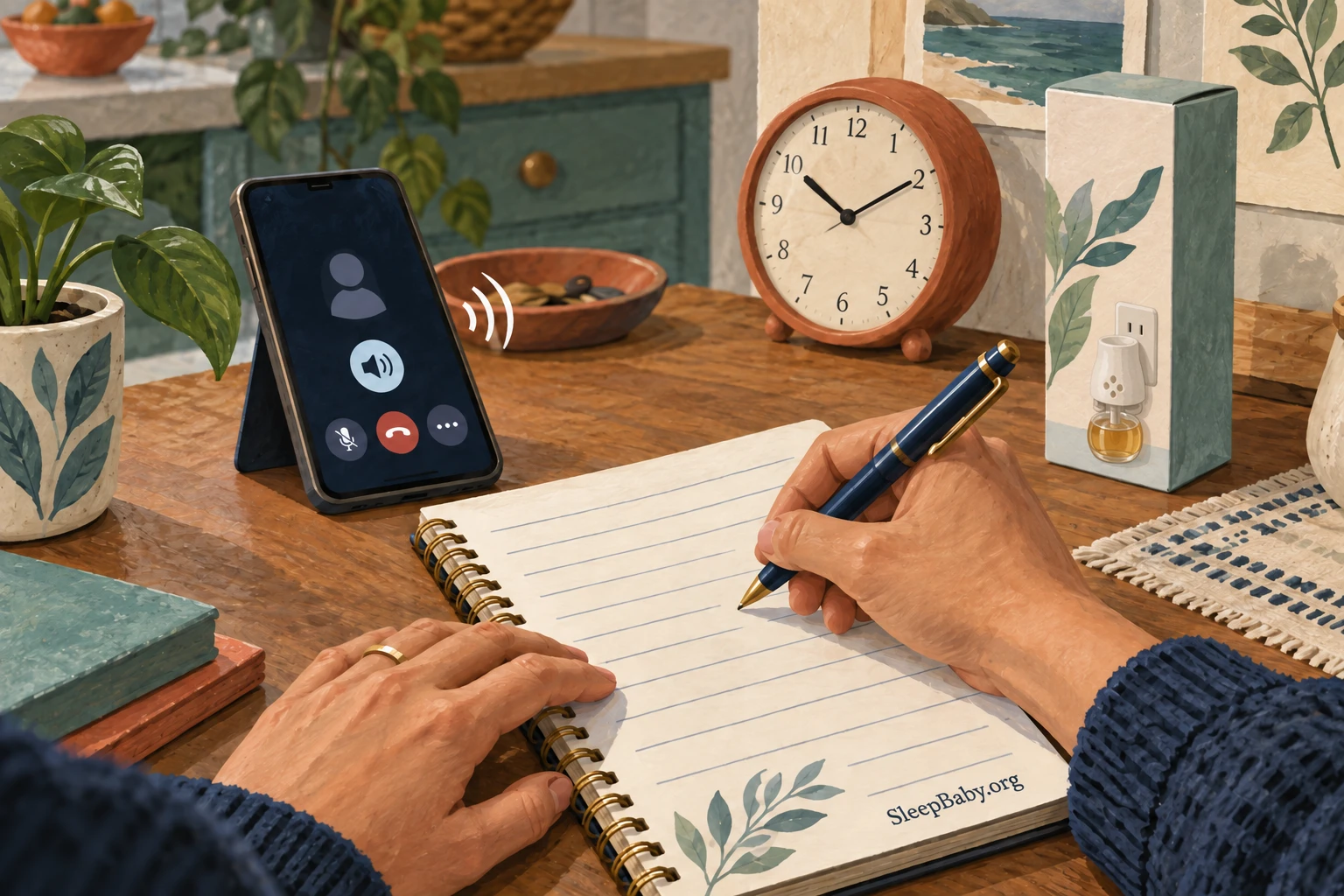
Read the instructions back in your own words. For example: “I’m going to do this now, watch for these changes, and call back at this point. Have I understood correctly?” You are checking the plan, not asking the specialist to promise an outcome.
If another adult takes over
Pass along the product, what you know about the exposure, and the actual instructions. “They said to watch” leaves too much missing. “Here is what they told us to watch for, and here is when to call again” is a useful handoff.
Keep the note where the supervising adult can see it. A photo of the label can help avoid a second search through the cupboard, but keep the original packaging too. Do not discard it while it is still needed to identify the product.

Can my baby sleep after this?
Ask Poison Control before treating the next nap as routine. There is no universal “wait this many hours, then bedtime is safe” rule I can give you for every baby and every refill. The answer depends on the assessment and any symptoms.
Tell the specialist if it is your baby’s usual nap time and describe any sleepiness you are seeing. A baby who seems unusually sleepy after a possible ingestion needs that detail assessed; I would not label it ordinary tiredness from the clock alone. If your baby cannot be awakened, call 911.
Once you have an individualized plan, follow it through the next handoff and sleep period. A monitor, an alarm, or a bedtime routine should not substitute for the supervision or medical care you were told to provide. If an instruction is unclear, call back and clarify it.
Ordinary sleep questions can wait until that plan is settled. There is no need to solve a missed nap, an untidy kitchen, and the exposure all at once. The immediate job is carrying out the instructions for this child and this product.
Make the reachable plug-in the last reachable plug-in
After your baby’s care is arranged, look at how the product became accessible. A refill in a low outlet is a different storage problem from a spare bottle in a shopping bag. I would fix the route that actually failed, then check for the same setup in other rooms.
For a baby who can reach the warmer, my practical choice would be to remove it from that accessible space. Moving it behind a chair is not the same as making it inaccessible. A chair can move, and a visitor may move it without knowing why it was there.
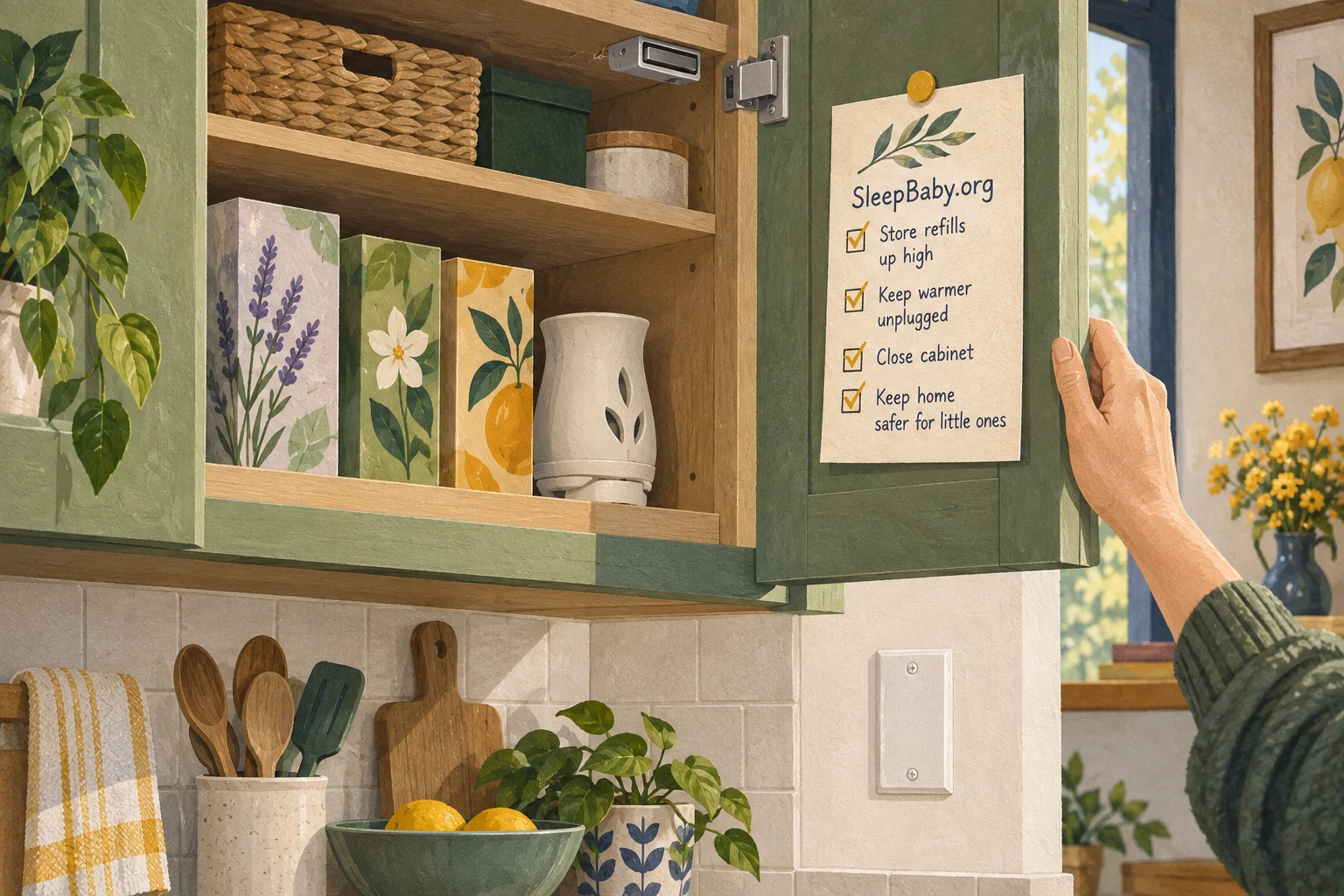
Check the refill’s whole route through the house
- Coming home: move new refills from shopping bags into secure storage.
- Waiting to be used: keep the original container and label, with spares locked away and out of sight and reach.
- In use: consider the outlet and what your child can reach from the floor or nearby furniture.
- Being replaced: keep the open carton, old refill, and loose pieces away from children while you finish the job.
The AAP recommends secure, out-of-reach storage for potentially poisonous household products and notes that safety latches can fail or be defeated. A lock adds a barrier; it does not make supervision unnecessary.
Check the guest room and a caregiver’s home too, if your baby spends time there. Point to the actual warmer when explaining the change. “We’re moving these refills into this locked cupboard” is clearer than a general reminder to be careful.
What if I am worried about the fragrance in the room?
Breathing a room fragrance and swallowing concentrated refill liquid are different exposures. Do not use information about ordinary air-freshener use to decide what to do after a possible swallow. If fumes are causing symptoms, move to fresh air and seek poison guidance; breathing trouble is an emergency.
You can choose to stop using a fragrance product without proving it caused every cough or difficult nap. I would discuss persistent symptoms with your child’s clinician and describe when they happen. This article cannot diagnose an allergy or establish a safe fragrance level for your particular baby.
A short look at the people who answer
NC Poison Control shares this brief nurse-led clip about calling its service. It is reassurance about asking for help, not instructions for treating a Glade exposure. Make the call first if an exposure has just happened.
Written takeaway: You can contact Poison Control about a possible poisoning or a question about a substance. You do not need to know for certain that your baby swallowed it. The U.S. number is 1-800-222-1222.
Optional storage help, after the immediate care
As an Amazon Associate, I earn from qualifying purchases.
Safety 1st Adhesive Magnetic Lock System
If spare refills are kept in a cabinet your child can access, a compatible cabinet lock is one practical barrier to consider. Safety 1st provides installation guidance for its Adhesive Magnetic Lock System, including the two-lock, one-key HS292 kit. Check the actual cabinet fit and the manufacturer’s directions before choosing it.
I would choose this for securing storage, not for covering an active plug-in warmer or as a guarantee against poisoning. Keep the key inaccessible to children and check that the cabinet latches each time. I have not personally tested this product, and I am not claiming that it is better than every other lock.
Look for the Safety 1st HS292 system on Amazon
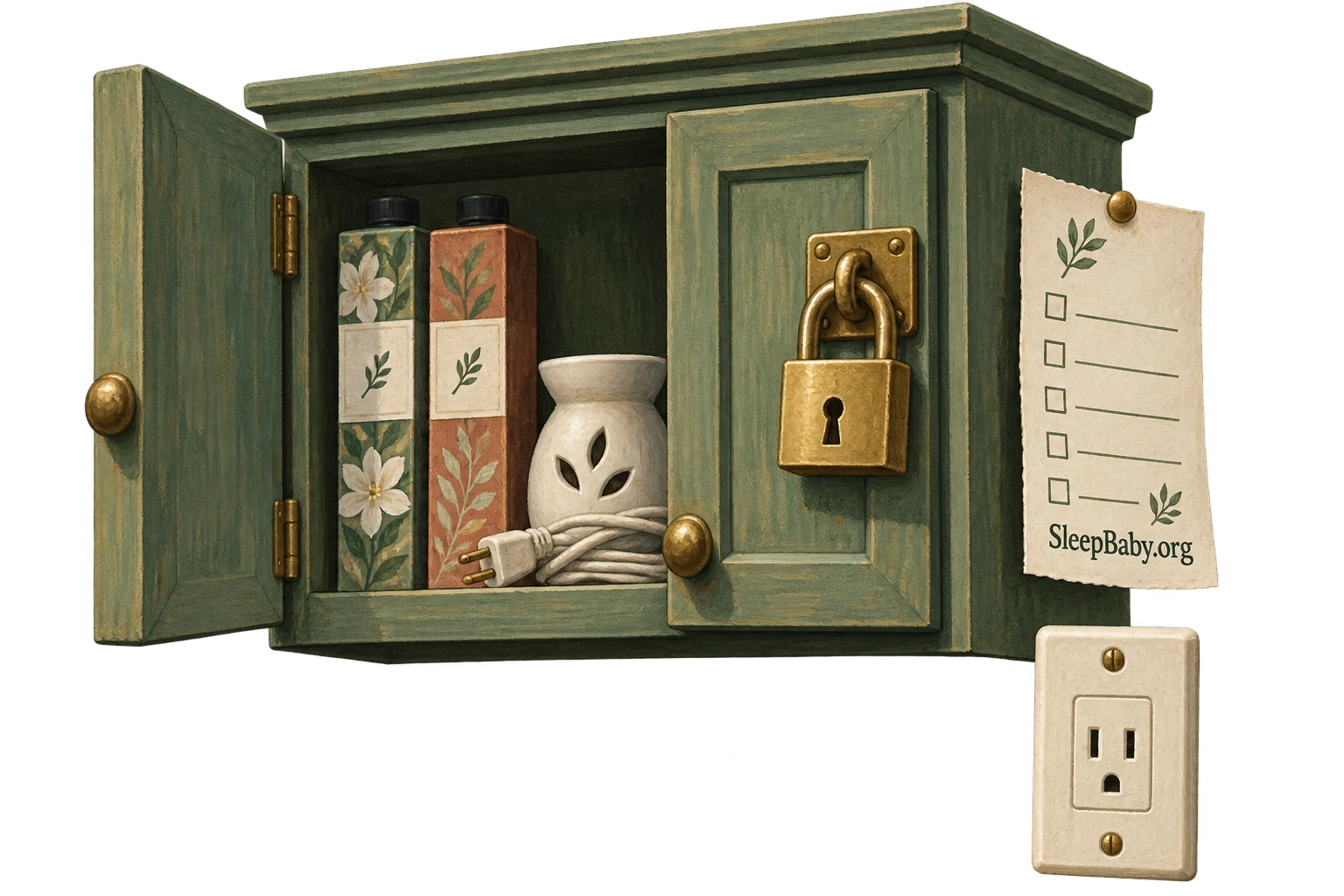
Free or already-owned alternative: remove the reachable plug-in and put spare refills in an existing locked, out-of-reach cabinet in their original packaging. You do not need to buy a new lock to use secure storage you already have.
A few details I would not use as an all-clear
“It was only a lick.”
Say exactly that if you witnessed a lick, but let the poison specialist decide what it means for the identified product and your child. Do not turn an uncertain event into a small exposure just because that sounds more reassuring.
“The bottle was nearly empty.”
Tell the specialist. Also explain whether you know how full it was before the event. “Nearly empty when found” and “almost empty before my baby touched it” are different pieces of information.
“My baby seems fine now.”
That is worth reporting, together with anything that happened earlier. It does not cancel the need for initial advice after a suspected swallow, and it does not override instructions you have already received.
“Another parent’s baby was fine.”
Their product, amount, age, and circumstances may have been different. I would rather have one clear plan for your baby than a collection of outcomes from other households.
Keep your attention on the next concrete step: get the exposure assessed, carry out the instructions, and make the product inaccessible. The rest of the evening can be planned around that.
Sources
- Poison Control: Air fresheners
- Poison Control: First aid guidelines
- Poison Control: How to get help
- American Academy of Pediatrics: Poison prevention and treatment
- SC Johnson: Glade Morning Cotton Blossom PlugIns ingredients
- NC Poison Control: Videos and PSAs
- Safety 1st: Home safety help and installation guidance
WHEN YOU ARE READY FOR ORDINARY SLEEP HELP
A clear next step is enough for tonight.
First, follow the advice for the exposure. When the remaining question is your usual bedtime or waking pattern, the SleepBaby.org homepage offers a planning preview and the free article library. You can look at a starting point before deciding whether the Workshop is useful to you.





What viewers said10 comments · 4 replies+
Archived comments from the original Baby Sleep Miracle presentation. Not independently verified by SleepBaby.org; individual experiences vary.
Thank you so much for this video! I had no idea about the dangers of baby swings :O
Hi Mary-Ann. I have a question: Is method in any way similar to the ones recommended by Dr Bucknam, Dr. Weissbluth or Dr. Karp? We tried those but none of them help.
Hi Regina, thank you for your question. The short answer is no. The techniques I share in my guide are based on newest scientific research and this is why I have never seen any approach similar to the one I recommend.
This method really works! I tried it on my son Jesus and after just one week he went from waking up more than 5 times a night to waking up just once or twice. You are a lifesaver, Mary-Ann!
I'm truly impressed with how much information you share in your video. And all for free! I can feel that you truly care about mothers like myself, and that's hard to find these days. I have recommended your site to several of my friends already.
Mary-Ann, our child suffers from autism. Is your approach still suited?
Chloe, I made sure my method can be used with any child, even babies who are special like yours. Please note that I'm not a doctor and that I always advice to consult with your physician because nothing is more important than the safety and well-being of your love.
Hallo Mary-Ann, I'm from Germany. Do you have your guide in German?
Hello Heide, we do! Normally you should already see our video in German. If not, please contact our support so they can guide you
Thenk you for your answer, Mary-Ann!
I just completed your approach and I have to say, it worked almost too well. Yes, it took a bit of getting used to with your bedtime routine but the difference is huge. My son George used to take 1 hours to go down and now he's firmly asleep in no more than 10 minutes! You're the best!
It seems I'm the only man watching this video, lol! What you shared about the 'emotional backpack' made immediate sense to me and I can't wait to help my little girl Mila to unpack it!
Hey there, just discovered your site and this really sounds different. Just wanted to say thanks for sharing :)
For everyone who's still thinking about getting Mary-Ann's guide I want to advise you to go ahead. I wasn't sure myself but now I'm so thankful I invested in this program. It made a huge difference in our life as a family and yes, my baby girl does sleep through the night now.