
If your baby ate Epsom salt, call Poison Control now at 1-800-222-1222 in the U.S., even if your baby seems well. Epsom salt contains magnesium sulfate; swallowing too much can cause more than an upset stomach. Keep the package with you, and do not make your baby vomit.
Call 911 immediately if your baby has trouble breathing, collapses, has a seizure, or cannot be awakened. Outside the U.S., use your local poison center or emergency number. Do not wait for symptoms before asking for poison advice.
I would put the phone call ahead of trying to work out whether a few missing crystals count as a dangerous amount. That decision depends on your baby and the exact product, not the size of the spill on the bathroom floor.
While you get help
- Stop further access. Move the package away. If your baby is awake and breathing normally, gently wipe visible residue from the mouth. Do not push a finger down the throat.
- Call with the original container nearby. Tell the specialist that this is a baby and whether the exposure involved dry crystals, a bath blend, or bathwater.
- Ask what to give by mouth. Do not force a drink or try to flush the salt out with a bottle of water. Follow instructions for your baby’s age, symptoms and product.
Do not give anything by mouth to a baby who cannot swallow safely, is not fully awake, is having a seizure, or is struggling to breathe. Emergency care comes first.

The four details that help Poison Control
You do not need perfect information to make the call. Put the package beside the phone, keep your baby with you, and separate what you saw from what you are assuming. A wet finger near an open bag does not tell you how much was swallowed.
The package-to-phone note
- 1. Product
- Read the full name and ingredient list. Include added oils, fragrances or melatonin if listed. Say if the label is missing.
- 2. Exposure
- Describe what actually happened: crystals in the mouth, a possible taste, or swallowed bathwater. Give an amount only if known. “I don’t know” is useful information.
- 3. Time
- Give the known time, or explain when you last saw the package closed and when you discovered it open.
- 4. Your baby
- Give age, known weight, current symptoms, medicines and health conditions. Mention any kidney problem. Do not delay the call to find a scale.
If another adult is present, one person can make the call while the other gathers the label. I would avoid turning this into a search for a precise teaspoon measurement. Report the uncertainty so the specialist can account for it.
Why Epsom salt deserves a call
Plain Epsom salt is magnesium sulfate, not table salt. Some products are labeled as saline laxatives as well as soaking aids. That does not make an accidental infant exposure safe.
Magnesium-containing products can cause diarrhea, vomiting and abdominal discomfort. A large exposure can also raise magnesium in the blood and affect muscle function, breathing and heart rhythm. Kidney problems can increase risk. These possibilities are reasons to get advice, not a prediction that your baby will develop severe poisoning.
The Epsom salt label reviewed for this guide says to consult a doctor for children under six and to get medical or poison-center help after an overdose. It does not give a home safety cutoff for a baby who found the bag. I would not shrink an adult laxative dose into an infant dose.
A bag of crystals and a sip of bathwater are different exposures
The specialist needs to know what was in reach. “Epsom salt” may describe one ingredient rather than the entire product.
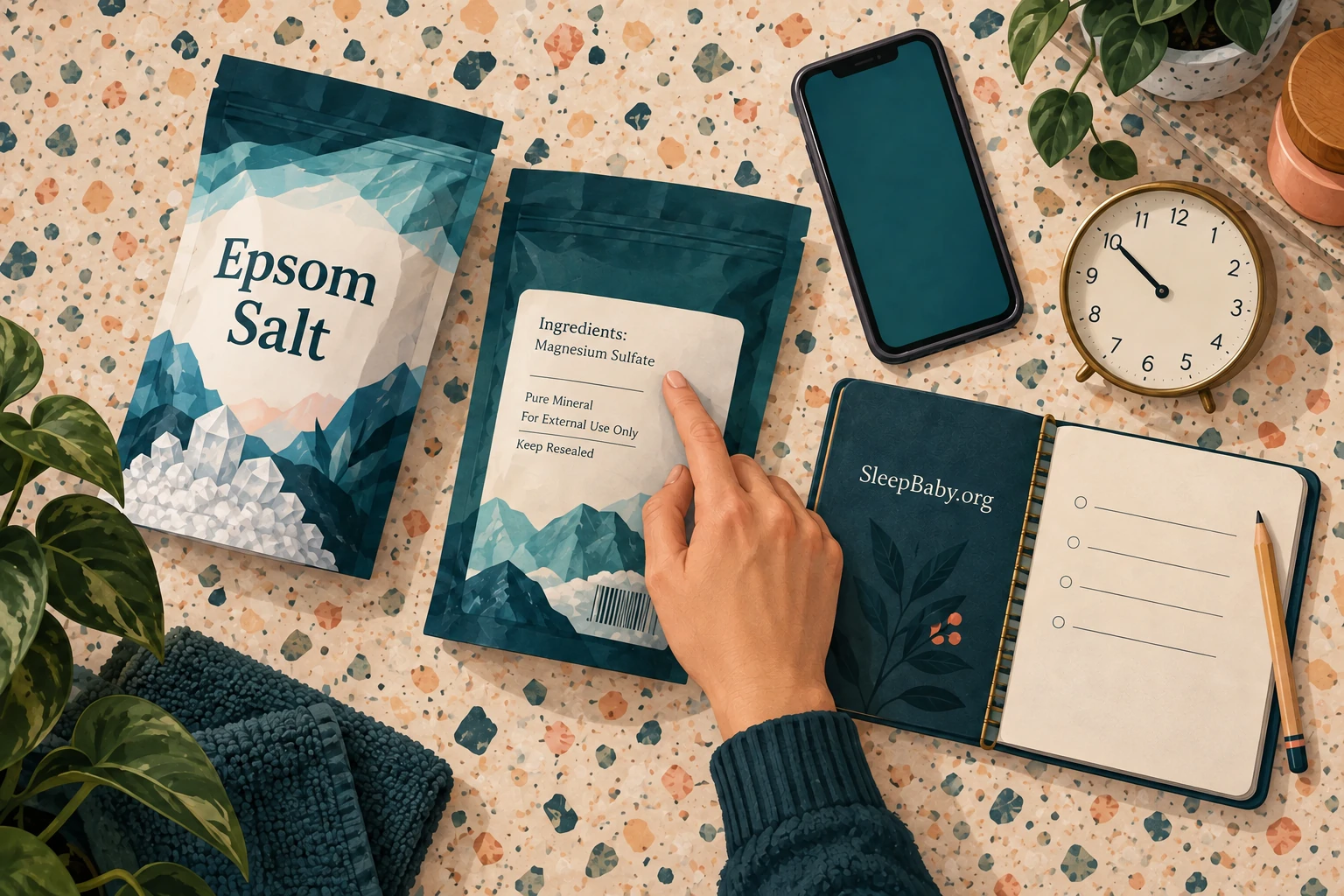
Read the back of the package
Plain crystals: Look for magnesium sulfate and the full ingredient list. Keep any Drug Facts panel available.
Scented or bedtime blends: Give the exact version. For example, Dr Teal’s sells an Epsom salt blend with melatonin, chamomile and lavender. A brand name alone does not identify the formulation.
Foaming bath, body wash or bath bomb: Say which form it was. Other ingredients matter; do not apply advice for plain salt to a different bath product.
Bathwater: Describe the product added, how much was put in the tub if known, and what you saw your baby swallow. Dilution changes the exposure, but this page cannot calculate clearance from a guessed sip.
Which symptoms change what you do?
The Poison Control magnesium guide describes digestive symptoms and, in more serious poisoning, weakness, reduced alertness and breathing or heart problems. You are not expected to diagnose magnesium toxicity at home.
Use the change you can see
Emergency: Trouble breathing, collapse, a seizure, or inability to wake your baby means call 911 immediately.
New symptoms: Tell Poison Control promptly about vomiting, diarrhea, unusual weakness, or a baby who seems unusually drowsy. Follow their escalation instructions. Do not label a new change “just tired” because it is near naptime.
Possible dehydration: Fewer wet diapers than usual, few or no tears, or a sunken soft spot need urgent medical advice. If your baby is hard to wake or has breathing difficulty, use emergency services.
What I would not try at home
Do not induce vomiting, give another laxative, or try a homemade antidote. Do not use a salty drink to make your baby sick. The Maryland Poison Center specifically advises against home remedies used to trigger vomiting.
Keep adult directions off your baby’s care plan. Instructions to dissolve a laxative dose in a glass of water are directions for that labeled use, not first aid for an infant. Ask the poison specialist whether to offer a feed or fluid, which one, and how much. Follow that answer rather than a general internet tip.
LATER, WHEN THE CARE PLAN ALLOWS
Let the bath salts sit this one out

Once you have exposure-specific advice and know what tonight requires, you can explore a simple bedtime starting point at SleepBaby.org. The free browser preview offers three choices and one suggested starting step, with no sign-up or card.
If you want more structure for ordinary sleep planning, the separate, optional paid SleepBaby.org Workshop has short lessons you can revisit and a seven-night tracker. You can leave bath additives out of that plan.
Neither the preview nor the Workshop treats an ingestion, provides medical clearance, or tells you when monitoring can stop. Follow Poison Control or your clinician’s instructions first.
If home observation is recommended
Ask the specialist to make the plan concrete: what changes should trigger a call back, whether any feeding instructions apply, how long to watch, and what to do about the next nap. The plan for your baby may differ from the plan another family received.
I would write those answers down while still on the phone. It is easy to remember “watch at home” and lose the part about what you are watching for. If you are unsure you understood, repeat the instructions back and ask for clarification.
Keep the container until the specialist says you no longer need it. If you are told to seek care, take it with you when practical. New symptoms deserve another call even if an earlier conversation sounded reassuring. Severe emergency signs still mean emergency services.
Write the instructions, not an all-clear
Advice received: ____________________
Call back or seek care if: ____________________
Feeding, nap and observation instructions: ____________________
Who is with the baby next: ____________________
This is a place to copy professional advice, not a checklist for deciding your baby is safe.
Can my baby go to sleep after eating Epsom salt?
Get exposure-specific advice before treating the next sleep as an ordinary nap. There is no universal number of minutes after which this article can tell you an ingestion is over. Ask whether your baby may sleep and what observation is needed.
Unusual sleepiness is a symptom to report, not proof that a bath product is helping your baby relax. If your baby cannot be awakened, call 911. I would not use a monitor reading, a quiet room, or a normal-looking diaper as a substitute for the advice from the call.
When sleep is appropriate under that plan, keep the usual safe sleep setup: place your baby on their back on a firm, flat, level infant sleep surface with a fitted sheet and no pillows, loose blankets or toys. Do not incline the mattress or add a positioner because you are worried about vomiting. Follow medical instructions about observation and seek help if the situation changes.
Do Epsom salt baths help infant constipation, eczema or sleep?
I would not turn an accidental exposure into a reason to try Epsom salt as a treatment. Poison Control’s discussion of bath products explains that claims about meaningful magnesium absorption through the skin and internal health benefits are not supported by good evidence.
That leaves no sound basis here for recommending a baby bath schedule to treat constipation, diaper rash, eczema or sleep problems. Ask your pediatrician about the actual symptom and an age-appropriate plan. Do not give Epsom salt by mouth to your baby on your own, and do not assume a product marketed for relaxation has been established as safe or effective for infants.
A familiar bedtime routine can stay simple. Once the exposure has been addressed, ordinary things such as clean pajamas and your usual quiet routine do not need a magnesium claim attached to them.

Make the bathroom harder to explore next time
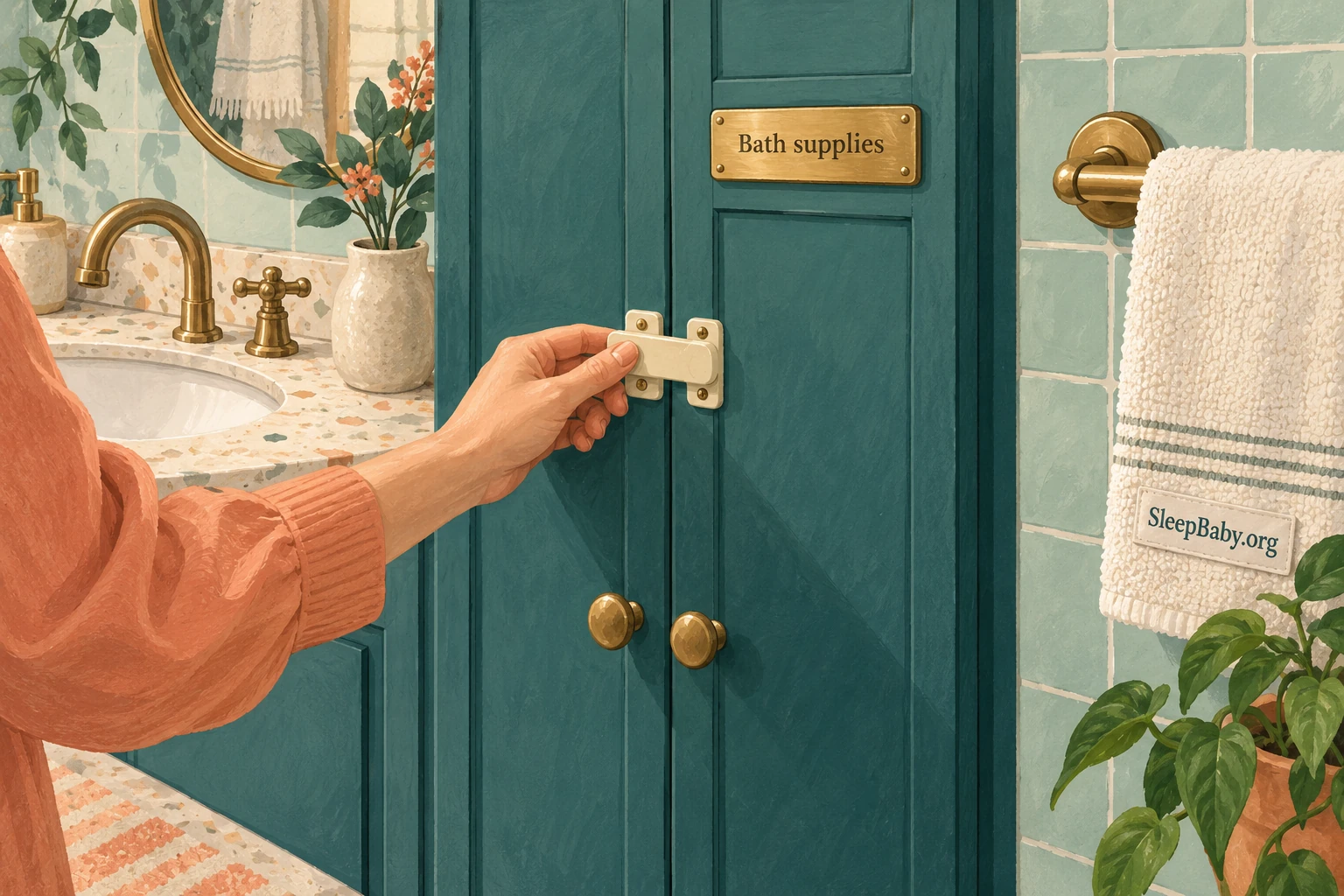
My first change would be the storage spot, not a new bath product. Keep salts and other household products closed in their original containers, out of sight and reach, ideally in a locked cupboard. A decorative jar loses the label and can make a household product look like something to taste.
Check the route your baby actually used. Was the bag beside the tub, on a low shelf, in an overnight bag, or left on the floor while the bath ran? Fix that route before the next bath. If another adult can stay with your baby, clean up the spill and secure the container while you follow the care plan.
Do not assume a resealable top or a high shelf is enough. Children learn to climb, and child-resistant packaging is not childproof. Check that the cupboard latches after each use; keep visiting caregivers’ toiletries and supplements secured too.
Optional storage help: check your cupboard first
As an Amazon Associate, SleepBaby may earn from qualifying purchases.
If you need a lock for compatible cupboard hardware, the Safety 1st OutSmart Flex Lock, white, two-pack is one option to investigate. I would check the exact model, your door hardware and the manufacturer’s instructions before choosing it. A latch is an added barrier, not permission to leave a reachable product unattended.
See the Safety 1st OutSmart Flex Lock on Amazon
Use what you already have: move the original closed bag into an existing secure, latched cupboard out of sight and reach. There is no need to buy a new lock if your current storage already does the job. This is for future storage, never treatment for an ingestion.
A hospital guide to reducing household poisoning risks
St. Louis Children’s Hospital’s “How to poison-proof your home” covers safer storage. Save this for after you have handled the exposure; do not delay a call to watch it.
Written takeaway: keep harmful products in their original packaging, secure storage, and check that cabinet locks are engaged. If the player does not load, read the hospital’s matching written guide.

Give the next caregiver the whole plan
A handoff after a scare can be very short and still be useful. Share the product name, what was known about the exposure, when you called, and the exact instructions. Point out where the package and written note are kept.
Instead of saying “everything is fine,” say what you were told to do and what would change that plan. If grandparents or a sitter will be there for the next nap, make sure they have the call-back number and know who to contact. I would rather repeat one clear plan than leave the next adult piecing it together from messages.
Questions that often come up after the call
What if it was only a lick?
Describe it as a lick if that is what you saw, and say if the amount is uncertain. Do not turn that word into a safety guarantee. Poison Control can assess a possible taste in the context of the actual product and your baby.
What if my baby seems completely normal?
That is useful to report, but do not wait for symptoms to make the initial call. The purpose is to find out what this exposure requires while you still have the label and the details close at hand.
Should I throw the bag away?
First keep it available for the call and any medical visit. Secure it away from your baby. Once the care plan is settled, decide whether it has a safe storage place in your home; discarding the label immediately can remove useful information.
Sources
- Poison Control: first aid for poisonings
- Poison Control: magnesium overdose
- MedlinePlus: laxative overdose
- Poison Control: getting help and preparing for the call
- Maryland Poison Center: first aid for poisoning
- DailyMed: Signature Select Epsom salt label
- Poison Control: bath bombs and magnesium claims
- Dr Teal’s: melatonin, chamomile and lavender Epsom salt product identity
- NHS: dehydration and signs in babies
- NICHD Safe to Sleep: reducing sleep-related risks
- St. Louis Children’s Hospital: keeping children safe from poisoning
- St. Louis Children’s Hospital: poison-proofing video and written guide
- Safety 1st: official home safety manuals and model guide
KEEP THE NEXT STEP SMALL
A secured cupboard. A clear care plan. Then bedtime.
For the exposure, use the advice you received for your baby. When ordinary bedtime planning is appropriate again, the free SleepBaby.org preview can help you choose one place to start. No bath salts required.






What viewers said10 comments · 4 replies+
Archived comments from the original Baby Sleep Miracle presentation. Not independently verified by SleepBaby.org; individual experiences vary.
Thank you so much for this video! I had no idea about the dangers of baby swings :O
Hi Mary-Ann. I have a question: Is method in any way similar to the ones recommended by Dr Bucknam, Dr. Weissbluth or Dr. Karp? We tried those but none of them help.
Hi Regina, thank you for your question. The short answer is no. The techniques I share in my guide are based on newest scientific research and this is why I have never seen any approach similar to the one I recommend.
This method really works! I tried it on my son Jesus and after just one week he went from waking up more than 5 times a night to waking up just once or twice. You are a lifesaver, Mary-Ann!
I'm truly impressed with how much information you share in your video. And all for free! I can feel that you truly care about mothers like myself, and that's hard to find these days. I have recommended your site to several of my friends already.
Mary-Ann, our child suffers from autism. Is your approach still suited?
Chloe, I made sure my method can be used with any child, even babies who are special like yours. Please note that I'm not a doctor and that I always advice to consult with your physician because nothing is more important than the safety and well-being of your love.
Hallo Mary-Ann, I'm from Germany. Do you have your guide in German?
Hello Heide, we do! Normally you should already see our video in German. If not, please contact our support so they can guide you
Thenk you for your answer, Mary-Ann!
I just completed your approach and I have to say, it worked almost too well. Yes, it took a bit of getting used to with your bedtime routine but the difference is huge. My son George used to take 1 hours to go down and now he's firmly asleep in no more than 10 minutes! You're the best!
It seems I'm the only man watching this video, lol! What you shared about the 'emotional backpack' made immediate sense to me and I can't wait to help my little girl Mila to unpack it!
Hey there, just discovered your site and this really sounds different. Just wanted to say thanks for sharing :)
For everyone who's still thinking about getting Mary-Ann's guide I want to advise you to go ahead. I wasn't sure myself but now I'm so thankful I invested in this program. It made a huge difference in our life as a family and yes, my baby girl does sleep through the night now.