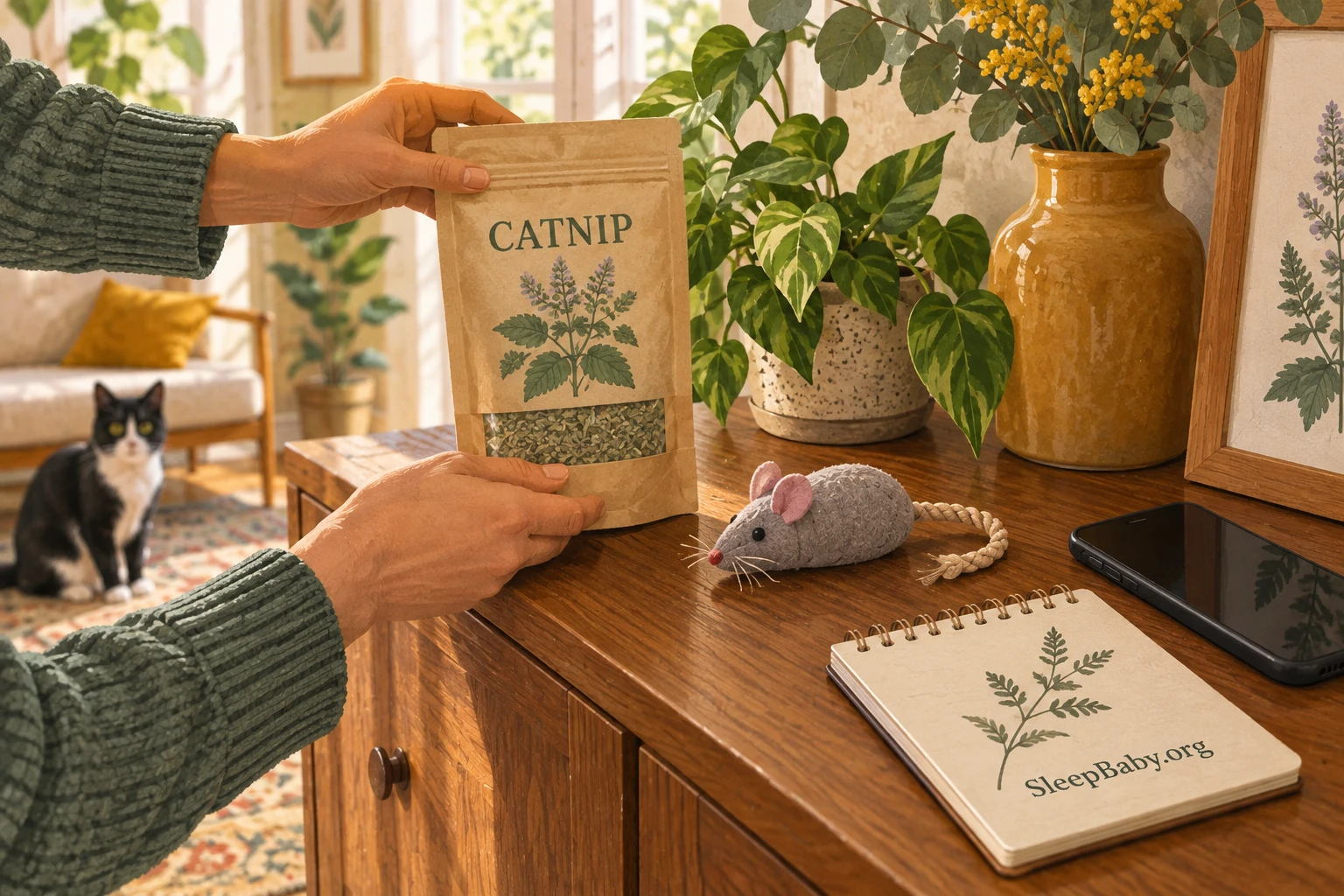
If your baby ate catnip, take the product away and call Poison Control at 1-800-222-1222 in the U.S. for advice about the exact exposure. Don’t wait for symptoms. If your baby has trouble breathing, collapses, has a seizure, or cannot be awakened, call 911 immediately. Don’t make your baby vomit.
I would check the packaging before assuming this was simply a mouthful of leaves. Loose catnip, a spray, and the filling of a torn cat toy are different things to report. Outside the U.S., contact your local poison service or urgent medical service; use your local emergency number for severe symptoms. Poison Control’s first-aid guidance explains the emergency signs.
SleepBaby.org · The original video
A little help
for the night ahead.
Take a moment to watch the original Baby Sleep Miracle presentation. Your article will be right here when you’re ready to keep reading.
Ready to get started?Take the next step with SleepBaby.
Help my baby sleepWhat to do right now
- Check your baby first. Breathing and responsiveness matter more than identifying every leaf on the rug. Get emergency help for the signs above.
- Stop access. Move the pouch, plant, spray, or toy out of reach. If your baby is alert and breathing normally, gently wipe away loose material you can easily reach at the front of the mouth with a damp cloth. Never sweep a finger blindly into the throat.
- Keep the evidence. Save the package and the toy, including any loose pieces. Call with what you know; an unknown amount is a reason to ask for help, not a reason to delay.
Don’t give salt water, induce vomiting, or use food or a large drink to try to flush it through. Ask the poison specialist what, if anything, your baby should have by mouth. General plant instructions aren’t an infant fluid prescription.
Sources: Texas Poison Center Network, NHS choking guidance, and Poison Control.

Is catnip poisonous to babies?
Catnip is the herb Nepeta cataria. I wouldn’t describe it as harmless for every baby, in every amount. The human evidence doesn’t give us a reliable home rule such as “one pinch is safe” or “watch for two hours and you’re done.” A sprinkle of dried leaves also doesn’t tell us anything useful about a concentrated product with other ingredients.
A 1997 medical case report describes a toddler who developed central nervous system depression after eating a large amount of catnip. That means reduced nervous-system activity, rather than the playful behavior people associate with cats. It’s one reported case, not a prediction for your baby. The abstract does not establish a safe infant dose or tell us how often this happens.
That distinction is why I’d make the call without declaring an emergency from the word catnip alone. Your baby’s condition and the actual exposure determine the next step. A poison specialist can assess those details; an article can’t clear a child from a description like “a little bit.”
A cat enjoying a plant isn’t evidence that a baby can eat it. The National Capital Poison Center also points out that even plants considered nonpoisonous can be choking hazards. “Natural,” “organic,” and “for cats” don’t answer the infant-safety question.
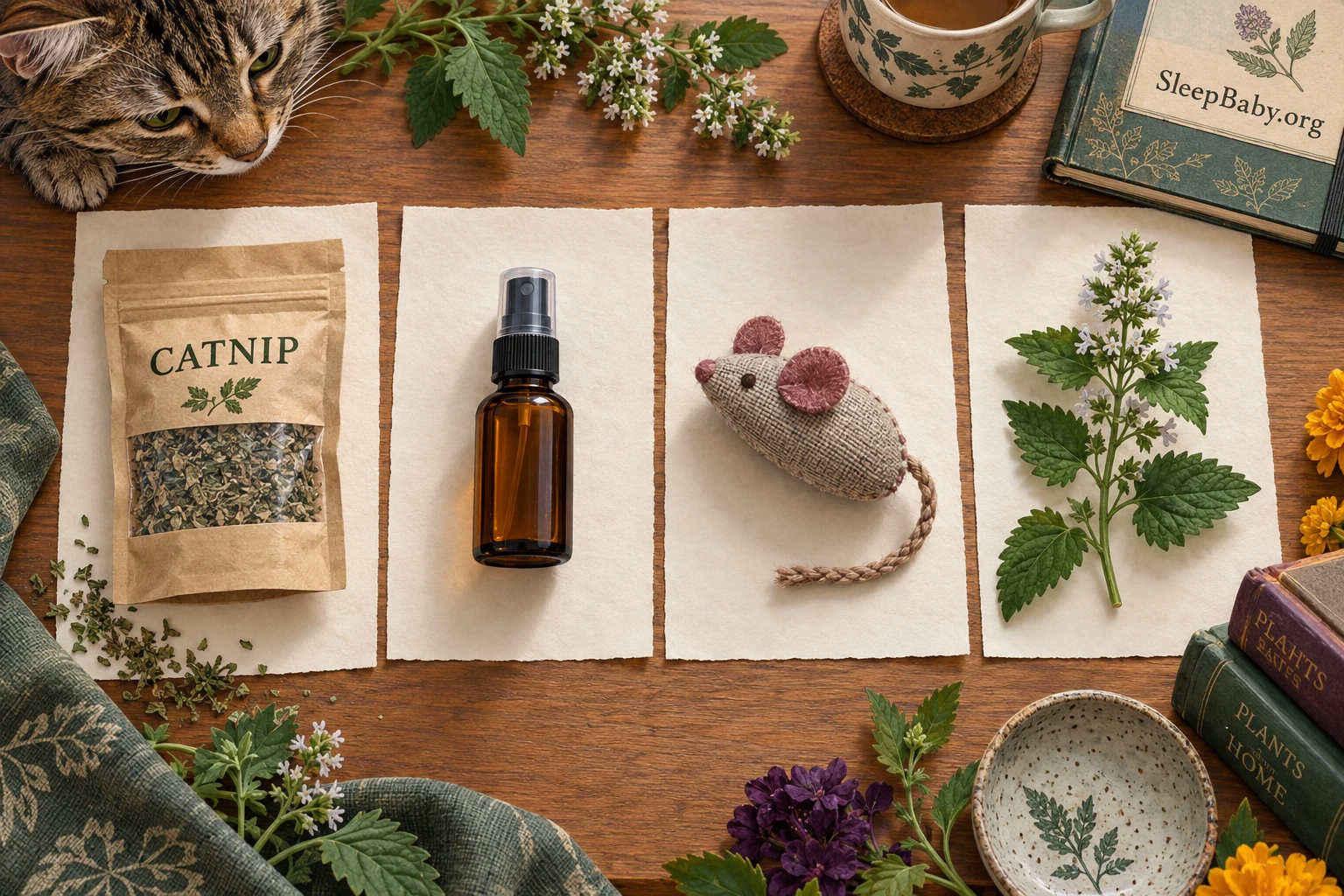
Work out what your baby actually reached
Read the full product name and ingredient list aloud when you call. A photo of the front of a pouch may miss the useful information on the back. If you can’t find the packaging, say so. Don’t put off getting advice while you search the house.
Loose dried catnip or a fresh plant
Tell the specialist whether this was dried material from a labeled package or a plant from a pot or garden. Keep the label or a plant sample safely away from your baby. Don’t identify an unknown plant from its smell, your cat’s interest, or a picture that seems close enough.
If you know a garden product was used on the plant, have that container available too. The question then includes both the plant and anything applied to it. Report uncertainty plainly rather than choosing whichever explanation feels more reassuring.
Catnip spray, oil, extract, or a liquid refill
Use the exact label, including other ingredients and concentrations if listed. Don’t treat a liquid as the equivalent of dried leaves. Poison Control warns that essential-oil products can cause poisoning, and oil entering the lungs during swallowing or choking can cause pneumonia. Some formulations also contain alcohol or other ingredients.
Call promptly about a swallowed oil or product containing essential oils, even if your baby looks comfortable. If coughing or breathing difficulty follows the exposure, tell the specialist immediately; breathing difficulty needs emergency services. These are general oil-exposure concerns, not a claim that every catnip spray has the same formula or risk.
A torn mouse toy, loose stuffing, or a missing piece
Look at the whole toy. The dried herb may be only one part of what was in your baby’s mouth. Mention missing fabric, filling, string, plastic, a bell, or anything else you cannot account for. A partly emptied toy doesn’t prove that every missing bit was swallowed, but the possibility belongs in the call.
A possibly swallowed battery or magnet needs immediate emergency-department assessment, even without symptoms. This matters if the toy has an electronic or magnetic part; it is not an assumption that ordinary catnip mice contain them. A large or sharp object also needs urgent assessment. Alder Hey Children’s Hospital explains these swallowed-object risks.

THE LABEL CHECK
Bring five details to the call
I use LABEL here as a way to organize the information, not as a test your baby has to pass.
- L · Look at your baby
- Describe breathing, alertness, and any symptoms first.
- A · Actual product
- Give the full name, ingredients, and whether it was a leaf, liquid, or toy.
- B · Baby’s details
- Give age, known weight, medicines, and relevant medical history. Say when you don’t know.
- E · Exposure estimate
- Explain what you saw and what might be missing. Separate a witnessed swallow from a possibility.
- L · Last known time
- Give the time it happened, or the range between last seeing the item intact and discovering it.
A useful opening is: “My baby is ___ months old. I found ___ at about ___. The label says ___. I saw ___, and right now my baby is ___.” Fill it with your observations, not guesses.
Poison Control describes the information its specialists ask for. U.S. phone advice is free, confidential, and available 24 hours a day.
AFTER THE EXPOSURE PLAN IS CLEAR
Give bedtime its own small plan

Once you have professional guidance for the catnip exposure, you can leave ordinary sleep planning for a separate moment. The SleepBaby.org planning preview offers a browser-based starting step without a sign-up or card.
If you want more structure for ordinary bedtime decisions, the optional paid SleepBaby.org Workshop offers short lessons you can revisit and a seven-night tracker. I would keep the poison specialist’s instructions separate from that sleep plan.
The preview and Workshop do not assess ingestion, treat symptoms, tell you whether your baby can nap, or replace monitoring advice. No purchase is needed to use the safety steps in this article.
Symptoms that change what you should do
The important question isn’t whether a symptom appears on a generic list of “catnip side effects.” It’s whether your baby needs help now. There isn’t enough infant-specific evidence to label every episode of vomiting, fussiness, or sleepiness as a predictable catnip reaction.
Emergency help now
Call 911 for trouble breathing, collapse, seizure, or a baby you cannot wake. If your baby is choking and cannot breathe or cry effectively, get emergency help and begin infant choking first aid. Don’t wait for a video to load or finish reading this page.
New symptoms after a possible swallowed toy part
Seek urgent medical assessment for new drooling, trouble swallowing, repeated gagging or vomiting, feeding refusal, or blood in vomit or stool after a suspected swallowed object. Those concerns need evaluation rather than an assumption that the herb has upset your baby’s stomach. Breathing problems or difficulty waking move this into emergency territory. See Alder Hey’s symptom guidance.
Your baby seems well
That’s useful information for the call, but it doesn’t identify the substance or amount. Don’t wait for your baby to become unwell before contacting Poison Control. If home observation is recommended, write down the specific changes to watch for, how long that advice applies, and whom to contact if something changes.
Can I let my baby nap after eating catnip?
I would ask that directly during the exposure assessment: “It’s nearly nap time. What should I do about sleep, and what changes need another call?” A normal nap schedule doesn’t explain new, unusual drowsiness after a possible ingestion. Report that change promptly rather than treating it as proof the herb is relaxing your baby.
If your baby cannot be awakened, call emergency services. If your baby is sleepier than usual but responsive, contact Poison Control or your clinician immediately for instructions. The catnip case report is a reason to take altered alertness seriously, not a reason to keep every exposed baby awake for an arbitrary number of hours.
Once a professional has advised that ordinary sleep is appropriate, follow their monitoring instructions and usual safe-sleep guidance. Put your baby on their back on a firm, flat, level infant sleep surface with only a fitted sheet. Keep cat toys, pillows, and loose blankets out. Don’t settle on a sofa holding your baby as a substitute for a clear observation plan. NICHD’s Safe to Sleep guidance explains the sleep-space basics.
Before another adult takes over, give them the product details and the actual advice you received. “Poison Control said to watch for these changes” is a much more useful handoff than “I think everything’s fine.” Keep the instructions where both of you can find them.
Don’t turn catnip into a baby sleep remedy
Finding advice about catnip tea for adults doesn’t establish that it’s appropriate for an infant. I wouldn’t offer catnip tea, oil, or a supplement to settle a baby, or give more of it after an accidental taste.
Poison Control cautions against giving infants herbal preparations without checking with their health professional. Safety studies are limited, ingredients may vary, and botanical preparations can cause adverse effects or interact with medicines. An accidental exposure and an intentional sleep treatment are different decisions; neither is answered by a pet-product label.
If someone already gave your baby a tea or remedy, include that in the call. Bring the recipe or packaging and explain the amount offered as accurately as you can. The useful task is identifying the exposure, not defending why it happened.
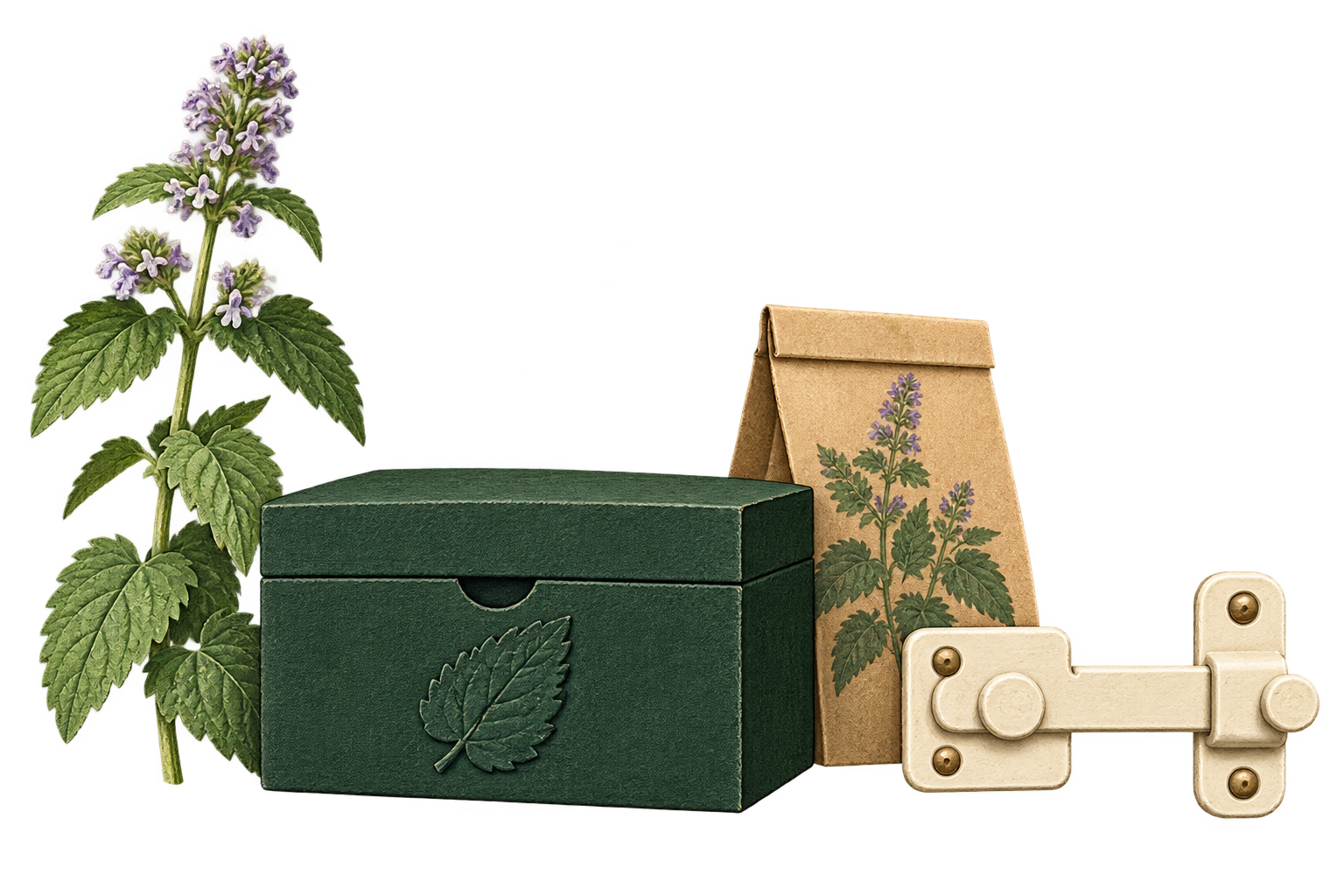
Make the pet-supply area harder to reach
After the immediate advice is handled, I’d follow the route the item took. Was a pouch left beside the scratching post? Did a cat carry a toy into the play area? Did a visitor refill the catnip jar and leave it on a low shelf? Fix the specific access point you found.
- Store the refill supply. Keep catnip, sprays, oils, and other pet products in their original labeled containers, secured out of children’s sight and reach.
- Check the toy before putting it back. Retire a torn toy with exposed filling or loose parts. Count missing pieces for the exposure call before discarding anything.
- Separate play spaces. Pick up cat toys before baby floor time and check the infant sleep space. A pet can move an item after you’ve tidied.
- Give other caregivers a specific rule. Show them where pet supplies belong and make clear that cat toys aren’t baby toys.
You don’t need to redesign the whole room tonight. Move the accessible supply, keep the label, and choose one storage habit everyone can repeat. A high location is more useful when a child can’t climb to it and a pet can’t knock the contents down.
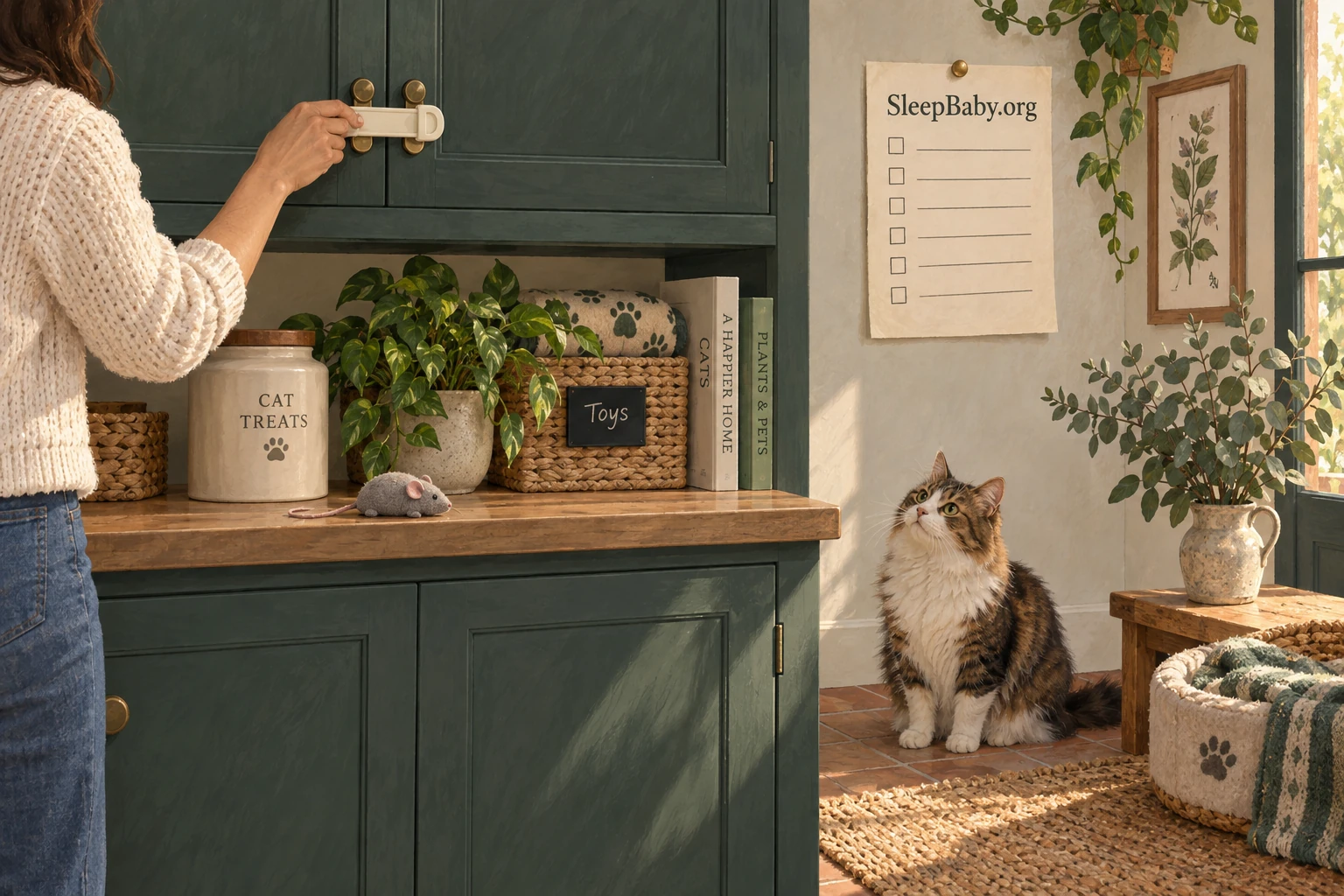
A cabinet option if pet supplies keep ending up within reach
As an Amazon Associate I earn from qualifying purchases.
The Safety 1st Cabinet Slide Lock, model 11002, is worth considering if your storage cabinet has compatible side-by-side handles or knobs. The manufacturer’s listing describes a sliding design that attaches without hardware. Check its fit and current installation instructions before choosing it.
My reason for including it is straightforward: a designated closed pet-supply cabinet is easier to maintain than remembering to move a pouch after every use. I haven’t tested this lock, and a latch does not make a cabinet childproof or replace supervision. It also won’t stop a cat carrying an already accessible toy into another room.
Compare the Safety 1st Cabinet Slide Lock on Amazon
Already-owned alternative: move the original packages into an existing locked cupboard you can use now. If you don’t have one, immediately relocate them out of sight and reach in a secure area inaccessible to your baby while you arrange suitable storage. Keep the labels with the products. Buying something can wait; removing access cannot.
Video: recognize choking and gagging
This BabyCentre video is linked from the NHS page on choking and gagging. It’s background learning for the choking risk of leaves or a torn toy, not catnip-poisoning advice. Use emergency services and immediate first aid during an actual choking episode.
Written takeaway: a loud, effective cough is different from silent or ineffective coughing with difficulty breathing. Stay with a baby who is coughing effectively. A responsive infant under one who cannot cough or breathe effectively needs infant choking first aid: up to five back blows, then up to five chest thrusts if needed, checking after each. Do not use abdominal thrusts on an infant or blindly sweep the mouth. If the baby becomes unresponsive, start CPR and follow the emergency dispatcher’s instructions.
Get medical help after clearing a choking blockage. The NHS written first-aid steps remain available if the video won’t load. NHS video referral and gagging guidance.

Before you put the package away
Keep the product name, exposure time, and professional instructions together until the recommended observation is finished. If another detail turns up, such as a torn seam or a different ingredient, pass it on. New information can change the advice.
For me, the next useful step is a clear plan for this baby and this product. Once that is in place, ordinary household and bedtime decisions can become ordinary again.
WHEN YOU’RE READY FOR ORDINARY BEDTIME QUESTIONS
One starting step is enough
Finish the exposure plan with Poison Control or your clinician first. When the question is ordinary bedtime planning, the SleepBaby.org homepage offers a free browser-based preview to help you choose a starting step.
Keep tonight simple: follow the advice for your baby, secure the pet supplies, and let optional sleep planning wait until it is useful.
Sources
- Poison Control: First aid for poisonings
- Poison Control: How to get help
- NHS: How to stop a child from choking
- NHS: Choking and gagging on food
- Safety 1st: Cabinet Slide Lock, model 11002
- NICHD: Reduce the risk of sleep-related infant death
- Osterhoudt and colleagues (1997): Catnip and the alteration of human consciousness
- Poison Control: Do not give herbal supplements to infants
- Poison Control: Essential oils
- Poison Control: Poisonous and non-poisonous plants
- Texas Poison Center Network: Know Your Plants
- Alder Hey Children’s Hospital: Swallowed something
SleepBaby.org · The original video
A next step for
the next bedtime.
Still thinking about sleep? Watch the presentation here, then explore the SleepBaby program whenever you’re ready.
Ready to get started?Take the next step with SleepBaby.
Help my baby sleep