
If your baby ate baking soda straight from the package, or you aren’t sure how much went into their mouth, call Poison Control now at 1-800-222-1222 in the U.S. Don’t wait for symptoms, and don’t make your baby vomit. If your baby has trouble breathing, has a seizure, collapses, or cannot be awakened, call 911 immediately. Outside the U.S., contact your local poison service or emergency number.
I would keep the actual box beside the phone. “Baking soda” is useful information; the exact label, your baby’s age, and what you saw are more useful than a guess about a safe spoonful.
SleepBaby.org · The original video
A little help
for the night ahead.
Take a moment to watch the original Baby Sleep Miracle presentation. Your article will be right here when you’re ready to keep reading.
Ready to get started?Take the next step with SleepBaby.
Help my baby sleepThe first move is a call
Take the package away and prevent another mouthful. Gently wipe visible powder from the mouth with a soft, wet cloth. A toddler who can spit can spit out what remains. Do not force vomiting or try a homemade antidote.
Tell the specialist right away about any symptoms. Ask what, if anything, to give by mouth and what to do about the next feed. Don’t use a large drink to try to wash the powder through.
Poison Control can assess a possible exposure even if you did not see a swallow. You do not need to prove that your child ate a dangerous amount before calling.
Guidance: Poison Control, Missouri Poison Center and the American Academy of Pediatrics.
What can baking soda do to a baby?
Baking soda is sodium bicarbonate. Ingesting too much can disturb sodium levels and the body’s acid-base balance, and it can produce gas in the stomach. An ingredient used in a recipe is not automatically harmless when a child eats the concentrated powder. Poison Control’s baking soda guidance recommends getting case-specific help after an ingestion.
That doesn’t mean every touch or taste causes poisoning. It means this page cannot decide which exposure your baby had. A powdery lip, a tipped box, and an unknown amount are observations to report, not a dose calculation.
For example, if you found a carton on its side and powder on the floor, some may have spilled rather than been swallowed. I would describe both facts. I would not turn the size of the floor spill into the amount inside a baby’s stomach.
Symptoms change the urgency, but don’t wait for them
Call 911: trouble breathing, a seizure, collapse, or a baby who cannot be awakened.
Report promptly to Poison Control: vomiting, diarrhea, unusual irritability, muscle weakness or spasms. Mention belly discomfort or swelling and anything else that looks different from your baby’s usual behavior.
No symptoms yet: still call about the exposure. Looking comfortable does not establish the swallowed amount or replace an assessment.
Sources: Poison Control first aid and MedlinePlus: baking soda overdose.
Read the package, not just the word “soda”
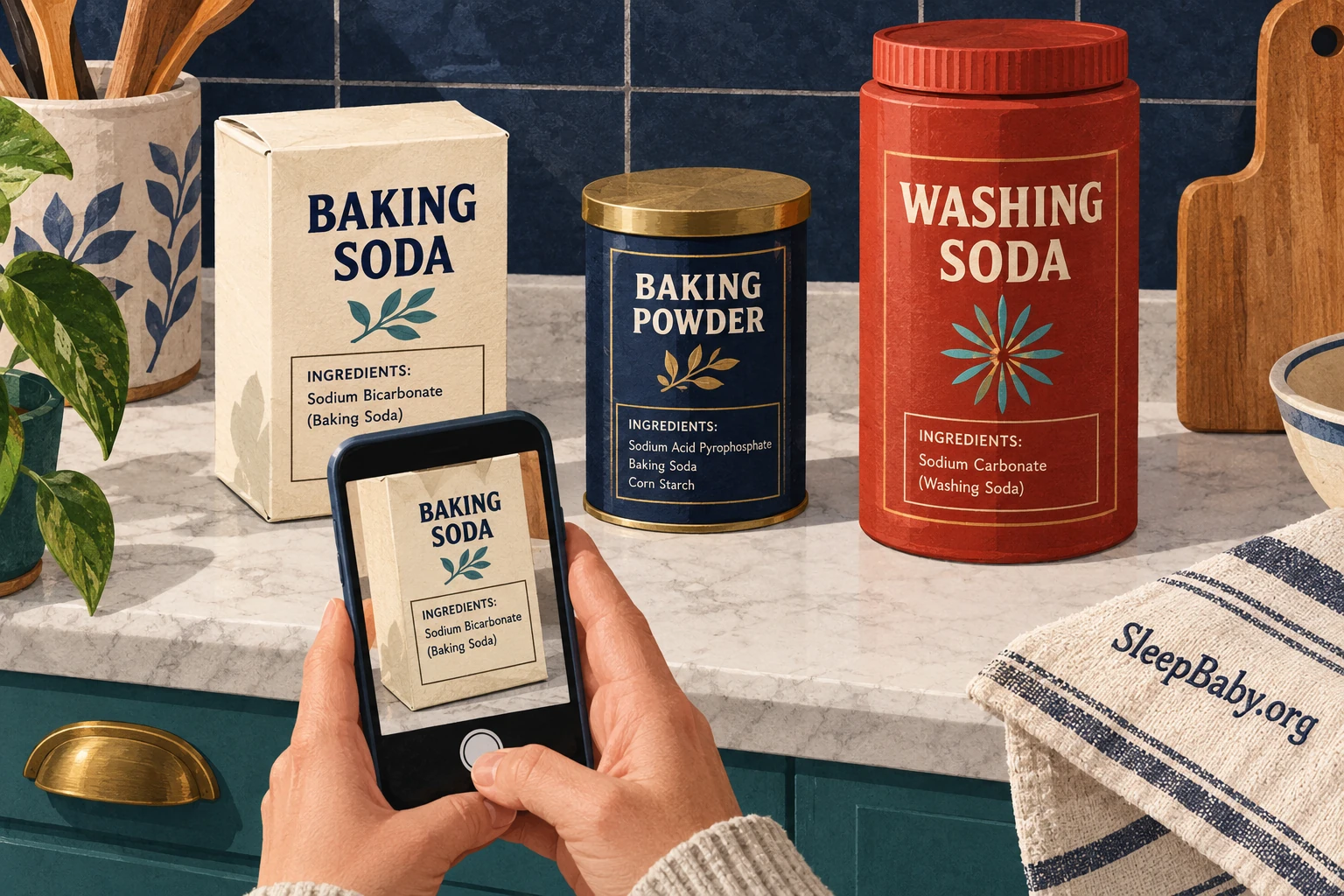
The front label is a start. Turn the container around so you can read its ingredients to the specialist. If you have a photo of the package, keep it available. Don’t delay the call to find a matching product online.
Three similar names, three descriptions to give
- Plain baking soda
- Look for sodium bicarbonate. Say whether it came from a baking box, an open refrigerator deodorizer, or another container.
- Baking powder
- This contains bicarbonate plus other ingredients. Read the exact product rather than treating it as interchangeable with baking soda.
- Washing soda or a cleaning mixture
- Washing soda is sodium carbonate, a different chemical. A cleaner advertised as containing baking soda may include additional substances. Give the full name and ingredient list.
A familiar-looking box is not enough to identify a substance that has been transferred into an unmarked tub. If the label is missing, say so. If someone mixed it with detergent, vinegar, essential oils, or another product, report every ingredient you know. Don’t attempt to reproduce the mixture for the call.
MedlinePlus treats washing soda exposure separately. Instructions for that product should not be borrowed as treatment instructions for an infant who swallowed baking soda.
What if it was in food?
Baking soda used normally in cooking and baking is a different situation from eating the powder. MedlinePlus makes that distinction. If you are concerned that a recipe contained far too much, explain the recipe error and what your child ate to Poison Control. Don’t estimate safety by how the food tasted to you.
Keep those two questions separate: “Was baking soda an ordinary ingredient?” and “Did my child get an unusual amount?” A normal ingredient list and an accidental spill into the batter are different stories.
A call card you can use while holding your baby
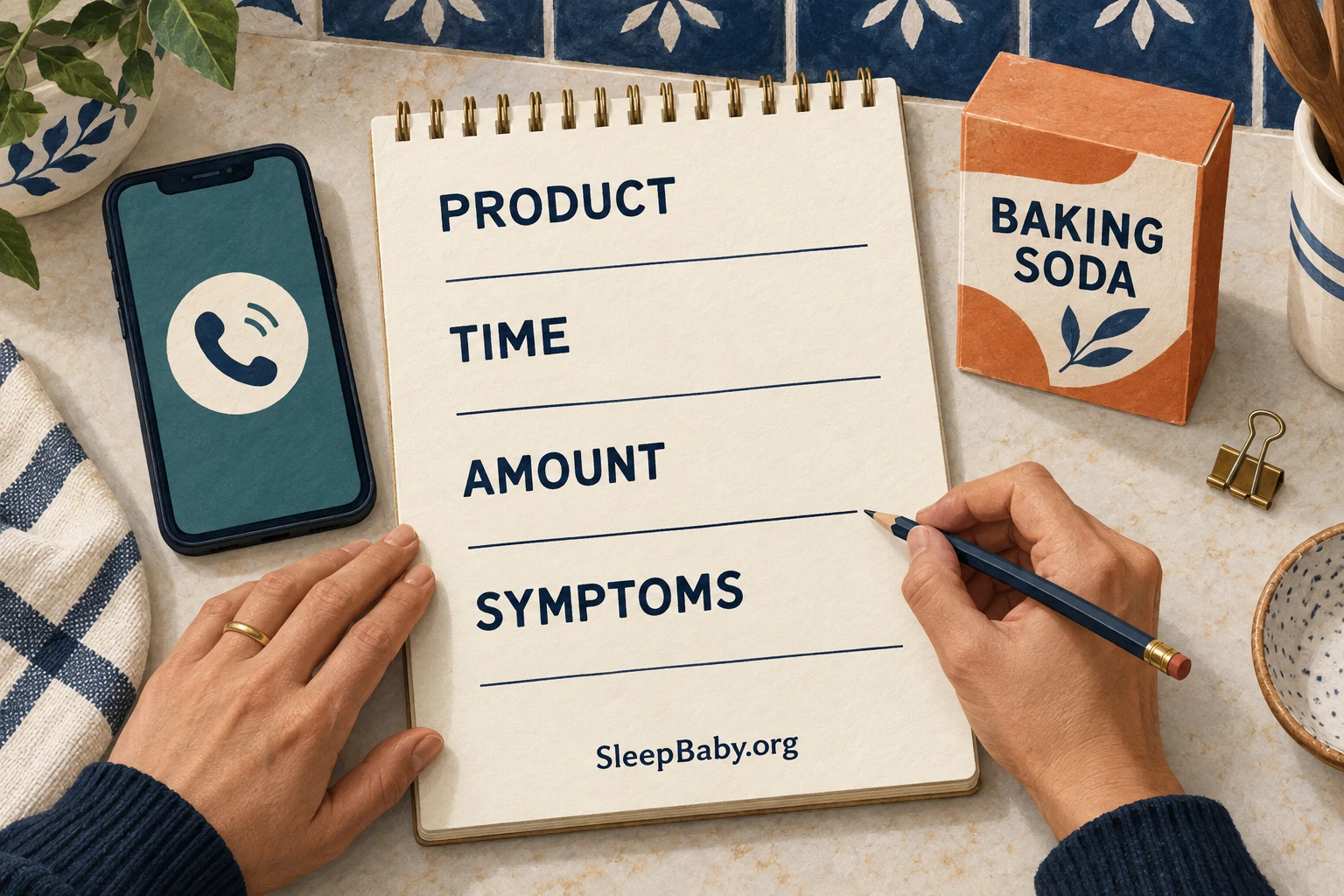
You don’t need a polished account. Start with the concern, then let the specialist guide the questions. I would use the four headings below as a place to put the facts, not as a form that has to be finished before dialing.
BOX · BABY · CLOCK · CALL
BOX: exact product name, ingredients and container size. Bring the package to the phone if you can.
BABY: age, known weight, symptoms, health conditions and medicines. Say when you don’t know a weight.
CLOCK: when it happened, or when you discovered it. Describe what you actually saw; say “unknown” when the swallowed amount is unknown.
CALL: write the advice down and ask the specialist to repeat anything you missed. Include any follow-up they want.
A useful opening: “My baby may have swallowed baking soda. I have the box. The amount is unknown.” Add the facts you do know.
This is especially useful when two adults saw different pieces of the event. One found the carton; another saw powder on the child’s hand. Neither needs to fill in the missing part. Keeping the account literal helps the person on the phone ask the right next question.
AFTER THE MEDICAL QUESTION IS SETTLED
Keep care notes and bedtime notes separate

When your baby no longer needs an exposure-related plan and you want help with ordinary nights, you can explore the free planning preview at SleepBaby.org. It asks three questions and offers a starting step without a sign-up or card.
The optional paid SleepBaby.org Workshop adds short steps you can revisit and a seven-night tracker. Those can help you keep an ordinary bedtime experiment organized after the urgent concern has been addressed.
Neither the preview nor the Workshop assesses poisoning, tells you when to stop observation, or promises a sleep result. Follow the poison specialist’s instructions first. A notebook you already own is enough for tonight’s care notes.
After the call, keep the instructions in one place
The plan may involve care at home or an in-person evaluation. Follow the recommendation for your child rather than borrowing another parent’s outcome. If you are directed to an emergency department, take the container if possible. HRSA explains that treatment depends on the substance, amount, age, weight and medical history.
If home observation is recommended, make the handoff specific. A note saying “Poison Control said okay” leaves out the instructions that made that advice useful. Write what they told you to do, what would require another call, and any follow-up timing they gave.
Before ending the call, these are reasonable questions to ask:
- What symptoms should make me call you again or get medical help?
- What should I do about feeding and fluids?
- What should I do if a nap or bedtime falls during the observation period?
- Is any further check-in needed, and who should I contact?
Use their answers, including their timing. I would not add a home countdown from a search result, or decide that a certain number of quiet minutes means the concern has passed. This article does not supply an all-clear time.
Skip the kitchen remedies
Don’t try to make your baby vomit, and don’t use ipecac. The AAP advises against both after a swallowed poison. Don’t give activated charcoal on your own; HRSA says the poison center should decide whether it is appropriate.
I would also leave vinegar, lemon juice, salt water and extra baking soda out of the response. Trying to “balance” one kitchen ingredient with another is not a treatment plan. Give the specialist the product details and follow their instructions instead of adding another exposure.
Don’t force anything by mouth if your child is having trouble swallowing, is having a seizure, or is not fully awake. Call emergency services for the serious signs above. General first-aid advice about drinks has conditions; it is not permission to pour water into a baby’s mouth. Poison Control describes those limits.
Should I give breast milk, formula, milk or water?
Ask the poison specialist about your baby’s next feed and any fluids. Have their usual feeding method ready to describe. I would not replace a feed, dilute formula, give a large volume of water, or use food as an antidote based on a general article.
If you already gave something, say what it was and how much you know was taken. That is information for the assessment, not something to hide while you try another remedy.
What if the powder got in an eye or was breathed in?
Tell Poison Control about every route of exposure. For powder in an eye, begin rinsing with room-temperature running water for 15–20 minutes and get poison advice. If powder was inhaled, move away from the dust to fresh air and call. Breathing trouble means emergency help. These are HRSA first-aid steps; they don’t replace assessment of anything swallowed.
Can my baby go to sleep afterward?
Get the exposure assessed before treating sleep as the next routine task. Ask directly about naps and overnight observation. I cannot tell from a sleepy face whether your baby is ready for an ordinary nap or needs medical attention.
Be concrete about a change: “This is different from their usual pre-nap behavior” is more useful than simply calling your baby tired. A baby who cannot be awakened needs 911, not a longer nap. Don’t use a monitor or the fact that it’s bedtime as reassurance about the exposure.
Once the treating professional has said how to proceed, keep the ordinary sleep setting safe: place your baby on their back on a firm, flat sleep surface, with only a fitted sheet and no pillows, positioners or loose bedding. Don’t incline the mattress because you are worried about their stomach. The AAP’s safe-sleep guidance explains the usual setup.
A night affected by a call or a medical visit does not need a new sleep-training plan. My priority would be the care instructions and a clear handoff between adults. Ordinary bedtime planning can wait until that concern is resolved.
Close the access point after care is arranged
The most useful prevention question is specific: where was this package when your child reached it? That answer gives you a manageable change to make.

- On the counter during cooking: return it to its designated storage place as soon as you finish measuring. Keep your child away from open ingredients while you work.
- In a low cupboard: move it out of sight and reach. Check the closure rather than assuming a cabinet door is enough.
- In the refrigerator: consider the open deodorizing box as an accessible container, too. Place it where your child cannot reach it.
- In an unmarked jar: keep products in their original labeled containers so the contents stay identifiable.
Keep cleaning products separate from food. A baking ingredient that you also use for cleaning can end up in several places, so check each place you actually use it. The bathroom tub, laundry shelf and kitchen are different access points, even if they began with the same box.
A latch adds a barrier; it doesn’t make a cupboard childproof. The AAP notes that latches can fail or be defeated. Keep hazardous products out of sight and reach and follow the device’s installation instructions. Tell every caregiver where things belong, especially if storage changed after this incident.
An optional place for the original baking box
Lockabox One, Crystal: if your cupboard needs an additional storage barrier, this compact combination-lock box is one option I would compare. Its manufacturer describes a three-digit lock and an internal space about 11.1 × 7.6 × 6.3 inches. Measure the original package and the shelf before choosing it.
I would use it only as an extra layer in an out-of-sight, out-of-reach location. Keep the baking soda in its labeled carton inside; don’t pour powder into the box. It is a deterrent, not a guarantee that a child cannot get in, and it does not replace supervision or medical advice.
Already-owned alternative: use an existing suitable locked, inaccessible cupboard. Moving the original carton now is more useful than leaving it reachable while waiting for a delivery.
As an Amazon Associate, SleepBaby.org earns from qualifying purchases.
A short reminder of who to call
HRSA’s 30-second Poison Help Is on the Line uses household medication scenarios to explain the role of the Poison Help line. It is a general reminder, not a baking-soda treatment demonstration. If an exposure is happening now, make the call first.
Written takeaway: save 1-800-222-1222 in your phone for U.S. poison questions. You can ask for help with an uncertain exposure. Emergency signs still call for 911.
The questions I would not answer with a guess
“It was only a lick. Is that automatically safe?”
A lick and a mouthful are different observations, but neither phrase is a measured dose. Describe the contact honestly to Poison Control. You can ask about a minor-looking exposure without waiting for it to become an emergency.
“My baby seems fine. Can I just watch?”
Call first and get the observation plan for this exposure. Watching without knowing which changes matter or how to respond is not the same as following the specialist’s advice.
“How much baking soda is too much?”
There is no universal baby-safe teaspoon amount in this guide. Age, weight, the actual product and the amount involved matter. Adult antacid directions are not infant dosing instructions.
“Can I use it for gas or reflux another day?”
Don’t use household baking soda as a homemade antacid for your baby. Discuss ongoing feeding discomfort with your child’s clinician. Poison Control warns against self-treating stomach upset with baking soda without specific medical direction.
“Do I have to know the exact amount to call?”
No. Tell the specialist that it is unknown. A quick, honest account is more useful than time spent trying to turn missing powder into a precise number.

I would keep two notes after this: the care advice for this exposure and the storage change that closes the access point. One belongs to the person assessing your baby; the other is a practical household decision you can make once care is underway.
Sources
- Poison Control: baking soda risks and response
- Missouri Poison Center: baking soda first aid
- MedlinePlus: baking soda overdose
- Poison Control: first aid guidelines
- Poison Control: getting help and preparing for the call
- American Academy of Pediatrics: poison prevention and treatment tips
- HRSA: first steps in a poisoning emergency
- MedlinePlus: sodium carbonate (washing soda) poisoning
- American Academy of Pediatrics: safe infant sleep
- Poison Control: infant poison prevention
- HRSA: official Poison Help videos
- Lockabox: One storage box specifications
A SMALLER NEXT STEP
Return to ordinary nights when care allows
Once the exposure concern has been addressed, the free SleepBaby.org library and planning preview are there for ordinary bedtime questions. You can read, try the preview, or decide that no purchase is useful right now.
SleepBaby.org · The original video
A next step for
the next bedtime.
Still thinking about sleep? Watch the presentation here, then explore the SleepBaby program whenever you’re ready.
Ready to get started?Take the next step with SleepBaby.
Help my baby sleep