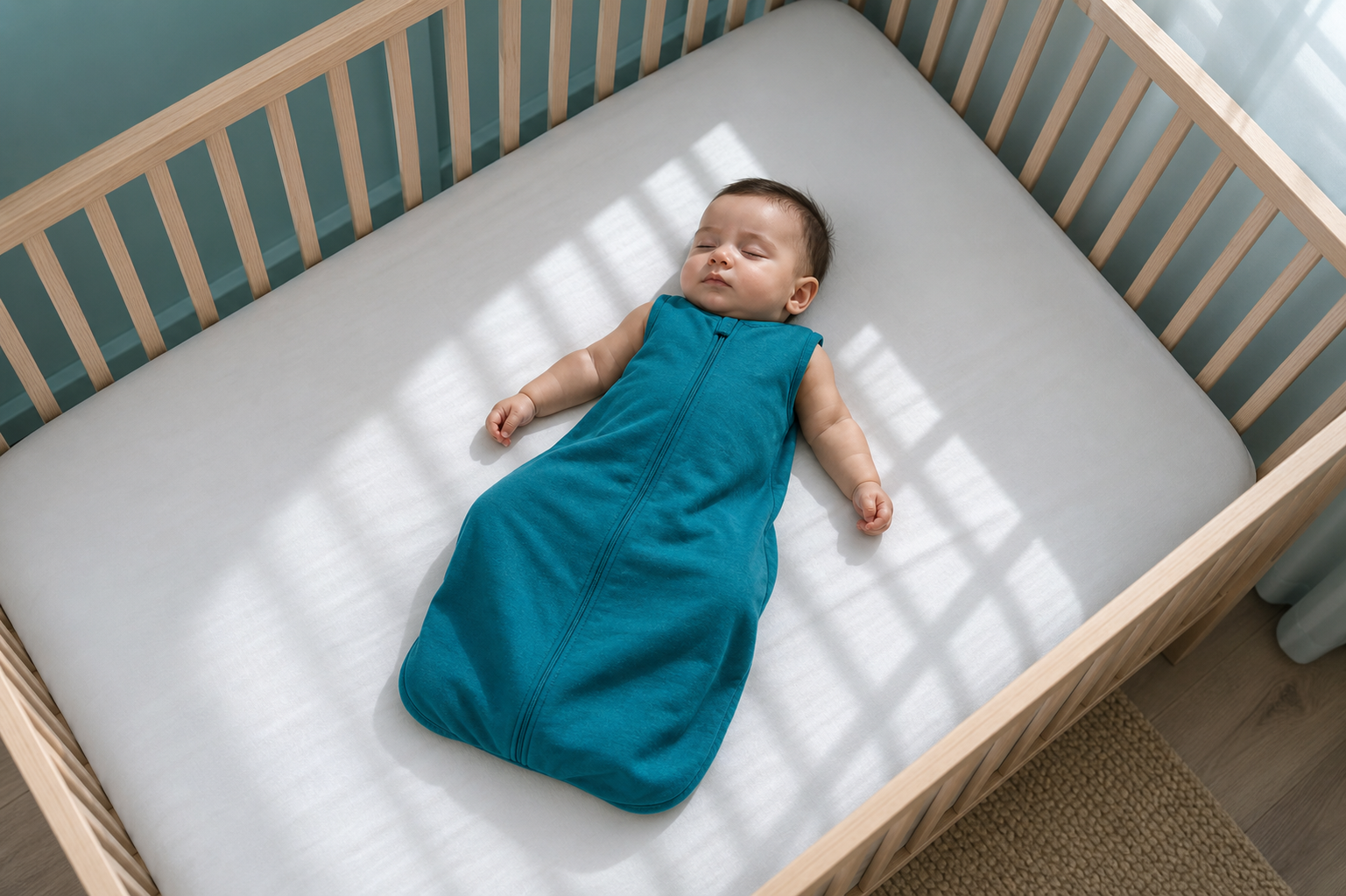
The safety answer, first
An unweighted sleep sack can replace a loose blanket. A weighted one should not.
A correctly sized, unweighted, arms-free baby sleeping bag or sleep sack can be used as a wearable blanket when your baby sleeps on their back on a firm, flat, level surface with no loose bedding. It is one useful piece of a safe sleep setup—not a product that prevents SIDS, and not a way to make an unsafe sleep surface safe.
Weighted sleep sacks, weighted swaddles, weighted sleepers, and weighted blankets are different. Current guidance from the American Academy of Pediatrics and the Centers for Disease Control and Prevention says not to use weighted sleep products for infants.
Safety guidance and the official CPSC recall search used for this guide were checked on August 13, 2026. Recall records and product guidance can change, so use the current official links when you check an item in your home.
That distinction is the whole hinge of weighted sleep sack safety. At night, though, the label rarely presents itself as a clean little logic problem. It is usually upside down near a zipper while you hold the garment under a hallway light, trying to decide whether “calming pressure” is a lovely marketing phrase or an instruction you should trust.
I would look at the adjective before I looked at the brand, the color, the price, or the number of sleepy moons printed on the package. Unweighted and weighted are not minor style choices. They lead to different safety answers.
SleepBaby.org · The original video
A little help
for the night ahead.
Take a moment to watch the original Baby Sleep Miracle presentation. Your article will be right here when you’re ready to keep reading.
What viewers said10 comments · 4 replies
Archived comments from the original Baby Sleep Miracle presentation. Not independently verified by SleepBaby.org; individual experiences vary.
Hi Mary-Ann. I have a question: Is method in any way similar to the ones recommended by Dr Bucknam, Dr. Weissbluth or Dr. Karp? We tried those but none of them help.
Hi Regina, thank you for your question. The short answer is no. The techniques I share in my guide are based on newest scientific research and this is why I have never seen any approach similar to the one I recommend.
This method really works! I tried it on my son Jesus and after just one week he went from waking up more than 5 times a night to waking up just once or twice. You are a lifesaver, Mary-Ann!
I'm truly impressed with how much information you share in your video. And all for free! I can feel that you truly care about mothers like myself, and that's hard to find these days. I have recommended your site to several of my friends already.
Mary-Ann, our child suffers from autism. Is your approach still suited?
Chloe, I made sure my method can be used with any child, even babies who are special like yours. Please note that I'm not a doctor and that I always advice to consult with your physician because nothing is more important than the safety and well-being of your love.
Hallo Mary-Ann, I'm from Germany. Do you have your guide in German?
Hello Heide, we do! Normally you should already see our video in German. If not, please contact our support so they can guide you
Thenk you for your answer, Mary-Ann!
I just completed your approach and I have to say, it worked almost too well. Yes, it took a bit of getting used to with your bedtime routine but the difference is huge. My son George used to take 1 hours to go down and now he's firmly asleep in no more than 10 minutes! You're the best!
It seems I'm the only man watching this video, lol! What you shared about the 'emotional backpack' made immediate sense to me and I can't wait to help my little girl Mila to unpack it!
Hey there, just discovered your site and this really sounds different. Just wanted to say thanks for sharing :)
For everyone who's still thinking about getting Mary-Ann's guide I want to advise you to go ahead. I wasn't sure myself but now I'm so thankful I invested in this program. It made a huge difference in our life as a family and yes, my baby girl does sleep through the night now.
Ready to get started?Take the next step with SleepBaby.
Pick your price
Sleep sack, sleeping bag, swaddle, TOG: a label decoder
Baby sleepwear has accumulated enough overlapping names to make a laundry tag feel like a small legal document. Here is the plain-language version.
An adult or camping sleeping bag is not infant sleepwear. A baby product should be designed and sized for its intended age and use. “Sleeping bag” can be a harmless regional synonym for “sleep sack,” but it is not permission to improvise with outdoor gear, down bags, oversized garments, or a product made for an older child.
The decoder also keeps one common mistake out of the crib: treating all wearable products as interchangeable. A swaddle changes what the arms can do. A well-fitted, unweighted, arms-free sack should not. A weighted panel adds a separate concern. Start with those functional differences and the label becomes much less mysterious.

Why current guidance says no to weighted infant sleep products
The AAP’s 2022 safe-sleep policy says weighted blankets, weighted sleepers, weighted swaddles, and other weighted objects should not be placed on or near a sleeping infant. The CDC likewise says products labeled as weighted—including sleep sacks—are not safe for infants. The federal Safe to Sleep FAQ from NICHD explains that studies have not established that putting weight on a baby’s chest is safe for sleep.
That is enough to make the practical decision: do not use a weighted sleep sack for an infant. You do not need to calculate whether the panel is “only” a certain number of ounces, wait for a recall, or run a home experiment to see whether your baby seems to sleep longer in it.
The boundary that changes the answer
Two products can look similar on a hanger and belong in different decisions
Unweighted, arms free, correctly fitted
May be used as wearable sleep clothing instead of a loose blanket, within the complete safe-sleep setup.
Next: check size, neck and arm openings, movement, warmth, closures, damage, and current recalls.
Weighted, compressive, or adds pressure
Not recommended for infant sleep under current AAP and CDC guidance, whether or not a particular model appears in a recall search.
Next: choose an appropriate unweighted option or ordinary sleep clothing; do not use the weighted product while waiting for more information.
This is guidance for infant sleep products, not an individualized medical plan. If your baby has a respiratory, cardiac, neuromuscular, developmental, temperature-regulation, or other medical concern, ask the baby’s clinician what sleep clothing is appropriate.
Why the concern? An infant’s rib cage, breathing mechanics, ability to move, and temperature regulation are still developing. Added weight may make chest movement or repositioning more difficult and may contribute to overheating. Those are safety concerns, not a formula that lets us predict exactly what will happen to one baby in one product.
I would be wary of any explanation that jumps from “we cannot prove this is safe” to a dramatic certainty it cannot actually support. But I would be equally wary of a seller using that uncertainty as permission. Parents do not need a courtroom-level finding about every model before choosing the option current pediatric and public-health guidance recommends: ordinary, unweighted sleep clothing.
A product can be attractive, widely sold, reviewed by happy customers, or described as meeting a standard without being recommended for infant sleep. The marketplace answers, “Can someone sell this?” It does not always answer the quieter bedside question: “Is this what I should place on my sleeping baby?” Those are different questions, and the second one deserves the better source.

What the small monitored study can—and cannot—tell us
Weighted-product marketing sometimes points to a study as if the word study settles the whole night. It does not. The primary study discussed in the AAP technical report involved 16 infants with neonatal abstinence syndrome in a clinical setting. Across 67 sessions, the infants were observed for 30 minutes while using a one-pound weighted blanket.
Read the study at its actual size
A narrow observation window, not an overnight safety clearance
Observed: a specific clinical population, a specific blanket, short directly monitored sessions, and measured vital signs in that setting.
Not established: overnight use, unattended home sleep, healthy infants, every age or body size, different weighted-panel designs, repeated long-term use, or protection from rare sleep-related events.
You can read the study record on PubMed and the AAP’s technical report on the evidence base. The honest translation is not “the study proved weighted sleep sacks are dangerous,” nor is it “the study proved they are safe.” It is that a small, short, monitored clinical pilot cannot answer the question parents are actually asking about routine, unobserved sleep at home.
This is one of those places where the size of the evidence matters as much as its existence. A flashlight beam can show you what happened in one small patch for half an hour. It cannot light an entire night, every nursery, and every product marketed with a soothing adjective.
Current guidance fills the practical gap: avoid weighted infant sleep products. That is not anti-research. It is the appropriately cautious decision while the home-use safety question remains unanswered.

Was there a weighted sleep sack recall? The accurate answer
A safety recommendation is not the same thing as a recall. In April 2024, a CPSC commissioner issued a statement warning against weighted infant swaddles and blankets, and several large retailers committed to stop selling weighted infant products. AAP leaders supported retailers pulling these products. Those actions matter, but it is inaccurate to describe them as a single nationwide recall of every weighted sleep sack.
For this guide, we ran dated searches of the official CPSC recalls data using “sleep sack” in product-name and recall-title fields, plus “weighted sleep sack” and “weighted sleep” in relevant fields. As of August 13, 2026, those exact searches did not return a class-wide weighted-sleep-sack recall or a weighted-sleep-sack-specific recall record.
That finding has a very important second sentence: not finding a recall is not evidence that a weighted sleep sack is safe. AAP and CDC guidance against weighted infant sleep products applies even when your particular brand or model is not in the recall database.
The same search did find product-specific recalls involving wearable sleep products for other hazards. For example, the CPSC recalled certain WeeSprout baby sleep sacks in 2023 because a zipper slider could detach and create a choking hazard. It recalled certain Zigjoy sleep sacks with feet in 2025 over a children’s sleepwear flammability hazard. In March 2026, certain HALO Magic Sleepsuits were recalled because zipper heads could detach and create a choking hazard.
Those examples do not mean all sleep sacks are recalled. They show why “sleep sack” is too broad for a useful recall answer. A recall attaches to exact products, date ranges, sizes, models, lots, batches, or other identifiers—and to a stated hazard and remedy.
The zipper-tag recall trail
How to check the item in your hand, not a product category in your head
- 1. Photograph the label before it fades further.Capture the brand, product name, size, model, lot or batch, date code, UPC, and country of manufacture. Save the order email or receipt if you have it.
- 2. Search the current official CPSC recalls page.Use the exact brand and product identifiers at CPSC Recalls. Wording varies, so try the model or brand as well as “sleep sack,” “sleep bag,” “wearable blanket,” or the product’s marketed name.
- 3. Match every identifier you can.A similar photo is not enough. Read the official notice for affected sizes, colors, sale dates, retailers, model numbers, and the exact remedy.
- 4. Stop using an exact recalled match.Follow the notice for a refund, replacement, repair, destruction, or another remedy. Do not sell, donate, or hand down a recalled item.
- 5. Report an incident or suspected defect.Use SaferProducts.gov for a consumer product-safety report. Keep the item, packaging, photographs, and purchase information unless emergency responders or the official remedy tell you otherwise.
If the product is weighted, you do not need a recall match to decide against using it for infant sleep. Set it aside and use appropriate unweighted sleep clothing. That is the cleanest way to keep the recall question and the guidance question from getting tangled together at bedtime.

What if the package says it meets a standard?
ASTM published F3735-26, a voluntary consumer safety specification for infant and infant/toddler wearable sleep products, in February 2026. Its public scope addresses hazards such as suffocation, strangulation, and choking for wearable sleep products intended through age two. A standard can improve shared definitions, testing, labeling, and product design.
It still does not turn a seller’s compliance claim into pediatric guidance. The public material we reviewed does not establish that added-weight infant sleep products are medically recommended. The CPSC also distinguishes voluntary consensus standards from mandatory federal rules and agency endorsement. If a package says “tested,” the useful follow-up questions are: tested to which exact standard, by whom, for what hazards, on which model, and does current infant-sleep guidance recommend this product category?
I would not ask a tired parent to adjudicate standards language beside the crib. The practical route remains simpler: no intentionally added weight for infant sleep; then inspect the ordinary unweighted garment for fit, warmth, damage, and recalls.
The 30-second fit check for an unweighted sleep sack
An ordinary sleep sack is not automatically appropriate because it is unweighted. Fit is what keeps a wearable blanket from becoming fabric that can ride up over the face, and condition is what keeps a useful zipper from becoming a loose part.
There is no universal starting weight such as 8 pounds 8 ounces that applies to every brand and design. Use the exact product’s size chart and instructions, then check the baby in the actual garment. The number on the package begins the decision; the fit on your baby finishes it.
Doorway-light garment check
Five places my eyes would go before the crib
Lay the sack flat once, then check it again while your baby is awake and supervised. This is not a tug-of-war test. You are looking for secure openings, free movement, and an intact garment.
- Neck and shoulders: the opening should sit securely at the shoulders. Your baby’s head must not be able to slip down inside when you gently assess the fit according to the product directions. A neckline that gapes, rides over the mouth, or swallows the chin is not a “grow into it” situation.
- Arm openings: they should not be so large that the body can slide into the sack or so tight that they rub or restrict. Check both sides; a twisted garment can look fitted from one angle.
- Hips and legs: there should be room to flex, open, and move naturally. Restricting the legs is not a sleep benefit, and a sack should never be used as a restraint or as a way to prevent climbing.
- Zipper, snaps, seams, and trim: fasteners should close as designed and stay away from the face. Stop using the item if a slider, pull, snap, thread, decoration, seam, or fabric panel is loose, broken, sharp, or separating.
- Face, hood, and extra fabric: the face and head stay uncovered. Choose no hood. Do not fold, pin, tie, modify, or add an insert to improve a poor fit; use the correct product and size.
Run your fingers along the neckline and zipper path. Look inside for a detached label, loose thread loop, or rough fastener. This small ritual is less glamorous than shopping by fabric print, but it answers the question the product photo cannot: what is this particular garment doing after washing and wear?
Wash and dry it according to the care label. Recheck the fit after laundering, after a growth spurt, and whenever the garment starts sitting differently. Stop using it if the baby can pull an opening toward the face, if the fabric bunches around the mouth, or if the hardware or seams are damaged.
Do not put a loose blanket over the sack. If your baby needs a warmer setup, adjust appropriate clothing layers or choose an appropriate unweighted warmth rating according to the manufacturer’s directions. A wearable blanket replaces loose bedding; it does not become the bottom layer of a blanket pile.

TOG is warmth, not added weight
TOG describes insulation. It can help you compare how warm garments are, but it is not a universal prescription for every room, climate, baby, base layer, fabric, or health situation. Two products with the same number may also have different instructions and fit.
A cool hand or foot does not, by itself, tell you that the baby needs another blanket. Check the chest or back and the baby’s overall condition. If your baby was born prematurely, has a fever, or has a condition that affects breathing, circulation, muscle tone, or temperature control, ask the clinician who knows their history how to dress them for sleep.
And keep TOG separate from “weighted.” A warm quilted fabric can have more insulation without containing a weighted panel. Conversely, a product advertised as lightly weighted may have a low TOG. One number cannot answer the other question.

Rolling changes swaddling—not the laws of pajamas
Stop using any swaddle or product that restrains the arms as soon as your baby shows signs of trying to roll. You do not need to wait for a complete, polished roll. The attempt is the boundary because a baby who reaches the stomach needs the arms free to help reposition the head and upper body.
An unweighted, arms-free wearable blanket is not automatically a swaddle. It may remain an option if it fits correctly, allows free movement, and is used within the product’s instructions. Do not add compression bands, tuck the arms inside an arms-free product, or use a smaller size to recreate a snug swaddle feeling.
This is also why “prevents climbing” is not a feature I would seek in sleep clothing. If your child is outgrowing the crib or can climb, follow the crib manufacturer’s limits and make the developmentally appropriate sleep-space transition. Clothing should not be used to restrict the child’s legs or override what their body is showing you.
If settling becomes difficult during a transition, change the soothing strategy rather than the safety boundary. These safe ways to help a baby settle in the crib can help you troubleshoot without adding weighted products or loose bedding. If back sleeping brings immediate protest, use safe steps when a baby cries on their back instead of wedges, positioners, or prone placement.
The sack does not replace the rest of safe sleep
A sleep sack is clothing. It cannot correct a soft mattress, an inclined surface, loose bedding, an adult bed, a couch, or another space not intended for infant sleep. For every sleep:
- Place your baby on their back.
- Use a firm, flat, level infant sleep surface with a fitted sheet.
- Keep blankets, pillows, bumpers, positioners, toys, and other soft or loose objects out.
- Keep the face and head uncovered and avoid overheating.
- Keep the environment smoke-free.
- Follow the sleep-space and product manufacturer’s limits and instructions.
If your newborn resists an empty bassinet, what to try when a newborn resists the bassinet gives you safer settling options. If you are traveling, use the same product and surface rules while you check a hotel sleep space before bedtime. Familiar pajamas do not make an unfamiliar surface safe, but a consistent checklist can keep the decision from changing just because the room did.
Shop the label, then inspect the actual garment
I would rather have one plain sleep sack that passes a boring list than a drawer full of beautifully marketed uncertainty. Before buying or using an unweighted wearable blanket, ask:
| Check | What passes | What stops use |
|---|---|---|
| Weight and compression | No intentionally added weight; arms free when rolling attempts begin. | Weighted panel, insert, beads, chest pressure, arm restraint past the swaddle boundary, or unclear construction. |
| Size and movement | Matches the product guide, secure at neck and armholes, with free hip and leg movement. | Head can slip inside, face can be covered, openings gape, body slides, or movement is restricted. |
| Warmth | Manufacturer directions fit the room, layers, fabric, and baby; head stays uncovered. | Sweating, hot or flushed skin, hot chest, hood, hat, loose blanket, or improvised layering. |
| Condition | Fasteners, seams, fabric, and trim are intact; care instructions are followed. | Loose zipper part, snap, thread, trim, torn seam, sharp edge, damaged fabric, or homemade modification. |
| Identity and recall | Label is legible; exact brand and model do not match a current recall. | Exact recall match, missing identity on a questionable item, or safety instructions you cannot verify. |
Do not assume a secondhand item is fine because it looks clean. Verify its identity, instructions, condition, and recall status. If the label is gone and you cannot establish what the product is—or whether it contains added weight—the sensible bedtime decision is to use something you can verify.
Do not add homemade weights, rice bags, inserts, pins, ties, straps, or alterations. Do not cut armholes or a neckline to change the fit. Sleep clothing is not the place for a clever fix that the design was never tested to carry.
If your baby looks unwell or struggles to breathe
If there is no emergency but a product seems to leave marks, interfere with movement, cause unusual warmth or sweating, or coincide with a change in breathing or responsiveness, stop using it and contact your baby’s clinician. Bring or photograph the product and label. “Is this normal?” is much easier to answer when the person helping you can see what was worn, how it fit, and what you observed.
The quiet-night takeaway
You do not need to reject every baby sleeping bag. You need to sort the category correctly.
Choose unweighted, arms-free, correctly fitted, intact sleep clothing. Use it on a baby placed on their back in a firm, flat, empty sleep space. Keep the face and head uncovered, follow the product’s warmth and size instructions, recheck fit as your baby grows, and check exact product identifiers against current recalls.
Skip weighted sleep sacks, weighted swaddles, weighted sleepers, and weighted blankets for infants. Do not wait for your exact model to be recalled, and do not let “gently weighted,” a seller’s test claim, or one small monitored study do more work than the evidence can carry.
The best bedtime product is not the one that promises the deepest sleep. It is the one that can quietly pass the label check, the fit check, the damage check, and the current guidance—then get out of the way while your baby sleeps. There are enough dramatic characters in a household at bedtime. The sleep sack should be allowed to be boring.
Sources
- American Academy of Pediatrics: 2022 safe infant sleep policy statement
- American Academy of Pediatrics: evidence base for the 2022 recommendations
- CDC: Helping Babies Sleep Safely
- NICHD Safe to Sleep: frequently asked questions
- NICHD Safe to Sleep: safe sleep environment
- U.S. Consumer Product Safety Commission: Safe Sleep
- U.S. Consumer Product Safety Commission: current recall search
- U.S. Consumer Product Safety Commission: recall API information
- CPSC commissioner statement on weighted infant products
- AAP News: retailer withdrawal of weighted infant sleep products
- PubMed: monitored weighted-blanket pilot in neonatal abstinence syndrome
- ASTM F3735-26: wearable sleep products specification
- U.S. Consumer Product Safety Commission: voluntary standards context
- NHS: safe sleep advice and baby sleeping bag fit
- UK Office for Product Safety and Standards: baby sleep product fit guidance
- HealthyChildren.org: AAP safe-sleep guidance for parents
- HealthyChildren.org: when to call emergency medical services
SleepBaby.org · The original video
A next step for
the next bedtime.
Still thinking about sleep? Watch the presentation here, then explore the SleepBaby program whenever you’re ready.
What viewers said10 comments · 4 replies
Archived comments from the original Baby Sleep Miracle presentation. Not independently verified by SleepBaby.org; individual experiences vary.
Thank you so much for this video! I had no idea about the dangers of baby swings :O
Hi Mary-Ann. I have a question: Is method in any way similar to the ones recommended by Dr Bucknam, Dr. Weissbluth or Dr. Karp? We tried those but none of them help.
Hi Regina, thank you for your question. The short answer is no. The techniques I share in my guide are based on newest scientific research and this is why I have never seen any approach similar to the one I recommend.
This method really works! I tried it on my son Jesus and after just one week he went from waking up more than 5 times a night to waking up just once or twice. You are a lifesaver, Mary-Ann!
I'm truly impressed with how much information you share in your video. And all for free! I can feel that you truly care about mothers like myself, and that's hard to find these days. I have recommended your site to several of my friends already.
Mary-Ann, our child suffers from autism. Is your approach still suited?
Chloe, I made sure my method can be used with any child, even babies who are special like yours. Please note that I'm not a doctor and that I always advice to consult with your physician because nothing is more important than the safety and well-being of your love.
Hallo Mary-Ann, I'm from Germany. Do you have your guide in German?
Hello Heide, we do! Normally you should already see our video in German. If not, please contact our support so they can guide you
Thenk you for your answer, Mary-Ann!
I just completed your approach and I have to say, it worked almost too well. Yes, it took a bit of getting used to with your bedtime routine but the difference is huge. My son George used to take 1 hours to go down and now he's firmly asleep in no more than 10 minutes! You're the best!
It seems I'm the only man watching this video, lol! What you shared about the 'emotional backpack' made immediate sense to me and I can't wait to help my little girl Mila to unpack it!
Hey there, just discovered your site and this really sounds different. Just wanted to say thanks for sharing :)
For everyone who's still thinking about getting Mary-Ann's guide I want to advise you to go ahead. I wasn't sure myself but now I'm so thankful I invested in this program. It made a huge difference in our life as a family and yes, my baby girl does sleep through the night now.
Ready to get started?Take the next step with SleepBaby.
Pick your price


Thank you so much for this video! I had no idea about the dangers of baby swings :O