

Three months old • flexible rhythm • feed-first care
A realistic 3-month-old sleep schedule is a flexible rhythm, not a strict clock. Keep feeding needs and safe sleep first, use morning light and a short bedtime routine as steady anchors, and let each nap move according to when the last one ended. Many babies this age still wake to eat, take short naps, and have days that look nothing like yesterday. That is not a failed schedule. It is a young nervous system still organizing sleep.
If you came here hoping for exact times, I will give you a sample day. I will also give you something more useful: the rules for changing that day when the 8:15 nap lasts 28 minutes, the 11:00 feed arrives early, or your baby announces at 5:40 p.m. that the proposed catnap has been rejected by management. At three months, the repair rule matters more than the printed clock.
I call this a soft-edge day. Three anchors stay fairly steady—morning light, responsive feeds, and a repeatable wind-down—while nap length, nap count, and bedtime are allowed to slide. Think pencil sketch, not train timetable.
The answer in one glance
Build the day around three anchors
1. Open the day
Choose a consistent-enough morning start, offer a feed according to your baby’s plan and cues, and bring in ordinary daylight and interaction.
2. Let feeds outrank nap math
Use awake time and behavior to anticipate sleep, but do not delay a hungry baby or override a clinician’s feeding plan to protect a schedule.
3. Close the day gently
Repeat a short sequence—dim lights, feed or other responsive care, fresh diaper if needed, cuddling, song, safe sleep space—without demanding a perfect bedtime.
Practical starting point: many families begin watching closely for sleep somewhere around one to two hours after waking. That is an observation range, not a medically required wake window. Your baby’s earlier cues and feeding needs matter more than finishing the timer.

Composite Kacey-and-Benjamin scene—not biography or evidence
The 27-minute nap does not get to grade your parenting
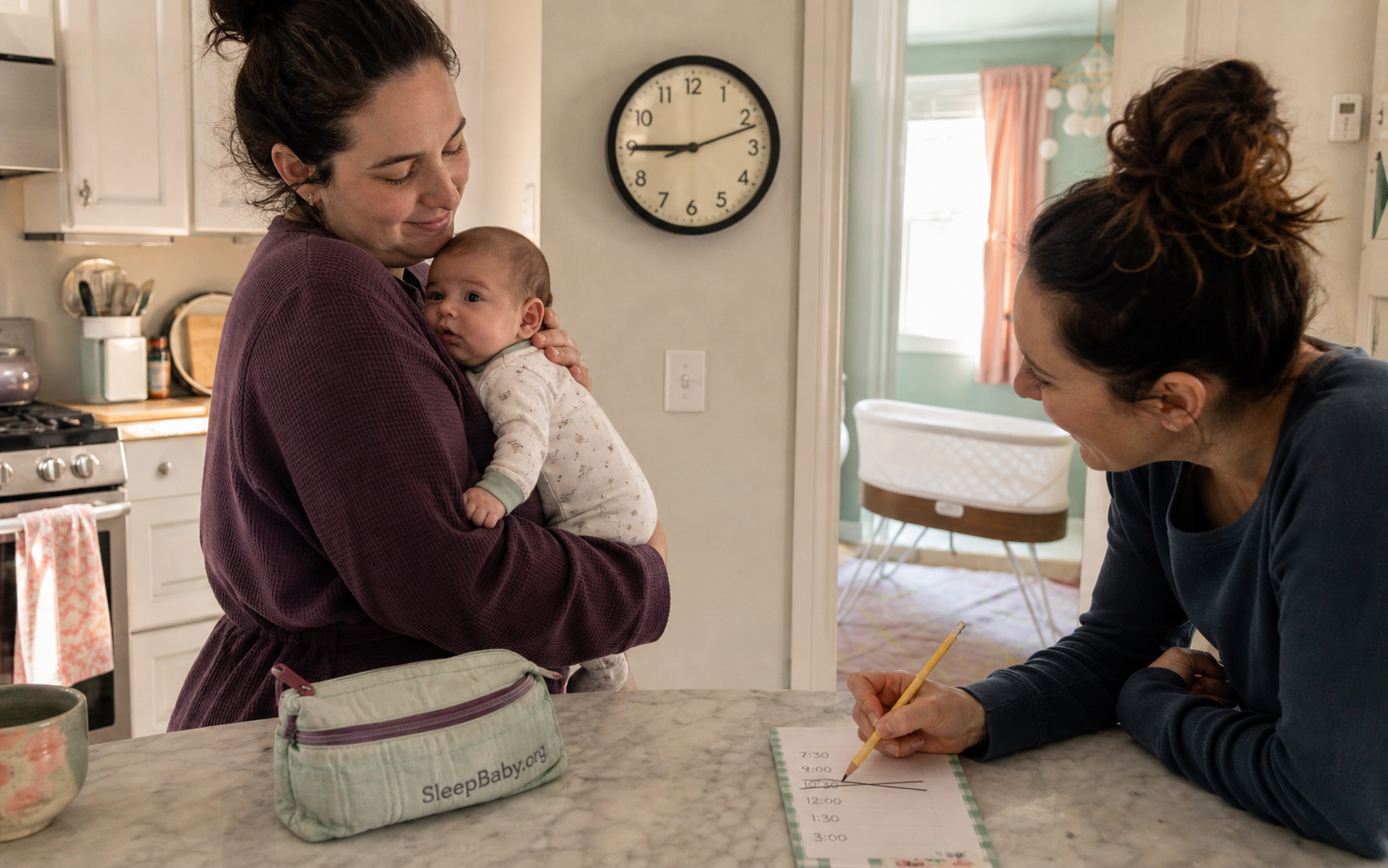
Picture an imagined kitchen at 9:02 a.m. Kacey has written a lovely sample schedule on the back of an envelope. Benjamin is holding an awake, fed, spectacularly unimpressed baby who slept for exactly 27 minutes. The coffee is still warm enough to count as a beverage, and the envelope is already wrong.
In this clearly labeled composite scene, I would not erase the whole day or keep a tired baby awake until the next printed nap. I would ask three smaller questions: When did the baby actually wake? Are hunger or discomfort cues showing up? What is the next safe, calm sleep opportunity? Then I would move only the next decision.
That is the emotional shift I want for you, too. A schedule can support your attention without becoming a verdict. The goal is not to make a three-month-old obey a spreadsheet. The goal is to notice a developing pattern, protect what matters, and stop doing frantic clock algebra every time a nap changes shape.
How much should a 3-month-old sleep?
The World Health Organization lists 14 to 17 hours of sleep in 24 hours, including naps, for ages 0–3 months. That is a population reference range—not a daily performance target and not a reason to force sleep. Some healthy babies land outside a neat number on a particular day, and sleep can look very different depending on feeding, growth, illness, prematurity, temperament, and where a baby is within the month.
The American Academy of Pediatrics also notes that babies do not have regular sleep cycles until about four months. That is why three months can feel like a doorway: you may see a longer first stretch at night or a more recognizable morning, then get a day of tiny naps and frequent wakes. Organization is beginning; predictability is not owed.
Use the range as a health conversation, not a quota
Look at your baby’s usual 24-hour pattern, mood when awake, feeding, growth, and ability to settle—not one rough day in isolation. If sleep is dramatically different, your baby is hard to wake, feeds poorly, has fewer wet diapers, seems ill, or simply worries you, contact your pediatric clinician. A schedule is never the right tool for explaining away a health concern.
If your baby still looks much more like a newborn than the example below, our flexible newborn sleep rhythm may help you see why scattered sleep is not a moral or organizational failure. For babies born early, use the guidance your clinical team gives you about corrected age and feeding rather than forcing a calendar-age schedule.
A movable example
Sample 3-month-old sleep schedule
This example begins at 7:00 a.m. only because a sample needs a starting point. Shift the whole sketch for your household, and shift each later sleep after a short or long nap. Feeds shown here are reminders, not limits; offer breast or bottle feeds according to your baby’s cues and individualized plan.
Open curtains, speak normally, and enjoy a little face-to-face play after feeding and care.
Begin the wind-down earlier if your baby is already disengaging, fussing, staring past you, or losing their smooth movements.
If the nap ended at 8:45 instead, this whole block moves earlier. Do not wait for 9:20 just because it appears here.
A short pre-nap cue—sleep sack if appropriate, curtains, phrase, song—can be enough. It does not need to become a 14-step ceremony.
Use supervised floor play or tummy time while awake as your baby tolerates it. This is activity time, never a sleep position.
This may be the long nap, the short nap, or something in between. The next decision begins when this nap actually ends.
Ordinary afternoon light and household sound can help distinguish day care from the quieter nighttime pattern.
Many babies need another sleep here. If earlier naps were tiny, this may happen sooner.
A short late nap may protect a later bedtime. A baby who slept longer earlier may skip it and start the wind-down sooner.
Dim the environment, keep care calm, and follow your baby’s feeding plan. Do not withhold a needed feed to hit bedtime.
Place baby on their back in the safe sleep space. Overnight feeds and wakes may still be normal and necessary.

Wake windows at 3 months: use the clock to notice, not command
A wake window is simply the time from waking to the next sleep. It can help you notice patterns, but it is not a vital sign. Practical infant-sleep guides often suggest beginning with roughly 60–120 minutes at this age. I would use that wide span as a reminder to look up from the laundry and watch your baby—not as permission to keep a tired or hungry baby awake until a number turns green.
Probably too early
- Bright, socially engaged, and calmly interested
- Repeatedly resisting the wind-down without distress
- Taking a long time to fall asleep across several attempts
Try: five to fifteen more minutes of calm awake time, then reassess.
Likely ready
- Gaze drifting away or play losing its sparkle
- Movements becoming less smooth or more jerky
- A familiar soft fuss or need for closer contact
Try: begin the same short pre-sleep sequence you can repeat later.
Possibly pushed too far
- Escalating crying or frantic movement
- Settling briefly, then startling back into distress
- The same difficult pattern after several comparable days
Try: offer the next sleep a little earlier tomorrow, after checking hunger, discomfort, and illness cues.
One cue on one day is not a diagnosis. Hunger can look like tiredness. A stimulating outing can shorten a comfortable awake period; a long nap may lengthen it. I care more about the pattern across several days than whether Tuesday’s second window matched an internet chart.
When the schedule breaks
What to do after a 30-minute nap
Short naps are common at this age because sleep is still organizing. A short nap can be frustrating without being a problem you caused. Here is the reset I would use:
- Pause and observe. If your baby is calm, give the moment a little space. If they are escalating, respond.
- Check the ordinary needs. Hunger, a dirty diaper, temperature, discomfort, illness, and the need for connection all outrank schedule theory.
- Choose one rescue attempt. If your baby still seems sleepy, use your usual responsive settling approach for a brief, calm attempt. You do not have to turn the entire next hour into a nap negotiation.
- If the nap is over, reset the window. Treat the actual wake time as the start of the next awake period. Expect the next sleep opportunity may come earlier after a tiny nap.
- Protect the evening with flexibility. Use a bridge nap, earlier wind-down, or calmer final awake period. Do not stretch an exhausted baby merely to reach the sample bedtime.
If naps suddenly changed rather than simply being variable, our guide to the so-called 3-month sleep regression separates normal maturation from the internet’s habit of naming every hard week. No label should stop you from checking feeding, illness, discomfort, or a major change in behavior.

Feeds and night waking come before schedule perfection
At three months, some babies give their families a longer first sleep stretch. Others still wake often. Both patterns can occur, and the number of feeds depends on breast or bottle feeding, growth, birth history, milk transfer, intake, health, and the plan you have with your pediatric clinician or feeding professional.
I would not use a sample sleep schedule to decide that a baby “should” go a certain number of hours without eating. I would not automatically assume every sound means hunger either. Start with what you know about your baby’s cues and plan: rooting, bringing hands to mouth, active searching, escalating fuss, the time and quality of the last feed, diaper output, and growth guidance. When uncertain, especially with poor weight gain, prematurity, illness, or feeding difficulty, ask the clinician who knows your baby.
The schedule may move; necessary care does not
Do not delay a hungry baby, stretch feeds to win a longer nap, introduce solids for sleep, or drop a night feed solely because an online schedule shows a blank space. A calm night pattern can mean dim lights, a quiet voice, efficient care, and a return to the safe sleep space—not ignoring a need.
If you are so sleepy that you might doze during a feed, plan for safety before you begin. The AAP specifically warns against feeding on a couch or armchair when sleep is possible. Ask another adult to stay nearby if available, reduce pillows and loose bedding around you, and place baby back on their own firm, flat sleep surface as soon as you wake or the feed is done.
For every nap and every night
The schedule changes; safe sleep does not
Every sleep in this article assumes the same written safety foundation:
- Place baby on their back for every sleep.
- Use a firm, flat, non-inclined sleep surface in a safety-approved crib, bassinet, portable crib, or play yard, with only a fitted sheet.
- Keep the sleep space empty—no pillows, loose blankets, bumpers, stuffed toys, positioners, or weighted items.
- Room-share without bed-sharing. Keep baby’s separate sleep space in your room, ideally for at least the first six months.
- Move sleep out of sitting devices. If baby falls asleep in a car seat, swing, stroller, carrier, or sling outside travel, move them to the firm, flat sleep surface as soon as practical.
- Avoid overheating and keep the head uncovered.
Three months is also an important swaddle boundary. Stop swaddling as soon as your baby shows any sign of trying to roll; do not wait for a birthday or a successful full roll. Some babies begin those attempts as early as two months. Do not use weighted swaddles or weighted blankets. A non-weighted wearable blanket that does not compress the arms or body can provide warmth while leaving the sleep space clear, used according to its sizing and instructions.
For a fuller walk-through of what belongs—and does not belong—in the sleep space, read what babies can safely sleep with. Keep the safety instructions here in mind even if a nap is late, contact naps are part of your awake-supported routine, or everyone in the house is exhausted.

When this is not a schedule problem
Contact your pediatric clinician promptly if sleep changes come with poor feeding, fewer wet diapers, repeated vomiting, unusual limpness, marked difficulty waking, pain, fever concerns in a young infant, or a baby who looks or acts substantially different from usual. Seek urgent help for breathing difficulty, blue or gray color, pauses that concern you, or any emergency sign. Because fever instructions change around this exact age boundary, use your clinician’s urgent guidance rather than trying to solve it with an earlier nap.
Trust the part of you that says, “This is not our ordinary tired.” I would rather have you ask a medical question that turns out to be reassuring than make a health concern fit inside a sleep chart.

What time should a 3-month-old go to bed?
There is no universal 7:00 p.m. deadline. Many three-month-olds are only beginning to shift from a newborn’s late evening sleep into an earlier, more recognizable bedtime. A bedtime somewhere in the evening may work; the useful time is the one that follows your baby’s actual last nap, feeding needs, and a comfortable final awake period.
I would look for the time when your baby naturally offers the longest sleep opportunity, then build a short routine before it. If that longest stretch currently begins at 9:00 p.m., you do not have to drag bedtime to 7:00 in one night. Move the wind-down gradually only if the existing pattern is creating a real problem for your family.
Lower the volume. Dim ordinary room lights and reduce stimulating play.
Complete responsive care. Feed according to cues and plan; change the diaper if needed.
Repeat one or two cues. Use the same phrase, short song, or gentle cuddle.
Use the safe sleep space. Place baby on their back in the clear, firm, flat crib or bassinet.
Rocking, holding, feeding, and cuddling are not character defects. At this age, responsive help is normal. If you experiment with placing your baby down calm or drowsy, treat it as an option—not a pass/fail skill and not a reason to withhold comfort. The AAP’s more explicit independent-sleep guidance is aimed at babies four months and older.
Watch the sleep space, not a sleep promise
See the AAP’s safe-sleep setup in under a few minutes
The American Academy of Pediatrics demonstrates the physical sleep-space choices that sit underneath every sample nap and bedtime in this guide. The video is included for visual reinforcement; all safety steps are also written above.
Creator: American Academy of Pediatrics
Watch the AAP safe-sleep video on YouTube
Your article-specific takeaway
The time on the schedule may move. The back position, clear sleep space, and firm flat surface remain the same for every sleep.
Change one thing, then watch
Use a three-day pattern test before rebuilding the schedule
A single unusual day is information, not a trend. When sleep feels messy but your baby is otherwise well, choose one small adjustment and watch comparable days before changing three more things. I use three questions:
Where does the friction repeat?
Is it consistently the first nap, the late-afternoon bridge, the first bedtime transfer, or every sleep? A repeated location is more useful than the total number of difficult moments.
What happened just before it?
Note actual wake time, feed quality, stimulation, outing, and early behavior. Keep the notes plain. You are looking for a pattern, not constructing a baby performance dashboard.
What is the smallest safe experiment?
Try the wind-down 10–15 minutes earlier, make the last awake period calmer, or add a bridge nap. Keep feeds and safe-sleep practices unchanged.
When every nap is short
Check whether attempts begin after your baby is already escalating, but also remember that short naps can be developmentally ordinary. Use an earlier opportunity for a few days, support one nap responsively if that helps your household, and avoid turning every wake into an hour-long rescue. If total sleep seems unusually low and your baby is persistently distressed or unwell, ask your clinician.
When the last nap ruins bedtime
Decide whether the late nap is a bridge or a full nap. If it begins late, it may need to be brief so there is room for bedtime; if the whole day was short, protecting sleep may matter more than an early clock time. I would rather accept an 8:45 bedtime than manufacture a miserable two-hour final wake window for the sake of 7:30.
When your baby wakes soon after bedtime
Respond to the baby in front of you. Check hunger, diaper, temperature, discomfort, and whether bedtime followed a very short or very long final awake period. One “false start” is not a diagnosis. Repeated changes paired with signs of illness or feeding trouble belong with your clinician, not a schedule calculator.
When day and night still seem reversed
Use daylight, conversation, and ordinary activity during awake daytime periods. Keep overnight care quiet and dim without making feeds less responsive. The contrast between day and night is the lesson; forcing a baby to stay awake is not. If the pattern remains extreme or worries you, ask at the next well visit or sooner if other concerns are present.
A practical nighttime-care tool
My pick for keeping 2 a.m. care dim and repeatable
If the hardest part of your soft-edge day is handling feeds and diaper changes without switching on a bright ceiling light or reaching for a phone flashlight, I would choose the Munchkin Shhh… Portable Baby Sleep Soother and Night Light. It combines a caregiver-controlled light and repeatable sound cue in one portable unit, which fits this stage better than a plush crib toy, a rigid schedule tracker, or another item placed in the sleep space.
Buy it for simpler low-stimulation transitions—not as a promise of longer sleep. Keep it on a stable caregiver surface outside the crib or bassinet and out of your baby’s reach. It is a routine tool, not a medical device or safe-sleep product.
See the Munchkin portable soother and night light on Amazon
As an Amazon Associate, SleepBaby may earn from qualifying purchases.
What changes between 3 and 4 months?
Over the next month, sleep cycles may become more recognizable, the first nighttime stretch may shift, and nap patterns may begin to organize—while also becoming temporarily more noticeable between cycles. You do not have to push four-month expectations backward onto today.
Keep observing which anchors help and which clock times keep moving. When your baby reaches the next boundary, our flexible 4-month-old sleep schedule explains what to reassess. Until then, the soft-edge day is enough: open the day, feed responsively, offer sleep before distress, close the evening gently, and protect the same safe sleep space every time.
I want you to remember the imagined envelope from the kitchen. Its times were wrong before the coffee cooled, but it still did its job: it helped Kacey and Benjamin see the next kind decision. That is what a good three-month schedule should do for you.
Sources
- American Academy of Pediatrics: Getting Your Baby to Sleep
- American Academy of Pediatrics: How to Keep Your Sleeping Baby Safe
- Centers for Disease Control and Prevention: Helping Babies Sleep Safely
- World Health Organization: 24-hour movement guidance for infants
- American Academy of Pediatrics: Safe Sleep Tips for Sleep-Deprived Parents
- American Academy of Pediatrics: Amount and Schedule of Baby Formula Feedings
- American Academy of Pediatrics: Swaddling—Is it Safe for Your Baby?
When the fridge schedule needs an eraser
Build a calmer plan for the night you actually have
A short nap does not have to turn the rest of the day into frantic math. SleepBaby can help you sort the pattern, choose the next manageable step, and keep your baby’s real needs at the center—without pretending a perfect clock is the price of a good night.