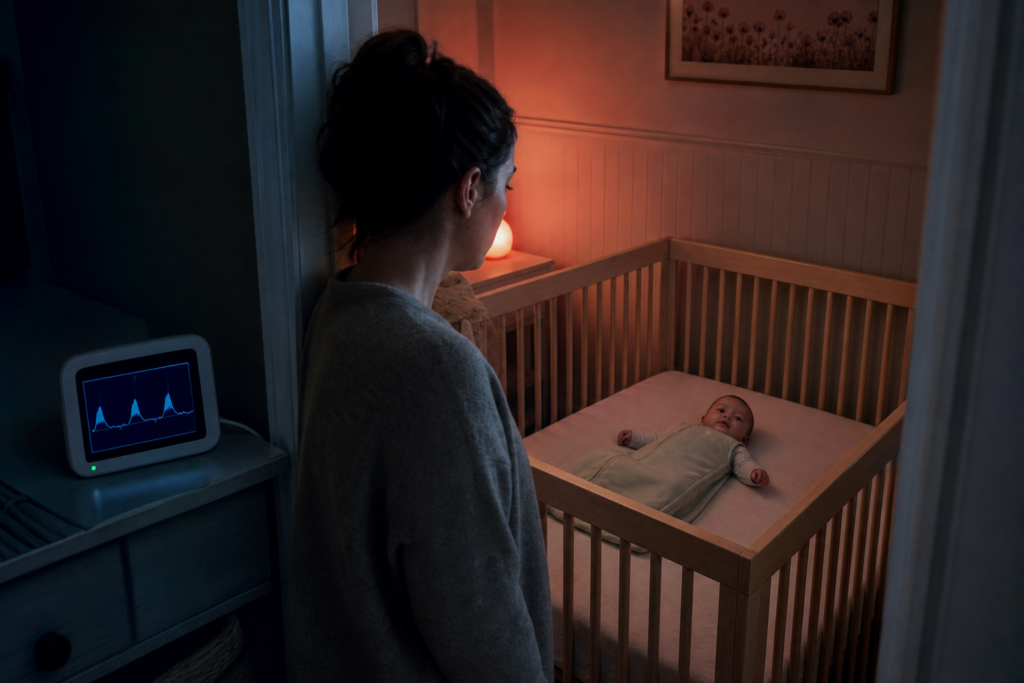
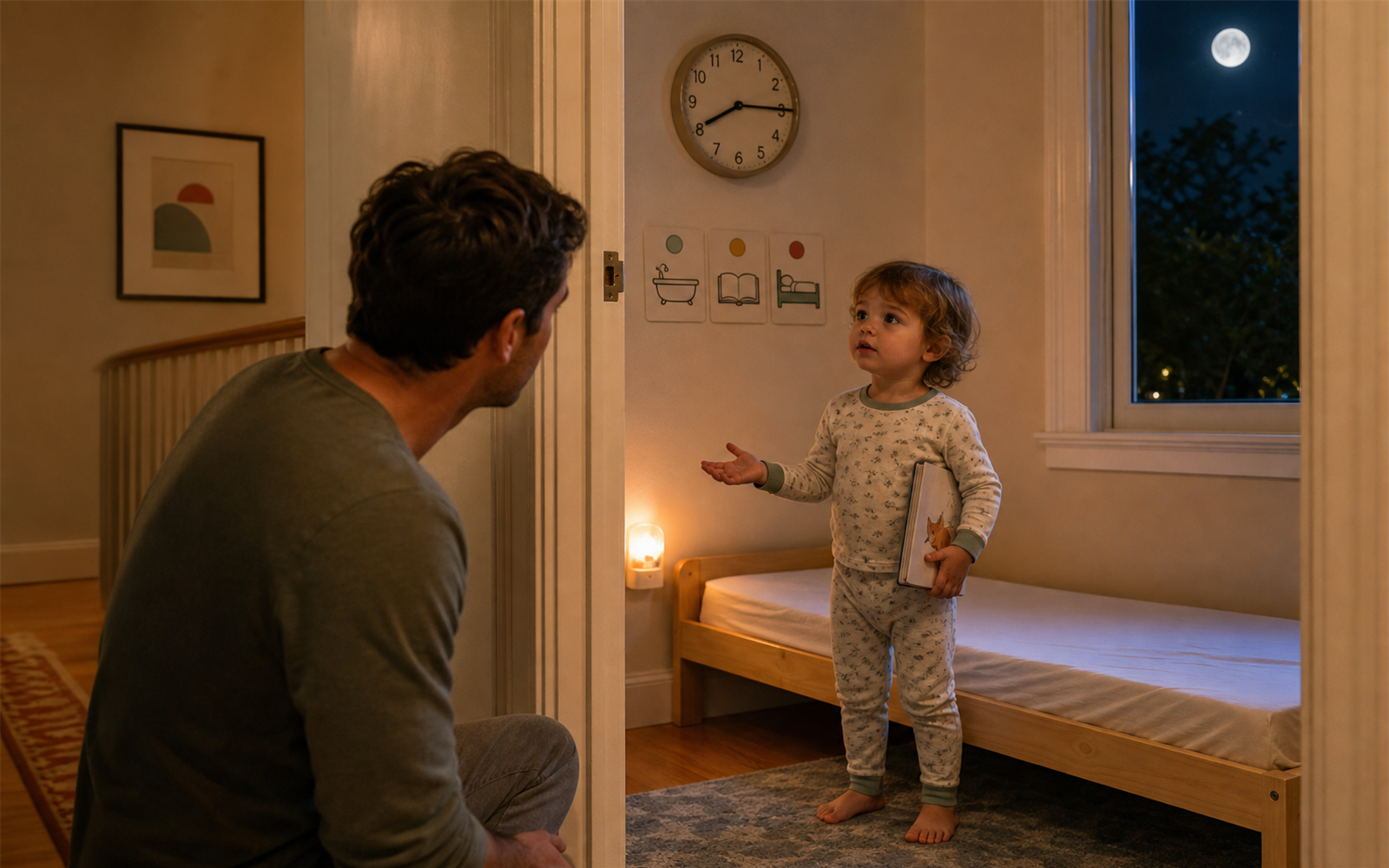
The bedtime book is closed. The cup is filled. The stuffed rabbit has been placed in the exact spot requested by its tiny but exacting supervisor. Then your two-year-old stands up and announces a need that apparently did not exist during the previous thirty minutes.
A 24-month sleep regression can describe a very real stretch of bedtime resistance, nap trouble, night waking or early rising, but it is not a formal diagnosis or a guaranteed event on a fixed second-birthday schedule. Around age two, independence, separation, language, imagination, changing sleep pressure, illness and ordinary boundary testing can all disrupt sleep. The useful question is not simply, “Is this the regression?” It is: Which part of sleep changed, what travels with it, and what single response fits that pattern?
When your child looks well and breathes comfortably, I would resist changing bedtime, nap length, response style, room setup and morning wake time all at once. That gives you five new variables and no idea which one mattered. Start by naming the part that changed.
“Regression” is the folder; these are the actual files
Not sleepy, repeated requests, leaving bed or needing a parent nearby.
Refusal, a later nap, a much shorter nap or a nap that pushes bedtime late.
Calling, crying, seeking the same help used at bedtime or waking with discomfort.
A new wake-for-day before the household is ready, with or without a changed nap.
Often a sign to review the whole 24-hour pattern and health context—not to change everything tonight.
SleepBaby.org pattern decoder: a description organizes the next question; it does not diagnose a regression.
Is there really a 24-month sleep regression?
There is no official developmental diagnosis called the 24-month sleep regression, and no authoritative calendar says every child must sleep badly at two. The phrase survives because parents recognize the experience: sleep had become more predictable, then the child’s ability to object, negotiate, remember, imagine and move seemed to arrive at bedtime as one enthusiastic committee.
The experience can be real without the label explaining its cause. CDC guidance describes the second year as a period of growing independence, new language, greater movement and wider emotional expression. The American Academy of Pediatrics also notes that two-year-olds may object strongly to changes in routine and test limits. Those shifts can alter bedtime. They can also occur at the same time as a cold, teething discomfort, travel, toilet learning, a room change, a new sibling, a later nap or a bedtime that no longer matches actual sleepiness.
I think of the regression label as permission to investigate, not permission to stop investigating. It tells me the family has noticed a change. It does not tell me whether the child needs more sleep opportunity, more sleep pressure, more predictable reassurance, a clearer boundary or medical attention.
The private fear under this search is often: We worked so hard for sleep. Did it disappear, and did I cause that? A better question is kinder and more useful: What changed first, and what happens immediately before and after it? Sleep is not erased because a two-year-old has discovered opinions. A new pattern is information, not a verdict on every choice you made before it.
What changes around age two—and why bedtime notices
A two-year-old can understand more of the bedtime sequence and also object to more of it. Language gives the child new ways to call you back. Memory makes the promised second book difficult to forget. Independence makes “I do it” relevant to pajamas, toothbrushing, the light switch and nearly every other step. Separation can feel sharper because the child understands that you are leaving the room but does not yet manage that feeling like an older child.
Imagination is also becoming richer. The room that looked ordinary last month may now contain a suspicious shadow. A sound in the hallway can acquire a story. That does not mean every protest is fear, and it does not mean fear should be dismissed as stalling. Ask what the child is showing you. A child who becomes distressed as you move toward the door needs a different response from a cheerful child who requests a fifth drink while arranging stuffed animals by seniority.
Then there is simple access to better tactics. A younger toddler may cry. A two-year-old may call your name, request a specific song, report an urgent sock problem and remember that yesterday one extra visit worked. This is not villainy. It is learning. The adult job is to stay warm while making the end of the routine predictable enough that bedtime does not become a nightly auction.
Match reassurance to separation; match predictability to stalling
Distress rises when you leave, parent preference is intense, and brief calm contact helps.
Try: “You’re safe. It is sleep time. I’ll check on you after I put away the cup.” Then keep the return brief and predictable.
The child is alert, inventive and increasingly specific; each fulfilled request produces another.
Try: “We did water and two books. Now it is sleep time. I’ll see you in the morning.” Repeat without adding a new event.
I would not demand perfect emotional quiet before leaving. The goal is not to prove that your child enjoys every boundary. The goal is to make the sequence understandable: comfort is available, the adult is calm, and bedtime still ends. Warmth and a limit can occupy the same room.
Check total sleep before dropping the nap
Children ages one to two are generally recommended to receive 11 to 14 hours of sleep across 24 hours, including naps, according to the American Academy of Sleep Medicine. That is a population range, not a stopwatch target. One child may sit comfortably near one end; another near the other. The number becomes useful only beside behavior, actual sleep onset, morning mood and the nap pattern.
Around age two, nap refusal is common enough to make parents wonder whether the nap is finished. Sometimes it is changing. Often one refused nap means only that the child was not ready at the offered time, was excited, was uncomfortable, or has discovered that staying awake produces interesting adult activity. The birthday itself does not prove the nap should disappear.
Look at both directions. A long or late nap can leave too little sleep pressure at bedtime, so the child talks, sings, rolls and requests until the body is ready. But cutting a needed nap can create an exhausted late afternoon, a frantic bedtime and more night disruption. Overtired and undertired can both look like “will not sleep,” which is why random schedule cutting is so confusing.
Two opposite schedule problems can wear the same pajamas
- Not enough sleep pressure at bedtime
- Long or late nap, cheerful extended settling, singing or playing in bed, and a child who does not seem sleepy. Consider a modest nap timing/length adjustment or bedtime fading—not an abrupt nap deletion.
- Not enough sleep opportunity across the day
- Nap loss plus late-day meltdowns, falling asleep in transit, frantic bedtime energy, difficult waking or a clear decline in mood. Protect nap opportunity or move bedtime earlier rather than stretching the child farther.
- Unclear
- Record three to five ordinary days before making a large change. Actual sleep matters more than time spent in bed.
If bedtime regularly occurs long before sleep, a gentle bedtime fade can reduce the long awake struggle: temporarily begin the final sleep attempt closer to the child’s natural sleep-onset time, then move it earlier in small steps as settling becomes easier. This is different from keeping an exhausted child awake to “wear them out.” The purpose is to align the bed with sleepiness and rebuild a clear connection, not to reduce sleep.
If the nap is inconsistent, keep offering a quiet rest opportunity while you observe. Some days may include sleep and some may not. On no-nap days, an earlier bedtime may be appropriate. On nap days, bedtime may need to reflect when the nap ended. I would rather make those small logical adjustments than declare an entire developmental era over because Tuesday’s nap was refused with confidence.
The night every variable looked guilty
Clearly labeled composite Kacey-and-Benjamin scene:
Imagine Benjamin at two, standing in bed after the routine with a newly urgent list: water, rabbit, different rabbit, door open, door less open, one verse of a song he had not requested since breakfast. I am in the hallway holding a cup and mentally placing the nap, bedtime, bath, room temperature and possibly the moon under investigation.
My first impulse is to rebuild tomorrow. Shorter nap. Earlier bedtime. New routine. More checks. Perhaps a chart with the administrative complexity of a small airport. Instead, I ask what the night is actually showing me. He is cheerful, not sleepy, and every return starts another request. The nap ended late. That is enough for one hypothesis.
So I keep the ending boring and kind: “Water is done. Rabbit is here. It’s sleep time. I’ll see you in the morning.” Tomorrow I protect the same routine and adjust only the timing. I do not turn one lively night into proof that Benjamin has forgotten how sleep works.
This is a composite scene, not Kacey or Benjamin’s documented family history and not scientific evidence. It demonstrates how to isolate one pattern without changing the entire system.
I use that scene because this age tempts adults into overreaction. The child’s new verbal skill makes every protest sound like evidence. But the content of the request is often less important than the sequence: Was the child distressed or playful? Sleepy or bright-eyed? Did one brief reassurance settle them, or did each response create a new request? Did the nap end later than usual? Those details tell you what to try.
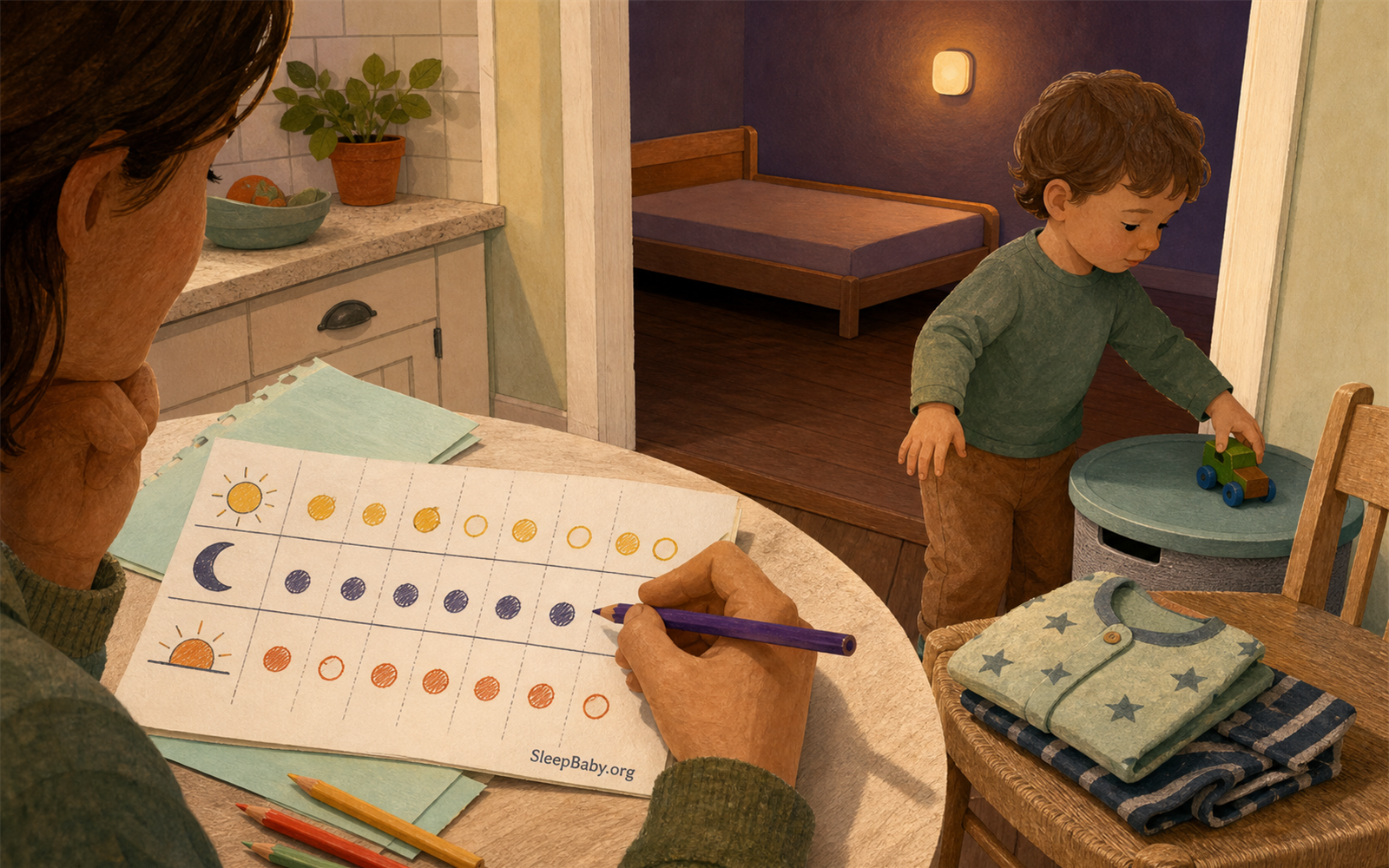
Use a three-to-five-day sleep note—not a perfect spreadsheet
You do not need months of data. You need enough ordinary days to separate a pattern from one spectacularly strange Tuesday. I would use a short note because memory after interrupted sleep becomes an unreliable narrator. “Up all night” may mean four brief calls. “Wouldn’t nap” may mean the offer moved ninety minutes later. Precision makes the next step easier without minimizing how exhausting it felt.
Record what happened, not what the night felt like
- Wake-for-day time
- Nap offered, actual start and end
- Routine start and lights-out
- Estimated actual sleep onset
- Night wakes, length and response
- Pain, illness, congestion or itching
- Snoring, pauses, gasping or effort
- Late-afternoon and morning mood
Do not wake a sleeping child or delay medical care to complete the note. This is a handoff tool, not a diagnostic test.
Add context that changed recently: travel, daycare schedule, a new room, a new sibling, toilet learning, illness, a parent returning to work or a comfort routine that expanded. Then circle the first reliable change. If the nap moved later before bedtime became difficult, start there. If bedtime became tearful after a separation change while the schedule stayed stable, start with predictable reassurance. If waking began with snoring and congestion, start with the child’s health.
Also count actual sleep across 24 hours, not just scheduled time in bed. A child placed in bed for twelve hours but awake for two of them did not receive twelve hours of sleep. Compare the rough total with the 11-to-14-hour recommendation and with the child’s functioning. The goal is not to force a number. It is to see whether the child has enough opportunity and whether the timing allows that opportunity to become sleep.
Match the response to the pattern
Generic advice says “be consistent,” which is technically useful and practically incomplete. Consistent with what? A response should fit the reason sleep is getting stuck. I would choose one lane, keep the rest of the evening familiar, and review the result after several nights unless the child is ill, unsafe or clearly worsening.
The first adjustment should answer the clue you actually saw
- Cheerful, long bedtime settling after a late or long nap: review nap timing/length or use a modest bedtime fade. Do not add repeated entertaining check-ins.
- Late-day collapse after nap refusal: preserve quiet rest and use an earlier bedtime on no-nap days. Do not stretch wakefulness simply to protect the clock.
- Separation distress: use a short repeated phrase, a predictable check and an ending the child can understand. Keep reassurance warm but avoid creating a new hour-long ritual.
- One-more-everything requests: meet normal needs before lights-out, name the final step, then repeat one calm boundary without bargaining.
- Night waking that requires the same help used to fall asleep: decide on a developmentally appropriate response you can repeat at bedtime and overnight. Change gradually if abrupt withdrawal would be unmanageable.
- Early rising: check total sleep, bedtime, nap and light/noise around waking. Keep the pre-morning response dark, quiet and boring rather than turning 5 a.m. into an accidental breakfast appointment.
None of this requires a cold, rigid performance. If your child is sick or frightened, respond to the child in front of you. Consistency means the broad message stays understandable: this is bedtime, I am here, you are safe, and the routine has an end. It does not mean withholding comfort to win a contest.
Give a well-matched, modest change several nights when possible. Toddler sleep is noisy data; one night can improve because the nap changed, the child was exhausted or the household happened to be quieter. Several nights show whether the direction is useful. If a change clearly makes sleep opportunity smaller, mood worse or distress much higher, step back and reassess rather than defending the experiment.
How long does the 24-month sleep regression last?
There is no evidence-based countdown that applies to every two-year-old. A temporary disruption connected to travel, illness or a schedule mismatch may improve quickly when the trigger resolves or timing is corrected. A pattern reinforced by an expanding bedtime routine may continue until the sequence becomes predictable again. Separation distress can ebb and return. A medical problem will not reliably end because an online article promised a certain number of weeks.
I would measure direction rather than demand a deadline. Is sleep onset becoming a little shorter? Are wakes less frequent or less dependent on a long response? Is the child’s mood improving? Can the family follow the plan without escalating everyone’s distress? Small movement matters.
If there is no improvement after a consistent, well-matched attempt; if the pattern is severe or prolonged; or if the child or family is functioning poorly, bring the sleep note to the pediatrician. The clinician can review health, development, schedule and breathing and decide whether further evaluation or individualized behavioral sleep support is appropriate.
How can I help my child fall asleep?
The American Academy of Pediatrics walks through practical nighttime and nap-time sleep supports. Watch for the emphasis on a predictable routine and age-appropriate settling—not a promise that one technique fixes every two-year-old.
SleepBaby takeaway: Use the video to simplify your routine, then use this article’s pattern note to decide whether timing, separation, requests, illness or breathing is the real place to begin.
Watch directly on the American Academy of Pediatrics YouTube channel.
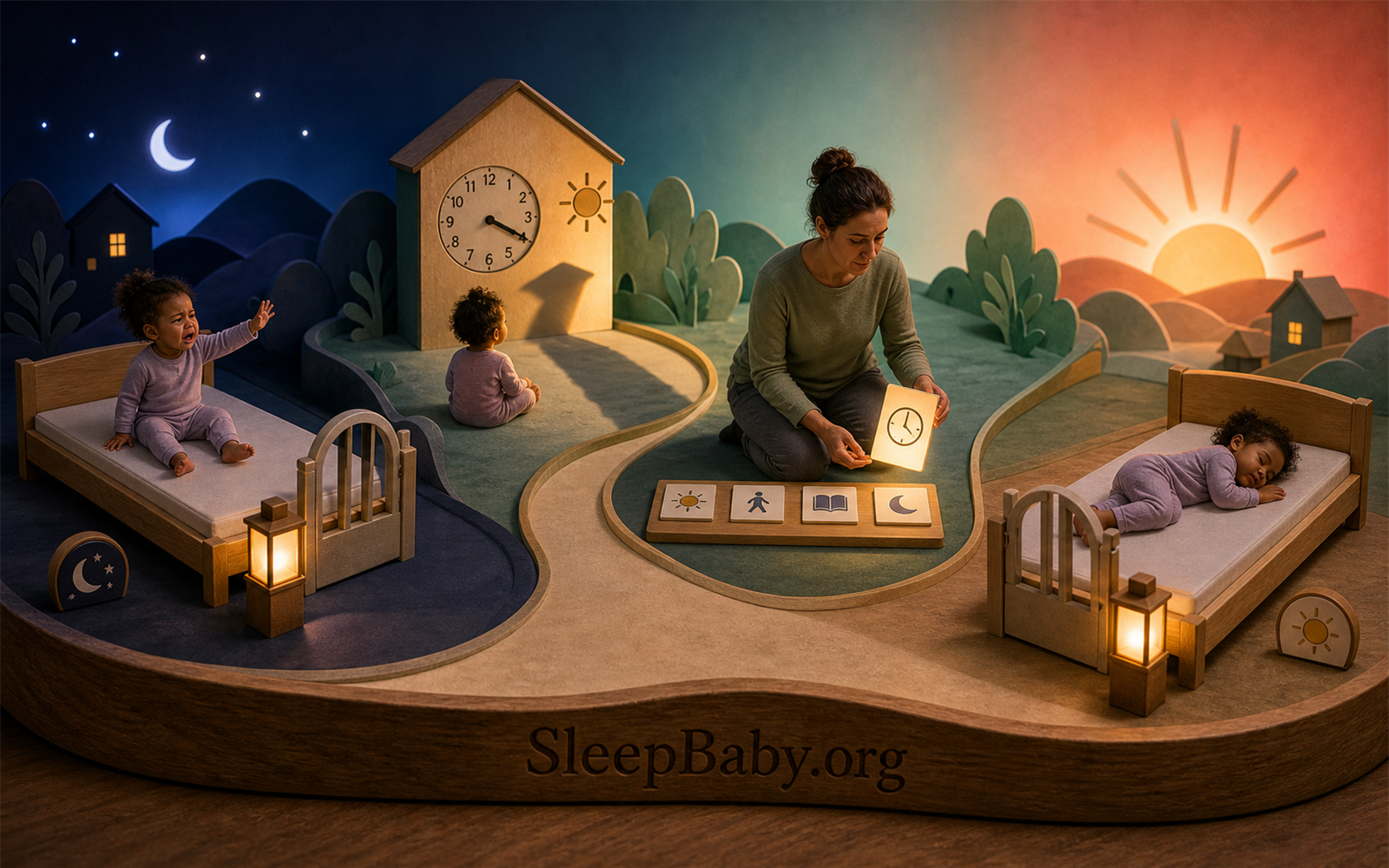
When the “regression” label is not enough
Call the pediatrician when the sleep change comes with persistent pain, recurrent fever or illness concerns, marked daytime sleepiness, a major behavior or attention change, loss of developmental skills, or disruption severe enough that the child or family is not functioning safely. Mention any new medication and ask before using melatonin, antihistamines or supplements. A two-year-old’s sleep should not become a home pharmacology experiment.
Bring up frequent snoring, mouth breathing, pauses, gasping, catch-up breaths or visible work of breathing. The American Academy of Pediatrics lists frequent snoring and nighttime breathing difficulty among childhood sleep-apnea signs. Those patterns do not diagnose apnea at home, but they do change the next step from “adjust the schedule” to “let a clinician assess the airway and sleep.”
Development also belongs in the conversation. CDC milestone guidance is not a diagnostic test, but it is clear that loss of skills or a concern about how a child plays, learns, speaks, acts or moves should be shared with the doctor. Do not explain away a meaningful developmental concern as a sleep regression. Sleep loss can affect behavior; behavior can affect sleep; a clinician can help sort the direction.
And if the problem is “only” sleep but it has become entrenched, asking for help is still reasonable. Behavioral bedtime and night-waking approaches have evidence, but the best plan depends on the child, family and pattern. You do not have to choose a method from a dramatic social-media argument. You can ask for an individualized path.
What I would do tonight
- Check health and breathing. If pain, illness or breathing is driving the wake, respond to that first.
- Name the changed sleep segment. Bedtime, nap, night waking, early rising or several?
- Finish needs before the final goodnight. Water, toilet or diaper, comfort item, brief connection—then name the ending.
- Use one calm phrase. “You’re safe. Books are done. It is sleep time. I’ll see you in the morning.” Adjust the reassurance for your child without inventing new routine steps.
- Write three facts tomorrow. Nap end, actual sleep onset and what the child was like before bed. Add wakes and morning mood if they matter.
- Choose one matched adjustment. Keep everything else recognizable long enough to learn from it.
The stuffed rabbit may still need its exact position tonight. Your child may still protest the end of the books. The changed understanding is that neither detail proves all prior sleep has vanished. One is part of the room; the other is a signal to read alongside timing, separation, health and what happens after you respond.
I would close the book, meet the ordinary need, hold the kind boundary and let tomorrow’s pattern—not tonight’s volume—decide the next adjustment. Two-year-olds can make a bedtime request sound like a constitutional amendment. You are still allowed to answer it with one calm sentence.
Sources
- American Academy of Sleep Medicine: Recommended Amount of Sleep for Pediatric Populations
- CDC: Milestones by 2 Years
- CDC: Positive Parenting Tips for Toddlers Ages 1–2
- HealthyChildren: Toddler Bedtime Trouble
- HealthyChildren: Separation Anxiety and Sleeping Trouble
- HealthyChildren: Emotional Development in 2-Year-Olds
- CDC: Structure and Rules for Toddlers
- American Academy of Sleep Medicine task force review: Behavioral Treatment of Bedtime Problems and Night Wakings
- HealthyChildren: Sleep Apnea in Children
- NHS: Sleep and Young Children