21-Month-Old Sleep Schedule: A Flexible One-Nap Day for Real Life
Build a flexible 21-month-old sleep schedule from total sleep, one midday nap, and the day your toddler actually had—not one rigid clock.
Updated August 24, 2026·16 minute read
✓Read the answer first. The Workshop is here only when you want the next step.
The clock is a clue, not a verdict
A 21-month-old sleep schedule that leaves room for an actual 21-month-old
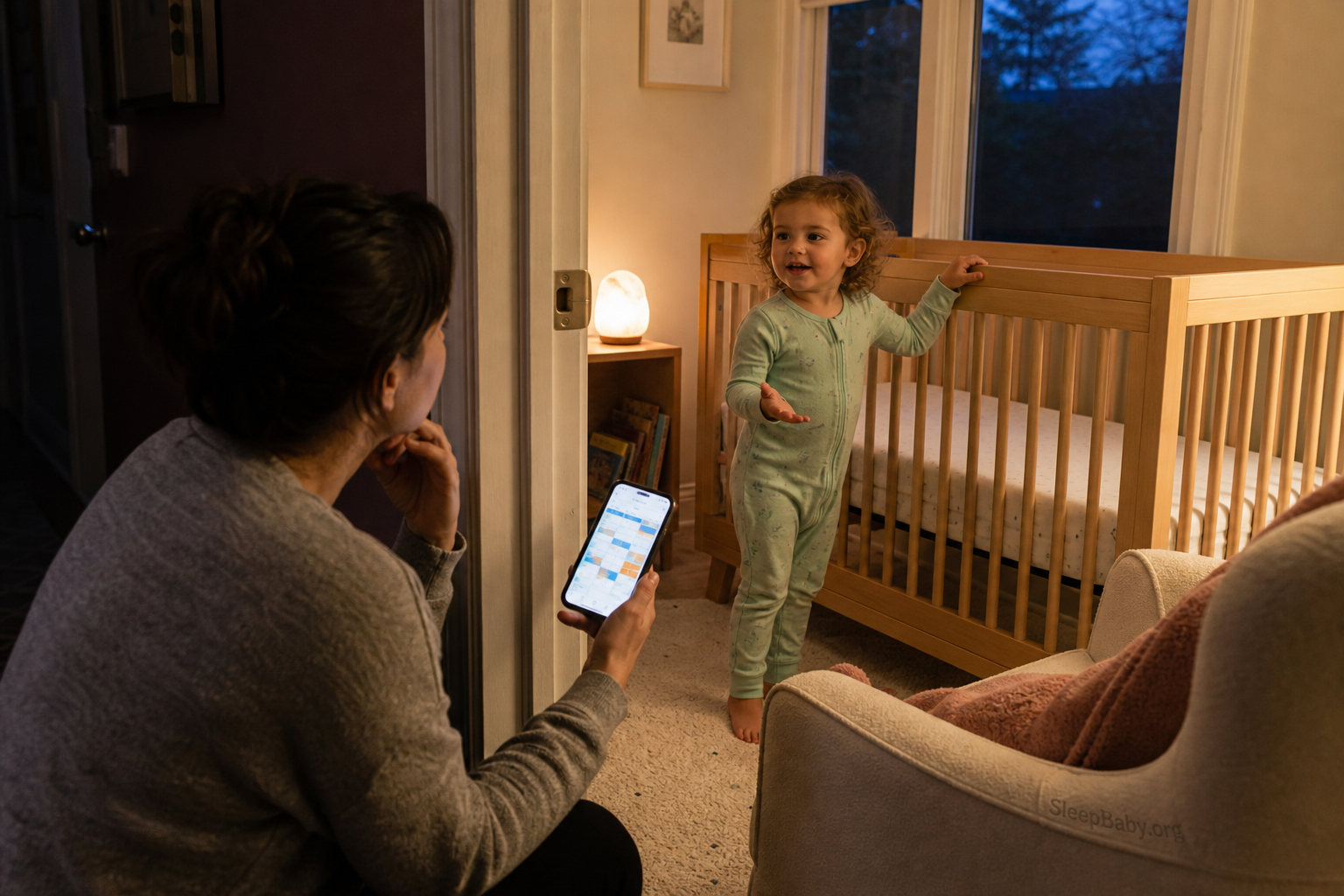
It is 7:42 p.m. The schedule screenshot on your phone says asleep by 7:30, while your toddler is standing in the crib giving a detailed tour of the ceiling, the curtain, and one mysterious speck on the wall. I would not turn that single evening into a schedule emergency.
Most 21-month-olds are on one midday nap and need 11–14 hours of actual sleep in 24 hours, including the nap. A useful starting shape is a 6:30–7:00 a.m. morning, a nap around 12:00–12:30 p.m. for roughly 1½–2 hours, and bedtime around 7:30–8:00 p.m. Those clocks orient you; they are not a test your child has to pass. Count actual sleep for three to five days, keep the morning and nap opportunity reasonably steady, and change one lever at a time.
The question beneath “What is the right 21-month sleep schedule?” is usually more tender: Have I caused these rough nights by missing the one correct time? No. A schedule is a readable experiment around a real child. It is not a grade on your parenting.
Start with this one-nap day
6:30–7:00 a.m. Out of bed and morning light
12:00–12:30 p.m. Nap opportunity begins
1:30–2:30 p.m. Likely nap ends
7:30–8:00 p.m. Bedtime range, adjusted to the day
This is a starting silhouette, not a prescription. A child who wakes at 6:10 a.m. for child care will often need the whole day shifted earlier. A child who sleeps until 7:15 a.m. and takes a long nap may not be ready for sleep at 7:15 p.m. I care more about the repeated relationship between wake time, actual nap sleep, bedtime behavior, and total sleep than about matching somebody else’s screenshot.
☾ SleepBaby.org · The original video
A little help for the night ahead.
Take a moment to watch the original Baby Sleep Miracle presentation. Your article will be right here when you’re ready to keep reading.
Baby Sleep MiracleWatch here
Original Baby Sleep Miracle
Press play when you’re ready.
Ready to get started?Take the next step with SleepBaby.
The whole day, not one saved clock time, explains why bedtime feels easy or impossible.
Actual night sleep plus actual nap sleep gives the useful 24-hour total.
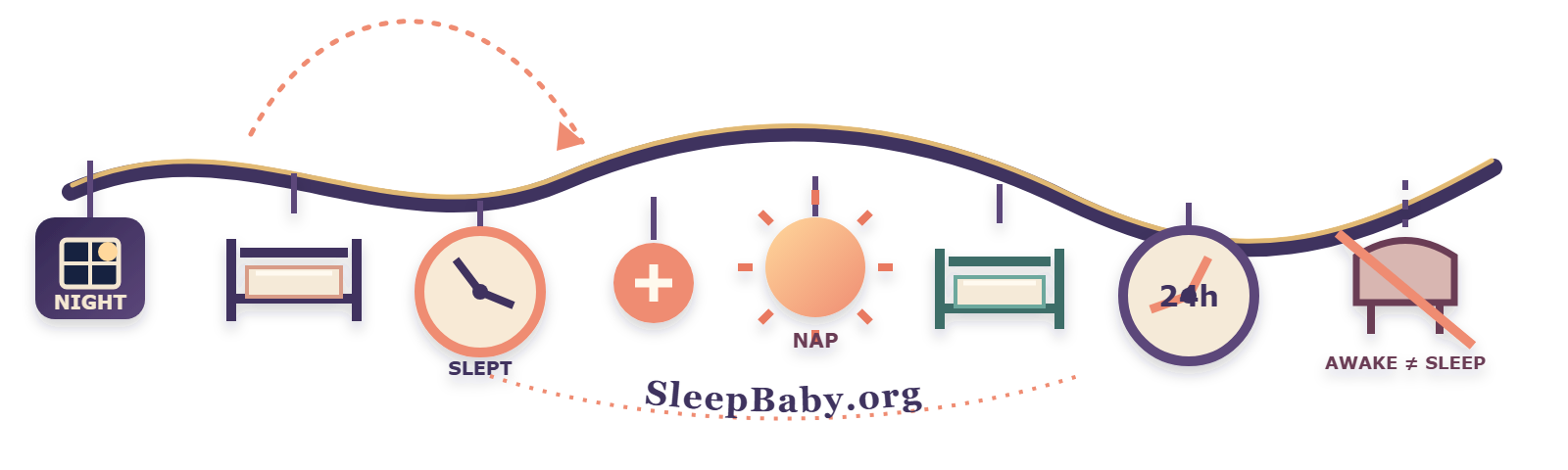
SleepBaby ribbon 1 — Count the sleep that happened: Night sleep plus nap sleep belongs in one 24-hour picture; awake-in-bed minutes stay outside the count.
The number that matters is the whole 24 hours
The American Academy of Sleep Medicine and the World Health Organization both place children ages 1–2 in an 11–14-hour total-sleep range per 24 hours, including naps. That range is health guidance for a population. It does not prove that your child needs a two-hour nap, a particular wake window, or a bedtime ending in :30.
I would count estimated sleep, not merely time offered. If your toddler is in bed from 7:30 p.m. to 6:30 a.m. but chats for 40 minutes before falling asleep and spends 25 minutes awake overnight, the night is not automatically 11 hours of sleep. You do not need laboratory precision. You need the same honest estimate each day so the pattern is comparable.
What goes in the total?
Count sleep, then annotate the edges
Count:
Estimated night sleep plus estimated nap sleep.
Do not count:
Happy talking, rolling, singing, or playing while awake in bed.
Note separately:
Long overnight waking, accidental car sleep, illness, travel, or an unusually chaotic day.
Read beside the number:
Mood, alertness, sleep onset, repeated waking, and how the child functions between sleeps.
A total near the edge of the range is not automatically a problem. A child who is alert, generally content, and settling predictably gives you different information from a child with the same total who is repeatedly falling apart late in the day. The clock needs context.
SleepBaby.org teaching note: the total is a compass; the repeated day is the map.
Two realistic schedule shapes
Families often ask for “the schedule” when they really need a shape that can survive their morning. Here are two. Neither is biologically superior. The difference is where the family’s day begins and which nap clock cannot move.
Two flexible one-nap schedules for a 21-month-old
Part of day
Later household morning
Earlier child-care day
Morning begins
7:00 a.m.
6:15 a.m.
Nap opportunity
12:30–2:15 p.m.
11:45 a.m.–1:30 p.m.
Into bed
About 7:45 p.m.
About 7:00 p.m.
What to watch
Whether sleep begins near 8:00 p.m. without a long cheerful party
Whether the earlier bedtime prevents a late-day collapse after the fixed nap
If the later-day child sleeps about 11 hours overnight and 1 hour 45 minutes at nap, the total is about 12 hours 45 minutes. That is one workable example inside the wider range—not a target to reproduce to the minute. A longer nap may support a slightly later bedtime. A short or missed nap may earn an earlier bedtime. One unusual Tuesday does not deserve permanent custody of the family schedule.
Keep the anchors recognizable even when the exact child-care and home clock times differ.
The order can stay steady even when one clock time shifts.
SleepBaby ribbon 2 — Keep one midday anchor: Morning light, lunch, one midday rest, afternoon play, and a bedtime lamp turn the day into a readable sequence.
Does a 21-month-old still need a nap?
One midday nap is the common starting pattern at 21 months. A single refusal does not mean the nap is finished. Toddlers can skip a nap because the room was noisy, the morning ran late, separation felt bigger that day, they are uncomfortable, or they simply discovered that closing their eyes would interrupt an important personal project involving a cup and a spoon.
I would look for a repeated pattern across comparable days. Is the nap beginning later and later despite a steady opportunity? Is a child consistently cheerful through the afternoon without it, then settling well at a reasonable bedtime? Or does the missed nap produce a brittle 4:30 p.m. child and a hard night? Those are different stories.
Pattern decoder
A refusal, a wobble, or a real transition?
Hold the nap: refusal is occasional, the child still sleeps on most days, or missed naps lead to obvious late-day strain.
Move the opportunity modestly: the child is repeatedly calm and awake at the old nap time but falls asleep when the nap starts a little later.
Investigate beyond timing: refusal arrives with illness, pain, breathing changes, a major environment change, or intense separation.
Do not declare victory from one day: a toddler can skip sleep and look spectacular for several hours. The invoice sometimes arrives at bedtime.
Use a three-to-five-day ledger before moving the clock
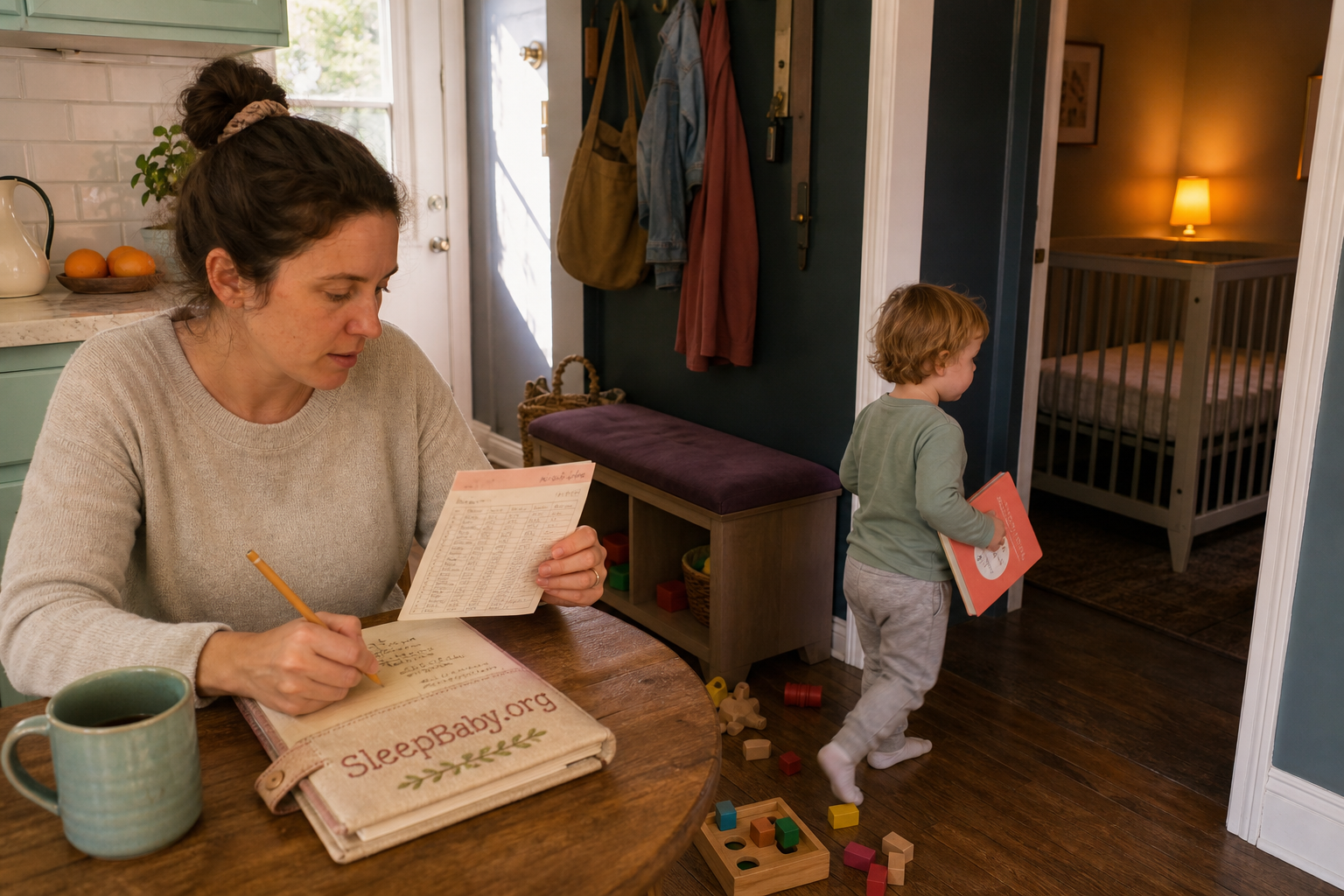
This is the part I wish every sample schedule put in larger type. A clock change is only useful if you can tell what it changed. For three to five reasonably typical days, record four numbers and one plain-language note. You are not building a toddler surveillance program. You are giving tomorrow’s tired self something better than memory.
Morning out-of-bed time. Use the time the day actually begins, not the first brief noise.
Estimated nap sleep. Record likely sleep start and end, not just crib or cot time.
Estimated nighttime sleep onset. “Into bed” and “asleep” are separate facts.
Meaningful overnight waking. Note waking long enough to change the total.
Add one evening phrase: cheerfully awake, falling apart, or settled in the usual range. That phrase often tells you which direction to test before the total alone does.
Example: Up 6:40 a.m. · Nap asleep 12:15–1:50 p.m. · Night asleep about 7:35 p.m. · No long wake · Evening: tired but steady.
SleepBaby.org reader tool: use estimates consistently; precision theater will not make the toddler more predictable.
Clearly labeled hypothetical scene—not a family memory or evidence
Kacey, Benjamin, and the screenshot that looked like a court order
Imagine Benjamin at 21 months, tucked into a safe empty crib at 7:30 p.m. and happily conducting a one-child podcast about the curtain. Hypothetical Kacey is outside the door staring at a schedule screenshot that says he should already be asleep. I can almost feel the temptation to move the nap, cap the nap, darken the room, lengthen the routine, and negotiate directly with time itself—all before breakfast.
What I would do instead is write down the actual night. If this happened once, I would call it a night. If Benjamin were cheerfully awake for 35 or 40 minutes across several comparable evenings while the nap and morning stayed steady, I would test bedtime 15 minutes later. If he were frantic after a short nap, I would test earlier. The scene matters because it separates a child who cannot yet sleep from a schedule that is “wrong.” The screenshot is not evidence. The repeated child is.
That distinction is emotionally useful, too. You are not hunting the one missing clock. You are learning which small invitation gives sleep the best chance to arrive.
Change one lever, then let the day answer
Once the ledger gives you a repeated pattern, choose one lane. I would keep morning rise and the nap opportunity as steady as real life allows, then test bedtime first in many cases. Fifteen minutes is large enough to observe and small enough that one test does not turn Thursday into a completely different time zone.
One-change decision rail
What the repeated pattern suggests
Cheerfully awake at bedtime for several nights
Try bedtime about 15 minutes later. Keep the wake time, nap opportunity, and wind-down recognizable while you watch what happens.
Late-day collapse or unusually fast sleep after a short nap
Try bedtime 15–30 minutes earlier that day. Do not automatically cap tomorrow’s nap because today was hard.
Nap keeps starting late and bedtime keeps drifting
Protect the nap opportunity first. Moving morning, nap, and bedtime together destroys the comparison.
One missed nap
Offer a calm rest period, avoid a late rescue nap that collides with bedtime, and use an earlier bedtime. Wait for repetition before changing the base schedule.
Give the test several comparable days when your child is well and life is reasonably ordinary. Success is not zero protest. I am looking for a day that feels more predictable, sleep onset that is not repeatedly far too early or far too late for the opportunity, and a toddler who is generally functional between sleeps. If you want the broader method, use this guide to adjust one schedule variable at a time.
A useful tool for the handoff—not a sleep treatment
Make the last ten minutes visible
If the hardest part is moving from play to the wind-down, the Time Timer MOD 10 Minute – Education Edition gives the adult one visible, disappearing countdown to use before both nap and bedtime. It fits this schedule experiment better than another light-control or sound product because its exact job is the transition: the clocks can stay put while the same short warning becomes predictable.
I would use it as a supervised adult cue—“When the red is gone, we put the blocks away and choose the book”—not as a promise that a toddler will understand it immediately or fall asleep on command. Keep it outside the sleep surface and out of reach when it is not being actively supervised, and follow the manufacturer’s battery and product instructions. It is not a toy, treatment, or proof that the schedule is correct.
As an Amazon Associate, SleepBaby may earn from qualifying purchases.
One changed variable gives you an answer; five changed variables give you noise.
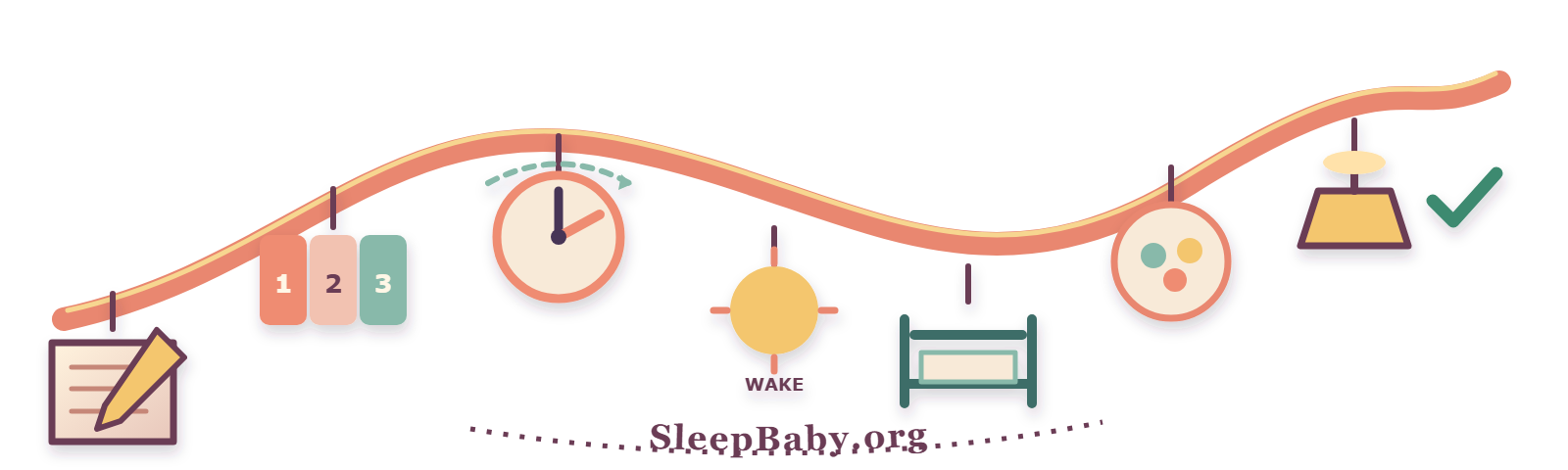
SleepBaby ribbon 3 — Move one pencil line: A ledger, pencil, one moved clock hand, and three steady anchors make the experiment readable.
When the sample schedule does not fix the night
A schedule can create friction, but it does not own every difficult bedtime. I sort the problem into four lanes: body, clock, connection, and boundary. The lanes can overlap. Their value is that they stop us from treating every wake-up as a math problem.
Four-lane decoder
What kind of problem is asking for attention?
Body
Illness, pain, teething discomfort, breathing changes, hunger, temperature, or another physical need. Attend to the child; do not protect the experiment.
Clock
The nap or bedtime opportunity repeatedly arrives before sleep pressure—or after the child has become profoundly tired.
Connection
Separation, change, or a need for a predictable reunion is driving repeated calls for the parent even when the timing is reasonable.
Boundary
The routine has expanded through repeated requests, inconsistent endings, or exciting returns. Warmth and a clear finish can coexist.
Long, contented talking or play across several nights may mean the sleep opportunity is too early. Frantic resistance after a short nap can point the other way. Repeated requests for water, one more book, or another parent check may be connection or boundary work even when the clock is sensible.
Keep the routine short enough to repeat: bathroom, pajamas, one or two books, a consistent goodnight phrase, bed. The AAP’s brush-book-bed example is useful because it is memorable, not because those exact three steps are magical. I would rather see a calm 15-minute routine you can repeat than a 55-minute production whose final act changes nightly.
Early waking
A later bedtime does not guarantee a later morning. Check dawn light, household noise, actual night duration, nap timing, and whether your toddler is distressed or simply awake. During a schedule test, keep the morning start cue reasonably consistent. If 5:20 a.m. receives bright light, breakfast, and the full daytime show one day but not the next, the evidence becomes harder to read.
Do not leave a distressed, hungry, ill, or unsafe child waiting to preserve a number. The schedule serves the child. The child does not serve the spreadsheet.
Night waking
Too much or too little sleep opportunity can contribute to waking, but clock times cannot diagnose the cause. Consider pain, illness, breathing, room temperature, separation, and whether the way your child falls asleep is difficult to repeat after a normal overnight arousal. If you change bedtime, do not simultaneously introduce a new settling method and cap the nap. You will have no idea which lever mattered.
Pair the nap note with what you can see in the evening before changing bedtime.
Child care, a short nap, and the day that went sideways
When child care owns the nap clock, treat that nap as the anchor. Ask for the actual sleep start and end when staff can provide it, then adjust home bedtime modestly according to the nap end and your child’s evening behavior. I would not spend the weekend forcing a completely different clock unless the repeated weekend pattern gives a clear reason.
The home handoff
Keep three facts on the same line
What time did sleep actually end?
What does the child look like by dinner? Cheerful, strained, or falling asleep in the high chair?
What is the smallest bedtime adjustment that fits those facts?
A 45-minute child-care nap and a 1-hour-45-minute nap do not have to lead to identical evenings. They also do not require two entirely different family systems.
If the nap is short
Move bedtime earlier that day if your toddler is clearly running out of road. Keep the evening boring in the best way: food, connection, ordinary routine, bed. Do not automatically cut tomorrow’s nap to “protect” the night. One short nap is a day to support, not a theory to defend.
If the nap is missed
Offer a quiet rest opportunity, avoid a late accidental nap when possible, and use an earlier bedtime. If a short car sleep happens, record it; ten or fifteen minutes can change bedtime even when it did not feel like a “real nap.” Return to the ordinary morning and nap anchors the next day. One rescue bedtime is not a new permanent schedule.
If travel or illness disrupted everything
Meet the immediate need first. When your child is well and home again, return to the familiar anchors rather than compensating with a chain of late naps and dramatic bedtime moves. A disrupted day is noisy data. It is not evidence that the base schedule failed.
Earlier bedtime is a gentle repair when the nap supplied less sleep than expected.
SleepBaby ribbon 4 — Short nap, softer evening: A short nap can bend the day toward dinner, pajamas, lower light, and a gentler earlier bedtime.
AAP routine support
Keep the routine steady while you test the clock
The American Academy of Pediatrics video below reinforces practical ways to help a child fall asleep. I am including it here because the most useful schedule experiment holds the wind-down recognizable while one clock variable changes.
What to carry into tonight: a predictable routine is the control group. When the same few steps stay steady, the effect of moving bedtime becomes easier to read.
Contact your child’s pediatrician when sleep difficulty is persistent and meaningfully affects daytime function, or when you notice loud habitual snoring, pauses or gasping in breathing, unusual breathing effort, recurrent pain, or other signs of illness. Urgent breathing difficulty or a child who appears acutely unwell belongs in urgent medical care, not a bedtime experiment.
Do not use melatonin, supplements, sedating products, or weighted sleep products as a schedule fix without appropriate pediatric guidance. No clock should override hunger, pain, illness, prescribed care, or an immediate safety need.
The questions that show up after the sample day
How long should a 21-month-old nap?
Many sample days use roughly 1½–2 hours, but there is no authoritative required nap length for every child. Count the nap inside the 11–14-hour day, then read bedtime behavior, night sleep, and daytime function. A shorter nap can still fit a child who sleeps more at night; a longer nap can fit when bedtime remains workable.
What time should a 21-month-old go to bed?
About 7:00–8:00 p.m. is a useful starting range for many families, with earlier days often needing earlier bedtime. The right test is whether the opportunity repeatedly meets the child near sleep—not whether the clock matches an online table.
Should I wake my toddler from a long nap?
Do not automatically cap the nap because one bedtime was late. First check the repeated 24-hour total and whether the long nap consistently pushes sleep onset too late. If it does, make a modest, consistent adjustment rather than abruptly removing a large amount of sleep opportunity.
Is this the 21-month sleep regression?
“Regression” is not a formal diagnosis with a fixed schedule. Development, separation, timing, illness, discomfort, environment, and settling conditions can all change sleep. Use the four-lane decoder and the child’s other symptoms instead of letting the label end the investigation.
What if my 21-month-old wakes at 5 a.m.?
Look at dawn light, noise, actual night duration, nap timing, and whether your child is distressed. Keep the morning cue steady during a test, but respond to hunger, illness, pain, or safety needs. Moving bedtime later may help a child whose night opportunity is too long, but it can also worsen an already tired child; the ledger tells you which story is repeating.
Does one refused nap mean we should drop naps?
No. At 21 months, one midday nap is still the common starting pattern. Treat one refusal as one day. Look for a durable pattern across comparable days and watch what the missed sleep does to the afternoon, bedtime, and night.
Relief comes from testing one change instead of treating the entire schedule as broken.
Turn your toddler’s real days into a calmer next step
That schedule on your phone can go back to being what it always should have been: a pencil sketch. The SleepBaby.org Workshop is a baby sleep workshop for parents who want practical tools for reading patterns, choosing the next manageable change, and bringing more clarity to bedtime without pretending one clock can promise a perfect night.
The workshop does not diagnose breathing, pain, illness, or developmental concerns, and it does not replace your child’s clinician. It helps with the part that belongs on the kitchen table: what happened, what matters, and which line you might revise next.