The short answer
An 18-month-old sleep schedule is a relationship, not one perfect row of times
Most 18-month-olds need about 11 to 14 total hours of sleep in 24 hours, including naps, and many are settling into one midday nap. That does not mean every toddler needs a 12-hour night, the same nap length, or the same bedtime. Start with three steady anchors: a reasonably consistent morning start, a midday sleep opportunity, and a familiar bedtime sequence. Then place bedtime according to the nap your child actually took—not the nap the schedule promised.
If the day is not working, I want you to change one lever at a time and watch several ordinary days. Look at total sleep, how settling feels, night continuity, early waking, and daytime function. A chart can help you see the day. It cannot grade your parenting or diagnose why your toddler woke.
SleepBaby.org · The original video
A little help
for the night ahead.
Take a moment to watch the original Baby Sleep Miracle presentation. Your article will be right here when you’re ready to keep reading.
Ready to get started?Take the next step with SleepBaby.
Help my baby sleep
Why 18 months can make a simple schedule feel impossible
You may have arrived here after opening six sample schedules and finding six different answers. One says noon nap. Another says 12:30. One promises a seven o’clock bedtime; another insists the last wake window must be exactly five hours. Meanwhile your toddler slept forty minutes at child care, refused the second nap at home, woke at 5:18 a.m., and somehow still found the energy to protest pajamas.
I hear the private question underneath all that clock math: Am I causing the bad nights by using the wrong schedule, and which part should I move first without making everything worse? My answer is usually reassuring and practical. A schedule may be part of the pattern, but one rough bedtime does not prove the day was “wrong.” Pain, illness, breathing trouble, a changing sleep space, separation feelings, travel, stimulation, or ordinary developmental variation can all sit beside timing. The safest useful move is to separate what the clock can help with from what it cannot explain.
The American Academy of Sleep Medicine recommends 11 to 14 hours per 24 hours for children ages 1 to 2. That range includes naps. Think of it as a wide evidence-based neighborhood, not an order to make your child sleep a certain number of hours. A toddler who sleeps 10½ hours overnight and 1½ hours at midday totals 12. Another who sleeps 11½ hours overnight and 75 minutes at midday also lands in the range. Their clocks do not need to match.

Build the day around three anchors
1. Morning start
Use a reasonably steady out-of-bed time and morning light. It does not have to be exact to the minute. The goal is to keep the day from drifting by hours after every unusual night.
2. Midday sleep opportunity
Offer one nap near the middle of your toddler’s actual day when one nap is working. During the transition, some days may still need a brief bridge or a different plan.
3. Familiar bedtime sequence
Keep the order recognizable—perhaps wash up, pajamas, brush, book, bed—while allowing the start time to respond to the nap and the child in front of you.
Anchors are steadier than exact wake-window arithmetic because they give the body repeated cues while leaving room for real life. If calculating every minute is making you more frightened than informed, it may help to step out of wake-window stopwatch anxiety and return to observable patterns.
Use a 24-hour sleep budget before moving the clock
Before deciding your toddler is sleeping “too much” in the day or “not enough” at night, I add the sleep that actually happened first. I do not count time in the crib as sleep, and I do not round a long settling period into the night total. I find a rough three-day view much more useful than one dramatic day.
Night sleep
From actual sleep onset to final waking, minus long awake periods you know about.
Nap sleep
Use the child-care report or your best estimate of when sleep began and ended.
24-hour total
Compare several ordinary days with the 11-to-14-hour population range and your child’s daytime function.
SleepBaby.org field note: the useful question is not “Did we hit 7:00?” It is “What did the whole day ask from the whole night?”
If totals are consistently far outside the expected range, your toddler is unusually sleepy, or waking is hard, do not keep trimming or stretching sleep on your own. That belongs in a conversation with the child’s clinician.
Flexible 18-month-old schedule examples
I use these as examples of relationships, not prescriptions. I keep the same basic shape in each row while shifting it with family wake time, because nap length, settling, child-care rules, and individual sleep need will change bedtime. When I write “begin routine,” I mean start the familiar sequence—not promise the minute sleep begins.
| Morning start | Lunch / wind-down | Nap opportunity | Bedtime response |
|---|---|---|---|
| About 6:00 a.m. | Lunch around 11:00; quiet transition after | Roughly 11:30 a.m.–12:00 p.m. start | Earlier routine after a short nap; later only if the nap and child support it |
| About 7:00 a.m. | Lunch around 11:30; quiet transition after | Roughly 12:00–12:30 p.m. start | Often begin the routine in the 6:30–7:30 range, shaped by actual nap sleep |
| About 8:00 a.m. | Lunch around 12:15; quiet transition after | Roughly 12:45–1:15 p.m. start | Shift the sequence rather than compressing the entire day to copy an earlier-waking child |
A schedule that begins at 8:00 is not automatically “too late,” just as a 6:00 start is not a parental failure. Check whether the timing works with the household, child care, total sleep, and your child’s behavior. If your family needs a fixed morning for work or care, use that as the strongest anchor and make smaller adjustments around it.

Is your 18-month-old still between two naps and one?
Many children move from two naps to one somewhere around 15 to 18 months, but I do not let the calendar make the decision. I do not treat a single refused nap as proof, and one marvelous one-nap day does not settle it either. Transitions often wobble because the child can manage a longer morning on some days but not yet hold that pattern after an early wake, a rough night, illness recovery, or a demanding child-care day.
Two naps may still fit today when…
the morning began unusually early, the first nap remains easy and restorative, the second nap can happen without pushing bedtime far beyond the child’s usual pattern, or one-nap days repeatedly end in exhausted late-afternoon sleep.
One nap may be becoming workable when…
the first sleep opportunity can gradually move toward midday, the second nap is repeatedly difficult rather than occasionally refused, one midday nap supports reasonable daytime function, and bedtime can remain manageable.
Use a bridge day when…
your toddler cannot comfortably reach the usual midday nap. A brief early rest, a slightly earlier main nap, or an earlier bedtime may protect the day. The exact bridge depends on what your child and child-care setting can safely do.
If this is the decision tying the whole day in knots, use the fuller framework to decide whether the second nap still fits the whole day. The goal is not to win a one-nap badge. It is to arrive at a pattern your toddler can repeat with enough total sleep.
A pediatric nap-transition explainer
Watch the change as a gradual move, not a cold-turkey clock reset
Boys Town National Research Hospital explains how the two-to-one-nap transition often unfolds and why the remaining nap can move toward midday over time.
Takeaway for tonight: move the remaining nap toward midday gradually and let a shorter transition day earn an earlier bedtime. One age or one nap refusal should not cast the deciding vote.
When the schedule is off, change one lever
It is tempting to change nap time, cap the nap, move bedtime, darken the room, and start a new settling method on the same night. Then even a better night cannot tell you what helped. I prefer a smaller experiment: choose the clearest repeated collision, move one lever modestly, and keep the other anchors recognizable for several ordinary days when it is safe to do so.
Lever A: nap start
Consider a small shift when the offered nap is repeatedly met with long, calm wakefulness or when the child cannot comfortably reach it. Do not use one refusal as the whole case.
Lever B: nap end
Inspect a repeated late or very long nap that collides with bedtime. The toddler actigraphy study found an association—not proof—between later or longer naps and later sleep onset or shorter nights.
Lever C: bedtime
Let the routine begin earlier after a short nap or hard transition day. A later bedtime may fit after a later, restorative nap—but later does not automatically produce a later morning.
I keep the notes plain: wake, actual nap start and end, routine start, estimated sleep onset, meaningful night wakes, final wake, and how your child functioned. I do not need a minute-perfect spreadsheet here. I need enough truth to see whether the same collision repeats.

Let four votes decide whether the change helped
Parents are often told to judge a schedule by how quickly bedtime happened. That is only one vote. A toddler can fall asleep fast after an exhausting day and still have a fragmented night or a miserable morning. A child can also need a little longer to settle while the total day is otherwise working well. I want the decision to include the whole pattern.
Vote 1: settling
Did sleep begin with less prolonged struggle, or was your toddler simply awake and content for a while? Calm wakefulness and intense distress are not the same signal.
Vote 2: the night
Did meaningful waking become less frequent or shorter across several comparable nights? One quiet night is welcome, but it is not yet a pattern.
Vote 3: morning
Did final waking move in a useful direction without forcing your child to stay in bed distressed? Morning light and household noise may vote too.
Vote 4: daytime child
Was your toddler generally alert, connected, and able to participate, or unusually sleepy, difficult to wake, or persistently distressed?
The votes do not need to be perfect. I look for a direction. If settling improves but the nap shortens, night waking grows, and your child is struggling through the afternoon, the change did not earn a full yes. If three votes improve and one stays neutral, I may hold the pattern long enough to see it clearly. If illness, breathing, pain, or unusual sleepiness enters the picture, I stop scoring the schedule and use the medical exit.
A pattern decoder for the five problems parents see most
This is not a diagnostic chart. I use it only to decide what to observe next while keeping medical and safety concerns in their own lane.
Clearly labeled hypothetical scene
If Benjamin and I were reading this day together
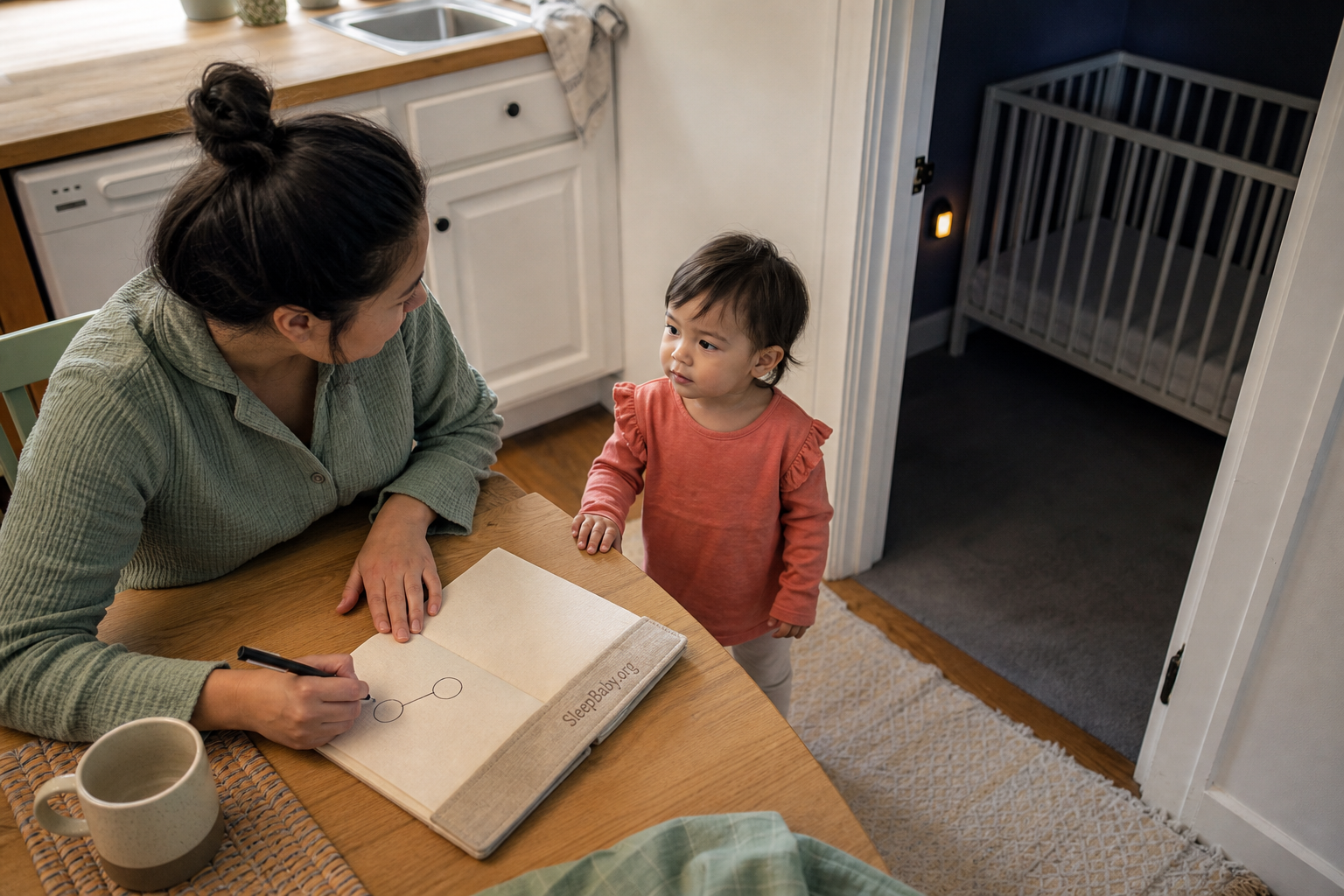
This is an illustration, not a claim about something that happened in my family. Imagine Benjamin and me at the kitchen table with a made-up toddler’s day in front of us: awake at 6:10, nap offered at noon, sleep beginning at 12:35, waking at 1:20, and a bedtime protest that started at 7:00.
I could circle the protest and declare bedtime the problem. Benjamin could point to the forty-five-minute nap and declare the nap the problem. But the page asks us to slow down. Was this one unusual day or the third similar day? Was the toddler cheerful after the nap or falling apart by dinner? Did the room brighten at 1:20? Were there pain, illness, or breathing signs? What time did sleep actually begin at night?
Then I would choose one modest experiment—perhaps beginning the bedtime sequence a little earlier after another short nap—while leaving the morning and midday opportunity recognizable. The value of the exercise is not that Kacey or Benjamin guessed correctly. It is that the parent no longer has to change everything at once.
Translate child-care days instead of trying to duplicate them
A child-care schedule may fix lunch and nap opportunity at times you cannot move. Home days may be quieter, later, or more flexible. I do not treat that difference as automatic inconsistency. I translate the day by comparing the sleep that happened and the child who came home, not by arguing over whether both settings use the same label.
Ask child care for four facts
- When was the sleep opportunity?
- When did sleep probably begin?
- When did your child wake?
- How did your child function afterward?
Translate that into tonight
- Short or missed nap: protect a calmer, possibly earlier routine.
- Long or late nap: expect bedtime timing to feel different.
- Usual nap and usual function: keep the familiar pattern.
- Illness, pain, or unusual sleepiness: leave the schedule lane.
On weekends, I do not try to recreate the classroom minute by minute. I keep the morning within a reasonable neighborhood, offer midday rest at a compatible point, and let bedtime respond to the actual nap. A schedule can be coherent without being identical.
Check the room before blaming the schedule
Timing gets blamed for problems caused by changing light, noise, temperature, or a device that behaves differently from one day to the next. If the nap repeatedly ends when sun reaches the room, or dawn waking tracks seasonal light, I test the environment before rewriting the schedule. I keep the setup simple: a dark-enough room, comfortable temperature, and a predictable sound environment if your family uses one. Secure cords, small parts, and devices out of reach and away from the sleep space.
Let the bedtime routine carry continuity when timing moves
A predictable routine does not have to be elaborate. The AAP’s “Brush, Book, Bed” framing works because the order is easy to recognize. Your version might be bath on some nights, washcloth on others, then pajamas, brush, two short books, song, and bed. Keep the final steps calm and similar even when the clock shifts after a short nap.
I would rather see a five-step routine you can repeat than a twelve-step production that delays sleep and leaves everyone resentful. Screens can make the transition harder, and autoplay can turn one song into a stream of stimulation. If you use audio, decide the track, volume, and stop behavior before the routine begins. The routine’s job is to make the next step legible—not to force sleep on command.
When climbing changes the question
At 18 months, some children begin trying to climb from the crib. I treat that as a sleep-space question, not a schedule problem. Follow the crib manufacturer’s limits and instructions, keep the mattress at the appropriate setting, and do not add objects that can become climbing steps. If the crib is no longer safe for your child, talk with the pediatrician and make the next sleep space and the whole room hazard-resistant. I would preserve the familiar bedtime sequence while the physical setup changes.
A new bed can coincide with more movement or calling out, but do not assume timing caused every response. Secure furniture, manage cords and windows, use appropriate gates or door safety as advised for your home, and keep dangerous objects inaccessible. Safety comes before protecting a charted bedtime.

Leave the schedule lane
When sleep needs medical or developmental guidance
Contact your child’s clinician for persistent snoring, breathing pauses, catch-up breaths, labored breathing during sleep, unusual daytime sleepiness, sustained pain or illness symptoms, a sudden sleep change that does not behave like ordinary timing friction, growth concerns, lost skills, missed milestones, or another developmental concern. The 18-month visit is also a routine point for developmental screening and for bringing the pattern you have observed.
Get emergency help now for stopped breathing, blue or gray color, inability to wake normally, a marked change in muscle tone, or another sign of a medical emergency. Do not delay emergency care to test a nap or bedtime change.

Your plan for tonight and the next three ordinary days
- Add actual night and nap sleep. Use the 24-hour total, not time offered in bed.
- Write down the three anchors. Morning start, midday sleep opportunity, and bedtime sequence.
- Name one repeated collision. Short nap, late nap, early wake, long settling, or increased night waking.
- Check safety, illness, breathing, and development first. Leave the timing experiment when the pattern points outside it.
- Move one lever modestly. Nap start, nap end, or bedtime—not all three.
- Watch several ordinary days. Look for a repeated change in settling, nights, mornings, total sleep, and daytime function.
You came looking for the correct 18-month-old sleep schedule. I hope you leave with something kinder and more useful: a day with shape, a way to see the whole 24 hours, and permission to adjust one thing without treating the chart as a verdict. The schedule is doing its job when it helps you notice your child more clearly.
Sources
- American Academy of Sleep Medicine: Recommended Amount of Sleep for Pediatric Populations
- American Academy of Pediatrics: Healthy Sleep Habits—How Many Hours Does Your Child Need?
- Boys Town National Research Hospital: Transitioning from Two Naps to One
- Scientific Reports / PubMed: Daytime nap controls toddlers’ nighttime sleep
- Centers for Disease Control and Prevention: Milestones by 18 Months
- American Academy of Pediatrics: Sleep Apnea in Children—Detection & Treatment
- American Academy of Pediatrics: Brush, Book, Bed
- American Academy of Pediatrics: Big Kid Beds—When to Switch From a Crib
SleepBaby.org · The original video
A next step for
the next bedtime.
Still thinking about sleep? Watch the presentation here, then explore the SleepBaby program whenever you’re ready.
Ready to get started?Take the next step with SleepBaby.
Help my baby sleep