13 months • one nap or two • flexible schedule
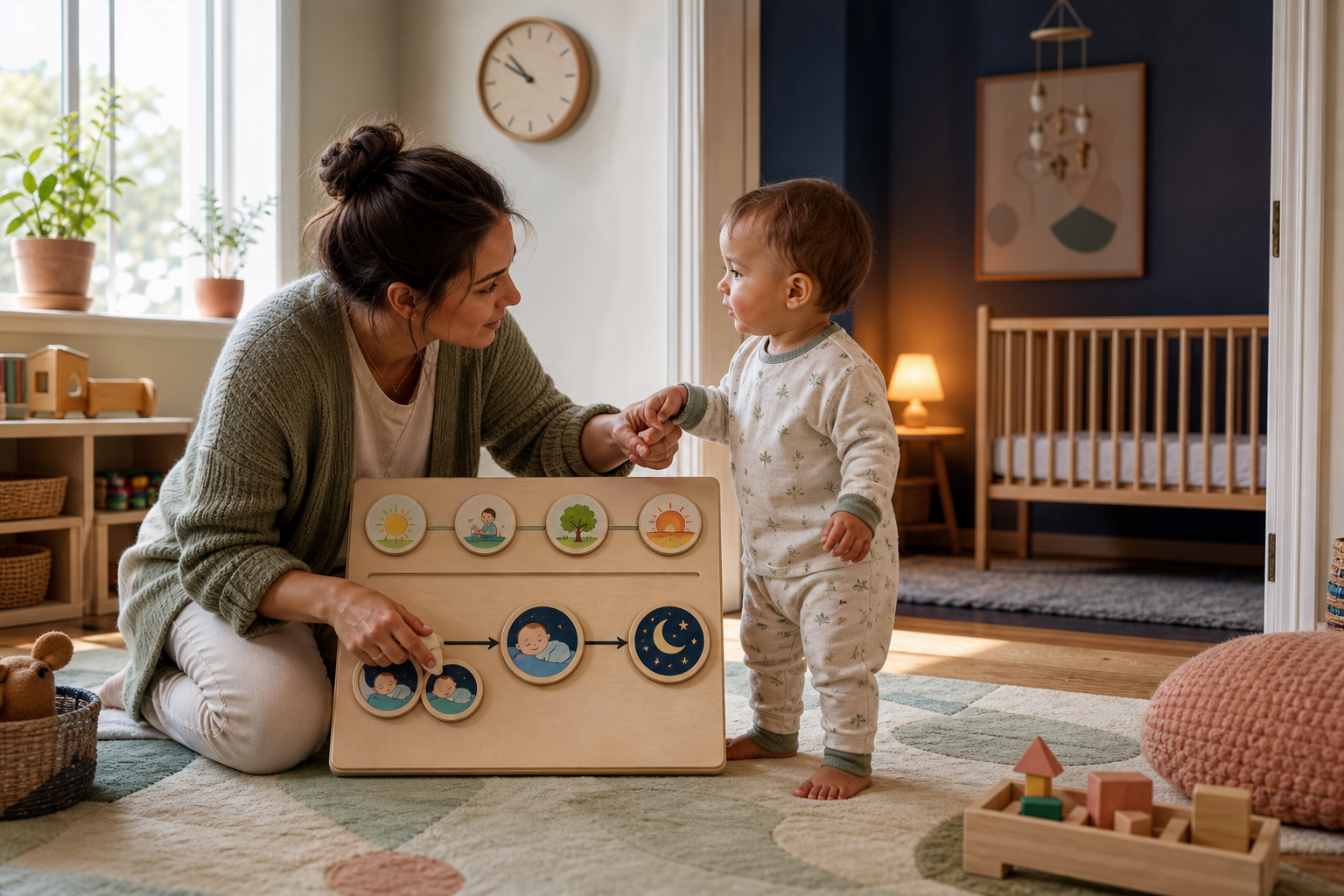
Your 13-month-old does not need one perfect schedule
If your 13-month-old suddenly treats the afternoon nap like an optional meeting, you may be wondering whether the whole schedule is wrong. The short answer is reassuring: most children this age need 11 to 14 total hours of sleep in 24 hours, including naps, and either a one-nap or two-nap day can fit inside that healthy range. The useful question is not, “What clock times does every 13-month-old follow?” It is, “Which pattern protects my child’s total sleep and gives us a reasonably settled bedtime?”
I would not force the one-nap transition because of one skipped nap, one early morning, or one chaotic daycare day. At 13 months, sleep can look gloriously predictable on Tuesday and become interpretive dance by Thursday. I look for a pattern across several ordinary days: when sleep actually starts, how long each nap lasts, whether the second nap still happens without a battle, and what bedtime looks like afterward.
How much sleep does a 13-month-old need?
The American Academy of Sleep Medicine recommends 11 to 14 hours of sleep in each 24-hour period for children ages 1 to 2 years, including naps. The CDC repeats that same range. It is a population guideline, not a stopwatch test. One healthy toddler may be cheerful and steady on 12 hours while another genuinely needs closer to 14.
Count sleep, not time in the crib. If your child is in bed from 7:00 p.m. to 7:00 a.m. but spends an hour awake overnight and 30 minutes chatting before sleep, that is not 12 hours of nighttime sleep. Add the sleep that actually happened overnight to the sleep that actually happened during naps. You do not need laboratory precision; a realistic estimate over three to five days is enough to reveal whether the schedule is protecting sleep or merely looking tidy on paper.
I also care about the child you see during the day. A schedule deserves another look when a toddler is regularly falling asleep during meals or car rides, unraveling long before bedtime, taking very short naps after heroic stretches awake, or waking repeatedly in a way that leaves the whole family depleted. Conversely, a child who falls asleep comfortably, wakes in a workable mood, and lands inside the recommended range may not need “fixing” because a sample schedule online uses different clock times.
I would rather see an honest range than a perfect-looking chart built from wishful rounding. I want the notes to describe the child in front of me, because my next decision should answer what actually happened.

Two realistic 13-month-old sleep schedule examples
These are starting points, not prescriptions. Shift them around your child’s usual morning, childcare realities, and actual sleep duration. The intervals matter less than the relationship between naps and bedtime.
Example A: two naps
- 6:30–7:00 a.m. Wake
- 9:45–10:30 a.m. First nap
- 2:15–3:15 p.m. Second nap
- 7:15–7:45 p.m. Bedtime
This pattern can work when the first nap is short enough to leave room for a useful second nap. If nap one regularly stretches well past an hour and nap two disappears, gently shortening or moving the first nap may be a cleaner experiment than abruptly deleting it.
Example B: one nap
- 6:30–7:00 a.m. Wake
- 11:45 a.m.–1:45 p.m. Nap
- 6:45–7:30 p.m. Bedtime
During the transition, the midday nap may be shorter than this. An earlier bedtime is often the kindest bridge. Keeping a newly one-nap toddler awake until a late “normal” bedtime can turn a schedule experiment into a very long evening.
A daycare schedule may set the nap time for you. In that case, make morning wake time and bedtime your adjustable anchors. A child who naps at noon in care may need an earlier bedtime after a short nap and a slightly later bedtime after a long one. Consistency does not mean refusing to respond to what actually happened.
I use these examples as pencil marks, not permanent ink. I would shift them around the morning your child actually starts, and I can still call the day consistent when bedtime responds sensibly to nap length.
Is your 13-month-old ready for one nap?
The transition is usually a process, not a graduation ceremony. Some toddlers move cleanly to one nap; many alternate between one- and two-nap days for a while. I would look for several signs arriving together:
- The second nap is refused repeatedly for a week or two, not just during illness, travel, teething discomfort, or a developmental burst.
- When the second nap does happen, bedtime shifts so late that night sleep shrinks.
- The first nap starts later naturally and can lengthen into a restorative midday nap.
- Your child can reach late morning without routinely falling asleep in the stroller, car, or high chair.
- One-nap days produce a better night and a manageable mood more often than they produce frantic exhaustion.
A single skipped afternoon nap is weak evidence. So is bedtime resistance by itself. At 13 months, resistance can also come from separation feelings, practicing new movement or language, a stimulating evening, hunger, discomfort, or simply discovering that standing in the crib gets an audience.
If you are unsure, try a “bridge” rather than a hard switch. Move the first nap later by 15 minutes every few days, keep bedtime earlier when the nap is short, and use a brief rescue nap only when the day is clearly falling apart. Avoid a late rescue nap that steals the pressure needed for bedtime. The goal is not to prove that your toddler can stay awake; the goal is to arrange sleep so that sleep can happen.
If the transition is still unfolding next month, the same whole-day test in our 14-month-old sleep schedule can help you decide whether two naps still fit or one nap is becoming steadier.
A clearly labeled composite scene: the kind of nap-transition week many families recognize
In this composite Kacey-and-Benjamin moment, Benjamin refuses his afternoon nap with such confidence that I immediately decide he has moved on to one nap. I picture a neat new schedule. By 4:37 p.m., he is sitting on the kitchen floor furious at a banana that has broken in half, and my elegant plan is beginning to look less like progress and more like a very long wake window.
The useful lesson is not that this exact scene proves anything; it does not. It is that one dramatic day can make a parent overcorrect. I would record what happened, use an early bedtime, and look for the pattern again tomorrow. Three ordinary days tell me more than one spectacular nap refusal.
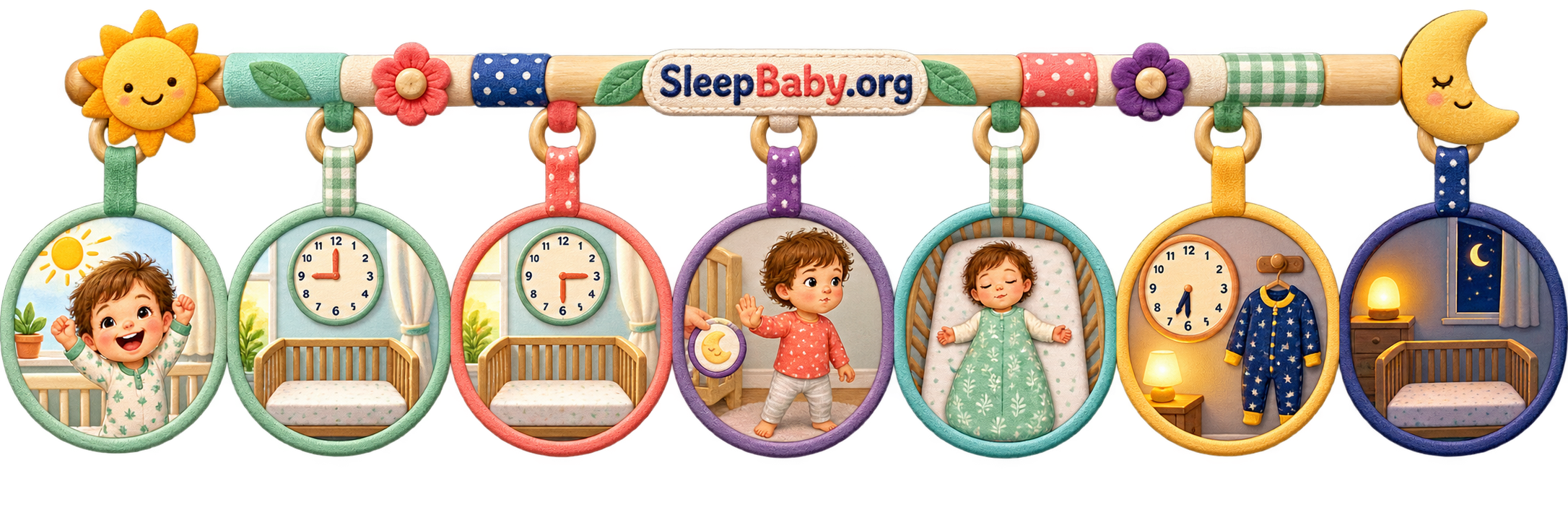
The three-day schedule diagnostic I would use first
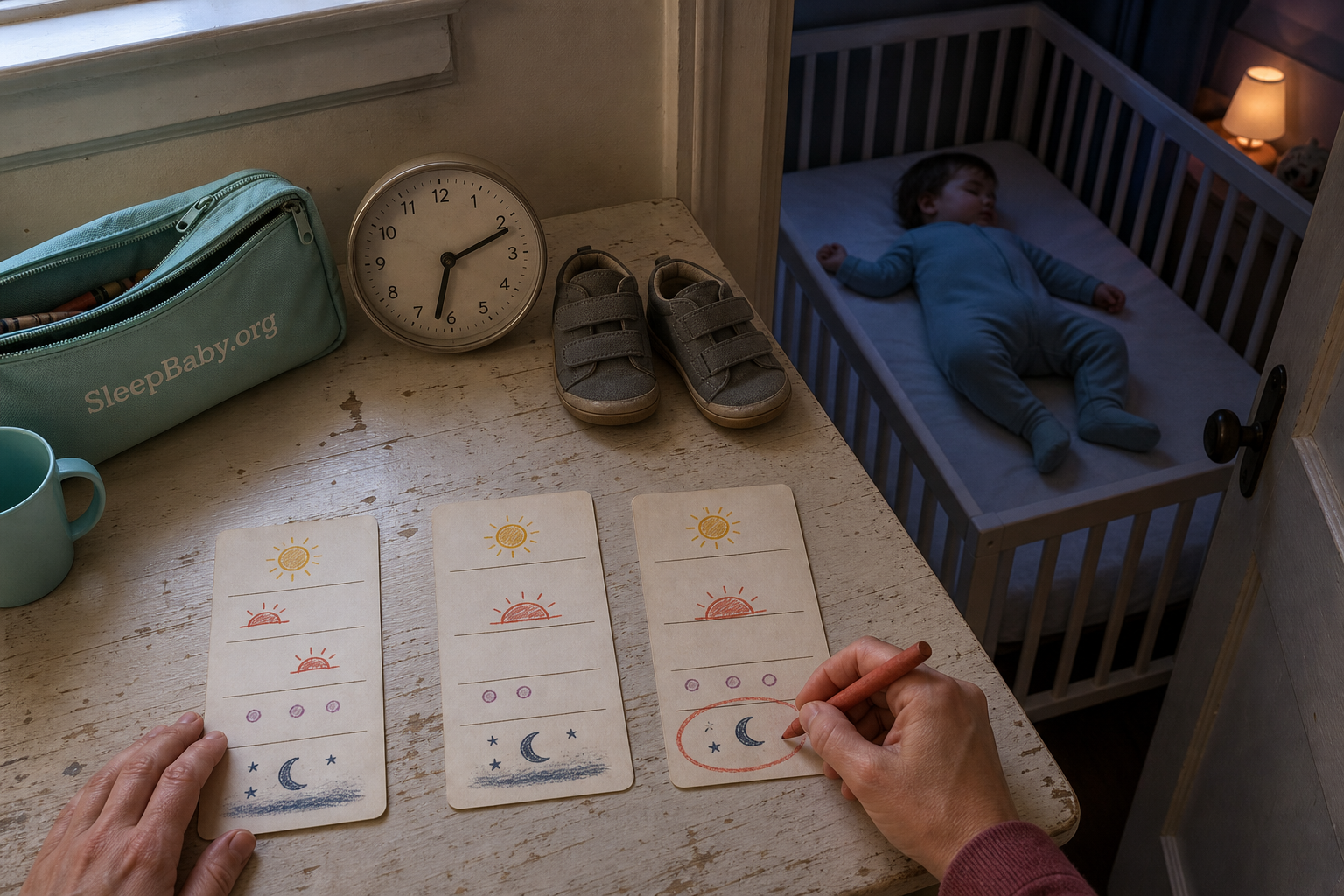
When sleep feels chaotic, I want less guessing, not more complexity. For three ordinary days, write down only four things: morning wake time, actual nap sleep and wake times, bedtime sleep onset, and meaningful night waking. Add a short note for illness, travel, daycare, or an accidental car nap. That is enough.
- Total the sleep. Is your child usually landing inside 11 to 14 hours?
- Find the pressure point. Is the first nap too early and preserving a two-nap rhythm? Is nap two ending too late? Is the one nap too early to carry the afternoon? Is bedtime fixed even when nap length changes?
- Change one thing. Shift one nap or bedtime by 15 to 30 minutes. Do not simultaneously change the room, routine, feeding pattern, response to waking, and nap count.
- Hold the experiment. Give the new timing several comparable days unless your child is clearly ill, deeply overtired, or the change is making sleep worse.
- Judge the whole day. Look at sleep onset, total sleep, mood, and night waking together.
Wake windows can be a useful shorthand, but they are observations, not medical rules. A schedule that says “3.5/3.5/4” cannot account for a 20-minute stroller nap, a fever, a daycare celebration, or a toddler who needs more sleep than the average. I use the clock to notice patterns; I do not ask a tired child to obey arithmetic.
What common sleep problems may be telling you
The second nap has become a battle
First check when nap one begins and ends. A generous morning nap can remove the sleep pressure needed for the afternoon. If your child still seems to need two naps, try moving nap one slightly later or capping it modestly before eliminating nap two. If the second nap remains absent and bedtime keeps drifting, begin nudging toward a midday nap.
Bedtime suddenly takes forever
A late second nap is an obvious possibility, but it is not the only one. Review the wind-down, evening light, vigorous play, separation needs, and whether bedtime is earlier than your child can realistically sleep. The AAP recommends a predictable quiet routine and regular bedtime. Keep it simple enough to repeat: clean up, brush teeth, pajamas, books, cuddle, bed. A routine should cue sleep, not become a 14-step negotiation.
Your toddler wakes very early
Early waking can follow an overtired day, a bedtime that has drifted too late, a bright room, hunger, discomfort, or simply a stable body-clock pattern. Avoid changing everything after one 5:00 a.m. morning. Keep the room quiet and dark, expose your child to morning light at the desired start of day, and protect naps while you examine the pattern. If moving bedtime later makes waking even earlier and reduces total sleep, reverse course.
When I see an early wake, I start with the previous day before I rewrite the morning. I do not assume that a later bedtime will produce a later start; I let the next few days of total sleep answer that.
There is a long awake party overnight
A “split night” can happen when the child has more time in bed than they can sleep, when daytime sleep is unusually long or late, or during developmental disruption. It can also occur with discomfort or illness. Compare total sleep opportunity with actual sleep, then adjust conservatively. A small timing change is easier to interpret than a complete schedule rebuild.
Naps last only 30 or 40 minutes
A short nap can be a normal one-off. Repeated short naps may mean the nap is mistimed, the environment is interrupting sleep, or the child is arriving overtired. On a one-nap day, do not demand that a 35-minute nap carry six more waking hours. Offer an early bedtime or, when appropriate, a brief earlier rescue nap while the transition settles.

Light is worth checking before you blame the schedule
At 13 months, a bright room can end a nap or announce morning before the household is ready. If light is visibly the problem, a removable window covering is a more direct test than buying a toddler clock your child is not developmentally ready to interpret or adding sound to a room that is already quiet.
A practical pick for testing a darker sleep space
The Tommee Tippee Sleeptime Portable Baby Travel Blackout Blind attaches to a window with suction cups and can move between rooms. That makes it useful for a renter, a grandparent’s house, or travel when early daylight is repeatedly cutting a nap short. It fits this situation better than a toddler wake clock, which asks a 13-month-old to understand a color rule, and better than a sound machine when brightness—not noise—is the obvious cue.
Why I would buy it: if daylight is consistently ending naps or starting the day, this gives you a removable way to test whether darkness improves timing before paying for permanent shades. Measure the window, follow the installation directions, keep every part inaccessible from the sleep space, and watch room temperature and ventilation. It is an environmental tool, not a treatment or a sleep guarantee.
See the Tommee Tippee portable blackout blind on Amazon
As an Amazon Associate, SleepBaby may earn from qualifying purchases.
Feeding, development, and separation can look like a schedule problem
Thirteen months brings real change. Many children are moving toward family meals and cups, becoming more mobile, practicing words and gestures, and showing stronger opinions about where a parent should stand at bedtime. Sleep does not happen in a sealed compartment.
Keep meals and milk predictable enough that hunger is not repeatedly colliding with naps or bedtime, while following your pediatrician’s feeding guidance. Do not put a toddler to bed with a bottle of milk, formula, juice, or another sugary drink; the AAP’s bedtime guidance pairs tooth brushing with books and bed for a reason. If feeding is difficult, growth is a concern, or night waking is tied to unusual thirst, vomiting, pain, or poor intake, that is not a problem to solve by stretching a wake window.
Separation can make the last step of bedtime suddenly louder. Offer connection inside the routine rather than endlessly expanding it: the same two books, the same short phrase, the same cuddle, then bed. Your child can dislike the boundary and still feel securely accompanied. If you change your response, choose something you can repeat calmly at 2:00 a.m.; consistency built on an impossible plan will not last.
AAP toddler sleep video
When separation anxiety looks like a broken schedule
At 13 months, a sudden need for more reassurance can arrive at the same time as a nap transition. This American Academy of Pediatrics video helps separate a normal developmental need for connection from a clock problem that needs another schedule edit.
Takeaway for tonight: keep the bedtime sequence predictable, offer brief loving reassurance, and judge the nap schedule from several days of total sleep—not from one louder separation night.
Watch “Separation Anxiety: It’s Completely Normal” on YouTube
New movement can also show up in the crib. Give plenty of safe practice during the day. If your toddler stands and cannot get down comfortably, practice bending knees and sitting while awake. Keep the sleep space appropriate for your child’s size and development, follow the crib manufacturer’s limits, and do not add products that claim to restrain movement or position sleep.
Safe sleep still outranks schedule optimization
Use a firm, flat, non-inclined sleep surface that meets current safety standards, with a fitted sheet and a sleep space free from entrapment and strangulation hazards. The AAP notes that experts generally consider soft objects to pose little risk to healthy children after 12 months, but it also states that research has not identified a moment when they become 100% safe. You do not need to add a pillow, weighted item, positioner, bumper, or loose bedding to make a schedule work.
Do not use melatonin or another sleep aid for a 13-month-old unless your child’s clinician has specifically evaluated the situation and directed its use. A schedule article cannot diagnose pain, reflux, iron deficiency, breathing problems, eczema, an ear infection, or another medical cause of disrupted sleep.

How to adjust the schedule without losing the plot
A schedule adjustment works best when it answers a specific observation. If nap two starts at 3:45 p.m. and bedtime has moved to 9:00, the experiment might be a shorter first nap or an earlier second-nap opportunity. If a one-nap day ends in a 4:30 p.m. collapse, the experiment might be moving the nap earlier or using bedtime at 6:15 for a few days. “Make the schedule better” is too vague; “protect at least 11 total hours while we move the midday nap 15 minutes later” is something you can evaluate.
Keep morning wake time within a reasonably steady band when family life allows. A wildly different morning changes every later comparison. Then use bedtime as a responsive anchor rather than a punishment for a poor nap. An early bedtime after a short nap does not necessarily cause an early morning; sometimes it prevents the overtired second wind that makes bedtime and overnight sleep harder.
Give the experiment enough time to show a pattern, but do not become loyal to a plan that is plainly failing. If three comparable days bring shorter total sleep, escalating distress, and more night waking, return to the last workable pattern. Transition days do not have to look identical. You can use two naps after an unusually early wake and one nap after a solid night, provided the variation is helping rather than creating constant uncertainty.
I would also tell every caregiver the same simple plan. A schedule cannot be interpreted when one person caps the morning nap, another lets it run, and a third offers a late car nap without recording it. Share the target nap window, the latest reasonable wake time from the final nap, and the early-bedtime fallback. That is enough structure for consistency without handing everyone a minute-by-minute instruction manual.
Finally, separate settling support from schedule timing. If your child needs more reassurance during a developmental week, you can offer that reassurance without moving bedtime two hours or abandoning the nap plan. Change one layer at a time. The more clearly you can see cause and effect, the faster you can stop experimenting and get back to living your day.
Frequently asked questions
What is a normal wake window for a 13-month-old?
There is no official medical wake-window prescription. Many two-nap schedules use shorter morning stretches and a longer stretch before bed; one-nap schedules use a longer morning and afternoon. Treat published numbers as starting points. Your child’s actual sleep onset, nap length, mood, and total sleep are better evidence.
Should I cap naps?
Cap a nap only to solve a specific pattern, such as a long first nap repeatedly erasing nap two or a late nap consistently pushing bedtime beyond the child’s sleep need. Make a modest change and protect total sleep. Waking a child from every nap because a template says so can create the overtiredness you were trying to avoid.
Can a 13-month-old switch between one and two naps?
Yes. Alternating can be a practical transition strategy. A short one-nap day may need an early bedtime; an unusually early morning may need two naps. The pattern usually becomes clearer over time.
What bedtime is best?
The best bedtime allows enough night sleep within the 11-to-14-hour daily total and follows the nap that actually happened. For many families that lands somewhere around 7:00 p.m., but the exact time is less important than sufficient sleep and a predictable routine.
Is this a 13-month sleep regression?
“Regression” is a descriptive label, not a diagnosis or a required developmental event. Before naming the phase, check nap timing, total sleep, illness, discomfort, new skills, separation, and environmental changes. The label matters less than the pattern.
A schedule should make the day kinder, not more rigid
If I could leave you with one idea, it would be this: do not use a 13-month-old sleep schedule to grade your child. Use it to notice where sleep is getting squeezed. Count the whole day. Decide whether two naps still fit. If they do not, move toward one nap in small steps and let bedtime come earlier while the new nap matures.
The parent searching at an unreasonable hour usually is not asking for a prettier timetable. You are asking whether you have missed something and whether tomorrow can be easier. Start with three days of honest notes and one small change. If your toddler’s body tells you the plan is wrong, believe the child before the chart.
Sources
- American Academy of Sleep Medicine: Recommended Amount of Sleep for Pediatric Populations
- CDC: About Sleep and Positive Parenting Tips for Toddlers
- HealthyChildren.org: Healthy Sleep Habits, Brush, Book, Bed, and Toddler Bedtime Trouble
- HealthyChildren.org: Safe Sleep and Separation Anxiety & Sleeping Trouble
- Wirral Community Health and Care NHS: Safer Sleep (1–2 years)
- Healthier Together / NHS: Healthy Sleep, Child 1 to 5 years
Turn tomorrow into one useful sleep experiment
Write down today’s wake time, naps, bedtime sleep onset, and estimated total sleep. Circle one pressure point—first-nap timing, second-nap timing, bedtime, or room light—and leave the other variables alone. When you need the next gentle answer, return to SleepBaby’s wider sleep library.






What viewers said10 comments · 4 replies+
Archived comments from the original Baby Sleep Miracle presentation. Not independently verified by SleepBaby.org; individual experiences vary.
Thank you so much for this video! I had no idea about the dangers of baby swings :O
Hi Mary-Ann. I have a question: Is method in any way similar to the ones recommended by Dr Bucknam, Dr. Weissbluth or Dr. Karp? We tried those but none of them help.
Hi Regina, thank you for your question. The short answer is no. The techniques I share in my guide are based on newest scientific research and this is why I have never seen any approach similar to the one I recommend.
This method really works! I tried it on my son Jesus and after just one week he went from waking up more than 5 times a night to waking up just once or twice. You are a lifesaver, Mary-Ann!
I'm truly impressed with how much information you share in your video. And all for free! I can feel that you truly care about mothers like myself, and that's hard to find these days. I have recommended your site to several of my friends already.
Mary-Ann, our child suffers from autism. Is your approach still suited?
Chloe, I made sure my method can be used with any child, even babies who are special like yours. Please note that I'm not a doctor and that I always advice to consult with your physician because nothing is more important than the safety and well-being of your love.
Hallo Mary-Ann, I'm from Germany. Do you have your guide in German?
Hello Heide, we do! Normally you should already see our video in German. If not, please contact our support so they can guide you
Thenk you for your answer, Mary-Ann!
I just completed your approach and I have to say, it worked almost too well. Yes, it took a bit of getting used to with your bedtime routine but the difference is huge. My son George used to take 1 hours to go down and now he's firmly asleep in no more than 10 minutes! You're the best!
It seems I'm the only man watching this video, lol! What you shared about the 'emotional backpack' made immediate sense to me and I can't wait to help my little girl Mila to unpack it!
Hey there, just discovered your site and this really sounds different. Just wanted to say thanks for sharing :)
For everyone who's still thinking about getting Mary-Ann's guide I want to advise you to go ahead. I wasn't sure myself but now I'm so thankful I invested in this program. It made a huge difference in our life as a family and yes, my baby girl does sleep through the night now.