
At 7:42 a.m., the schedule on your phone says “nap.” Your ten-week-old says “absolutely not” with the bright, fascinated eyes of someone who has just discovered the ceiling fan. Forty minutes later, when the schedule says “awake time,” those same eyes are closing against your shoulder.
A realistic 10-week-old sleep schedule is a flexible sequence, not a fixed timetable: feed responsively, share a short stretch of calm awake time, watch what your baby does, then offer sleep when tired signals gather. Use the sample day below as orientation—not a performance standard. Babies under four months have wide normal variation in sleep duration and pattern, and feeding needs must outrank a chart.
The early sleep questions
Small stretches of sleep.
A lot to work around.
With a young baby, you’re fitting sleep around feeds, changes, and the next time they need you. Press play below for baby-sleep ideas to consider with your baby’s age and care needs in mind.
Prefer to read?Press play for a little help with your baby’s next bedtime.
Kind words about the original video
“Thank you so much for this video!”
“I'm truly impressed with how much information you share in your video.”
The SleepBaby Workshop
Get the Workshop.
Explore the Workshop, including Our Night Handoff and the Caregiver Shift & Fatigue Plan. 15 guides and five audio tracks in a simple browser hub. Read, listen, and return to the part you need.
Current price shown in the cart.
Digital Workshop. Nothing ships.
A conversation, if you want one.Night Owls is the SleepBaby chat room. Read what is there or join in.

A sample 10-week-old sleep schedule—with honest movable parts
I know “be flexible” can sound like advice handed down from someone who has never tried to plan a shower. So here is a usable day. It assumes a roughly 7 a.m. start only to make the arithmetic readable. Shift the whole shape earlier or later, and let individual naps, feeds and awake periods change it as the day unfolds.
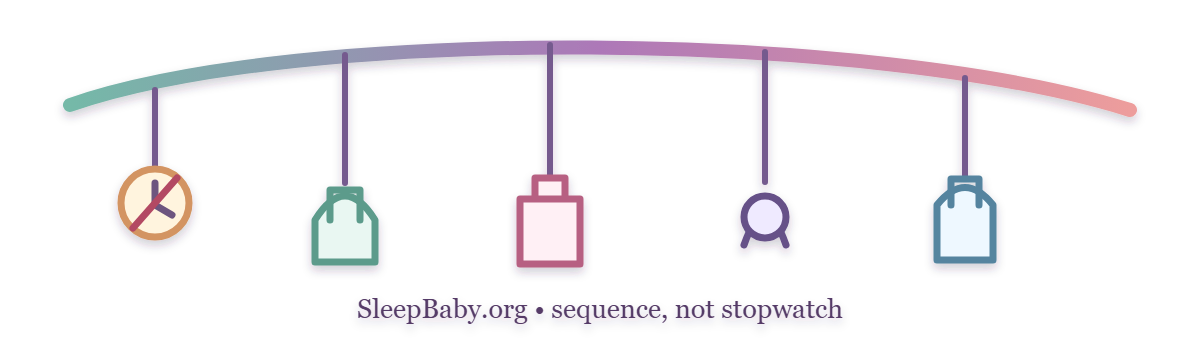
Watch the handoffs, not the minute marks
| Approximate time | Possible rhythm | What can move it |
|---|---|---|
| 7:00 a.m. | Wake, feed, diaper, daylight and quiet connection | Baby’s actual morning start and hunger cues |
| 8:00–8:20 | Nap opportunity | Earlier after a broken night; later if calmly engaged |
| 9:15–10:00 | Wake and feed; brief awake time | The first nap may last 25 minutes or well over an hour |
| 10:30–11:15 | Second nap opportunity | Hunger may arrive before sleep; feed first when cues say so |
| 12:00–1:00 p.m. | Feed, care, a little floor time, then another nap | Short naps can pull the whole afternoon earlier |
| 2:30–4:30 | One or two feed-awake-sleep cycles | This is often the least clock-like part of the day |
| 5:00–7:30 | Cluster feeding, a short nap, low-key awake time, bedtime routine | Late-day fussiness and feeding needs |
| Night | Safe sleep stretches interrupted by feeds and care | Growth, feeding method, temperament, illness and individual development |
The table does not promise a certain number of naps, a bedtime, or a longest night stretch. That is intentional. The American Academy of Sleep Medicine does not publish a sleep-duration target for infants younger than four months because normal patterns vary widely and evidence is insufficient to tie one range to health outcomes. You may see popular totals elsewhere; use them as broad descriptions, not a pass-fail line.
At ten weeks, the more useful questions are concrete: Is your baby feeding effectively? Growing as expected? Waking enough to eat? Producing the wet diapers your clinician expects? Having alert, connected periods? Settling for at least some sleep across twenty-four hours? Your pediatric clinician can interpret those answers in the context of this particular baby.
When I use a sample day like this, I am looking for a rhythm I can recognize, not a score I can defend. I would rather move one nap because the baby’s cues changed than preserve a beautiful grid that no longer describes the baby in front of me. That keeps the clock useful without asking it to overrule feeding, growth or connection.
How long should a 10-week-old stay awake?
Many ten-week-olds manage only a relatively short period between sleeps. Online wake-window charts often suggest something around an hour, sometimes a little less or more. I treat that as a prompt to start watching—not as a biological deadline. Research does not establish one minute-perfect wake window that every ten-week-old must follow.
Count from waking, including the feed and diaper change. That detail matters because a forty-minute feed does not happen outside the wake window in a secret annex. If the baby begins staring past you, turning away, yawning repeatedly, clenching fists, making jerky movements or escalating from calm to frantic, start the wind-down. If the baby is quietly alert and engaged, you do not need to lunge toward the bassinet because an app changed color.
Same clock time, three different answers
- Calm and connected
- Keep awake time gentle. Talk, cuddle, look around or try supervised tummy time.
- Turning away and fading
- Reduce stimulation and begin the familiar wind-down before fussing becomes the main event.
- Rooting or hands to mouth
- Respond to hunger. Do not withhold a feed because the schedule expected sleep first.
One signal alone can mislead. Hands to mouth can be hunger, exploration or soothing. A yawn can happen without an immediate nap. Look for a cluster and compare it with what happened before. The parent skill here is not perfect prediction; it is noticing a change early enough to offer a reasonable next step.
Feeding is not an obstacle to the schedule
A ten-week-old day still organizes heavily around feeding. Breastfed babies may feed frequently or cluster-feed. Formula-fed babies also vary in timing and amount. Hunger and fullness cues matter more than a generic interval: rooting, lip movements and hands toward the mouth can signal hunger; slowing, relaxing, closing the mouth or turning away can signal fullness.
Do not stretch a hungry baby to reach a nap time or pressure a full baby to finish a bottle. And do not copy another family’s overnight interval if your clinician has told you to wake for feeds. Prematurity, corrected age, weight gain, jaundice history, milk transfer, reflux symptoms and medical conditions can all change the plan.

Every nap still has the same safe-sleep floor
A flexible schedule never means a flexible sleep surface. Place your baby on their back for every sleep on a firm, flat, noninclined surface designed for infant sleep, with only a fitted sheet. Keep pillows, blankets, bumpers, toys, positioners and other soft items out. Room sharing on a separate infant sleep surface is recommended, ideally for at least the first six months.
If your baby falls asleep in a swing, bouncer, stroller, carrier or car seat, move them to a proper flat sleep surface as soon as it is safe and practical after travel. No monitor, sound machine, positioner or schedule prevents SIDS or makes an unsafe sleep setting safe. Weighted swaddles, weighted sleep sacks and weighted blankets are not safe for infants. If you swaddle, stop when your baby shows signs of trying to roll; swaddling is optional, not a required schedule ingredient.
I keep this boundary deliberately simple because I do not want a hard nap to turn into a negotiation with the sleep surface. If I need to change the timing, the routine or my expectations, I can change those. The back-flat-firm-empty setup stays put.
Back + flat + firm + empty
- Back for every sleep
- Firm, flat, noninclined infant mattress
- Fitted sheet only; no soft objects or loose bedding
- Separate infant sleep surface in the caregiver’s room
- No product substitutes for these basics
Why back sleeping remains the answer—even with spit-up
This AAP-linked explanation shows how infant airway anatomy supports the back-sleep recommendation. It is useful when a relative suggests inclining or side-positioning the baby after a feed.
Takeaway: use the back position on a flat, firm surface; do not solve spit-up by changing the sleep position or inclining the mattress.

Four ways the schedule “breaks”—and the better repair
At ten weeks, the schedule is supposed to be revised by real life. I would not treat each surprise as evidence that the whole day failed.
Repair the next handoff, not the entire day
Offer a feed if hungry, keep the next awake period gentle and watch for tiredness earlier. Do not insist the next nap wait for its printed time.
Follow your clinician’s feeding instructions. If growth and feeding are on track and no waking plan applies, let the next cycle begin when baby wakes.
Make the routine smaller: feed, dim light, diaper if needed, cuddle, safe sleep offer. Bedtime does not need a twelve-step ceremony.
A short evening nap may push bedtime later. That can be more humane than keeping an exhausted baby awake to defend 7 p.m.

How to help day and night emerge without forcing it
Ten weeks can feel like a tantalizing in-between age. Some babies begin placing a longer sleep stretch after evening, and some still distribute sleep with complete democratic fairness across all twenty-four hours. Early sleep and feeding behavior runs in short repeating cycles; the circadian contribution—the body’s stronger day-night organization—builds over the first months. It is a development, not a switch you forgot to turn on.
I would support that development with contrast, not exhaustion. After the morning start, open the curtains and let ordinary household life be ordinary. Speak, make eye contact, offer supervised awake activity and do not try to preserve cathedral silence for every daytime nap. At night, keep feeds and changes safe but low-key: dim practical light, quiet voices, no celebratory tour of the living room. The message is simply that daytime has social texture and nighttime has less.
That does not mean keeping a tired baby awake during the day to manufacture better nights. Overtiredness is not a circadian teaching tool. Nor does it mean waking every daytime nap at the same arbitrary length. Feeding needs and clinician instructions come first. The useful contrast lives around necessary care; it does not require depriving the baby of sleep or food.
Give the body clock contrast it can gradually learn
Morning light, conversation, ordinary household sound, feeds, brief play and sleep when tired.
Dim safe lighting, quiet feeds and changes, little stimulation, then back to the safe sleep space.
Do not add: forced wakefulness, skipped feeds or pressure to “sleep through.”
If the longest stretch lands early in the evening, you can experiment gently with the surrounding routine, but I would not repeatedly wake a sleeping ten-week-old merely to push the stretch later without discussing feeding and growth context with the pediatric clinician. A “dream feed” is not universally necessary, and it is not a reliable engineering lever. If you try any timing change, keep the baby on their safe surface, keep the feed responsive and judge it by the whole family’s functioning—not by one unusually good night.
Morning also deserves a range. If your baby wakes at 5:45 one day and 7:10 the next, you can choose a consistent-enough household start without pretending the earlier waking did not happen. Feed a hungry baby. Keep the room dim if you hope for more sleep. If the baby is fully awake and the effort to resettle has become a forty-minute negotiation with someone who cannot sign contracts, start the day and let the first nap move earlier.
What if my 10-week-old will not settle on schedule?
First, separate not sleepy from too activated to settle. A calm baby studying your face may need a few more quiet minutes awake. A baby who is rooting may need a feed. A baby who is turning away, stiffening, flailing and crying may need the environment simplified quickly. Those three scenes can sound identical when summarized as “fighting sleep,” but they ask for different responses.
I would run a short check in this order:
- Body: hunger cues, burp, diaper, temperature, illness signs or obvious discomfort.
- Signal load: light, sound, faces, toys, movement and repeated attempts from several adults.
- Timing: was the last nap unusually short or long? Has this awake stretch already included a long feed?
- Method: choose one calm settling approach for a few minutes instead of switching from bouncing to shushing to singing to walking every twenty seconds.
- Safety: when the caregiver is becoming dangerously sleepy or overwhelmed, place baby safely in the crib or bassinet and get support.
At this age, feeding, holding, rocking or soothing a baby to sleep is not a moral failure and does not prove you have created a permanent “bad habit.” The HealthyChildren guidance about placing babies down drowsy to build independent settling is explicitly framed for babies four months and older. Ten weeks is not four months wearing an ambitious planner. You can practice an occasional calm bassinet offer when it suits the baby, but you do not need to turn every nap into a training session.
If transfer attempts keep failing, protect the basics. An awake adult may hold a sleeping baby, but the adult must remain awake and attentive. If you might fall asleep, move the baby to the safe infant sleep surface. Couches and armchairs are especially hazardous places to doze with an infant. Before a night feed, notice your own level of exhaustion, reduce bedding and hazards, and ask another adult to help you stay awake when possible. If you accidentally fall asleep, return the baby to the bassinet or crib as soon as you wake.
I also watch for the moment when “schedule research” is disguising a health concern. New sudden difficulty waking, much weaker feeding, repeated vomiting, breathing changes, fever or dramatically fewer wet diapers is not a cue to download a different routine. A persistent pattern of distress around feeds or lying flat deserves a clinician’s assessment rather than a homemade reflux schedule.
When the baby is healthy and the issue is simply a stubborn nap, you are allowed to stop. Reset the room, feed if hungry, offer a cuddle, and try again after a short calm interval. One missed nap does not require a punitive late bedtime or a day of strategic wakefulness. It requires a gentler next decision.
What schedule progress actually looks like
Progress at ten weeks is often subtle. The morning may begin within a more recognizable range. One nap may become easier to offer. The longest sleep stretch may land at night more often. You may identify tiredness before crying rather than after. The bedtime sequence may become familiar even though its start time still moves.
I would count those as real gains. I would not require every nap to occur in the bassinet, every feed to land at equal intervals, or every night to improve in a straight line. Infant sleep development is noisy data. A growth spurt, vaccination, visitor, stuffy nose or afternoon of short naps can temporarily redraw the whole day.
A useful weekly review is brief: What is becoming predictable? Which handoff repeatedly becomes hard? Is the problem the baby’s wellbeing, the parent’s exhaustion, or merely the mismatch between real life and a sample chart? That last question has saved me from trying to fix healthy variability with increasingly elaborate rules.
If family sleep deprivation is severe, say that plainly at the pediatric visit. The baby can be developing normally while the household still needs help. Ask about feeding, growth, sleep safety, shifts between caregivers and practical ways for each adult to obtain protected rest. “Normal” does not mean you must handle dangerous exhaustion alone.
The same time can need a different answer
Clearly labeled composite Kacey-and-Benjamin scene:
Imagine Benjamin is ten weeks old on two different Tuesdays. At 9:08 a.m. on the first one, he is staring at the window, legs bicycling, mouth relaxed. I have the schedule open and the unreasonable confidence of a person who has consumed half a cup of coffee while it was still warm. The chart says nap. Benjamin’s whole body says, “I have five more minutes of curtain research.”
At 9:08 a.m. the next Tuesday, his gaze keeps slipping away. His hands are tight, his movements have that disorganized edge, and he turns his face from mine. Same time. Different baby information. This time I lower the room, shorten the conversation and offer sleep.
That is the skill I want the schedule to teach: not obedience to 9:08, but the ability to notice which version of 9:08 has arrived.
I use a sample day to reduce decision fatigue. I do not use it to overrule the evidence standing in front of me wearing a tiny sleeper. When something works for three days and fails on the fourth, I first ask what changed—nap length, feeding, stimulation, illness, growth-spurt behavior—before declaring the baby has “ruined” the routine.

One repeatable cue can do more than five new rules
You do not need to redesign feeds, wake windows, nap locations, sound, light and bedtime all at once. Pick one cue that can stay recognizable while the timing moves: a short phrase, the same sleep sack when appropriate, dimmer light, or one quiet sound.
Reset tomorrow with one change
If today felt scrambled, do not compensate with a stricter spreadsheet tomorrow. Choose one variable:
- Expose the baby to ordinary daylight and interaction after the morning start.
- Begin watching for fatigue a little earlier before one recurring difficult nap.
- Make nighttime feeds dim, quiet and boring.
- Shorten the bedtime routine until you can repeat it on a hard evening.
- Write down only three anchors—morning start, one representative nap and bedtime—rather than documenting every eyelid movement.
Then observe for several days unless feeding, illness or safety concerns require faster action. Changing one thing gives you information. Changing six things gives you a household mystery with excellent formatting.
When I troubleshoot this age, I write down what I changed and what I am watching before I touch anything else. That keeps my tired brain from turning one short nap into a full redesign. I am not trying to make every day identical; I am trying to learn which cue or handoff is actually carrying the pattern.
Keep / change / watch
Responsive feeds and the safe sleep setup.
One cue or one difficult handoff.
Baby’s cues, feeding, comfort and the next few days—not one isolated nap.
Sources
- American Academy of Pediatrics: Getting Your Baby to Sleep
- American Academy of Sleep Medicine: Pediatric Sleep Duration Consensus
- Dias et al.: Infant Sleep-Wake Reference Values Systematic Review
- Löhr & Siegmund: Early Infant Ultradian and Circadian Rhythms
- CDC: Milestones by 2 Months
- CDC: Hunger and Fullness Cues
- AAP: 2022 Safe-Sleep Policy Statement
- HealthyChildren: Safe Sleep for Sleep-Deprived Parents
- HealthyChildren: Fever and Your Baby
- AAP: Preventing Excessive Noise Exposure
Build a calmer plan around the baby you actually have tonight
A ten-week schedule cannot promise a long stretch. It can help you see the next safe, sensible handoff with less midnight arithmetic.
The SleepBaby.org Workshop
Make a plan for
the next bedtime.
Practical help for wake-ups, short naps, and sharing the night shift. Watch the original video, then get 15 guides and five audio tracks for $75.
$75 USD, paid once. No subscription. Digital access.
Watch the original Baby Sleep Miracle presentation
Press play for a little help with your baby’s next bedtime.
Original presentation. Watch before you decide.
15practical guides
5audio tracks
1one-time payment
Kind words about the original video
“Thank you so much for this video!”
“I'm truly impressed with how much information you share in your video.”
Inside the Workshop
Start with the night
you're having.
You don't need to read all 15 guides before bedtime. Choose the one that answers the question in front of you, then come back for the next part.
Before you buy
A few things
made clear.
A straightforward purchase, with space to decide what fits your family.
What am I buying?
The SleepBaby.org Workshop includes 15 digital guides, five audio tracks, and the original Baby Sleep Workshop PDF as an additional download. It costs $75 USD, paid once, with no subscription. Nothing is shipped.
Where should I start?
Try Tonight Rescue when you need a starting point. If your question is more specific, go straight to the guide on naps, a caregiver handoff, the sleep space, or another topic. You can read at your own pace.
Is this personal sleep coaching?
No. This is an educational collection for parents of babies and young children. Use the age-specific guidance, and bring feeding, breathing, growth, illness, or other health concerns to your child's clinician. It does not diagnose a problem or promise a sleep result.
Is the video the paid Workshop?
You can watch the original Baby Sleep Miracle presentation on this page. Your purchase is the SleepBaby.org Workshop collection of guides, audio tracks, and the original PDF described here.
How do I find it after checkout?
Choose Open my Workshop on your thank-you or order-status page to open the full Workshop portal. Download the guides and book as PDFs for reading offline. Keep your order confirmation so you can return to the portal and audio player. If you need help finding your access, use our Workshop download help.
The SleepBaby.org Workshop
Have somewhere to start
at the next bedtime.
15 practical guides. Five audio tracks. One $75 purchase.



Leave a comment