Skip to content
SleepBaby .org
Toddler Care

Understanding Why Your Toddler Likes to Feed You

Read the answer first. The Workshop is here only when you want the next step.

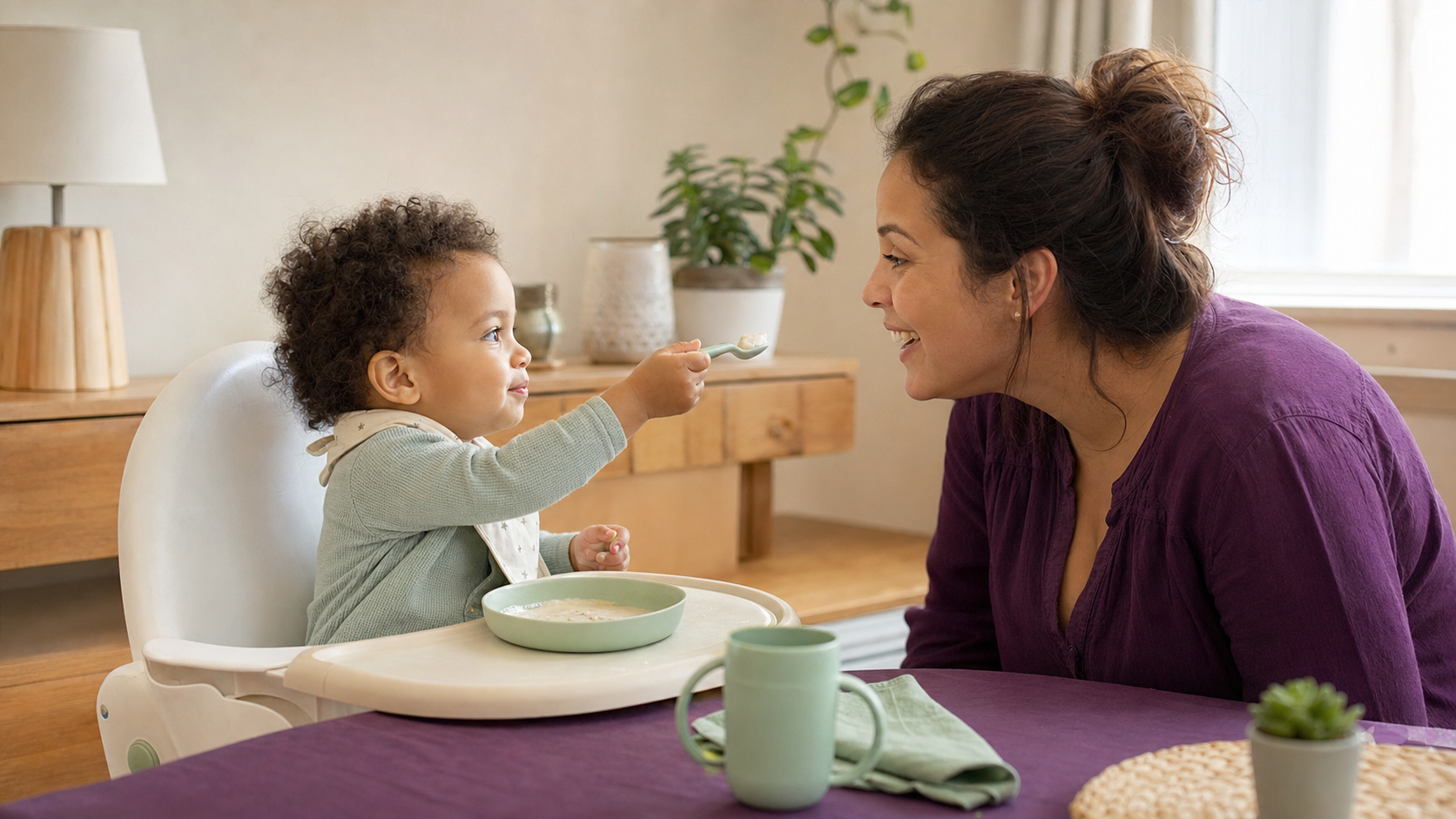
A toddler safely offers a spoonful of soft food to a smiling parent, illustrating why toddlers like to feed caregivers.

A toddler’s world is brimming with joy, curiosity, and ceaseless exploration. As parents, you may sometimes find your toddler offering you their food, which can be quite endearing and yet puzzling. Why does my toddler feed me, you may ask? This post uncovers multiple reasons why toddlers might want to engage in this behavior, offering an insight into their fascinating world.

1. Mimicking Parental Behavior

Beginning from around eight months, toddlers can imitate simple expressions and actions. Your toddler feeding you could simply be a playful act of imitation. As they watch you feed them, they internalize the process and then, to your surprise, try to replicate it.

2. A Subtle Refusal to Eat

There might be instances when your toddler doesn’t want to eat. This could be because they don’t like the food, aren’t in the mood to eat, or are distracted by something else. In such situations, they might start feeding you as a subtle signal of their reluctance.

3. A Playful Mood

Toddlers are known for their unpredictable behavior. When they are in a playful mood, they might incorporate anything within their reach into their games, including their food. Your toddler might try to feed you as part of their play, expecting you to join in their fun.

4. Curiosity About Feeding

Toddlers are naturally curious and love to explore their surroundings. As they start crawling or walking, they become even more intrigued by various processes, including feeding. When your toddler tries to feed you, it could be a sign of their curiosity about the feeding process.

5. A Signal That They Are Full

If your toddler is full, they might not feel the need to eat more. However, they may not be able to express this verbally. Instead, they might start feeding you to convey their feeling of satiety or to share the pleasurable sensation of a full stomach.

6. Idle Hands Seeking Activity

With the development of motor skills, toddlers find new ways to keep their hands busy. If they start feeding you out of the blue, it might simply be their way of keeping their hands engaged.

7. An Expression of Love and Care

Even at a tender age, toddlers can express a unique bond with their parents or caregivers. Feeding you could be your toddler’s unique way of reciprocating your care and expressing their love for you.

8. An Obsession with Feeding

With their limited mobility, toddlers have few activities they can fully engage in. Your toddler feeding you might be a reflection of their obsession with the activity because it’s something they can do with ease.

9. A Desire to Control the Feeding Process

Toddlers love to initiate and control various activities. Feeding you allows them to oversee the process, from grabbing the spoon to offering you bites. This provides them with a sense of control and involvement, which they deeply enjoy.

What Does It Mean When a Baby Shares Food With You?

When a baby shares food with you, it’s usually a sign of developmental growth. It indicates that your child is beginning to understand the concepts of sharing and empathy. They’ve observed adults around them sharing food and are attempting to replicate this social behavior. Sharing food can also be a demonstration of trust and affection from your baby. It’s a positive behavior that parents should encourage and appreciate.

Why Do Babies Offer You Food?

Babies offer you food for a number of reasons:

  1. Imitation: Babies are excellent observers. They often mimic adult behavior as a means of learning, and offering food is one such instance.
  2. Empathy: Even at a young age, babies can show signs of empathy. Offering you food could be their way of ensuring you are also fed and taken care of.
  3. Social Interaction: Babies understand from a young age that food has a social aspect. Sharing food can be a method of interaction for them.
  4. Exploration: Babies are naturally curious and like to experiment with their surroundings. Offering food allows them to understand the different reactions it can elicit.

Do Autistic Toddlers Share Food?

Autistic toddlers, just like neurotypical toddlers, may share food, but the behavior can vary greatly from child to child. While some autistic toddlers may regularly share food as part of their routine, others may not, especially if they have sensory issues associated with certain foods. If you’re unsure, it’s best to discuss this with a pediatrician or a child development specialist.

When Do Babies Start Sharing Food?

Typically, babies start sharing food when they’re between 18 and 24 months old. This is the age when they begin to grasp the concept of sharing and are more aware of their social environment. However, every child is unique, and the age can vary. It’s essential to encourage sharing behavior whenever it emerges to help your child develop empathy and social skills.

How SleepBaby.org Can Assist

At SleepBaby.org, we’re committed to helping parents navigate the fascinating journey of parenting. From understanding why your baby shares food to assisting you with creating an ideal sleep environment, our team of experts offers comprehensive advice. If you’re wondering how food sharing relates to sleep, it’s all about establishing routines. Consistent meal and sleep schedules can help your toddler feel more secure, often leading to better sleep.

SleepBaby.org is dedicated to providing you with practical tips, expert advice, and support. Visit our website today for more invaluable resources.
From the guide to your next step

Explore SleepBaby.org

Step-by-step sleep help · newborn through toddler

A starting point for your nights.

SleepBaby is a browser-based Workshop for parents of newborns through toddlers. Choose your baby’s age, usual full wakes, and the change you want most. The free preview gives you one thing to try, what to watch over the next few nights, and a look at the help inside the Workshop.

Use the free library

3 questions · no card · visible preview stays in this browser · analytics follows your privacy settings

Example: 8–12 months · 3–4 wakes · fewer wakes

Let’s choose one response you can repeat.

Here’s one example. Your three answers will shape your own starting point.

Try this next
At the first wake, check what your baby needs and use a quiet reassuring phrase while you feed or comfort them.
What to watch
Notice the timing of the first repeated wake and what helped across nights 2–5, without withholding needed feeds or comfort.
Your effort
Keep a familiar response and compare a few first-wake notes.
Before you begin
Care first, then a familiar response
A small note for each night

Across seven nights, keep a note of the first wake and your response; add nap timing when you know it, then review one small change rather than rewriting the whole night.

The Workshop pairs short steps you can revisit with a seven-night tracker, so the response you’re trying and the notes about it stay together.

Example only. Answer the three questions to see a starting step for your family.

Fictional illustrative tracking example

Fictional illustrative full-wake tracking example over seven nights. The invented baseline ends at 4.0 wakes and the invented illustrative path ends at 1.6 wakes. These are not measured or predicted results. TonightNight 2Night 3Night 4Night 5Night 6Night 7
Fictional starting patternFictional illustrative path

This graph is a separate fictional example. Your answers do not change it.

Don’t take a sales claim on faith. Inspect the decision paths.

Illustrative planning scenarios—not measured customers or verified outcomes. Use the views below to inspect upside, downside, no-change, and no-purchase paths.

Choose an illustrative decision view
Closest waking pattern8–18 mo

What progress could look like

Illustrative family pattern

2.0 fewer night-wakings(example range: 1.2–2.9)

↓ 44%example
Night-wakings per night over seven illustrative nights. Current example: 4.5 wakes to 4.5 wakes. Illustrative path: 4.5 wakes to 2.5 wakes. Example change: 2.0 fewer night-wakings.

Planning example · not an observed cohort

Closest bedtime pattern4–7 mo

What progress could look like

Illustrative family pattern

18 min faster settling(example range: 9–31 min)

↓ 38%example
Settling time in minutes over seven illustrative nights. Current example: 47 min to 47 min. Illustrative path: 47 min to 29 min. Example change: 18 min faster settling.

Planning example · not an observed cohort

Closest morning patternToddler

What progress could look like

Illustrative family pattern

42 min later morning wake time(example range: 21–64 min)

↑ 42 minexample
Morning wake time over seven illustrative nights. Current example: 5:30 am to 5:30 am. Illustrative path: 5:30 am to 6:12 am. Example change: 42 min later morning wake time.

Planning example · not an observed cohort

Planning examples, not testimonials or cohort evidence. Real outcome claims should appear here only when they are independently auditable. Decision safeguards

What the complete Workshop adds after the preview.

Tonight’s Starting Step

A clear first move based on the three answers you choose.

Seven-Night Tracker

A simple way to log changes without treating one night as proof.

Tired-Parent Format

Short steps built for exhausted adults to revisit together.

See the starting point before checkout.

The preview shows the first action, time involved, tracking focus, and reasons the paid Workshop may not be the right next step. It is a planning screen, not a promised outcome. Current purchase and refund terms appear on the secure purchase page.

3-question planning preview Free library stays available Secure SleepBaby purchase page

Take a look, then decide.

Use the preview, inspect the limitations, and decide whether the complete Workshop is worth it for your family.

A few choices. A place to begin.

Your private sleep preview.

Tell me what nights look like, and I’ll help you choose one thing to try.

No sign-up. No card.

Private Workshop preview · 3 questions · no card

A starting point for your family.

Choose your baby’s age, usual full wakes, and what you’d like to explore.

How this preview uses your answers

This is a planning preview, not a medical or safety clearance or a promised result. Your choices stay in this browser tab for this visit, including when you move between our articles and homepage. Growth OS may record categorical choices and actions unless analytics is turned off in the site’s privacy settings or your browser sends GPC/DNT. Google Analytics receives them only after analytics permission. The preview never sends typed sign-in values, your name, email, password, or free text. Deleting the visible preview does not erase analytics already recorded. Privacy policy.

1 of 3
How old is your baby?